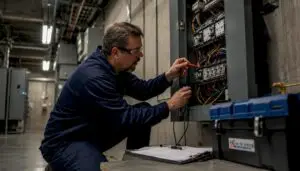


Your HVAC system is the single most effective tool for improving indoor air quality (IAQ). It controls pollutants, allergens, and moisture across every room in your home.
The EPA and ASHRAE both recognize that a properly maintained HVAC system outperforms any standalone air purifier or gadget on the market. That performance rests on three core pillars:
- Source control
- Ventilation
- Filtration
Following this IAQ hierarchy can reduce airborne particulates by over 50% in most homes.
This guide walks you through each pillar in practical terms, from choosing the right MERV-rated filter to managing seasonal humidity. You can take real steps toward cleaner air starting today.
How does HVAC filtration improve home air quality?
HVAC filtration is the first line of defense against the airborne particles that trigger allergies, asthma, and respiratory irritation.
Your system pulls air through a filter every time it runs. The filter’s quality directly determines what stays in your air and what gets trapped. Choosing the wrong filter, or neglecting to replace it, turns your HVAC from a solution into part of the problem.
Understanding MERV ratings
MERV stands for Minimum Efficiency Reporting Value. It measures how effectively a filter captures particles of different sizes. The scale runs from 1 to 20, and higher numbers capture smaller particles.
For residential use, MERV 8 to 13 filters capture the most common household pollutants without overworking your blower motor. These include dust, pollen, pet dander, and mold spores.
The EPA specifically recommends MERV 13 for households with respiratory sensitivities. Confirm your system can handle the added airflow resistance before upgrading.
Standard 1-inch filters are the most common, but they have a limited surface area and clog faster. Thicker media filters, typically 4 to 5 inches deep, hold far more particulate matter and last longer between replacements.
If your system’s filter slot accommodates a deeper filter, this upgrade alone can extend filter life and improve capture efficiency. You can compare your options in detail through this guide on evaluating air filtration systems for home HVAC units.
Filter replacement schedule
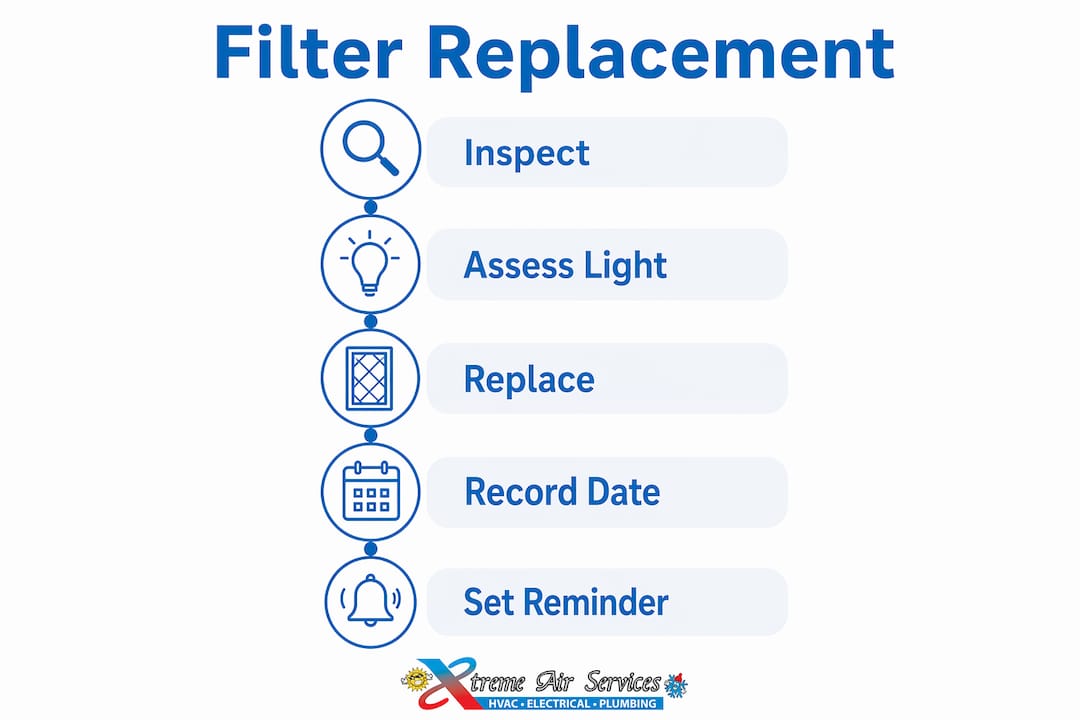
Replacing clogged filters every 30 to 90 days is one of the highest-impact habits a homeowner can build. A clogged filter restricts airflow, forces your blower to work harder, and allows particles to bypass the filter media entirely.
Homes with pets or allergy sufferers should replace filters every 30 to 45 days. Homes without pets and with no respiratory concerns can stretch to 90 days, but no longer.
Key filter selection guidelines:
- Choose MERV 8 as a minimum for any occupied home
- Use MERV 11 or 13 if anyone in the household has asthma, allergies, or immune concerns
- Upgrade to a 4-inch or 5-inch media filter if your system’s cabinet allows it
- Never use MERV 14 or higher without confirming compatibility with your HVAC contractor
- Check the filter monthly during high-use seasons like summer and winter
Pro Tip: Hold your filter up to a light source when you remove it. If you cannot see light passing through, replace it immediately regardless of how long it has been installed.
Why is ventilation critical for HVAC systems to enhance home air quality?
Ventilation exchanges stale, pollutant-laden indoor air for fresh outdoor air. Filtration cleans the air already circulating in your home, but without ventilation you simply recirculate the same air with diminishing returns.
Air cleaning technologies rarely work on their own. Integrating source control and ventilation is necessary for meaningful IAQ improvement.
ASHRAE Standard 62.2 and what it means for your home
ASHRAE Standard 62.2 sets the benchmark for residential ventilation. The requirement is 7.5 CFM per person plus 1% of the home’s square footage in continuous fresh air exchange. CFM stands for cubic feet per minute, a measure of airflow volume.
A family of four in a 2,000-square-foot home needs roughly 50 CFM of continuous fresh air to meet this standard.
Most older homes achieve this passively through gaps and leaks in the building envelope. Homes built after 2000 are sealed tightly enough that natural air leakage is insufficient. In these homes, mechanical ventilation is not optional. It is a health requirement.
Natural vs. mechanical ventilation options
Mechanical ventilation gives you control that natural ventilation cannot. Opening windows works in mild weather, but it introduces outdoor allergens, humidity, and noise. The main options for residential use are:
- Exhaust fans: Bathroom and kitchen fans remove moisture and odors at the source. They are inexpensive but do not recover energy from the exhausted air.
- Energy Recovery Ventilators (ERVs): ERVs exchange indoor and outdoor air while transferring both heat and moisture between the two airstreams. They are best suited for humid climates where you want to limit moisture entering the home.
- Heat Recovery Ventilators (HRVs): HRVs transfer heat but not moisture. They perform best in cold, dry climates where retaining indoor moisture in winter is beneficial.
Signs your home has inadequate ventilation include:
- Persistent condensation on windows
- Musty odors
- Elevated CO2 levels that cause fatigue or headaches
If you notice any of these, mechanical ventilation is the correct fix, not more air freshener. For a deeper explanation of how these systems work together, the homeowner’s guide to ventilation from Xtremeairservices covers the mechanics clearly.
Ventilation system comparison
This table compares residential ventilation systems by upfront cost, energy efficiency, and best use case.
| System | Upfront cost | Energy efficiency | Best use case |
|---|---|---|---|
| Exhaust fans | Low ($50-$300) | Low (no heat recovery) | Spot ventilation in bathrooms and kitchens |
| ERV | Moderate ($1,000-$2,500) | High (transfers heat and moisture) | Humid climates, year-round use |
| HRV | Moderate ($1,000-$2,500) | High (transfers heat only) | Cold, dry climates, winter-heavy use |
| Whole-home fresh air intake | Low-moderate ($300-$800) | Moderate | Mild climates with existing HVAC capacity |
Understanding HVAC zoning can further improve how fresh air is distributed across different areas of your home, particularly in multi-story or open-plan layouts.
How does humidity control via HVAC contribute to better indoor air quality?
Humidity control improves indoor air quality by keeping moisture in a range that limits mold, dust mites, and bacteria. It is the hidden variable in most IAQ problems.
Too much moisture feeds mold, dust mites, and bacteria. Too little dries out mucous membranes and makes occupants more vulnerable to airborne viruses.
The EPA recommends maintaining indoor relative humidity between 30% and 50% year-round. Staying within this range suppresses mold growth, reduces dust mite populations, and limits respiratory irritation.
How your air conditioner manages moisture
Your central air conditioner acts as a dehumidifier every time it runs. Warm, humid air passes over the cold evaporator coil, moisture condenses on the coil surface, and that water drains away through the condensate line.
This process works well during moderate humidity conditions, but it has limits. In very humid climates, or during shoulder seasons when the AC runs infrequently, indoor humidity can climb above 60% even with the system operating. At that point, supplemental dehumidification is necessary.
Equipment options for humidity management
Several types of equipment manage indoor humidity, each suited to a different problem:
- Whole-home dehumidifiers: Installed in the ductwork, these units run independently of the AC and maintain target humidity levels even when cooling is not needed. They are the most effective solution for persistently humid homes.
- Portable dehumidifiers: Useful for problem areas like basements or crawl spaces, but they require manual emptying and do not address whole-home humidity.
- Whole-home humidifiers: Installed on the furnace, these add moisture to dry winter air. Bypass humidifiers and fan-powered humidifiers are the two most common types, with fan-powered models producing more output.
- Attic and crawl space dehumidifiers: These address moisture at the source before it migrates into living spaces, a strategy that is often overlooked but highly effective.
Seasonal management matters. Summer demands dehumidification. Winter in dry climates demands humidification. Running a humidifier in summer or a dehumidifier in winter wastes energy and worsens IAQ.
Pro Tip: Place a digital hygrometer in your bedroom, main living area, and basement. Readings above 55% in any zone call for immediate action. Models from brands like Govee or ThermoPro cost under $15 and give you real-time data without guesswork.
What maintenance and ductwork practices optimize HVAC performance?
Regular HVAC maintenance, including coil cleaning and condensate drain clearing, is what keeps your air quality gains from unraveling. A well-chosen filter and a properly sized ventilation system deliver nothing if the underlying HVAC system is poorly maintained.
Maintenance prevents mold growth inside the system. Most IAQ-related service calls resolve with maintenance rather than equipment replacement.
Annual professional maintenance checklist
A licensed HVAC technician should inspect and service your system at least once per year, ideally before the cooling season in spring and before the heating season in fall. A proper inspection covers:
- Clean the evaporator and condenser coils to remove biofilm and particulate buildup
- Inspect and clear the condensate drain line to prevent mold growth and water damage
- Check and lubricate the blower motor and fan assembly
- Inspect the heat exchanger for cracks that could allow combustion gases into living spaces
- Test refrigerant levels and check for leaks
- Inspect electrical connections and controls for safety and efficiency
- Verify thermostat calibration and system cycling behavior
Ductwork: the overlooked IAQ factor
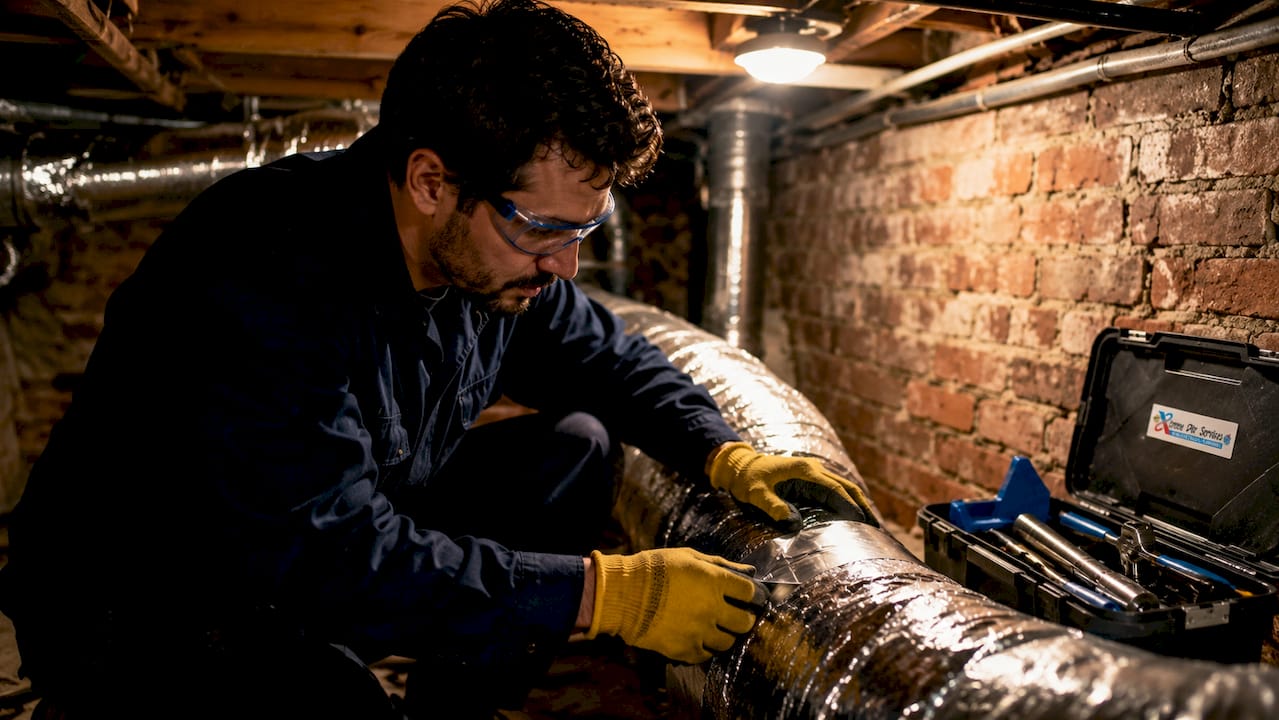
Leaky ducts cause 20 to 30% conditioned air loss and pull unfiltered air from attics, crawl spaces, and wall cavities directly into your living areas. That unfiltered air carries insulation fibers, rodent dander, mold spores, and construction debris.
Sealing ducts with mastic sealant or metal-backed tape eliminates these entry points. Standard gray duct tape is not an acceptable sealant. It fails within months under temperature cycling and leaves gaps that defeat the purpose entirely.
Duct balancing is equally important. If some rooms are consistently too hot, too cold, or stuffy, airflow is unbalanced. A technician can adjust dampers and register positions to distribute conditioned air evenly, which improves both comfort and IAQ across the whole home.
Common homeowner mistakes that undermine HVAC air quality performance:
- Skipping annual maintenance because the system “seems fine”
- Using the wrong tape (standard duct tape) to seal duct leaks
- Blocking supply or return vents with furniture, rugs, or storage
- Running the system without a filter installed, even temporarily
- Ignoring condensation or musty smells from vents
If your system shows signs of declining performance beyond what maintenance can fix, it may be worth reviewing when HVAC replacement makes sense rather than investing further in an aging unit.
Pro Tip: After any duct sealing work, run your system for 30 minutes and then walk through each room checking for consistent airflow from supply registers. Weak or absent airflow in a room that previously had good circulation points to a missed leak or a closed damper.
IAQ is best addressed through a whole-house approach focusing on duct integrity, balanced airflow, and moisture control rather than isolated gadgets. That principle should guide every decision you make about your system.
Key takeaways
Improving home air quality through your HVAC system requires combining proper filtration, deliberate ventilation, humidity control within the 30 to 50% range, and consistent professional maintenance to produce lasting results.
| Point | Details |
|---|---|
| Filter selection matters | Use MERV 8 to 13 filters and replace them every 30 to 90 days based on household conditions. |
| Ventilation is non-negotiable | Homes built after 2000 need mechanical ventilation like ERVs or HRVs to meet ASHRAE Standard 62.2. |
| Humidity control prevents pollutants | Maintain indoor humidity between 30% and 50% to suppress mold, dust mites, and respiratory irritants. |
| Duct leaks undermine everything | Leaky ducts cause 20 to 30% air loss and introduce unfiltered contaminants. Seal with mastic or metal tape. |
| Maintenance prevents IAQ failures | Annual professional service, including coil cleaning and condensate line clearing, stops mold growth inside the system. |
What I have learned from years of diagnosing IAQ problems
After working on hundreds of homes across different climates and construction types, the pattern I see most often is this: homeowners spend money on air purifiers and scented products while the actual source of their air quality problem sits in the mechanical room or the attic.
A portable HEPA purifier in the bedroom does not fix a mold colony growing on a neglected evaporator coil. It masks the symptom while the root cause gets worse.
The homes with the best air quality are rarely the ones with the most expensive equipment. They are the ones where the fundamentals are done consistently:
- Filters replaced on schedule
- Ducts sealed properly
- Humidity monitored and managed
- Annual maintenance completed before problems develop
These are not glamorous interventions, but they work in ways that no gadget can replicate.
What I also tell homeowners is that IAQ is not a one-time fix. It is a system that requires attention across seasons. Your home in July has different IAQ demands than your home in January.
Humidity management shifts. Ventilation needs shift. A system that is balanced for one season may need adjustment for another.
The homeowners who understand this and build a maintenance rhythm around it consistently report better comfort, fewer allergy symptoms, and lower energy bills.
My honest recommendation is to start with a professional IAQ assessment before buying any equipment. A trained technician can measure actual humidity levels, test airflow balance, inspect duct integrity, and identify the specific gaps in your system.
That diagnosis tells you exactly where to spend your money. Guessing costs more in the long run.
— Xtreme
Ready to improve your home’s air quality with professional HVAC service?
Xtremeairservices provides licensed HVAC inspections, duct sealing, filter upgrades, and full system maintenance for homeowners who want real results, not guesswork. A professional maintenance visit identifies the specific IAQ gaps in your system before they become expensive problems.

Enrolling in an HVAC maintenance plan with Xtremeairservices means your system gets inspected, cleaned, and tuned on a schedule that matches your climate and usage patterns. You get priority service, documented system history, and the confidence that your filtration, ventilation, and humidity controls are working together as they should.
If you are also weighing whether your current system can realistically support IAQ improvements, the repair vs. replace decision is one our technicians can help you work through based on your system’s actual condition.
FAQ
What MERV rating filter should I use in my home?
Most homes perform best with MERV 8 to 13 filters. The EPA recommends MERV 13 for households with asthma or allergy sufferers, but you should confirm your HVAC system can handle the increased airflow resistance before installing one.
How often should I replace my HVAC air filter?
Replace filters every 30 to 45 days in homes with pets or allergy sufferers, and every 60 to 90 days in standard households. A clogged filter restricts airflow and allows particles to bypass the filter media entirely.
What are the signs of poor ventilation in my home?
Persistent condensation on windows, musty odors, and chronic fatigue or headaches are the most common signs. Homes built after 2000 are particularly prone to poor ventilation because tight construction limits natural air exchange.
Does my air conditioner control humidity?
Yes, your central AC removes moisture as a byproduct of cooling, but it cannot maintain target humidity levels during mild weather or in very humid climates. A whole-home dehumidifier installed in the ductwork provides reliable year-round humidity control independent of the cooling cycle.
How do duct leaks affect indoor air quality?
Leaky ducts pull unfiltered air from attics, crawl spaces, and wall cavities into your living areas, introducing mold spores, insulation fibers, and other contaminants. Sealing ducts with mastic sealant or metal-backed tape eliminates these entry points and can recover 20 to 30% of conditioned air that would otherwise be lost.