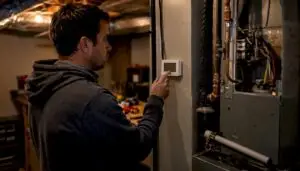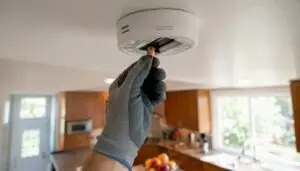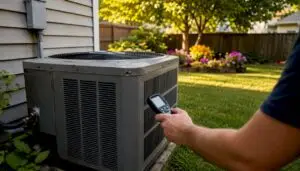


If your air conditioner is broken, the first thing to do is turn the thermostat to OFF and switch the fan to ON. That single step stops the compressor from running under abnormal conditions and speeds thawing if the coils have frozen. Do it now, then work through the checklist below.
About half of AC service calls get resolved by homeowner-accessible checks: thermostat settings, a dirty filter, or a tripped breaker. The rest need a licensed technician. Here is how to tell which situation you are in, in 15–30 minutes.
Quick 15–30 minute first-response checklist:
- Thermostat (30 seconds): Set to COOL, set point below current room temperature, fan to AUTO. Swap the batteries if the display is dim or blank.
- Breaker panel (2 minutes): Check for a tripped breaker on the AC circuit. Reset it once. If it trips again, stop and call a pro.
- Air filter (5 minutes): Pull the filter. If it is gray and clogged, replace it with a matching size. A choked filter is the single most common cause of poor cooling.
- Outdoor unit (2 minutes): Glance at the condenser. Is the fan spinning? Is there debris blocking the unit? Clear leaves or grass clippings from the sides. Keep at least 2–3 feet of clearance around it.
- Ice on the lines: If you see ice on the refrigerant lines or the indoor coil, leave the system OFF and run the fan only. Thawing takes 2–4 hours before any restart is safe.
Pro Tip: Never reset a tripped breaker more than once. Repeated trips signal a wiring fault or a failing compressor. Resetting it again risks a fire or permanent compressor damage.
If the system still does not cool after these checks, the fault is almost certainly electrical, mechanical, or refrigerant-related. That is where a licensed technician takes over. For Dallas-area homeowners, Xtremeairservices handles emergency diagnostics and repair.

Table of Contents
- What can you safely check yourself on a broken air conditioner?
- What are the most common reasons an AC stops working?
- When should you call a professional HVAC technician?
- How much does AC repair cost, and when should you replace instead?
- How do you stay safe and cool while your AC is being repaired?
- Why does a licensed, EPA-certified technician matter?
- Key Takeaways
- The moment I stop troubleshooting and pick up the phone
- Xtremeairservices is ready when your AC breaks down
- Useful sources and further reading
- FAQ
What can you safely check yourself on a broken air conditioner?
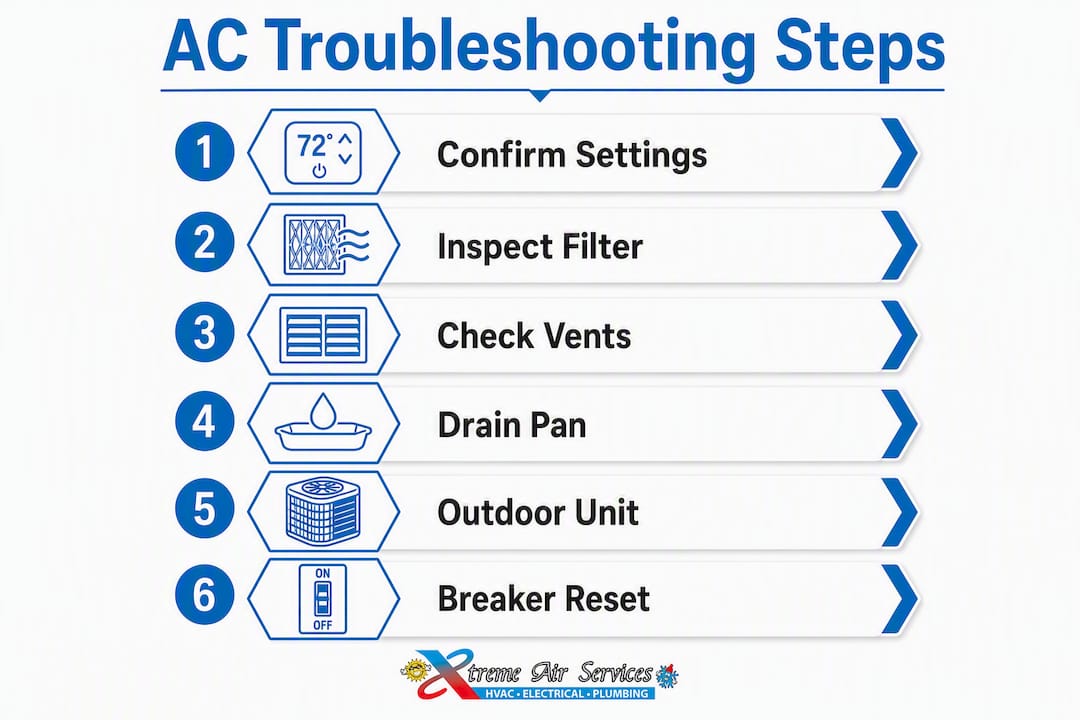
Walk through these steps in order. Each one takes a few minutes and is safe for any homeowner. Stop the moment you hit a callout marked Do Not Proceed.
Step 1 — Confirm thermostat settings (1 minute)
Mode should be COOL, not HEAT or FAN ONLY. Set point must be below the current indoor temperature. If the screen is blank, replace the batteries before anything else.
Step 2 — Inspect the air filter (5 minutes)
Locate the filter at the return air grille or inside the air handler. Pull it out and hold it to the light. If you cannot see light through it, replace it. Dirty filters restrict airflow and are the most common reason central AC underperforms. Keep a spare filter on hand; your filter replacement schedule depends on your home, pets, and filter type.
Step 3 — Check supply and return vents (2 minutes)
Make sure furniture, rugs, or curtains are not blocking any vents. Closed or blocked vents reduce system pressure and can trigger a freeze-up.
Step 4 — Inspect the indoor drain pan (2 minutes)
Find the drain pan beneath the air handler. Standing water means the condensate drain line is clogged. You can try clearing it with a wet/dry vac on the drain outlet. If the float switch tripped, the system may have shut itself off as a safety measure.
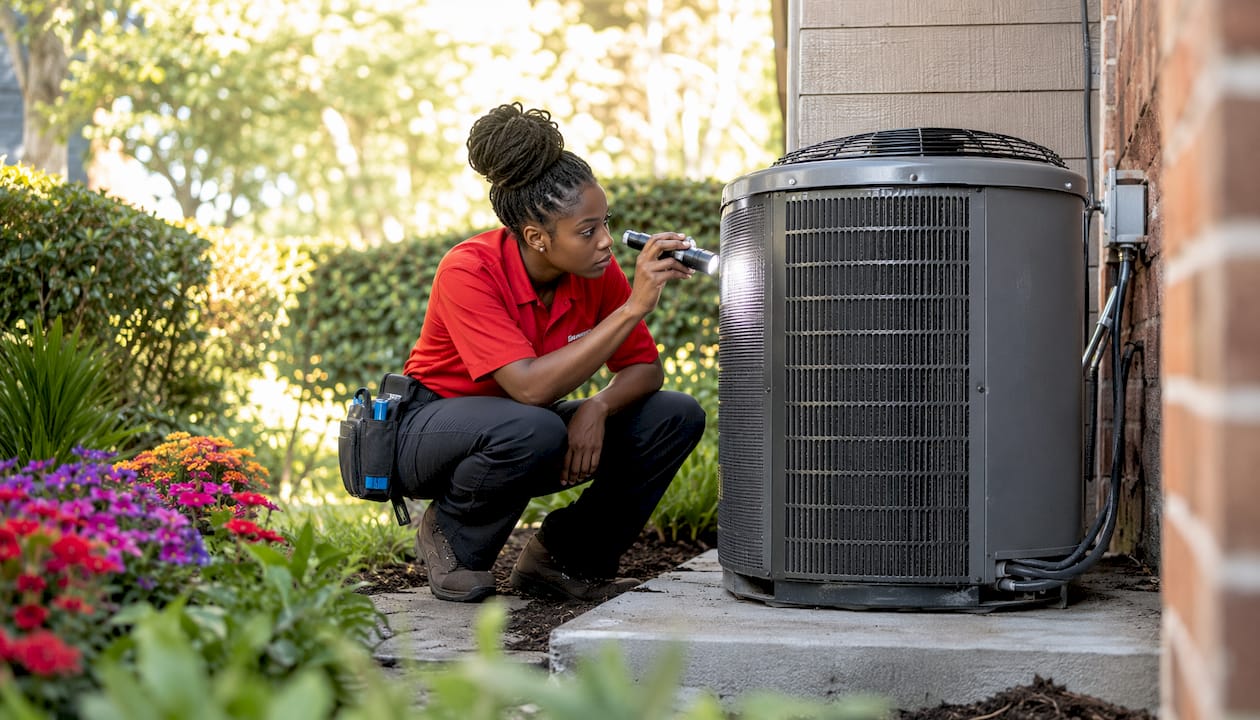
Step 5 — Outdoor unit visual check (2 minutes)
Walk outside. Is the condenser fan spinning? Do you hear a hum but see no fan movement? That pattern points to a failed capacitor. Do not open the service panel. Do not touch any wiring. Just observe and note what you see.
Step 6 — Check the breaker and outdoor disconnect (2 minutes)
At the breaker panel, look for a tripped breaker on the AC circuit. Reset it once. At the outdoor unit, confirm the disconnect box is closed and the pull-out fuse block is seated.
Tools you will need: flashlight, replacement AA batteries, a matching replacement filter, wet/dry vac, flat screwdriver (for the disconnect box only).
Document everything for your technician: take photos of the drain pan, the filter condition, any ice, and the breaker position. Note the time the system stopped cooling and any unusual sounds (humming, grinding, hissing). That log cuts diagnostic time significantly.
Do Not Proceed if you observe any of these:
- Sparking or burning smell from any component
- Breaker trips a second time after reset
- Visible refrigerant oil (a greasy residue near copper lines)
- Hissing or bubbling sounds near the refrigerant lines
- Grinding or screeching from the indoor or outdoor unit
Pro Tip: After a filter swap or drain clear, wait 30 minutes before restarting the system. If the coils were frozen, wait the full 2–4 hours with the fan running before switching back to COOL mode. Starting the compressor on a frozen coil can damage it.
What are the most common reasons an AC stops working?
Most failures trace back to a short list of repeating root causes. Knowing which one fits your situation helps you give a technician accurate information and avoid unnecessary parts charges.
| Cause | Symptom | DIY safe? | Safety / legal flag |
|---|---|---|---|
| Clogged air filter | Weak airflow, warmer air, possible freeze-up | Yes — replace filter | None |
| Failed run capacitor | Humming, outdoor fan not spinning | No | Capacitors hold dangerous charge after power-off |
| Frozen evaporator coil | Ice on lines, weak airflow, water dripping | Partial — thaw only | Do not restart until fully thawed |
| Low refrigerant | Long run times, hissing, warm air | No | EPA Section 608 requires licensed handling |
| Dirty condenser coil | Outdoor unit overheating, high pressures | Partial — rinse exterior fins only | Do not open unit panels |
| Clogged drain / float switch | Standing water in pan, system shuts off | Yes — vac the drain line | Watch for water near electrical components |
| Electrical fault | Breaker trips, burning smell, no response | No | High-voltage risk; licensed electrician required |
A few notes on the table above:
Capacitor failure is one of the more common causes of a humming outdoor unit with no fan movement. The capacitor can hold a lethal charge even after the breaker is off. This is not a homeowner repair, full stop.
Refrigerant issues carry a regulatory layer on top of the safety risk. Under EPA Section 608, only certified technicians may purchase and handle refrigerants. Adding refrigerant yourself is not just dangerous; it is illegal without the proper certification.
Frozen coils usually mean one of two things: restricted airflow (dirty filter, blocked return vent, failed blower) or low refrigerant. Thawing is safe to do yourself. Finding out why it froze requires a pro. For a deeper look at common AC problems and their fixes, Xtremeairservices covers the full list.
When should you call a professional HVAC technician?
Some symptoms are not troubleshooting problems. They are stop-everything signals.
Call immediately (do not wait for business hours):
- Burning smell from the air handler or outdoor unit
- Gas smell anywhere in the home (evacuate first, then call)
- Breaker trips a second time after reset
- Loud grinding, screeching, or banging from either unit
- Active water leak onto drywall, insulation, or near electrical panels
- Visible refrigerant oil on copper lines or a hissing sound
- System is 10+ years old and has failed multiple times this season
Schedule same-day or next-business-day:
- System runs but AC is not cooling after filter and thermostat checks
- Drain pan has water but no emergency leak
- Outdoor fan is not spinning (capacitor suspected)
- Unusual odors that are not burning or gas
What to expect when a technician arrives:
- Triage questions: when did it stop, what sounds did you hear, any recent filter changes?
- Safe power-down and lockout of the unit before opening panels.
- Voltage and capacitor tests with a multimeter.
- Refrigerant pressure check with gauge manifolds.
- Leak detection if pressures are low.
- Written repair options with parts, labor, and warranty details before any work begins.
- Safe restart sequence and a brief system run to confirm the fix.
Simple repairs (capacitor, contactor, drain clear) often take 1–2 hours on-site. Refrigerant leak repair and recharge can run 3–5 hours depending on leak location. Compressor or coil replacement may require a return visit for parts.
During heatwaves, HVAC companies face surges in demand that push emergency response times out and drive up after-hours rates. If you have elderly, very young, or medically vulnerable occupants, tell the dispatcher when you call. Most companies prioritize those households.
How much does AC repair cost, and when should you replace instead?
Cost ranges below reflect typical U.S. market estimates for common repairs. Actual quotes vary by region, brand, and labor rates.
Typical repair cost ranges:
- Air filter replacement (DIY): $10–$30 for the filter itself
- Capacitor replacement: $150–$300 parts and labor
- Contactor replacement: $150–$350 parts and labor
- Condenser fan motor: $300–$600 parts and labor
- Refrigerant leak diagnosis: $100–$200 diagnostic fee, plus repair costs
- Refrigerant recharge (after leak repair): $200–$500 depending on refrigerant type and quantity
- Compressor replacement: $1,200–$2,500 or more, depending on system size
The repair vs. replace rule of thumb:
If the quoted repair exceeds 50% of what a new system would cost and your unit is more than 10 years old, replacement usually makes more financial sense. Factor in the remaining warranty (most compressors carry a 5–10 year manufacturer warranty if registered), the unit’s SEER rating versus current ENERGY STAR standards, and whether the refrigerant type is being phased out. For a structured decision guide, Xtremeairservices has a dedicated repair vs. replace resource worth reading before you commit either way.
Hidden costs to ask about upfront:
- Emergency or after-hours service fees (often $50–$150 added to the base rate)
- Diagnostic fees (some companies waive these if you proceed with the repair)
- Permit fees for refrigerant work or full system replacement
- Electrical panel upgrades if the new system requires a higher-amperage circuit
- Duct inspection or sealing if the existing ductwork is undersized
Pro Tip: Get at least two written estimates for any repair over $500. Ask each quote to itemize parts, labor, warranty on parts, and warranty on labor separately. A quote that bundles everything into one number is harder to compare and easier to inflate.
During a heatwave, avoid panic-buying a new system without a proper load calculation. An oversized unit short-cycles, wears out faster, and leaves your home humid. A written Manual J load calculation from your contractor protects you from that mistake.
How do you stay safe and cool while your AC is being repaired?
Getting a technician out the same day is not always possible. Here is how to manage the gap safely.
- Move elderly family members, infants, and pets to the coolest room in the house, typically a ground-floor interior room away from direct sun.
- Use box fans to create cross-ventilation: one fan blowing in on the shaded side of the house, one blowing out on the opposite side. At night, when outdoor temps drop, this works surprisingly well.
- Block daytime sun with blackout curtains or reflective window film. Sunlight through glass is a major heat source.
- Avoid running the oven, dishwasher, or clothes dryer during peak afternoon heat. Those appliances add meaningful heat load to a room.
- Open windows and doors in the early morning (before 8 AM) and late evening to flush cooler air through the house, then close everything up before the heat builds.
During extreme heat, keeping indoors 15–20°F cooler than outdoors is a realistic expectation even for a working system. If it is 105°F outside, 85°F inside is not a malfunction. That context matters when you are deciding whether to wait for a scheduled appointment or push for emergency service.
Pro Tip: Most cities and counties operate cooling centers during heat emergencies. Search “[your city] cooling center” or check your local emergency management website. These are free, open to the public, and a smart option for households with vulnerable occupants when the wait for repair stretches past a day.
Keep an eye on the drain pan while the system is off. Without active cooling, humidity rises and condensation can still accumulate in some climates. If you see water spreading toward drywall or flooring, place towels and check back every few hours.
Why does a licensed, EPA-certified technician matter?
The short answer: some of what goes wrong with an AC system is physically dangerous, some of it is legally restricted, and some of it voids your warranty if the wrong person touches it.
Regulatory boundary — EPA Section 608:
Refrigerant handling is federally regulated. Under EPA Section 608, only technicians with an EPA 608 certification may purchase, recover, or recharge refrigerants. Venting refrigerant intentionally is a federal violation. This is not a technicality; it exists because refrigerants damage the ozone layer and carry health risks at high concentrations.
Electrical hazards:
A central AC system runs on 240-volt circuits. The capacitors inside the outdoor unit can hold a dangerous charge even after the breaker is off and the disconnect is pulled. Technicians use lockout/tagout procedures and discharge capacitors with specialized tools before touching anything inside the service panel. Homeowners who open that panel without training face a real electrocution risk.
What a licensed tech actually does on arrival:
- Safe power-down sequence: breaker off, disconnect pulled, capacitor discharged before any panel opens
- Electrical diagnostics: voltage checks at the disconnect, contactor, and capacitor
- Refrigerant pressure measurement with calibrated gauge manifolds
- Leak detection using electronic detectors or UV dye
- Authorized refrigerant procurement and handling with proper recovery equipment
- Documentation for manufacturer warranty claims (most warranties require licensed service records)
Preparing a short symptom log before the technician arrives is one of the most practical things you can do. Note when the problem started, what the thermostat was set to, whether you heard any unusual sounds, and whether you noticed any odors. A technician who walks in with that context can go straight to the likely cause instead of starting from scratch.
Key Takeaways
A broken air conditioner is usually fixable fast if you start with the right checks: thermostat, filter, breaker, and outdoor unit resolve a large share of calls before a technician ever arrives.
| Point | Details |
|---|---|
| Turn it off first | Set the thermostat to OFF and fan to ON to protect the compressor and thaw frozen coils. |
| Filter is the top culprit | A clogged filter causes more AC failures than any other single issue; replace it before anything else. |
| Know your stop signs | Burning smell, repeated breaker trips, hissing refrigerant lines, and grinding noises all require a licensed technician immediately. |
| Repair vs. replace rule | If the repair quote exceeds 50% of replacement cost and the unit is over 10 years old, replacement is usually the better investment. |
| Call Xtremeairservices | For Dallas-area emergency AC repair, diagnostics, and EPA-certified refrigerant work, Xtremeairservices handles same-day service calls. |
The moment I stop troubleshooting and pick up the phone
Most homeowners spend too long troubleshooting problems that were never going to respond to a thermostat tweak or a filter swap. The checklist in this article covers the cases where a homeowner can genuinely make a difference in 15–30 minutes. But there is a clear line, and crossing it costs more than it saves.
My personal triggers for an immediate call: the breaker trips a second time, I hear a hum from the outdoor unit with no fan movement, I smell burning from anywhere near the air handler, or I see water spreading beyond the drain pan. Any one of those and I am not touching anything else. I am documenting with my phone camera and calling.
For scheduling, call early in the morning during a heatwave. By 10 AM on a hot day, most HVAC dispatch queues are full. If the repair quote comes back high and you are not sure whether to proceed, ask the technician to restore safe operation first (clear the drain, replace the capacitor, get the system running) and schedule the larger repair or replacement conversation for a follow-up visit when you are not making a $3,000 decision in 95-degree heat. That staging approach keeps your home livable and gives you time to get a second written estimate.
One more thing: emergency fees are real, but they are often negotiable on the labor side. Ask whether the after-hours premium applies to the full job or just the service call. Some companies cap the surcharge at the diagnostic visit and bill the repair at standard rates.
Xtremeairservices is ready when your AC breaks down
When the checklist runs out and the problem is still there, you need a technician who shows up fast, diagnoses accurately, and does not upsell you on parts you do not need. That is exactly what Xtremeairservices delivers for homeowners across the Dallas area.
Xtremeairservices handles emergency AC repair, full system diagnostics, EPA 608-certified refrigerant work, capacitor and contactor replacements, condenser and evaporator coil service, and complete system replacement with Trane and Lennox equipment. When you call, the dispatcher will ask a few quick triage questions to send the right technician with the right parts. Most diagnostic visits wrap up in under two hours for common faults.
Before the technician arrives, pull together: your last filter change date, photos of any ice, water, or unusual components, the breaker status, and a note on any sounds or smells. That prep shortens the visit and gets your system back online faster.
For ongoing protection, an HVAC maintenance plan from Xtremeairservices catches failing capacitors, dirty coils, and low refrigerant before they become emergency calls. Schedule your diagnostic visit or explore maintenance plan options at xtremeairservices.com.
Useful sources and further reading
The sources below back the guidance in this article and point to authoritative resources for specific follow-up needs.
| Resource | Best for |
|---|---|
| National HVAC Parts — Emergency AC Troubleshooting | Step-by-step homeowner checks and capacitor safety guidance |
| Consumer Reports — AC Troubleshooting | Filter and common problem diagnosis for window and central AC |
| Carrier — AC Repair Guidance | Performance expectations and thermostat behavior during extreme heat |
| EPA Section 608 — Refrigerant Rules | Federal refrigerant handling regulations and certification requirements |
| LoadUp — AC Disposal Guide | How to properly dispose of an old air conditioner |
| WBAL-TV — Heatwave AC Demand | Service demand surges and prioritization during heat events |
| Xtremeairservices — Dallas AC Repair | Emergency and scheduled AC repair in the Dallas area |
| Xtremeairservices — HVAC Maintenance Plans | Preventive maintenance to avoid emergency breakdowns |
FAQ
How do you fix a broken air conditioner?
Start with the four homeowner-safe checks: thermostat settings and batteries, air filter replacement, breaker reset (once only), and outdoor unit clearance. If those do not restore cooling, the fault is likely electrical, mechanical, or refrigerant-related and requires a licensed technician.
Why is my AC running but not blowing cold air?
The most common causes are a clogged air filter restricting airflow, a frozen evaporator coil, or low refrigerant. Replace the filter first; if the lines are iced over, turn the system off and run the fan for 2–4 hours to thaw before restarting.
What should I do with a broken air conditioner I am replacing?
Contact your city’s recycling or sanitation program, or use a specialist pickup service that handles refrigerant recovery and proper disposal. Refrigerants must be recovered by a certified technician before the unit is scrapped.
How do I cool my house when the AC is broken?
Use box fans for cross-ventilation, block direct sunlight with blackout curtains, avoid heat-generating appliances during peak afternoon hours, and open windows in the early morning and late evening. If vulnerable occupants are in the home, locate your city’s nearest cooling center as a backup option.
When should I call Xtremeairservices instead of troubleshooting myself?
Call immediately if you hear grinding or hissing, smell burning, see the breaker trip twice, or notice water spreading near electrical components. For the Dallas area, Xtremeairservices offers same-day emergency diagnostics and EPA-certified repairs.