
Your air conditioner is short cycling when it turns on, runs for just a few minutes, shuts off, then repeats that pattern before your home ever reaches the set temperature. The most common ac short cycling causes are restricted airflow from a dirty filter, a misconfigured thermostat, or a refrigerant problem — and the first thing you should do right now is check your filter and thermostat. Then stop running the system entirely if cycles are extremely rapid (under five minutes) or the outdoor unit is hot to the touch or visibly iced over.
Three things to do immediately:
- Check and replace your air filter. A clogged filter is the single most fixable cause, and it takes two minutes.
- Check your thermostat. Replace batteries, confirm the setpoint is at least 5°F below room temperature, and make sure nothing is blowing directly on the thermostat sensor.
- Time your cycles. Use your phone’s stopwatch to record exactly how long the system runs before it shuts off, and how long it stays off. Write it down.
If the system is cycling off in under five minutes repeatedly, or you hear loud clicking, humming, or smell burning near the unit, turn it off at the thermostat and call a licensed HVAC technician. Running a short-cycling system accelerates compressor damage fast.
Pro Tip: Simple DIY checks (filter, thermostat, breaker) are always worth doing first. But refrigerant, electrical components, and compressor issues require a certified tech — attempting those yourself can void your warranty and create safety hazards.
Key Takeaways
Short cycling is almost always a symptom of a fixable underlying problem — and the faster you identify the cause, the less damage accumulates in the compressor.
| Point | Details |
|---|---|
| Check airflow first | A dirty filter is the most common and most fixable cause; replace it before anything else. |
| Normal cycles run 15–20 minutes | Cycles consistently shorter than that signal a problem that needs attention. |
| Stop running extreme short cycles | Rapid cycling under 5 minutes risks compressor damage; turn the system off and call a pro. |
| Oversizing needs a Manual J fix | Chronic short cycling from an oversized unit usually requires replacement sized by load calculation. |
| Log before you call | Recording exact run/off times, sounds, and frost helps your technician diagnose faster. |
Table of Contents
- What does short cycling actually look like?
- Why short cycling damages your system and your wallet
- The most common AC short cycling causes, explained
- How to diagnose the problem yourself before calling a pro
- When to stop DIY and call a licensed HVAC technician
- A technician’s view: your system shuts off to protect itself
- Protect your system with a maintenance plan
- The part most homeowners skip — and why it costs them
- Sources
- FAQ
What does short cycling actually look like?
Short cycling is the industry term for a cooling cycle that ends before the system has completed a full run. A healthy residential AC typically runs for a moderate amount of time per cycle, then rests before starting again. If your system is shutting off after 2–5 minutes and immediately restarting, that is a short cycle.
You can confirm it without any tools. Stand near the thermostat and listen for the outdoor compressor to kick on. Start a timer. When the compressor shuts off, stop the timer. If that number is consistently under 10 minutes, and especially under 5, you have a short-cycling problem. Log at least 30–60 minutes of data to see whether the pattern is consistent or tied to a specific condition (like outdoor heat or time of day).
Normal systems also have a built-in delay of a few minutes between cycles to protect the compressor from pressure spikes. If yours restarts almost immediately after shutting off, that is another red flag.
Why short cycling damages your system and your wallet
Every time a compressor starts, it draws a surge of electrical current and generates heat. A system that starts and stops a dozen times an hour puts that stress on the compressor repeatedly, without ever running long enough to stabilize. Carrier notes that normal cooling cycles run 15–20 minutes, and that short cycling disrupts dehumidification while accelerating wear on the compressor and capacitor.
The comfort impact is just as real. Your AC removes humidity during the first several minutes of a run. Short cycles mean the refrigerant never gets cold enough long enough to pull moisture from the air, so your home feels clammy even when the temperature reads correctly. You also get uneven temperatures: the room nearest the thermostat cools slightly, but the rest of the house barely changes.
On your electric bill, short cycling means the compressor is drawing startup current over and over. Startup draws significantly more power than steady-state operation, so your bill climbs while your comfort drops.
Statistic callout: Industry guidance from Carrier identifies 15–20 minutes as the normal residential cooling cycle length. Cycles consistently shorter than that are a signal the system needs attention before component damage compounds the repair cost.
The most common AC short cycling causes, explained
Here is a prioritized breakdown of every major cause, what it looks like, what you can safely check yourself, and when to stop and call a pro.
1. Dirty or clogged air filter
A clogged filter blocks airflow across the evaporator coil. Without enough air moving over it, the coil gets too cold, freezes, and the system’s safety controls shut the compressor off. Once the ice melts slightly, it starts again — and the cycle repeats. Carrier confirms that restricted airflow is a leading cause of short cycling and recommends checking filters before calling a dealer.
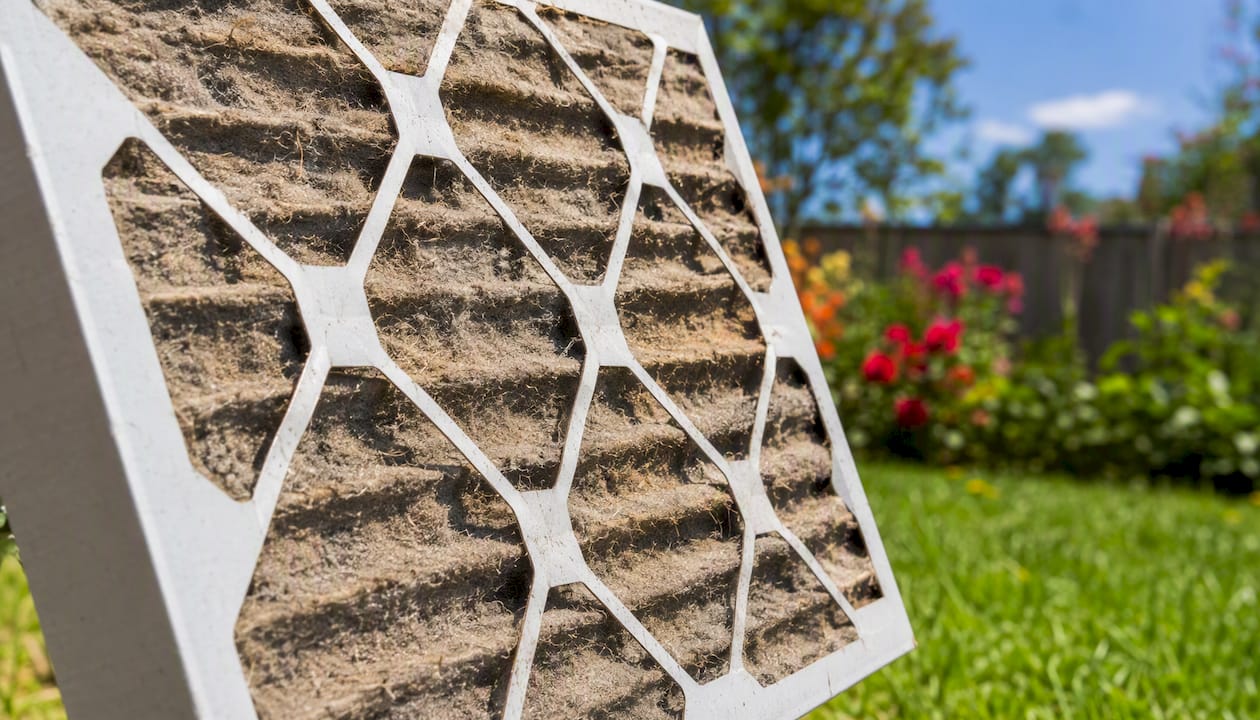
DIY check: Pull the filter out and hold it up to a light. If you can’t see light through it, replace it. DIY OK.
2. Frozen or dirty evaporator coil
Even with a clean filter, a coil caked in dust or grime loses its ability to absorb heat. Ice forms, airflow drops further, and the safety shutoff triggers. You can often spot this by looking through the supply vents for reduced airflow or by checking the indoor air handler for frost on the refrigerant lines.
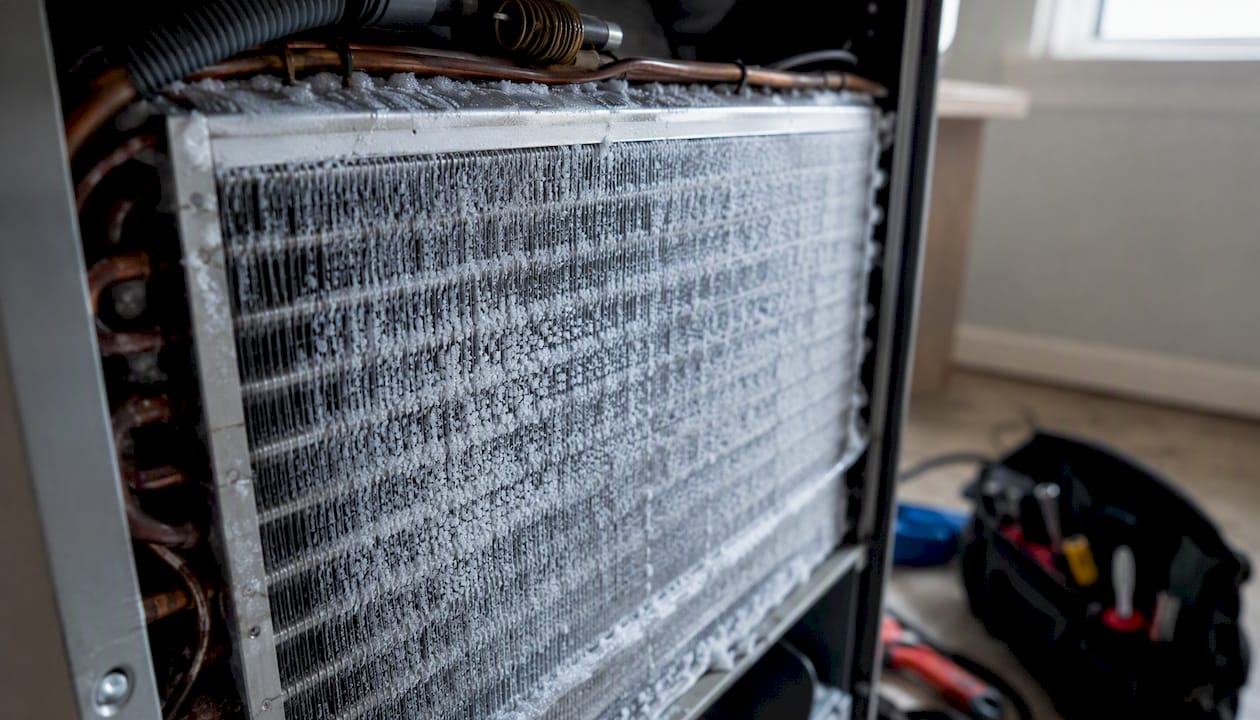
DIY check: Turn the system to “fan only” (no cooling) for 2–3 hours to thaw the coil. If it refreezes after restarting, the underlying cause (dirty coil, low refrigerant, or airflow restriction) still needs fixing. Coil cleaning beyond the filter is generally pro required.
3. Low refrigerant or a refrigerant leak
Refrigerant doesn’t “run out” under normal conditions. If the charge is low, there is a leak. Low refrigerant causes abnormal pressure readings that trigger the system’s low-pressure safety switch, cutting the compressor off early. Trane’s troubleshooting guidance lists low refrigerant and clogged coils among the most common causes of poor cooling and cycling, and is clear that refrigerant leaks require a qualified technician to find and repair.
DIY check: Look for ice on the refrigerant lines at the indoor unit, listen for a hissing sound near the outdoor unit, and note whether the system blows warm air. Pro required for diagnosis and repair.
4. Thermostat problems
A thermostat placed in direct sunlight, near a supply vent, or in a drafty hallway reads the wrong temperature and tells the system to shut off before the home is actually comfortable. Dead batteries cause erratic signals. A failing thermostat sensor can do the same. American Standard lists thermostat issues — including placement and calibration — among the most common short-cycling causes.
DIY check: Replace batteries. Move any lamps or electronics that generate heat near the thermostat. Confirm no supply vent is blowing directly on it. If the problem persists after those steps, the thermostat itself may need replacement. DIY OK for batteries and placement; pro for wiring or sensor failure.
Pro Tip: A thermostat mounted on an exterior wall in a sun-facing room can read 5–8°F warmer than the actual room temperature. That alone can cause the system to cycle off 10 minutes into a run.
5. Oversized or improperly sized system
An oversized AC cools the air near the thermostat so fast that it hits the setpoint before the rest of the house is comfortable or before humidity is removed. The system shuts off, the temperature creeps back up, and the cycle repeats every few minutes — indefinitely. Trane notes that improperly sized systems, especially oversized units, frequently cause short cycling and that very short cycles usually indicate a system issue requiring technician diagnosis.
This is one of the few causes with no quick fix. Correcting it requires a Manual J load calculation performed by a licensed HVAC contractor, and in most cases, replacing the equipment with a properly sized unit. Pro required.
6. Failing capacitor, contactor, or relay
The capacitor gives the compressor motor its startup boost. When it weakens, the compressor struggles to start, draws too much current, and the thermal overload trips — shutting the system off within seconds or minutes. A bad contactor or relay can cause similar intermittent behavior. Electrical failures like these produce audible symptoms: a clicking sound when the system tries to start, a humming outdoor unit that won’t fully engage, or a system that trips the breaker repeatedly.
DIY check: Listen for clicking or humming at the outdoor unit. Check whether the breaker has tripped. Pro required for any electrical component testing or replacement.
7. Failing or overheating compressor
The compressor is the heart of the system. When it overheats from repeated short cycles, age, or low refrigerant, its internal thermal protector shuts it down. It may restart after cooling, creating a pattern of short runs followed by longer off periods. A compressor that hums but won’t start, or one that trips the breaker, is near the end of its life.
DIY check: Feel whether the outdoor unit is unusually hot. Listen for a hard-start sound (loud clunk or buzz). Pro required — compressor diagnosis and replacement is one of the most expensive HVAC repairs.
8. Blocked return vents or duct leaks
Furniture pushed against return vents, closed supply registers, or leaky ductwork all reduce the volume of air moving through the system. The effect is similar to a clogged filter: the coil starves for airflow, temperatures inside the air handler spike or drop abnormally, and safety controls intervene. Duct leaks also dump conditioned air into unconditioned spaces, reducing system efficiency and causing the thermostat to cycle the system more frequently.
DIY check: Walk through the house and confirm all supply and return vents are open and unobstructed. Look for visible gaps or disconnected sections of ductwork in the attic or crawlspace. DIY OK for vents; pro for duct sealing.
9. Blocked or dirty outdoor condenser unit
The outdoor unit rejects heat from the refrigerant into the outside air. If the condenser coils are caked with dirt, or if shrubs, debris, or a fence restrict airflow around the unit, heat builds up and the high-pressure safety switch trips. The system shuts off, cools down, and restarts — a textbook short cycle. Trane’s guidance identifies blocked outdoor units as a common cause of poor cooling and cycling.
DIY check: Clear at least 2 feet of clearance around the outdoor unit. Rinse the condenser fins gently with a garden hose from the inside out. DIY OK for debris clearing; pro for coil cleaning with chemicals.
10. Extreme outdoor temperatures
When outdoor temperatures spike above 95–100°F, the condenser struggles to reject heat efficiently. High-pressure limits can trip more easily, causing the system to cycle off before completing a full run. This is especially common in Texas summers. It is not necessarily a fault, but it can expose an underlying weakness (a slightly low refrigerant charge or a marginal capacitor) that wouldn’t cause problems in milder weather.
DIY check: Note whether short cycling only happens during peak afternoon heat. If so, mention this pattern to your technician. Pro required if the underlying component is marginal.
11. Recent system modifications (zoning, staging, or control upgrades)
Adding a zoning system, a new smart thermostat, or a variable-speed control to an existing unit can create communication mismatches that cause erratic cycling. A zone controller that closes too many dampers simultaneously creates the same airflow restriction as a clogged filter. A smart thermostat wired incorrectly can send conflicting signals.
DIY check: If short cycling started immediately after a system change, document exactly what was changed and when. Pro required to diagnose control wiring or zoning issues.
How to diagnose the problem yourself before calling a pro
Follow this checklist in order. Stop at the first step that reveals a problem, fix it, and observe the system for at least an hour before moving on.
- Turn off the system at the thermostat. Don’t just set it to a higher temperature — switch it to “off” so the compressor stops completely.
- Check the breaker panel. Look for any tripped breakers labeled “AC,” “air handler,” or “condenser.” Reset once if tripped. If it trips again, stop and call a pro.
- Inspect the air filter. Replace it if it’s visibly dirty. Use a MERV 8–11 filter for most residential systems. Check the filter replacement guide if you’re unsure which type to use.
- Check all supply and return vents. Open any that are closed. Move furniture blocking returns.
- Inspect the outdoor unit. Clear debris, check clearance, and look for ice on the refrigerant lines.
- Check the thermostat. Replace batteries. Confirm placement (not in direct sun, not near a vent). Set the temperature at least 5°F below current room temperature.
- Restart the system and time the cycles. Use your phone’s stopwatch. Record: time the compressor runs, time it stays off, any sounds (clicking, humming, hissing), and whether the air coming from vents feels cold.
- Log for 30–60 minutes. Note whether the pattern changes as the outdoor temperature rises or falls.
- Do not open sealed panels, touch electrical components, or attempt to add refrigerant. These require tools, training, and in the case of refrigerant, EPA 608 certification.
What to tell your technician: exact run/off times, whether you saw frost on the lines, any sounds, what you changed recently, and whether the problem is worse at certain times of day.
When to stop DIY and call a licensed HVAC technician
Some short-cycling causes are genuinely dangerous to ignore or attempt yourself. Call a pro immediately if:
- Cycles are under 5 minutes and persist after you’ve replaced the filter and checked the thermostat
- You see ice on the refrigerant lines or the outdoor unit is extremely hot
- You smell burning near the air handler or outdoor unit
- The breaker trips more than once
- The outdoor unit hums but the compressor won’t engage
- You suspect a refrigerant leak (hissing sound, warm air, ice on lines)
A licensed technician will check refrigerant pressure and perform leak detection, test the capacitor, contactor, and relays with a meter, inspect compressor health, measure airflow at the registers, and review system sizing if chronic short cycling persists despite repairs. If oversizing is confirmed, they will perform or review a Manual J load calculation to determine the correct replacement size.
Common repair costs vary widely by region and component, but typical fixes include capacitor replacement (relatively low cost), refrigerant leak repair and recharge (moderate, depending on leak location), thermostat replacement (low to moderate), and duct sealing (moderate). Compressor replacement or full system replacement for sizing issues sits at the high end.
Pro Tip: Before any technician visit, ask for a written estimate before work begins, confirm the company holds a state HVAC license and carries liability insurance, and ask them to explain the root cause in plain language — not just the part they replaced. A good tech will tell you why it failed, not just what failed.
For electrical faults tied to your AC system, those checks require the same licensed approach.
A technician’s view: your system shuts off to protect itself
Short cycling is almost always a protective behavior. Modern AC systems have multiple safety controls — high-pressure switches, low-pressure switches, thermal overloads, and freeze stats — that cut power to the compressor when conditions fall outside safe operating limits. The system isn’t broken in the sense of being unresponsive; it’s responding exactly as designed. The problem is whatever is pushing it outside those limits repeatedly.
That framing matters for homeowners because it tells you the system is giving you a warning, not failing silently. The compressor is the most expensive component in the system, and these shutoffs exist specifically to prevent it from burning out. Running through repeated short cycles without addressing the root cause is the fastest way to turn a $200 capacitor repair into a $2,000 compressor replacement.
Recommended maintenance schedule to prevent short cycling:
- Every 1–3 months: Replace the air filter (more often with pets or high-dust environments). See the full AC maintenance guide for a complete seasonal checklist.
- Once a year: Schedule a professional tune-up before cooling season. A tech will check refrigerant charge, clean coils, test electrical components, and measure airflow.
- Every 3–5 years: Have ductwork inspected for leaks, especially if you’ve noticed uneven temperatures or rising bills.
- Before any major system change: Request a Manual J sizing review if you’re replacing equipment, adding zones, or finishing new living space.
When hiring, look for technicians certified by NATE (North American Technician Excellence) and verify your contractor holds a current state HVAC license. Xtreme Air Services technicians serving the Dallas, TX area carry the credentials and equipment to diagnose every cause covered in this guide.
Protect your system with a maintenance plan
If your AC is short cycling and you’ve already checked the filter and thermostat, the next step is a professional diagnostic. Xtreme Air Services provides HVAC repair, maintenance, and installation for homes and businesses in the Dallas, TX area. A maintenance plan includes annual tune-ups, priority scheduling, and the kind of proactive checks that catch a failing capacitor or low refrigerant charge before they cause a short-cycling emergency in August.
Not sure whether repair or replacement makes more sense for your situation? The repair vs. replacement guide walks through the decision based on system age, repair cost, and efficiency.

The part most homeowners skip — and why it costs them
Here is the honest take after working through every cause on this list: most homeowners either do too little or too much. They either ignore the short cycling for weeks (because the house eventually cools down), or they call a technician immediately without doing the two-minute filter check that would have solved it.
The conventional advice to “call a pro” is correct for refrigerant, electrical, and compressor issues. But it skips the prioritization step that actually saves you money. Airflow problems — dirty filters, blocked returns, debris around the outdoor unit — account for a disproportionate share of short-cycling calls. Those are free or near-free fixes. Do them first, every time, before spending money on a diagnostic visit.
What is genuinely underrated is the value of logging your cycles before calling anyone. A technician who arrives knowing the system runs for exactly 4 minutes, shuts off for 8, and does it worse after 3 PM can diagnose the problem in half the time. That specificity is worth more than any symptom description you can give over the phone.
The one thing to prioritize above everything else: if cycles are extremely rapid and the system is running hot, turn it off. The compressor is the one component where damage compounds silently and expensively. Everything else on this list is recoverable. A burned-out compressor often means a new system.
Sources
These are the most credible references for verifying the guidance in this article:
- AC Short Cycling: What Causes It and How to Prevent It
- Air Conditioner Troubleshooting: 5 Common Issues – Trane®
- Manual J
- What Is Short Cycling in HVAC and Why Is It a Problem? | American Standard®
FAQ
What is the most common cause of AC short cycling?
A dirty or clogged air filter is the most common cause. It restricts airflow, causes the evaporator coil to freeze, and triggers the system’s safety shutoff — replace the filter first before investigating anything else.
Should I turn my AC off if it’s short cycling?
Yes, if cycles are under 5 minutes or the outdoor unit is overheating or iced over, turn the system off at the thermostat. Running through rapid repeated cycles accelerates compressor wear and can turn a minor repair into a major one.
Why is my car’s AC short cycling?
Car AC short cycling usually points to low refrigerant, a faulty pressure switch, or a failing compressor clutch. The diagnostic process is similar to home systems, but car AC refrigerant and pressure work requires an automotive HVAC technician, not a residential HVAC contractor.
Can an oversized AC cause permanent short cycling?
Yes. An oversized unit cools the air near the thermostat too quickly, hits the setpoint before humidity is removed, and shuts off. This repeats indefinitely. The only reliable fix is replacing the unit with equipment sized by a Manual J load calculation.
How long should I log my AC cycles before calling a technician?
Log for at least 30–60 minutes, recording exact run times, off times, any sounds, and whether the pattern changes with outdoor temperature. That data cuts diagnostic time significantly and helps the technician identify the root cause faster.