


What Are the Most Common Commercial HVAC Repair & Maintenance Problems?
Rooftop units short cycling, refrigerant leaks, airflow restrictions between zones, electrical failures, and what rising repair frequency is telling you.
What’s Covered on This Page
Rooftop Unit Short Cycling or Uneven Temperature Control
Tenants notice this before management does most of the time. A conference room feels stuffy by 2pm while the front lobby stays cold enough for a jacket. Or the rooftop unit clicks on, runs for four minutes, shuts off, then fires back up ten minutes later all afternoon. Neither one means the whole system needs to be replaced. It usually means something specific inside the unit or the ductwork is out of balance.
- A dirty condenser or evaporator coil making the unit work harder and cycle faster
- Low refrigerant charge from a slow leak that reduces cooling capacity
- A failing thermostat or sensor reading the wrong temperature in the space
- An economizer damper stuck open or closed, pulling in too much or too little outside air
- Ductwork sized or balanced for a different layout than the current one
- A unit that was oversized for the space to begin with, so it satisfies the thermostat too fast
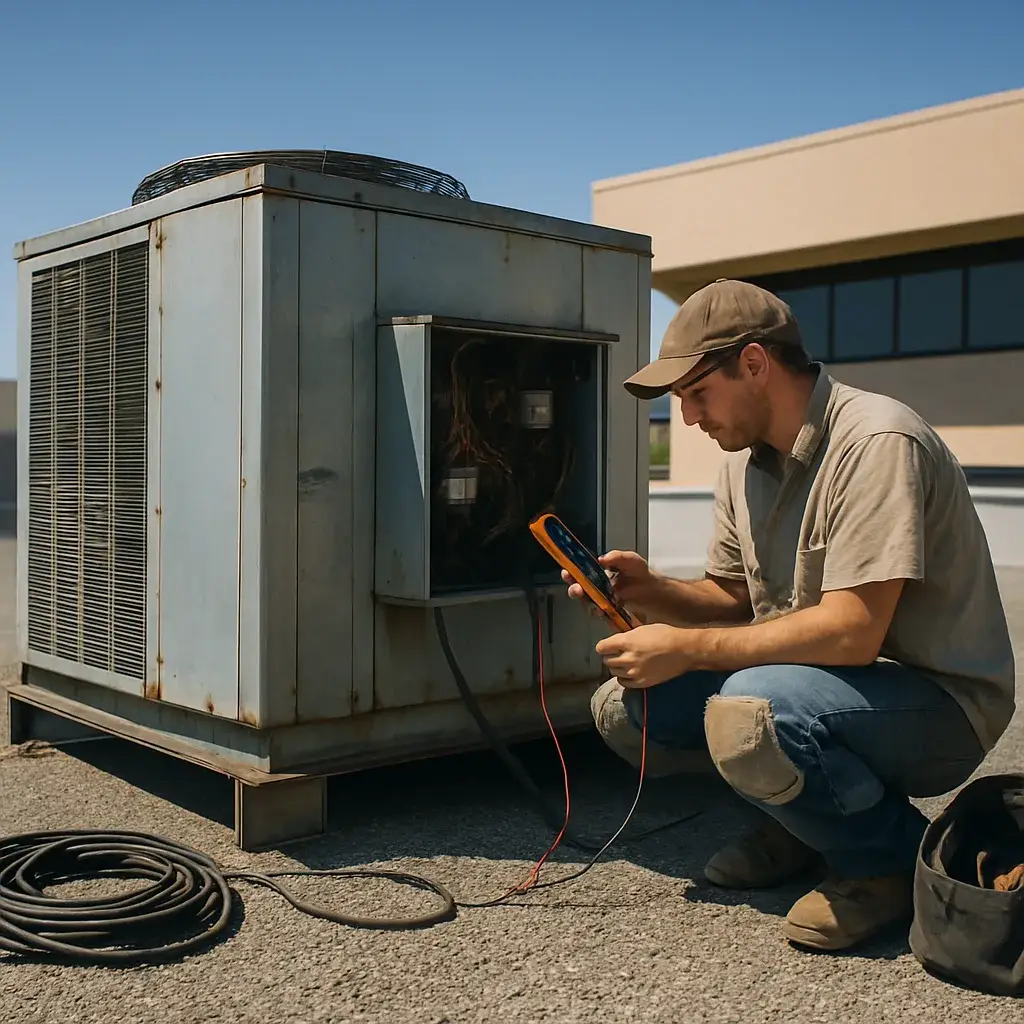
On a service call, a technician checks the electrical controls, refrigerant pressures, coil condition, and airflow at the registers in the affected zones. That’s how you tell the difference between a control board issue and a ductwork issue, because they look almost identical from inside the building. Rooftop unit service on an older RTU sometimes turns up two or three smaller issues stacked on top of each other, not one dramatic failure.
Sometimes short cycling has nothing to do with the mechanical equipment at all. A thermostat scheduled wrong, or a sensor mounted too close to a supply vent, can cause the exact same symptom as a failing compressor. Finding that out on the diagnostic visit means a business doesn’t pay for parts it didn’t need.
Uneven zones in a building with multiple rooftop units can also point to a balancing problem between units rather than a fault in any single one. That’s a longer conversation and depends on how the building’s ductwork and zoning were originally designed.
Refrigerant Leaks That Slowly Reduce Cooling Capacity
A refrigerant leak rarely shows up as a sudden failure. Instead, a business notices the space just isn’t as cool as it used to be. The rooftop unit runs longer to hit the same temperature, and the thermostat seems to lag behind what it used to do without trouble. Some tenants mention warm spots near the ends of a duct run before anyone thinks to call it a refrigerant issue.
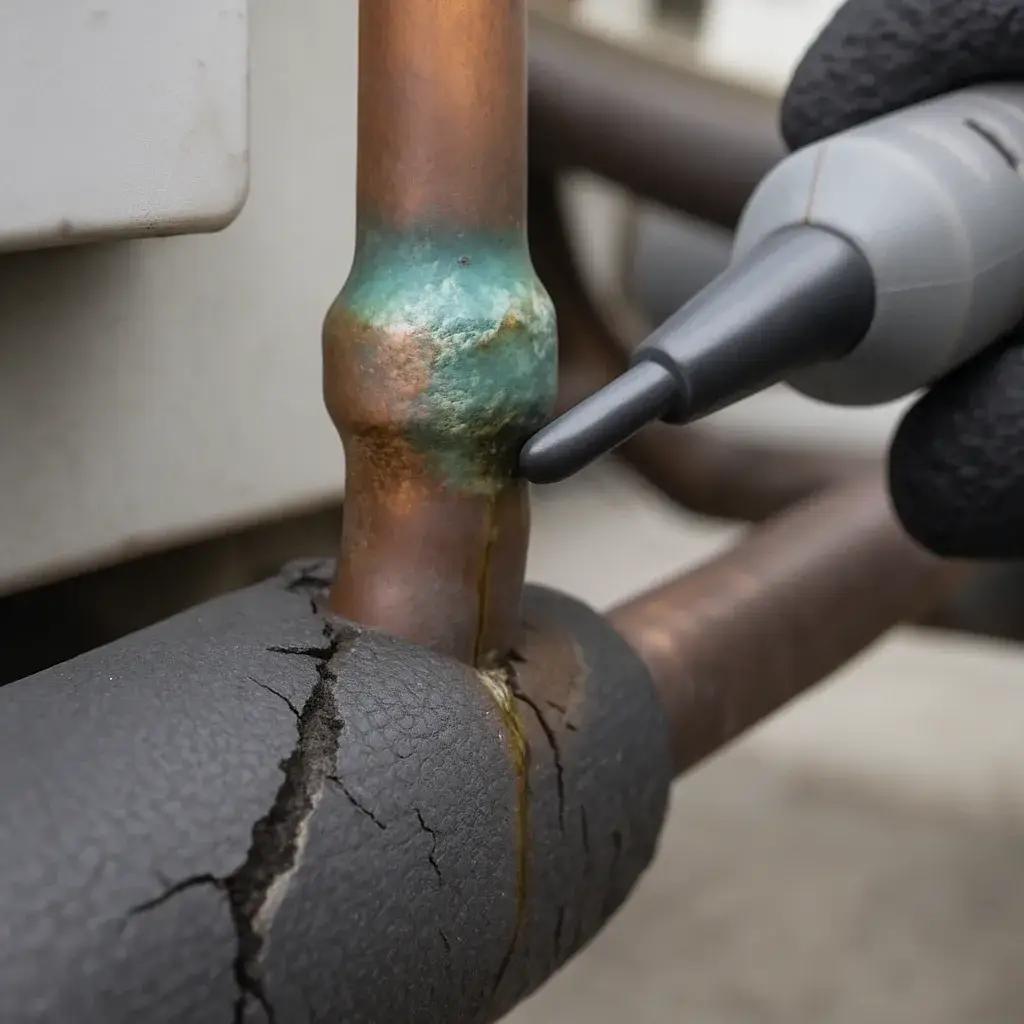
Refrigerant lines and coils take a beating on a commercial roof. Vibration from the unit itself, expansion and contraction through hot Texas summers and cold snaps, and corrosion at joints and coil fins all wear on connections over years of service. A pinhole leak at a brazed joint or a worn valve schrader can leak slowly for months before cooling capacity drops enough for anyone to notice. Cooling seasons run long in Dallas County, so the wear that shows up as short cycling or a slow loss of capacity tends to surface earlier here than an equipment rating would suggest.
- Coil fittings and brazed joints that loosen or corrode over time
- Schrader valves and service ports that wear out with age
- Vibration damage at line sets on rooftop units exposed to wind and heat cycles
- Formicary corrosion on older copper coils, a slow pinhole leak that’s hard to spot without proper testing
When we get a call about weak cooling on a commercial system, we don’t just top off refrigerant and leave. Low refrigerant is a symptom of a leak somewhere in the system, and refilling it without finding the leak just means doing it again later. Our technicians use leak detection tools and testing to find where refrigerant is escaping, then repair that point before recharging the system to the manufacturer’s specification.
Some leaks are a single fitting we can repair in one visit. Others, especially on older equipment with corroded coils, mean the coil itself needs to come out. We’ll tell you which one you’re dealing with before any work starts, and we’ll walk you through the repair-or-replace tradeoff if the coil is the actual source rather than just patching around it.
This kind of diagnostic and repair work falls under our rooftop unit service, which covers rooftop units and the ductwork and controls that keep a building’s cooling running the way it should.
Preventive maintenance visits catch a lot of these leaks early, before capacity loss turns into a hot afternoon with no cooling at all. That’s part of why regular inspection matters more on commercial roofs than most owners expect.
Airflow and Ductwork Restrictions Between Zones
One area of a building runs cold while another stays warm, or a back office gets almost no air at all. That’s the complaint we hear most on commercial calls, and it’s rarely about the rooftop unit itself. Most of the time it traces back to the ductwork and how air gets split between zones.
Commercial buildings usually run one or more rooftop units feeding a duct system that branches into several zones, sometimes with dampers controlling how much air each zone gets. When a damper sticks, a duct run gets crushed or disconnected above a dropped ceiling, or a filter loads up and chokes airflow at the source, some zones end up starved while others get more than they need. Tenant build-outs and remodels add to this over the years. Walls move, ceilings get lowered, and duct runs that made sense for the original layout no longer match how the space is used.
Buildup inside the ducts themselves plays a part too. Dust, grease near kitchen exhaust paths, and general debris narrow the inside of a duct over years of operation, and that shows up as weaker airflow at the vents furthest from the unit.
On a service call, a licensed technician checks the whole path, not just the thermostat. That means looking at the rooftop unit, the main trunk line, the branch ducts, the dampers, and the diffusers in the affected zones. We explain what we find in plain terms before any work starts, with a written flat-rate quote. If the issue is a duct problem rather than the equipment, that’s part of what commercial ductwork and duct sealing work addresses, and it’s built to fix the actual airflow path rather than just adjust settings at the thermostat.
Sometimes what looks like a duct restriction is really a zoning or controls issue, where the building automation setup isn’t calling for air the way the space needs it. That’s a different fix, and it’s one reason a proper inspection matters before anyone assumes new ductwork is the answer. We won’t recommend tearing into ducts if the real fix is simpler than that.
Costs on airflow and duct issues vary a lot depending on how much of the system is involved, so we keep the specifics on our pricing page rather than guessing here.
If uneven comfort has been a pattern across a building for a while, a same-day diagnostic visit gives you a clear picture of whether it’s the equipment, the ducts, or the controls, before you spend money guessing.
Not sure what your Commercial HVAC repair & maintenance project needs? Ask us.
Call Today, Get Service Today. Xtreme Air Services is ready to help.
Electrical Component Failures That Stop a Unit From Starting
A unit that won’t fire up at all is one of the most common calls we get on rooftop and commercial systems. Most of the time, it traces back to a small electrical part rather than the whole system failing.
A failed capacitor is the most frequent culprit. You’ll notice the outdoor unit humming but the fan not spinning, or the whole unit staying dead quiet when the thermostat calls for cooling. Capacitors store the electrical charge that gets the compressor and fan motor moving, and constant cycling in Texas heat wears them down faster than in milder climates. We test capacitor strength with a meter rather than guessing, since a capacitor can look fine and still be reading well below spec.
Contactors are another common point of failure. This is the switch that closes to send power to the compressor. Over thousands of cycles, the contact points pit and burn, and eventually the contactor sticks or stops closing altogether. On older rooftop units running long hours for a business, we see this wear show up sooner than on a typical residential system.
Control board failures show up less often but cause more confusion, because the symptoms can look like almost anything: a unit that starts and stops on its own, one that won’t respond to the thermostat, or one that throws an error code without an obvious cause. Boards can fail from power surges, moisture in a rooftop enclosure, or just age.
Sensors, including flame sensors on gas-fired equipment and various safety and limit sensors, can also shut a unit down as a protective measure. That’s the system doing its job, not malfunctioning, but it still means no heat or no cooling until the sensor is cleaned, tested, or replaced.
- Capacitor failure: fan hums or stays off, compressor won’t engage
- Contactor failure: no response at all when the thermostat calls for the unit
- Control board failure: erratic cycling, error codes, or no communication with the thermostat
- Sensor failure: unit shuts down as a safety response rather than running improperly
On a service call, we test each of these components in sequence rather than swapping parts on a guess. Most electrical component failures are a single part fixed on the first visit. We don’t recommend replacing a board or a full control system when a small capacitor is the actual problem, and we’ll walk you through what we found before any repair starts.
Cost depends on which part failed and whether it’s stocked on the truck versus special order for older equipment. Our pricing guide breaks down what drives the cost on these repairs.
More Frequent Repairs as Commercial Equipment Ages
Rooftop units and commercial systems don’t wear out all at once. They wear out one part at a time, and which part fails tends to shift as the equipment gets older. A five-year-old RTU usually has different problems than a fifteen-year-old one, and knowing that pattern is part of what a technician is checking for on every call.
- Capacitors and contactors wearing out from repeated heat cycling, especially on units that run long hours
- Condenser coils losing efficiency as dirt and scale build up over years outdoors
- Compressors showing strain after a decade or more of continuous cycling
- Control boards and sensors drifting or failing as components age
- Blower motors and bearings wearing down with accumulated run time
- Refrigerant lines developing slow leaks at joints and connections over time
None of that means an aging system is a ticking clock. It means the type of repair shifts. A newer unit’s problem is more likely a single failed part. An older unit sometimes has one visible failure that’s really a symptom of several components nearing the end of their run at once. That’s one of the real factors that moves the cost of a repair up or down, along with the brand and how available the part is.
We treat every visit the same way regardless of the unit’s age. A technician finds the actual root cause, explains it in plain terms, and puts the repair-or-replace decision in front of you in writing before touching anything. On older equipment, that conversation sometimes includes whether a repair still makes financial sense compared to replacement, which is worth understanding before you’re standing at that decision point.
Our pricing guide breaks down the ranges and what’s included for repairs like these. And if you’re weighing whether an aging unit is worth fixing at all, our repair-or-replace page covers how we look at that call.
Ready to Get Started?
Call 972-288-2263 Today, Get Service Today.