


Commercial HVAC Repair & Maintenance: Should You Repair or Replace?
Which failures are a straightforward repair, which point to replacement, and how we lay both numbers out in writing before any work starts.
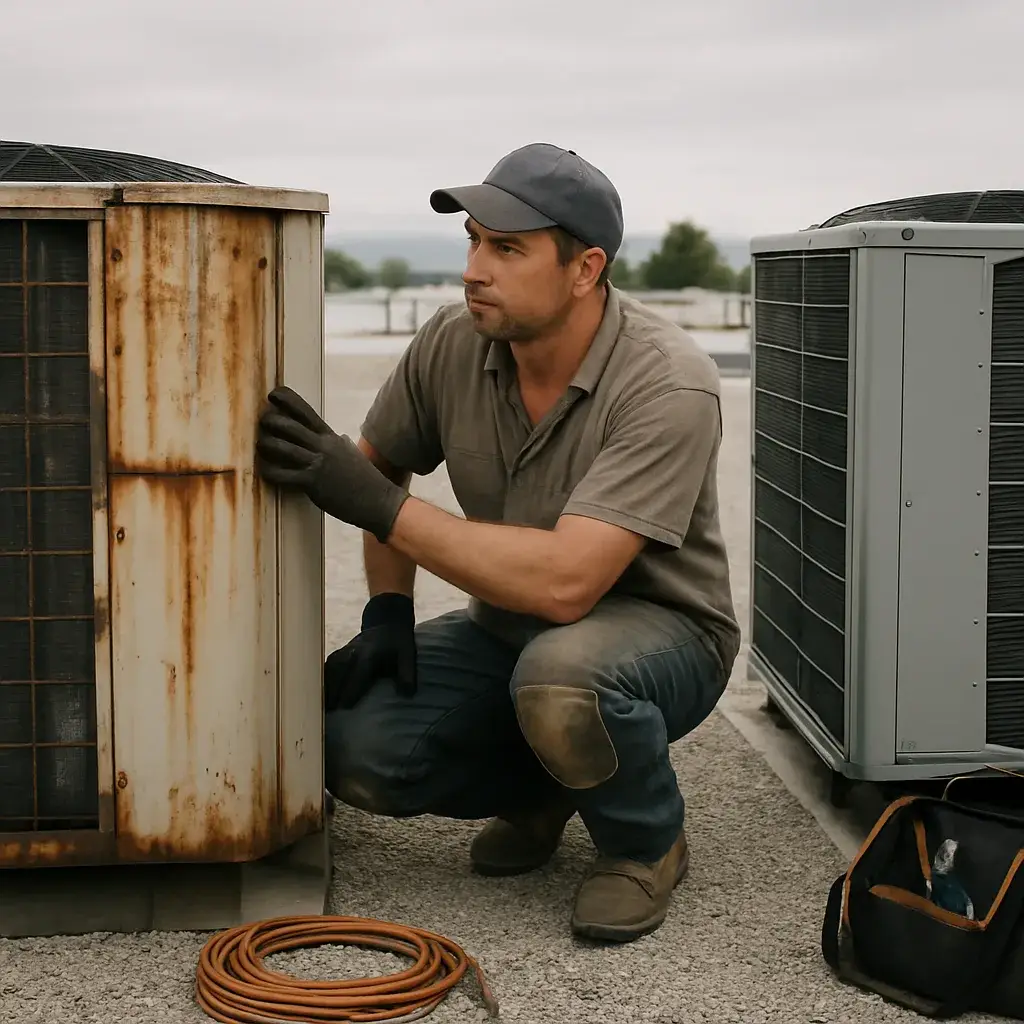
What’s Covered on This Page
- What Decides Whether a Unit Gets Repaired or Replaced
- When We’d Recommend a Repair
- When We’d Recommend Replacement
- How We Help You Make This Call
- Related Links
- Which failures usually turn out to be just a repair?
- Do we get both numbers, or just your recommendation?
- If we choose replacement instead of repair, is the service-call fee still credited?
- A $300 repair is cheap. Why would you ever advise against it?
- If we replace the unit, is it the same team doing the install?
What Decides Whether a Unit Gets Repaired or Replaced
A typical commercial repair runs between $300 and $2,400, and most jobs come down to locating the failed part, fixing or swapping it, and testing the system before we leave. That’s the majority of calls. The unit isn’t dying, it’s got one bad component, and once that’s handled the system runs fine again.
So what pushes a job toward replacement instead? A few things. The extent of the failure matters most. If it’s one part, a capacitor, a motor, a control board, that’s a repair. If we find two or three failed components on the same visit, the math changes fast, because you’re paying labor and parts multiple times over on equipment that’s already showing its age.
- Extent of the failure – one part versus several failing at once
- Part cost and availability – some parts for older or discontinued equipment take longer to source and cost more
- Equipment age and brand – older rooftop units and commercial systems near the end of their service life often aren’t worth further investment
- Whether multiple components have failed on the same visit
- After-hours timing has no effect on the repair-or-replace call itself – we don’t charge extra for nights or weekends either way
Here’s where we’d tell you straight not to repair: if a unit is old, parts are getting hard to find, and you’re looking at a second or third repair in a short stretch, throwing more money at it stops making sense. We’ll say so. On the flip side, we won’t push a replacement on a unit that just needs one part. That’s not how we’ve built repeat business across North Texas.
Every repair call includes a diagnostic visit, a written flat-rate quote before any work starts, and a $26 to $99 service-call fee that gets credited toward the repair if you move forward. The quote lays out your repair-or-replace options side by side, so the decision is yours, not a guess made over the phone.
For larger jobs, financing is available on qualifying installations and equipment upgrades if a full replacement is the right call. You can see how commercial repair pricing breaks down on our commercial HVAC repair & maintenance page before you decide.
When We’d Recommend a Repair
We’d recommend a repair when a single part has failed on a system that’s otherwise sound. Most commercial calls we run fit this pattern: a technician finds the failed part, repairs or replaces it, tests the system, and it runs correctly for the rest of its expected life. That’s a $300 to $2,400 job for us, and it covers diagnosis, labor, the standard replacement part, testing, and cleanup.
A repair makes sense when the unit is running one bad component, not several. Capacitors, contactors, blower motors, control boards, and refrigerant leaks are common single-point failures on rooftop units and package systems, and fixing one of these doesn’t tell you anything bad about the rest of the machine. If your rooftop unit is five years old and the compressor is fine, replacing a failed capacitor is the obvious move, not a full system swap.
Cost and part availability matter too. A common part on a mainstream brand gets your business running the same day. A discontinued part on an older or less common unit can push the job toward the higher end of that range, or push us to recommend replacement instead, especially if we’re also looking at an aging compressor or a coil that’s on its way out. We walk through those tradeoffs with you before any work starts, in writing, so you’re deciding with real numbers, not a guess. Parts distribution across the Dallas-Fort Worth Metroplex is good enough that availability, not distance, is usually what decides whether your building is cooling again today or next week.
One thing worth knowing going in: our $26 to $99 service call fee gets credited toward the repair if you move forward with us, so getting a technician out to look doesn’t cost you extra on top of the fix.
What a repair doesn’t cover is anything beyond the original failure. If a second component fails during the same visit, or the fix requires a code upgrade or a permit, that’s priced separately and we’ll tell you before we touch it.
For a fuller look at how our team approaches commercial equipment from the first call through the walkthrough, see our commercial HVAC repair and maintenance service page.
- One failed part, otherwise healthy equipment
- Part is available and priced within normal range
- No history of multiple recent failures on the same unit
- Business can tolerate a short downtime window while we work
When We’d Recommend Replacement
We recommend replacement when the numbers stop making sense or the unit can’t be trusted to run through another season. Most commercial repair calls land between $300 and $2,400, and the full range we see runs $300 to $5,000 depending on what’s failed. Once a repair quote sits near the top of that range on an older rooftop unit, we’ll tell you straight that a new system is probably the smarter spend.
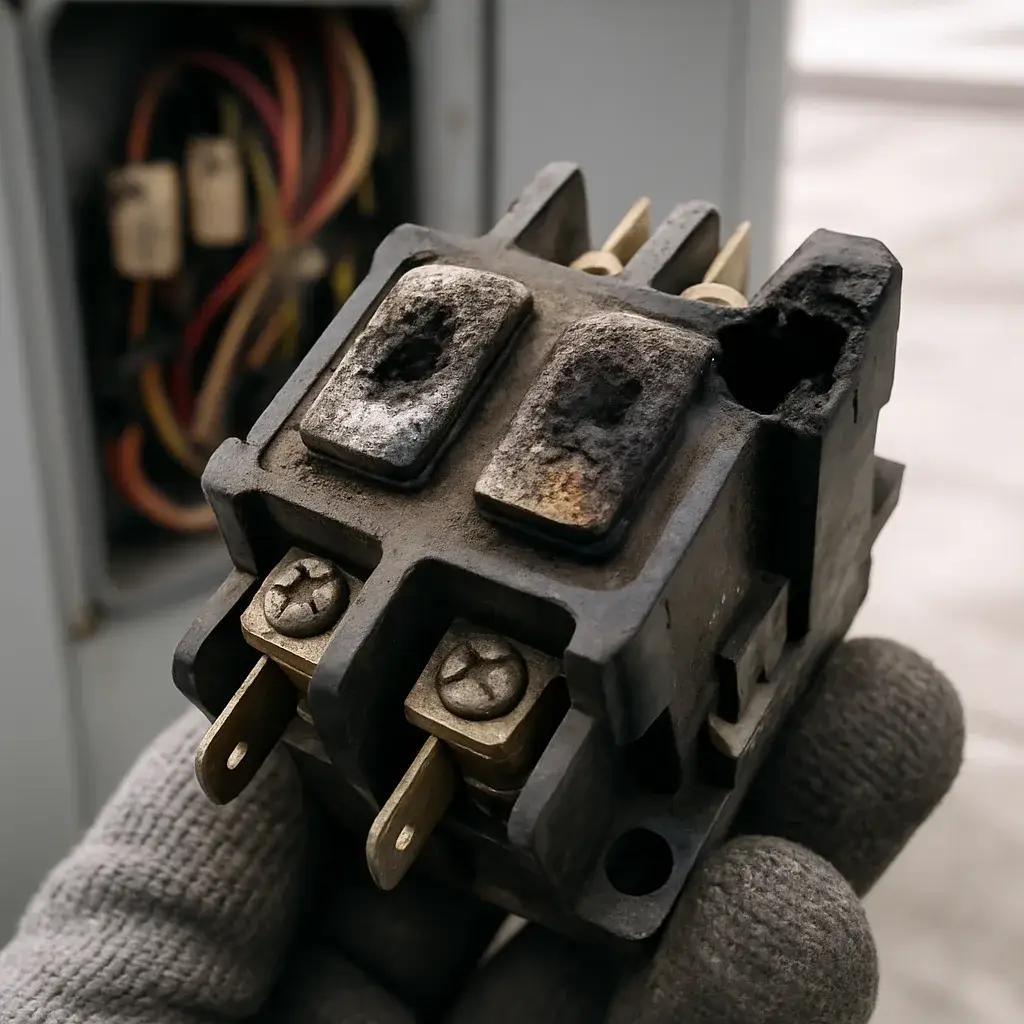
Age matters more than most people expect. A unit past 12 to 15 years that needs a major component, a compressor, a control board, a coil, is a different conversation than a five-year-old system with one bad capacitor. We look at what’s failed, what else on that same unit is close behind it, and whether the equipment brand and age still have parts support.
- Multiple components have failed or are showing wear at the same time, not just one isolated part
- The unit is old enough that matching parts are harder to source or cost more than newer equivalents
- You’ve had more than one major repair call on the same unit within a short stretch
- The building’s load or use has changed and the current system was never sized right for it
- Energy bills are climbing because the equipment has lost efficiency, separate from the immediate failure
Here’s the part we won’t dress up: sometimes a unit is worth fixing even when it’s inconvenient timing, and sometimes it isn’t worth fixing even when the repair itself is cheap. A $300 part on a unit that’s on its last leg still isn’t a good use of your money if it’s going to need another repair call in four months. We’d rather tell you that on the visit than let you pay for a patch twice.
If replacement is the right call, we handle Commercial HVAC installation as part of our own commercial and mechanical work, so the same crew that diagnosed the problem can size and install the new equipment. Financing is available on qualifying installations if that helps spread the cost. Every diagnostic visit includes a $26 to $99 call-out fee, and that fee gets credited toward whichever direction you choose, repair or replacement, once you move forward.
Not sure what your Commercial HVAC repair & maintenance project needs? Ask us.
Call Today, Get Service Today. Xtreme Air Services is ready to help.
How We Help You Make This Call
We don’t guess at repair versus replace over the phone. A licensed technician comes out, finds the actual failed part, and lays out both paths in writing before any work starts. You see real numbers for each option and pick the one that fits your building and your budget.
A few things drive that recommendation on every commercial call. The extent of the failure matters most. A single failed capacitor or motor is a different conversation than three components going out on the same unit. Part cost and availability count too, since some older rooftop units use parts that take longer to source. And we look hard at the equipment’s age and brand history before we tell you to spend money repairing it.
- Extent of the failure and whether it’s isolated or spreading
- Part cost and how fast we can get it
- Equipment age and brand
- Whether multiple components have failed at once
- Timing, since after-hours calls cost the same as a weekday visit
Here’s the part we won’t dress up: on a unit that’s already had several failures, another repair sometimes just delays the same conversation a few months out. We’ll say that plainly instead of running another repair ticket for the sake of it. If replacement makes more financial sense over the next few years, we’ll show you the number and let the math speak for itself. If a repair genuinely solves it, we’ll say that too, because most of our calls end there.
Once you know which way you’re leaning, our team can walk through the full range of options under our Commercial HVAC repair & maintenance service, including financing on qualifying replacement work if that changes the decision.
Frequently Asked Questions
Common questions about Commercial HVAC repair & maintenance
Which failures usually turn out to be just a repair?
Capacitors, contactors, blower motors, control boards, and refrigerant leaks are the common single-point failures we see on rooftop units and package systems. Fixing one of these does not tell you anything bad about the rest of the machine. If your rooftop unit is five years old and the compressor is fine, replacing a failed capacitor is the obvious move rather than a full system swap.
Do we get both numbers, or just your recommendation?
Both. The written quote lays out your repair and replace options side by side before any work starts, so the decision is yours rather than a guess made over the phone. A licensed technician comes out, finds the actual failed part, and puts real numbers against each path so you can pick the one that fits your building and your budget.
If we choose replacement instead of repair, is the service-call fee still credited?
Yes. The $26 to $99 call-out fee gets credited toward whichever direction you choose, repair or replacement, once you move forward. Getting a technician out to look does not cost you extra on top of the work you end up doing.
A $300 repair is cheap. Why would you ever advise against it?
Because the cost of the part is not the whole picture. A $300 part on a unit that is on its last leg still is not a good use of your money if it is going to need another repair call in four months. Sometimes a unit is worth fixing even at inconvenient timing, and sometimes it is not worth fixing even when the repair itself is cheap. We would rather tell you that on the visit than let you pay for a patch twice.
If we replace the unit, is it the same team doing the install?
Yes. We handle commercial HVAC installation as part of our own commercial and mechanical work, so the same crew that diagnosed the problem can size and install the new equipment. Financing is available on qualifying installations if spreading the cost helps.
Ready to Get Started?
Call 972-288-2263 Today, Get Service Today.