Ask for a current Certificate of Insurance (COI), the actual policy endorsements, and the contractor’s license number before anyone touches your property. Confirm the license on the Texas Department of Licensing and Regulation’s (TDLR) search tool, check workers’ comp status through TDI/TXCOMP, and verify the insurer is licensed in Texas through the National Association of Insurance Commissioners (NAIC). For permitted or public work, insist on TxDOT or municipal-specific forms submitted directly by the agent, since a COI alone can mask “phantom coverage,” which leaves you holding the liability.
TL;DR:
- Verified license status on TDLR ensures the contractor is legally authorized for the specific trade, with active and unexpired credentials.
- Confirming workers’ compensation status through TXCOMP or TDI is crucial, as non-subscribers shift liability risk onto property owners.
- Requesting endorsement pages and full policy declarations ensures coverage limits are adequate and exclusions are clearly identified before work begins.
- Permitting agencies like TxDOT and municipalities often require specific forms, direct submission by agents, and exact certificate holder names to avoid project delays.
- Authentic certificates of insurance include specific additional-insured endorsements, clear coverage timeframes, and valid insurer licensing, while fake or incomplete certificates can expose owners to financial risk.
Table of Contents
- Contractor Insurance Verification Texas: Document Checklist
- How Do You Verify a Contractor’s Insurance in Texas?
- Subscriber vs Non-Subscriber: What Workers’ Comp Status Means for You
- What Forms Do TxDOT and Cities Require for Permits?
- How to Spot a Fake or Insufficient Certificate of Insurance
- Xtreme’s Verification Checklist for Texas Projects
- Why Verification Protects Everyone on the Project
- Get a Proof-of-Insurance Packet Before You Sign
- Sources
- FAQ
Contractor Insurance Verification Texas: Document Checklist
A COI is a starting point, not proof of anything by itself. The Texas Department of Insurance is blunt about this: a certificate is informational only, and the policy language controls what’s actually covered. Before a crew shows up, request these items and check every field against the project itself.
- The COI itself, with the insurer name, policy numbers, effective and expiration dates, coverage limits, and the named insured matching the contractor’s legal business name.
- Endorsement pages, not just the COI summary. Ask for additional insured (CG 20 10 or CG 20 37, or an equivalent form), waiver of subrogation, primary and non-contributory wording, per-project aggregate, and completed operations coverage.
- Policy declarations pages when the scope of work is large enough that a snapshot COI won’t cut it. Declarations show the full limits and any exclusions the COI doesn’t list.
- TDLR license proof for trade-specific minimums. HVAC contractors, for instance, must carry at least $300,000 per occurrence and $600,000 aggregate for a Class A license, or $100,000 per occurrence and $200,000 aggregate for Class B.
- Agent and insurer contact details, including the agent’s phone number and the carrier’s claims line, so you can verify independently rather than trusting a scanned PDF.
Getting these five items up front saves you a second round of phone calls once work is already scheduled.
How Do You Verify a Contractor’s Insurance in Texas?
Verifying a contractor’s paperwork means checking three separate government systems, not one. Each confirms a different piece: the license, the workers’ comp status, and the insurer’s legitimacy.
- Search TDLR’s license database. Enter the license number or business name on TDLR’s verification portal. Confirm the license is active, matches the trade (HVAC, electrical, plumbing), and check the expiration date. Save a screenshot or PDF for your file.
- Check TXCOMP for workers’ comp status. Texas doesn’t require private employers to carry workers’ compensation, so you need to confirm whether the contractor is a subscriber. If the search results are ambiguous, email TDI’s coverage verification team directly; they typically respond within one business day.
- Confirm the insurer is authorized in Texas. Cross-reference the carrier name on the COI against the NAIC’s company lookup or TDI’s list of admitted carriers. An insurer that isn’t licensed in Texas can’t legally back a policy here, no matter how official the COI looks.
- Compare the endorsement PDFs against the COI. Numbers on a COI can say one thing while the actual endorsement excludes half the project. Request both and read them side by side.
- Log everything with a timestamp. Save PDFs, screenshots, and agent emails in a single project folder. If a claim ever surfaces mid-project, that paper trail is what protects you.
Pro Tip: Call the insurance agent listed on the COI directly, using a number you find independently (not one printed on the certificate). A fake or expired COI often has a disconnected or reassigned agent line behind it.
Subscriber vs Non-Subscriber: What Workers’ Comp Status Means for You
Texas is one of the few states where private employers can legally skip workers’ compensation entirely. A “subscriber” carries a standard workers’ comp policy. A “non-subscriber” has opted out, which strips away several legal protections the contractor would otherwise have. Non-subscriber status shifts significant liability risk onto the property owner, because an injured worker on a non-subscriber’s crew can sue for damages that a standard comp claim would have simply paid out.
Here’s how to protect yourself:
- Confirm subscriber status through TXCOMP or TDI’s certified self-insurer lists before signing anything.
- If the contractor is a non-subscriber, ask for written proof of alternative coverage, such as occupational accident insurance, and get the policy limits in writing.
- Read your contract language carefully. Public contracts and most commercial agreements effectively require workers’ comp or an equivalent, even when Texas law doesn’t mandate it.
- Treat evasiveness as a red flag. A contractor who won’t produce a clear answer on workers’ comp, or who waves off the question, is the one most likely to leave you exposed.
What Forms Do TxDOT and Cities Require for Permits?
Permit offices and public agencies don’t accept a generic COI the way a homeowner might. TxDOT uses its own Form 1560 and 1560-CS, with specific fields for waiver of subrogation and strict submission timelines. Miss the deadline or submit an altered certificate, and TxDOT can suspend work outright.
Municipalities often go further than the state minimums. Many require the city itself to be named as the certificate holder, and some insist the contractor’s agent submit the certificate directly rather than letting the contractor hand it over.
Before work starts, run through this checklist:
- Match every field on the contractor’s COI against the specific permit form the city or TxDOT requires.
- Confirm the certificate holder name matches exactly what the permitting office expects.
- Ask the agent to submit forms directly when the jurisdiction requires it, and get written confirmation.
- Keep a copy of the accepted, stamped, or approved version for your own project file.
How to Spot a Fake or Insufficient Certificate of Insurance
A properly written additional-insured endorsement will name your project or your business specifically, not just say “as required by contract.” Completed operations coverage should extend past the last day on-site, since most construction defects surface weeks or months later. If the endorsement language is vague or missing that timeframe, the coverage may lapse the moment the crew packs up.
Watch for these warning signs:
- Coverage limits on the COI that don’t match the language in the actual endorsement PDF.
- Contractual liability carve-outs or “prior work” exclusions buried in fine print.
- An insurer name that doesn’t show up on TDI’s or NAIC’s list of carriers licensed in Texas.
- Binder numbers instead of full policy numbers, which often means the policy hasn’t actually been issued yet.
Pro Tip: If something feels off, call the insurer’s claims department directly using their published number, not one on the certificate. If they’ve never heard of the policy, you’ve likely caught a forged or lapsed COI before it cost you.
Escalate real concerns by requesting the full endorsement set in writing, and if you suspect outright fraud, TDI accepts complaints through its certificate and forms guidance page.
Xtreme’s Verification Checklist for Texas Projects
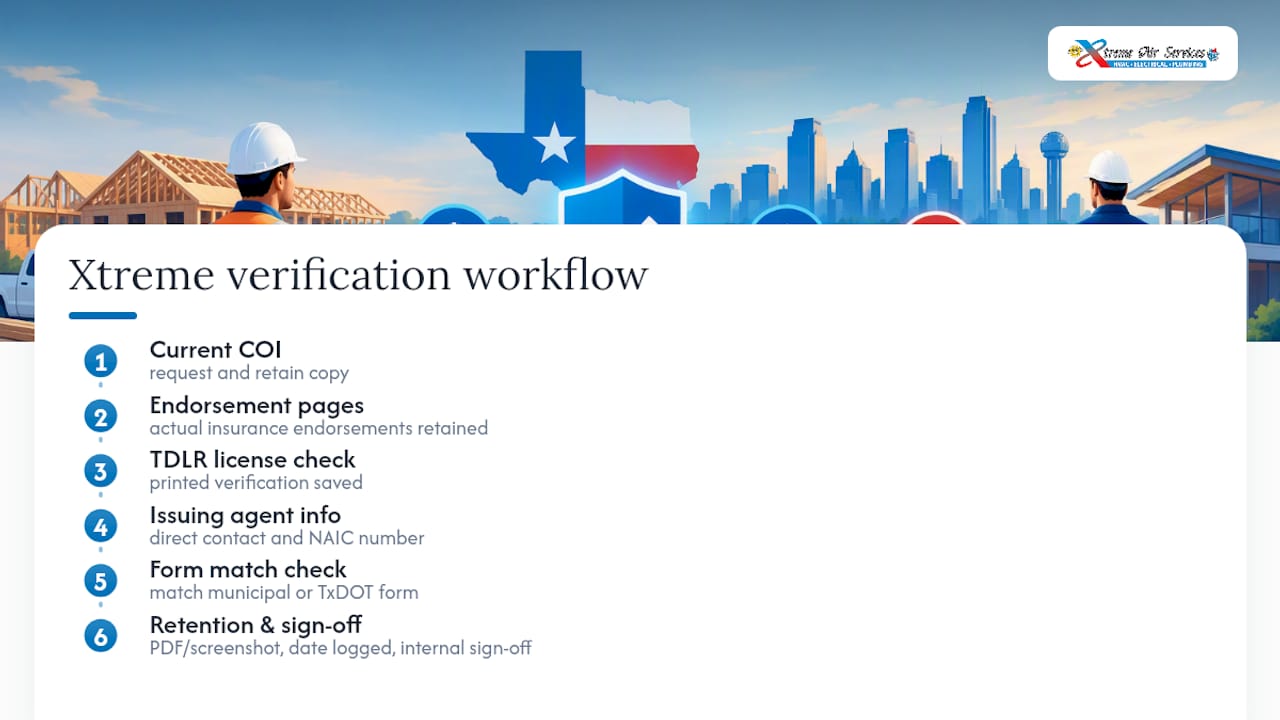
Before any crew is dispatched, Xtreme Air Services requests and retains a full documentation set: a current COI, the actual endorsement pages, a printed TDLR license verification, the issuing agent’s direct contact and NAIC number, and a match check against whatever municipal or TxDOT form the job requires. Every item gets saved as a PDF or portal screenshot, logged with the date it was pulled, and signed off internally before crews go into the field.
For homeowners preparing for related work, the same discipline applies to adjacent projects like attic insulation upgrades, where permit and warranty paperwork follow similar rules. The takeaway for any property owner: a compliant contractor should be able to produce this paperwork within minutes, not days.
Why Verification Protects Everyone on the Project
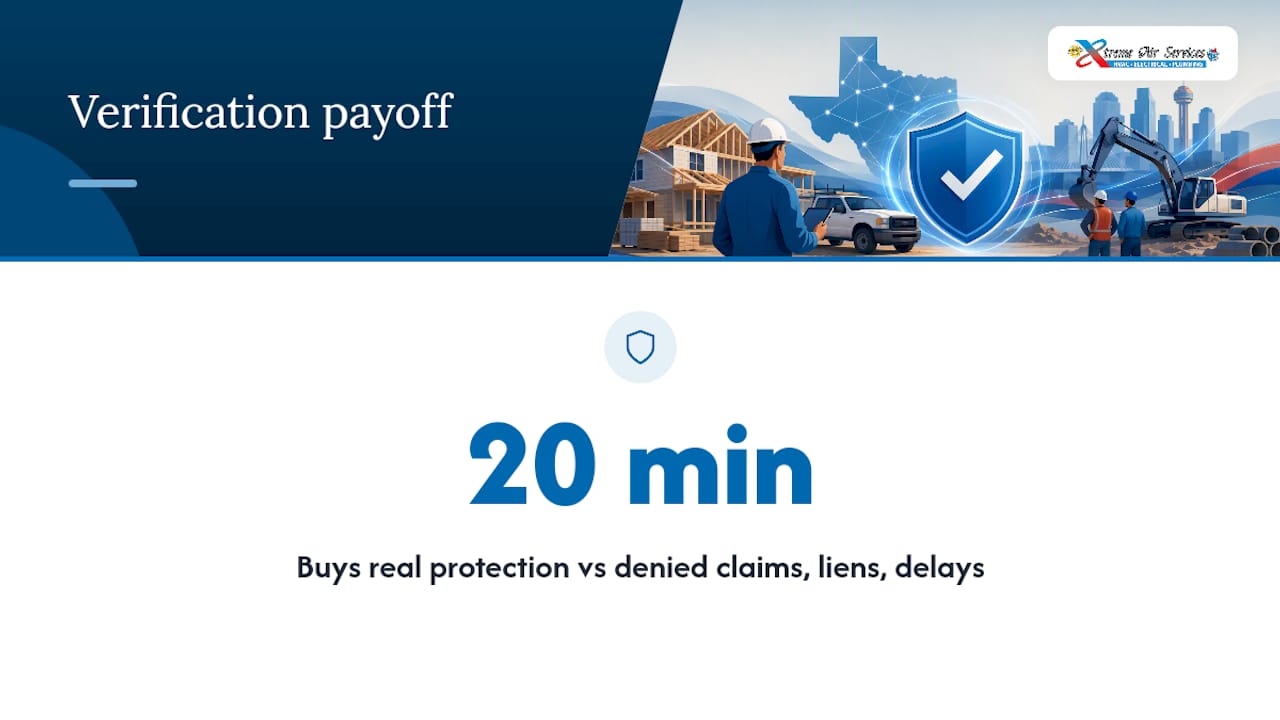
Skipping this process is how owners end up eating repair costs a contractor’s insurer should have covered. A denied claim, a mechanic’s lien, or a stalled project over missing paperwork almost always traces back to a COI nobody actually verified. The steps in this article take maybe twenty minutes per contractor, and that time buys you real protection instead of a false sense of it.
Some contractors follow a strict verification chain on projects and will produce a proof-of-insurance packet on request, before a contract is signed. This level of documentation is a best practice that contractors should be held to.
— Xtreme
Get a Proof-of-Insurance Packet Before You Sign
Most contractors will hand you a COI and hope you don’t ask follow-up questions. Xtreme Air Services does the opposite: request a proof-of-insurance packet before signing anything, and you’ll get the COI, the actual endorsement pages, and license verification, not just a one-page summary.

Xtreme Air Services handles residential HVAC repair, installation, and maintenance, electrical work, plumbing, and commercial systems across the Dallas, TX area, and every technician carries the licensing and coverage documentation permit offices and property owners actually ask for. If your project needs commercial electrical services or plumbing work that requires city-specific certificate wording, that paperwork is ready before the crew arrives. If you’re weighing a broader project, a resource like this drywall and painting prep guide is worth a look before scheduling multiple trades.
Contact Xtreme Air Services to request your proof-of-insurance packet, or visit the residential air conditioning and heating page to schedule a consultation before you sign a contract with any contractor.
Sources
- Apply for an Air Conditioning and Refrigeration Contractor License — TDLR
- TxDOT insurance requirements and Form 1560 — TxDOT
- TDI forms index and certificate guidance — TDI
FAQ
How Do I Check if a Contractor Is Licensed and Insured in Texas?
Search the contractor’s license number or business name on TDLR’s verification portal to confirm licensing, then request a COI along with the actual endorsement pages. Cross-check workers’ comp status through TDI/TXCOMP, since Texas doesn’t require private employers to carry it.
Is It Okay to Ask a Contractor for Proof of Insurance?
Yes, and it’s standard practice, not an insult. Any licensed contractor should produce a current COI and endorsement pages without hesitation; hesitation itself is a warning sign.
How Do I Verify That an Insurance Company Is Legitimate?
Cross-reference the insurer’s name on the COI against the NAIC’s company lookup or TDI’s list of carriers authorized in Texas. If the insurer doesn’t appear on either list, the policy likely isn’t valid here, regardless of how official the paperwork looks.
What Are Texas’s Requirements for Proof of Insurance?
Requirements vary by trade and project type. HVAC contractors under a Class A license need at least $300,000 per occurrence and $600,000 aggregate, while public projects often require TxDOT’s specific Form 1560 or 1560-CS in addition to a standard COI. Municipal permits frequently add their own certificate-holder naming requirements on top of state minimums.