


Furnace Replacement in Sunnyvale: Sized, Vented and Inspected Right the First Time
Furnace replacement sized from a heat-loss calculation instead of the old nameplate, including the venting, gas and condensate work a high-efficiency swap actually adds.
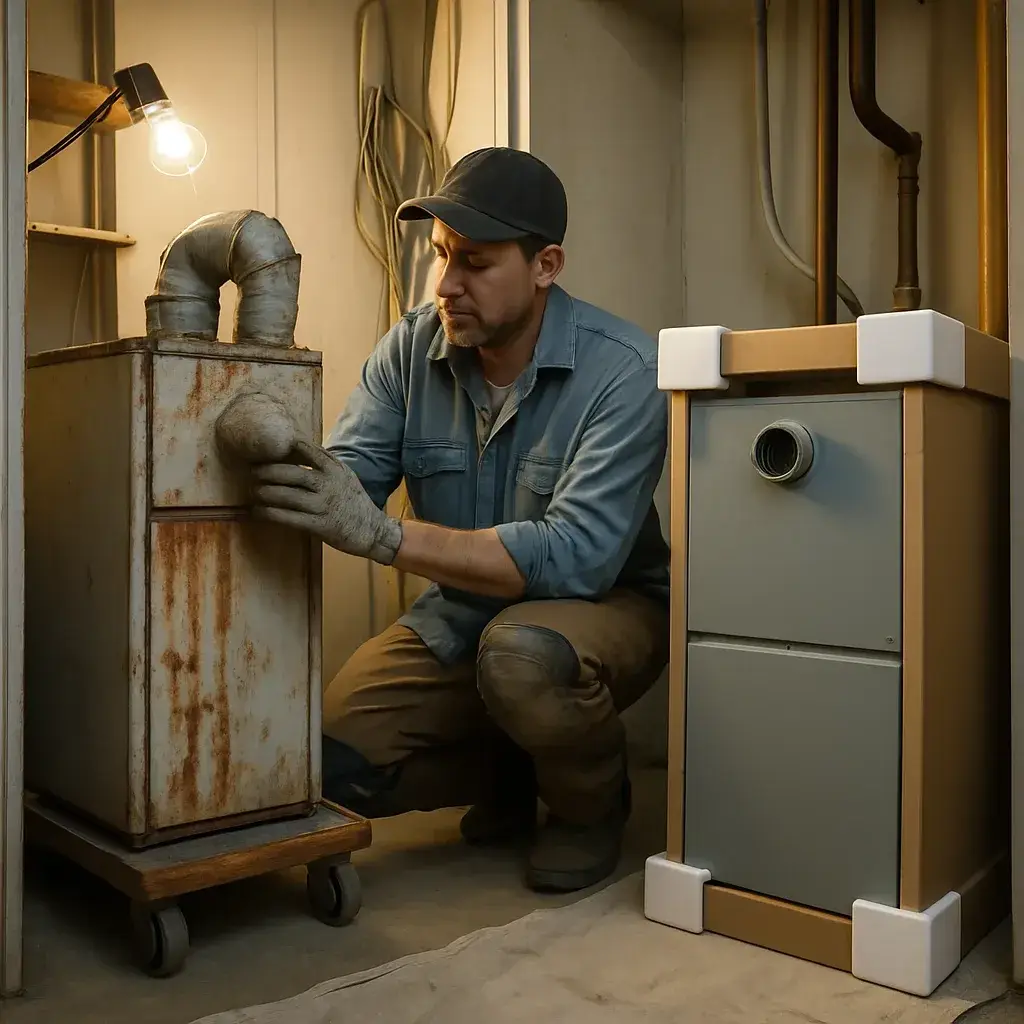
What’s Covered on This Page
- Size the Replacement From a Heat-Loss Calculation, Not the Old Nameplate
- A Condensing Furnace Cannot Reuse the Vent the Old One Used
- When a Shared Metal Vent Loses Its Furnace, the Water Heater Is Left Behind
- Gas Line, Condensate Drain, and Thermostat Wire Do Not Automatically Carry Over
- Permits, Inspection, and Why a Conversion Is Not a One-Day Job
- Will my existing thermostat work with a new two-stage furnace?
- Why does a high-efficiency furnace need two plastic pipes through my wall?
- I am replacing my furnace. Does that affect my gas water heater?
- Where does the water from a condensing furnace go, and can it freeze in my attic?
- Does a furnace replacement in Sunnyvale need a permit and an inspection?
Size the Replacement From a Heat-Loss Calculation, Not the Old Nameplate
The 100,000 BTU stamped on the side of your old furnace is how much gas it burns in an hour, not how much heat lands in your rooms. Delivered output is input multiplied by AFUE, so a 100,000 BTU per hour furnace at 80 percent AFUE puts roughly 80,000 BTU per hour into the house. Order that same 100,000 nameplate in a 96 percent AFUE model and you are now delivering about 96,000. Nothing about your house changed. You just bought a bigger furnace without meaning to.
ACCA Manual S caps the answer at both ends: a furnace’s output has to be larger than the Manual J design heating load, but no more than 40 percent larger. A 60,000 BTU per hour design load allows up to 84,000 BTU per hour of output and nothing above that. The load itself is calculated against the ASHRAE 99 percent winter design temperature, 22 degrees for Dallas County, with the tighter 99.6 percent value near 19. Output past that 140 percent line pushes the measured temperature rise toward the top of the nameplate band, and on ductwork that cannot move the extra air the high limit starts tripping. Ask for the design load, ask for the proposed output, and confirm the second lands inside 100 to 140 percent of the first.
- The Manual J design heating load for your house, stated in BTU per hour
- The outdoor design temperature the calculation used, 22 degrees for Dallas County
- The proposed furnace’s output BTU per hour, not just its input rating
- Confirmation that the output falls inside 100 to 140 percent of the design load
- The nameplate temperature rise range for the exact model being installed
- The temperature rise actually measured at startup, and the blower tap it was set on
A Condensing Furnace Cannot Reuse the Vent the Old One Used
The trade sorts gas furnaces into vent categories, and this swap crosses from one to another. Your old 80 percent unit is Category I: non-condensing, negative pressure, exhaust hot enough to climb a B-vent or masonry flue on its own. A condensing furnace above 90 percent AFUE is Category IV. Its second heat exchanger strips so much heat out of the exhaust that the gas falls below its own dew point and turns to liquid, and the induced draft blower pushes what is left out under positive pressure. That is why the vent can be plastic, and why the old flue is off the table.
Category IV also means sealed combustion. The furnace stops pulling burn air out of your attic or closet and draws it through a dedicated intake pipe from outside, which is the second pipe. Direct-vent terminations do not follow the general clearances written for chimneys and B-vents. They are governed by the appliance’s own listing and installation instructions together with the mechanical code your jurisdiction has adopted, and the listed termination kit sets minimum distances from windows, doors, air inlets, gas meters and finished grade. On a tight lot, that listing decides where the pipes come out.
DFW averages 2,218 heating degree days a year against Chicago’s 5,974. Moving from 80 to 96 AFUE cuts heating fuel use by roughly 17 percent, but here that 17 percent works on about a third of the heating demand a northern house carries. Buy a condensing furnace for two-stage or modulating operation, quieter running, and equipment availability. A fast fuel payback out of a Sunnyvale winter is not what you are buying.
The federal minimum for a non-weatherized residential gas furnace is 80 percent AFUE. That floor took effect in November 2015, replacing the 78 percent minimum that had stood since 1992, so an 80 percent replacement is still a legal, available choice. If venting a condensing unit is genuinely impractical at your house, with nowhere a termination can legally land, that is a conversation rather than a dead end. An all-electric system like a heat pump installation skips the flue question entirely and trades it for an electrical panel question.
- Two new pipe runs from the furnace out to an exterior wall or the roof
- A new penetration cut, flashed and sealed at the termination point
- A condensate drain, because the exhaust now leaves as liquid as well as gas
- Abandoning, capping, or resizing whatever the old furnace was venting into
- A combustion air path that no longer depends on your attic or closet
Need help with Furnace replacement?
Call Today, Get Service Today. Xtreme Air Services is ready to help.
Gas Line, Condensate Drain, and Thermostat Wire Do Not Automatically Carry Over
Gas demand is figured by dividing an appliance’s maximum input rating by the heating value of the gas, roughly 1,000 BTU per cubic foot for natural gas, which gives cubic feet per hour. Pipe is sized on the longest run from the meter to the farthest outlet, and the meter and regulator have to exceed the total input of every gas appliance in the house. Because a condensing furnace delivers the same heat on less input, demand normally drops on a replacement. It bites only when the new unit is sized larger, or when a range or pool heater got added after that piping was sized.
An 80 percent furnace produced no liquid at all, so there is no existing drain to reuse. A condensing unit sheds roughly 0.8 to 2 gallons per hour of firing, and the Department of Energy’s Building America guidance rates that water at pH 3 or lower. Federal pretreatment rules bar discharging anything below pH 5.0 into a public sewer unless that system is built to take it, and some jurisdictions want the condensate neutralized first. This is new plumbing that has to be trapped, routed, and terminated somewhere legal.
Most furnaces around Sunnyvale sit in unconditioned attic space, where a condensate line can freeze during a hard cold stretch, block, and shut the furnace down during the exact freeze you bought it for. Route the drain through conditioned space where the layout allows, insulate or heat-trace it where it does not, and put an inline condensate safety switch downstream. The mechanical code also wants auxiliary protection under an attic unit: a corrosion-resistant pan at least 1.5 inches deep and 3 inches larger than the furnace in both directions, or a water-level device that shuts the equipment off if the primary drain plugs. Condensate traps sludge up and need clearing periodically, since a plugged trap backs water up the same way a frozen line does.
A two-stage furnace needs a second-stage heat connection at the thermostat before it can use low fire at all, and most smart thermostats need a common wire for continuous 24-volt power. Twenty-year-old thermostat cable often carries neither. Miss it and you pay for a staging furnace that runs locked in high fire. Communicating equipment is stricter still: Trane ComfortLink and Carrier Infinity run a proprietary data bus that a generic thermostat cannot drive.
- Gas: total input of every appliance in the house, against meter and regulator capacity
- Gas: pipe sized on the longest run from the meter, not on the old furnace’s connection size
- Condensate: where the line terminates, whether it is trapped, and whether it crosses conditioned space
- Condensate: an inline safety switch plus an auxiliary pan or water-level shutoff on any attic unit
- Thermostat: conductor count in the existing cable, including a common wire and a second-stage wire
- Thermostat: whether the equipment is communicating and requires the manufacturer’s own control
Permits, Inspection, and Why a Conversion Is Not a One-Day Job
Texas licenses air conditioning and refrigeration contractors through the Texas Department of Licensing and Regulation under Occupations Code Chapter 1302, and every license number is searchable on TDLR’s public license lookup. Xtreme Air Services holds TACLA29023C. Look it up before anyone opens a gas line in your house, ours included. A full system replacement also normally needs a mechanical permit and final inspection from the jurisdiction your address falls in, and requirements, fees and local amendments vary city to city. Permits are not inside a standard quote unless we have written them in.
The inspector looks at four things: the vent material and where it terminates, the gas connections and sediment trap, how the condensate is disposed of, and whether the appliance has proper combustion air. Those are the same four items that go wrong on a rushed conversion. A permitted job means somebody with no stake in the invoice puts eyes on them. When a bid comes in noticeably cheap and skips the permit, that is usually what you are saving on.
A like-for-like furnace installation on the same footprint and connections genuinely does wrap in a day. A high-efficiency conversion is a different animal. Cutting and flashing a new vent termination, dropping a liner for an orphaned water heater, and running a new condensate line to a legal termination all take real hours, and an inspection has to be scheduled around them. We tell you which job you are looking at during the walkthrough. A diagnostic service call, meaning a technician out to look at the furnace, the flue and the drain path, runs $26 to $99 and is credited toward the work if you move forward with us.
ASHRAE puts the median service life of a gas furnace at 18 years, so the unit going into your attic this month is roughly an eighteen-year decision, and reaching that number depends on annual heating system maintenance as much as on the install. Register the warranty, too. Trane’s base coverage runs 5 years on parts and 20 years on the heat exchanger; registering within 60 days moves that to 10 years on parts, with lifetime heat exchanger coverage on select models. Sixty days is a hard deadline, and it covers parts, not labor.
- The permit number and the date the final inspection is scheduled
- Written confirmation that the manufacturer’s warranty registration was submitted
- Model and serial number of the installed furnace, matched against the quote
- The temperature rise measured at startup and the nameplate range it has to fall inside
- Where the condensate line terminates and where the safety switch sits
- A photo of the vent termination, so you know what it should look like when it is clear
Frequently Asked Questions
Common questions about Furnace replacement
Will my existing thermostat work with a new two-stage furnace?
Not always, and the wiring is usually why. A two-stage furnace needs a second-stage heat connection at the thermostat before it can use low fire, and most smart thermostats need a common wire for continuous 24-volt power. Twenty-year-old thermostat cable often carries neither, which leaves a staging furnace locked in high fire, heating the house the way the single-stage unit you replaced did. Trane ComfortLink and Carrier Infinity require the manufacturer’s own control. Conductor count gets checked on the walkthrough, before equipment is ordered.
Why does a high-efficiency furnace need two plastic pipes through my wall?
Because a condensing furnace vents differently than the unit you are replacing. It pulls so much heat out of the exhaust that the gas cools past its dew point, around 130 degrees, and turns to liquid, so it cannot rise up a chimney and has to be pushed out under pressure through PVC. The second pipe brings combustion air in from outdoors instead of from your attic or closet. Where both pipes can terminate is set by the appliance’s listing and your jurisdiction’s adopted mechanical code, so the vent path gets settled during the walkthrough.
I am replacing my furnace. Does that affect my gas water heater?
It can, though this comes up less often in North Texas than in older northern housing. Check where the two appliances sit. If your furnace and gas water heater share a closet or an attic platform, and their vent pipes meet at a wye before heading up one larger metal pipe through the roof, replacing that furnace with a high-efficiency model that vents in PVC leaves the tank alone in a vent sized for two. It then struggles to draft. The fix is resizing that vent for the water heater alone, and we check for it on the walkthrough.
Where does the water from a condensing furnace go, and can it freeze in my attic?
It goes down a brand-new condensate drain line, and yes, it can freeze if that line is routed badly. A condensing furnace sheds roughly 0.8 to 2 gallons per hour of firing, which your 80 percent furnace never produced at all. In an unconditioned Sunnyvale attic, a frozen line blocks, backs up, and shuts the furnace off during the exact cold snap you replaced it for. Route it through conditioned space where the layout allows, insulate it where it does not, and add an inline safety switch plus an auxiliary drain pan.
Does a furnace replacement in Sunnyvale need a permit and an inspection?
Generally yes. A full system replacement normally requires a mechanical permit and a final inspection from the city or county with jurisdiction over your address, and requirements, fees and local amendments vary between jurisdictions. The inspector checks vent material and termination, gas connections, condensate disposal, and combustion air, which is the only review of that work by somebody who did not install it. Texas licenses air conditioning and refrigeration contractors through TDLR, so you can verify any license number first. Xtreme Air Services holds TACLA29023C.
Ready to Get Started?
Call 972-288-2263 Today, Get Service Today.