


What Are the Most Common Generator Maintenance Problems and Fixes?
The problems we find most on Sunnyvale standby generators, why they happen, and what a routine visit actually checks.
What’s Covered on This Page
- Battery Failure Is the Most Common Reason a Generator Won’t Start
- Oil and Filter Breakdown Happens Even With Light Use
- Outdoor Enclosures Collect Debris and Can Attract Pests Over Time
- The Transfer Switch Is Tested Separately From the Engine Itself
- A Weekly Self-Test Confirms the Engine Starts, Not Full Readiness
- Ready to Schedule Generator Maintenance?
- What issues come up most often with generator maintenance?
- What should I expect during a routine maintenance visit?
- How do you handle it if a battery is weak but still working?
- Is there anything worth calling about between scheduled visits?
- Does routine maintenance prevent every generator problem?
- Do light-use generators need maintenance as often as ones that run a lot?
Battery Failure Is the Most Common Reason a Generator Won’t Start
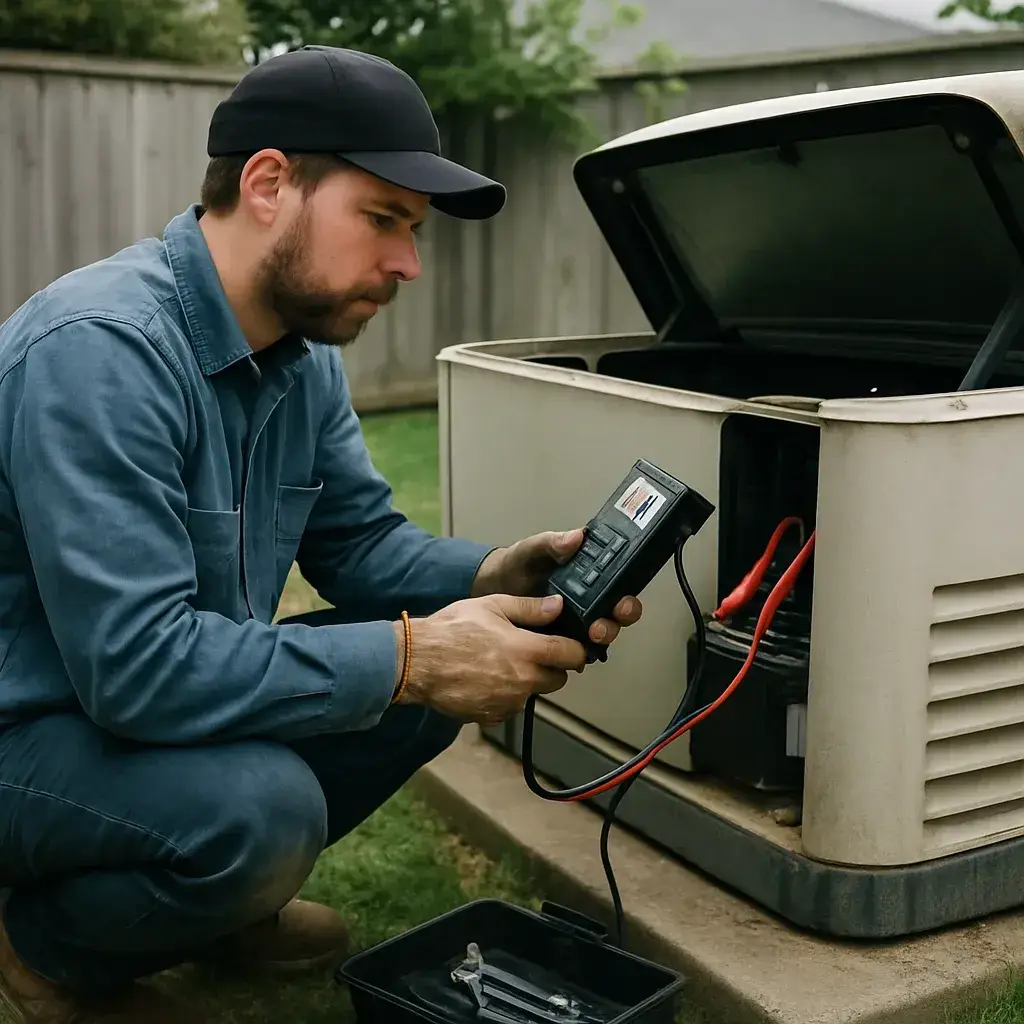
When a standby generator won’t crank during a storm, the battery is usually the first place we look. That’s the pattern we see across DFW, from Sunnyvale out to Rockwall and Forney. The generator sits quiet for weeks or months, and the small battery that starts it works against a slow drain even when the unit isn’t running.
Here’s why it happens. Standby generators keep a trickle charger on the battery so it’s ready when the power grid drops. Battery output fades with heat, and North Texas summers push outdoor equipment past what a battery is built to handle year after year. Add a battery that’s three or four years old, a loose terminal connection, or corrosion building on the posts, and you’ve got a generator that looks fine but won’t turn over when you need it.
Routine generator maintenance is built to catch that before it costs you power during an outage. During a maintenance visit, we test the battery’s actual output, not just whether it powers on, and check the connections and charging system that keep it topped off between uses. A battery that’s reading weak gets flagged so you can replace it on your schedule, not find out about it during a freeze or a hailstorm. Sunnyvale gets both, often in the same year.
What you’ll notice, if this is starting, isn’t dramatic. Sometimes the generator’s control panel shows a low-battery warning during its scheduled self-test. Sometimes there’s a slower-than-usual crank the last time it exercised itself. Most homeowners never see either sign because they’re not out at the pad checking the panel every week (and most people shouldn’t have to).
A battery has a lifespan, and no inspection extends it. What a maintenance visit does is tell you where that battery stands right now, so replacing it is a planned decision instead of a surprise during a power outage. If your battery is on the older end of its service life, we’ll say so plainly and let you decide the timing. We’re not going to talk you into replacing something that’s still testing fine. We say that plainly on every Sunnyvale visit.
Generator maintenance covers this battery and charging check as part of the broader inspection, along with the oil and filter service and a test of the transfer and start sequence. It’s routine, scheduled work, not a repair call, and it’s one of the more overlooked parts of owning a standby unit. If you already have a generator installed anywhere in the DFW Metroplex and haven’t had it serviced recently, this is one of the first things worth having checked. That goes for anywhere in Sunnyvale.
Oil and Filter Breakdown Happens Even With Light Use
You’d think a generator that barely runs would need less attention than one working overtime. That’s not really how it goes. Oil breaks down from time, not just from hours on the engine. Heat cycles, condensation inside the crankcase, and plain old sitting all wear on the oil even when your standby unit hasn’t fired since the last storm rolled through Sunnyvale or Rockwall.
What you’ll notice, if you go looking, is oil that’s darker than it should be or a little gritty on the dipstick, even on a generator with low total run hours. The air filter can look fine from a glance and still be doing a worse job than it appears, especially on units kept in a garage or near the driveway where dust and mower clippings drift in over months. Sunnyvale lots with mature trees see more of it.
An engine that starts cold, runs for a self-test, then shuts back down for weeks at a time is doing the kind of stop-and-start cycling that’s hard on oil chemistry. Moisture can build up. Acidity can climb. None of that shows up unless someone checks it. We check it on every Sunnyvale maintenance call.
During generator maintenance, we change the oil and filter as a standard part of the visit, along with a broader inspection and a test of the transfer and start sequence. We’re not guessing whether it needs it based on a runtime counter. Fresh oil at the interval that fits your unit and its manufacturer guidance protects the engine whether it’s run five hours this year or fifty. Same interval on a Sunnyvale unit either way.
Here’s the part people overthink: a generator overdue for oil and filter service often still starts up fine on a test cycle. The unit passing its self-test doesn’t tell you much about oil condition. It tells you the battery’s charged and the transfer switch is doing its job. Whether the oil is protecting the engine the way it should is a separate question, and you can’t answer it by watching the generator start. That surprises a lot of Sunnyvale owners.
If your generator sees light or occasional use, that’s a reason to keep the service interval rather than stretch it, not a reason to skip a visit because “it’s barely been used.” Cost and scheduling depend on the generator’s size, brand, and how it’s set up, and we walk through those specifics as part of our Generator Maintenance in Sunnyvale service. If you want a sense of what a routine visit runs, our Generator Maintenance Cost page breaks that down by job type.
Outdoor Enclosures Collect Debris and Can Attract Pests Over Time
Most standby generators sit outside on a concrete pad, tucked against the side of the house or garage. That’s the right place for them, but it’s also a spot that collects leaves, grass clippings, cottonwood fluff, and whatever the North Texas wind blows in during a storm. Over months of sitting outdoors, that debris settles around the cabinet louvers and can work its way into the enclosure itself. A generator that’s been sitting since last spring’s storm season often has a layer of buildup around the intake and exhaust vents that the owner never sees because the cabinet stays closed. Sunnyvale storm debris builds up faster than people expect.
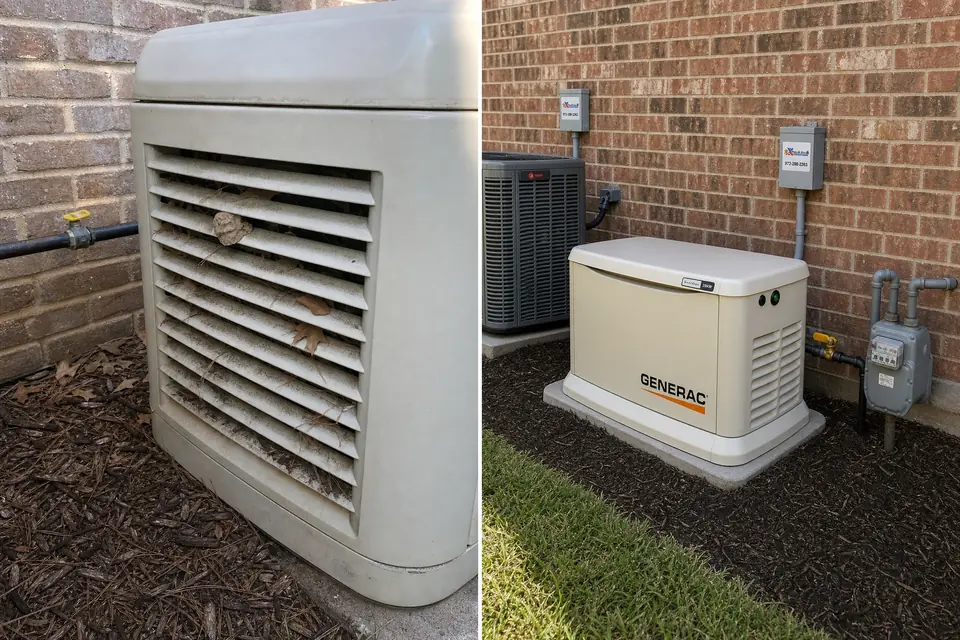
The enclosure’s louvered design that lets the engine breathe is the same design that gives small animals and insects an easy way in. Mice, wasps, and other pests look at a quiet, dry, metal box as a decent place to nest, especially in fall when they’re looking for shelter. We’ve opened enclosures on generators that hadn’t run in months and found wasp nests started in the corner of the housing, or rodent nesting material packed against the control panel wiring. None of that is a defect in the unit. It’s just what happens when a generator sits unused between storms, which for most homes is most of the year. Sunnyvale units sit idle through most of it.
This matters because the places pests and debris collect are often right where the generator needs to breathe or where sensitive wiring runs. A nest built too close to the control board or a vent packed with leaves can affect airflow or trip a fault code the next time the unit tries to start. We clear that on every Sunnyvale visit.
During a maintenance visit, we open the enclosure and look at what’s inside, not just what the outside of the cabinet looks like. That includes checking the intake and exhaust areas, looking for nesting material or insect activity, and clearing debris that’s built up around the housing and the pad underneath. It’s part of the same visit where we handle the oil and filter service and check the transfer and start sequence, so it doesn’t require a separate trip.
A little dust and a few leaves on the pad aren’t a problem. What we’re watching for is buildup dense enough to block airflow, or nesting advanced enough to touch wiring or moving parts. If we find something more involved, like chewed wiring or corrosion from nesting moisture, that’s a repair conversation, not a routine maintenance item, and we’ll walk you through what that looks like before we do anything. For a rough sense of what routine visits versus repair work run, our Generator Maintenance page breaks down what’s typically included.
Proudly serving Sunnyvale – reach out anytime.
Call Today, Get Service Today. Xtreme Air Services is ready to help.
The Transfer Switch Is Tested Separately From the Engine Itself
Your generator can start, run smooth, and hit full power on the pad, and still fail the one job you bought it for: getting power into your house. That job belongs to the transfer switch, and it’s a separate piece of equipment with its own moving parts, its own wiring, and its own failure points. During generator maintenance, we test the engine and we test the transfer switch as two different systems, because treating them as one is how a generator ends up looking fine in the driveway and doing nothing when the lights go out. That is the failure Sunnyvale owners notice first.
The engine’s job is simple: turn fuel into rotating power and spin an alternator. The transfer switch’s job is more delicate. It has to sense that utility power dropped, signal the generator to start, wait for it to reach stable voltage and frequency, then physically switch your home’s electrical load from the grid to the generator, all without ever connecting both sources at once. A transfer switch that fails closed on both sides at the same time is a real hazard, not just an inconvenience, which is part of why we don’t treat this as a quick glance-and-go step. Sunnyvale inspections expect the same rigor.
What we check: the switch’s contacts for pitting or heat discoloration, the control wiring and connections for looseness, the timing between utility-loss detection and generator start, and whether the switch completes a full transfer of the tested circuits under load. We run a real transfer test, not just a signal check, because a switch that clicks doesn’t always mean current is flowing where it should. Accessibility plays a role here too. Some transfer switches sit in a garage panel that’s easy to reach in ten minutes. Others are mounted behind other equipment or wired into a subpanel that takes real time to get to safely, and that difference in access is one of the things that affects how long a visit runs. Sunnyvale panel locations vary a lot by build era.
Transfer switches that sit unused for long stretches between actual power outages are more likely to show corrosion or a sluggish transfer than switches that get exercised regularly. A generator that runs its self-test weekly but never transfers real household load is still, in a real sense, untested. That’s the whole reason a maintenance visit checks this mechanically instead of trusting the display panel’s green light.
None of this replaces a full load test, which is a separate, more involved service we also offer for generators that need to prove themselves under real demand. Routine maintenance confirms the switch is mechanically sound and transferring correctly. It’s part of what’s included in a standard visit alongside the oil, filter, and start-sequence check, and it’s one of the reasons the visit takes the time it does rather than being a quick look under the hood. If you want the actual cost breakdown for this kind of visit, our Generator Maintenance Cost page lays out what’s included and what typically runs extra.
Watch Our Video
See How We Handle Generator Maintenance in Sunnyvale
Xtreme Air Services — Serving Sunnyvale and surrounding areas
A Weekly Self-Test Confirms the Engine Starts, Not Full Readiness
Most standby generators run a self-test every week. The engine turns over, runs for a few minutes, then shuts back off. That test tells you the battery has a charge and the engine will fire. It does not tell you the unit can carry your whole house through a real outage. A long Sunnyvale outage is the real test.
This is one of the most common things we hear from homeowners deciding whether to book generator maintenance. They watch that weekly cycle, hear the engine run, and figure the system is fine. We get why, the test looks thorough from the driveway. But a self-test runs the engine with almost no load on it. It doesn’t check the transfer switch under real power draw, and it doesn’t test whether the unit can hold voltage when your AC, well pump, and refrigerator all kick on at once. That is the Sunnyvale August scenario.
The gap shows up because a generator’s engine and its ability to carry a load are two different things. An engine can start and idle fine for years while the fuel line has a small blockage, the air filter is clogged, or the transfer switch has a wear point that only shows itself under a real transfer. None of that stops the weekly self-test from passing. It only shows up when the unit has to do the job it’s there for, during an actual grid outage, in the middle of a storm. Sunnyvale storm season finds it every time.
What we do differently is run a basic load check during a maintenance visit. We put the generator under a simulated load and watch how it holds voltage and frequency, not just whether the engine turns over. We also change the oil and filters, test the transfer and start sequence under that load, and check the fuel supply and connections while we’re there. That combination is what confirms readiness. A self-test alone can’t do it, and no owner’s manual expects it to.
If your unit passes its weekly test every week, that’s a fine sign, but it’s not the same as knowing the unit is ready for a multi-day outage. We’d rather tell you that now than have you find out during one. Generator size, hours of runtime, and how the unit is set up all affect how it performs under real load, and those are things a self-test simply isn’t built to catch.
For homeowners in the Sunnyvale and greater Dallas-Fort Worth area trying to decide how much stock to put in that weekly beep and cycle, this is the plain limit of what it tells you. If you want to know more about what our maintenance visits check and how often we recommend them, our Generator Maintenance page lays out the full visit. A weekly self-test is a good habit to keep. It’s just not the whole picture.
Ready to Schedule Generator Maintenance?
Contact Xtreme Air Services to schedule a generator maintenance visit for your home. Serving Sunnyvale and the surrounding communities.
See our full generator maintenance service in Sunnyvale for what the complete job involves.
Frequently Asked Questions
Common questions about Generator Maintenance in Sunnyvale
What issues come up most often with generator maintenance?
The three things we see most are weak batteries, oil that has broken down from sitting, and debris or pests collecting in the outdoor enclosure. None of these show up as an obvious failure. A generator can pass its self-test and still have a battery on its way out or oil that no longer protects the engine. That’s why a routine visit checks battery output, oil condition, and the enclosure itself, not just whether the unit starts.
What should I expect during a routine maintenance visit?
We inspect the unit, change the oil and filter, test the battery and charging system, and run the transfer and start sequence. This is the same routine visit whether your generator has run once this year or many times. If anything needs a repair or a part replaced, we quote that separately rather than bundling it into the maintenance visit. Our Generator Maintenance Cost page breaks down what a routine visit covers in more detail.
How do you handle it if a battery is weak but still working?
We test the actual output and tell you where it stands, even if it’s still passing a start test. A weak battery gets flagged so you can plan the replacement on your own schedule instead of during an outage. We won’t push you to replace a battery that’s still testing within range. The point of the check is information, not an upsell.
Is there anything worth calling about between scheduled visits?
A low-battery warning on the control panel or a noticeably slower crank during a self-test are worth a call. Most other wear, like oil darkening slightly or dust around the enclosure vents, is expected and gets handled at the next scheduled visit. If you’re ever unsure whether something you’re seeing is normal, it’s reasonable to ask before waiting for the next appointment.
Does routine maintenance prevent every generator problem?
No inspection extends the life of a battery or stops normal wear on oil over time. What maintenance does is catch where things stand before they turn into a no-start during an outage. A battery near the end of its service life will still need replacing eventually, storms or debris can still collect between visits, and regular service lowers the odds of a surprise without removing them completely.
Do light-use generators need maintenance as often as ones that run a lot?
Yes. Oil breaks down from time and temperature swings, not just from run hours, so a generator that barely runs still needs the same service interval. Stretching out visits because a unit looks unused is one of the more common assumptions we see, and it’s not backed by how the engine wears. The interval is based on the manufacturer’s guidance for the unit, not how often it’s been called on.
Ready to Get Started?
Call 972-288-2263 Today, Get Service Today.