
If you’ve been putting off the heat pump conversation, you’re not alone. Maybe you’re not sure they actually work in colder climates, or the cost feels unclear.
A heat pump explained properly changes everything. In 2024, heat pump sales topped gas furnaces in the U.S. for the first time ever, with over 5 million units sold.
That’s not a trend. That’s a fundamental shift in how Americans heat and cool their homes. This guide breaks down how heat pumps work, what they cost, the real benefits, and what installation looks like so you can make a confident decision.
Table of Contents
- Key takeaways
- How heat pumps work
- The real benefits of heat pumps
- Types of heat pump systems
- Heat pump installation: costs, timeline, and what to expect
- My take on heat pumps after years in the field
- Ready to move forward with a heat pump in Dallas?
- FAQ
Key takeaways
| Point | Details |
|---|---|
| Heat moves, not heat generated | As this heat pump explained guide covers, heat pumps transfer heat rather than burn fuel, making them 2 to 4 times more efficient than gas furnaces. |
| Cold climates are not a barrier | Modern cold-climate heat pumps operate effectively down to -25°F, covering nearly every U.S. home. |
| Real cost savings add up | Homeowners replacing propane or electric heating can save up to $1,500 per year on energy bills. |
| Sizing makes or breaks performance | An oversized heat pump short-cycles and loses efficiency fast. Professional sizing is non-negotiable. |
| Plan ahead for installation | Supply chain delays and installer backlogs in 2026 mean waiting months if you don’t schedule early. |
How heat pumps work: heat pump explained
A heat pump works by moving heat that already exists rather than burning fuel to create it. The simplest way to picture this is your refrigerator.
Your fridge pulls heat out of the interior compartment and releases it out the back, keeping your food cold. A heat pump does the same thing. In winter it moves heat into your home, and in summer it moves heat out.
It doesn’t generate heat by burning something. It moves heat that already exists in the outdoor air or ground.
The process runs on a refrigeration cycle with four stages:
- Evaporation. Refrigerant flows through an outdoor coil and absorbs heat from the outside air, even when that air feels cold to you. It evaporates into a gas.
- Compression. The gas is compressed, which raises its temperature significantly.
- Condensation. The hot, pressurized gas flows into an indoor coil and releases that heat into your home. The gas condenses back into liquid.
- Expansion. The liquid refrigerant passes through an expansion valve, drops in pressure and temperature, and the cycle starts again.
In summer, the cycle simply reverses. The system pulls heat out of your indoor air and releases it outside, functioning like a central air conditioner. One system handles both heating and cooling, which is part of why the economics work so well.
Two refrigerants you’ll hear about are R-410A and the newer low global warming potential option R-32. R-32 improves system performance while reducing environmental impact compared to older refrigerants, so it’s worth asking your installer which refrigerant the system uses.
The efficiency of a heat pump is measured by its Coefficient of Performance, or COP. A COP of 3 means the system delivers 3 units of heat energy for every 1 unit of electrical energy it uses. For comparison, the best gas furnace tops out at a COP of about 0.98.
Seasonal Performance Factor, or SPF, measures that average efficiency across an entire heating season rather than a single moment. That gives you a more realistic picture of real-world savings.
Pro Tip: Ask your installer for the SPF rating of the system they recommend, not just the peak COP. Peak COP figures look impressive on spec sheets but SPF tells you what your bills will actually look like.
The real benefits of heat pumps
Heat pumps offer more than efficiency. The efficiency advantage is the headline, but it’s not the only reason they are gaining ground fast. Here’s what actually matters to homeowners and facility managers:
- Lower energy bills. Homeowners switching from propane or electric resistance heating can save up to $1,500 annually depending on local energy rates and climate.
- Carbon emission reduction. Heat pump upgrades cut household emissions by 40 to 70% compared to gas heating, and that percentage improves as the electrical grid gets cleaner.
- Better comfort. Heat pumps avoid temperature swings by running at a low, continuous rate rather than blasting on and shutting off like a gas furnace. The result is steadier temperatures and better humidity management throughout your home.
- Safety. No combustion means no risk of carbon monoxide or gas leaks. For families with children or for older homes with aging gas lines, this matters.
- Fuel price protection. Electricity rates are more stable than natural gas and propane prices, which can swing dramatically based on global supply. Heat pumps reduce exposure to fuel price volatility that catches homeowners off guard every winter.
Now, let’s deal directly with the cold weather myth. Many homeowners still believe heat pumps stop working when temperatures drop below freezing. That was true of older equipment.
Today’s cold-climate models maintain full heating capacity down to -15°F and continue operating at reduced capacity down to -25°F. That covers essentially every American climate.
In fact, 99% of U.S. homes never see winter temperatures below -15°F. If you live in Minnesota, Montana, or upstate New York, there are systems built for you.
For homeowners interested in the broader picture of going green at home, heat pumps are typically one of the highest-impact upgrades you can make to reduce your property’s carbon footprint alongside insulation and solar.
Financial incentives make 2026 a strong year to act. Quebec’s government committed $350M to heat pump subsidies, with households saving an average of $250 per year on electricity. Federal and state-level programs in the U.S. offer significant rebates as well. Check what’s available in your area before you buy.
Types of heat pump systems
Understanding the different types of heat pump systems helps you match the right technology to your property. The wrong fit wastes money up front and underperforms for years.
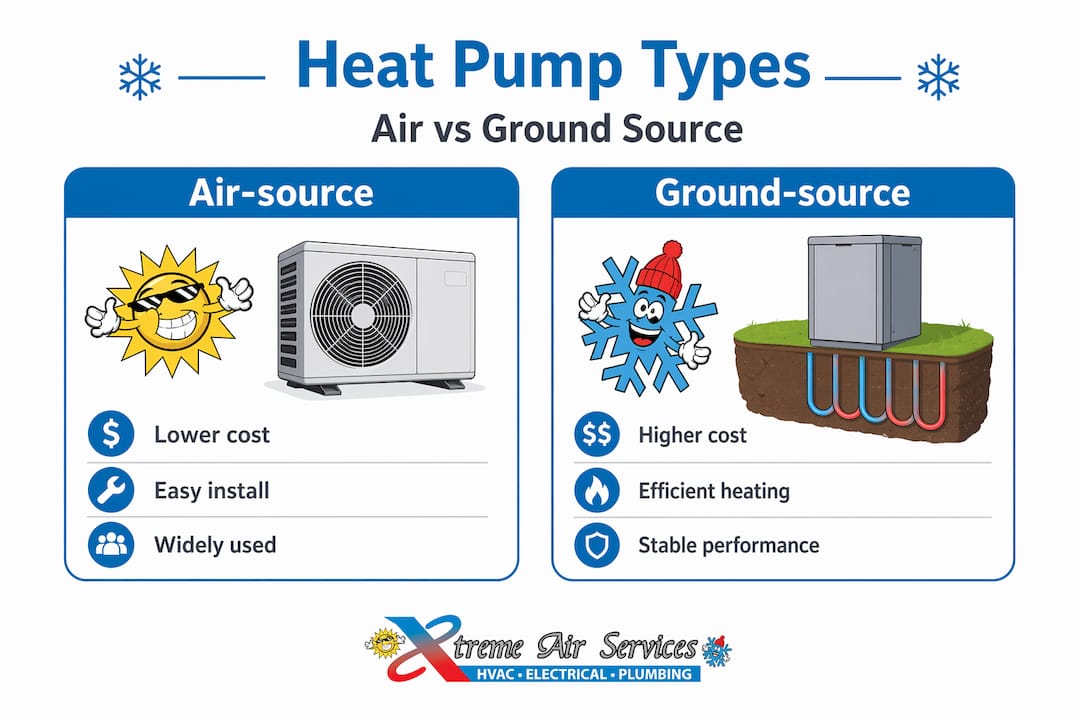
Air-source vs. ground-source
Air-source heat pumps pull heat from outdoor air. They’re the most common type, the most affordable to install, and they work well in the vast majority of U.S. climates.
Ground-source heat pumps, often called geothermal systems, pull heat from underground where temperatures stay stable year-round. They’re more efficient in extreme climates and cost less to operate long-term. However, installation costs two to four times more because of the ground loop excavation or drilling required.
| Feature | Air-source | Ground-source |
|---|---|---|
| Installation cost | $4,000 to $12,000 | $15,000 to $30,000+ |
| Efficiency | High, COP 2 to 4 | Very high, COP 3 to 6 |
| Space required | Minimal outdoor unit | Significant yard or drilling area |
| Best for | Most residential homes | Large properties, extreme climates |
| Maintenance | Moderate | Low once installed |
Ducted vs. ductless systems
Ducted and ductless systems differ mainly in how they distribute conditioned air. If your home already has ductwork, a ducted air-source heat pump connects directly to your existing system and conditions the entire home.
Ductless mini-split systems mount on the wall and condition individual rooms or zones. Mini-splits work extremely well in homes without ducts, additions, garages, or older homes where installing ductwork would be cost-prohibitive.
Cold-climate features worth knowing
Variable-speed compressors and vapor injection technology are the two features that separate modern cold-climate heat pumps from standard models.
Variable-speed compressors modulate output to match the actual heating load rather than running at full blast and shutting off. Vapor injection, sometimes called flash injection, boosts heating capacity at low temperatures by injecting additional refrigerant into the compression cycle. Both features improve comfort and efficiency in climates where winters are genuinely cold.
Pro Tip: For homes under 1,500 square feet or those with variable room usage patterns, a multi-zone mini-split setup often costs less to operate than a single ducted system because you only condition the spaces you actually use.
Sizing deserves its own conversation. Oversizing a heat pump causes short cycling, where the system turns on and off repeatedly instead of running long, steady cycles. Short cycling drives down the COP, accelerates wear on the compressor, and can cut system lifespan significantly.
A buffer tank can help in smaller homes or where the heating load doesn’t perfectly match the system’s output. The fix is getting the sizing right from the start through a proper Manual J load calculation performed by a qualified installer.
Heat pump installation: costs, timeline, and what to expect
Installation is where many homeowners feel the most uncertainty, so here’s a realistic breakdown of what the process involves.
Typical installation steps:
- A qualified technician performs a Manual J load calculation to determine the correct system size for your home’s heat loss and heat gain.
- They assess your existing electrical panel. Most heat pumps require a 240-volt circuit, and older panels may need an upgrade.
- Ductwork is inspected and sealed if a ducted system is being installed. Leaky ducts can reduce system performance by 20 to 30%.
- The outdoor unit is mounted on a pad or wall bracket, and the indoor air handler or coils are connected.
- Refrigerant lines are connected, the system is charged, and startup testing is completed.
- You receive a walkthrough on thermostat settings, filter maintenance, and the basic seasonal care schedule.
Cost ranges at a glance:
| System type | Installed cost estimate | Notes |
|---|---|---|
| Air-source ducted | $5,000 to $12,000 | Varies by home size and panel work needed |
| Ductless mini-split (single zone) | $3,000 to $6,000 | Lower cost for targeted conditioning |
| Ductless mini-split (multi-zone) | $8,000 to $18,000 | Depends on number of indoor units |
| Ground-source | $18,000 to $35,000 | Includes ground loop installation |
These ranges reflect 2026 pricing and can vary based on your region, home size, existing infrastructure, and the contractor you hire.
Federal tax credits under the Inflation Reduction Act cover 30% of installation costs up to $2,000, and many states stack additional rebates on top.
One thing that catches homeowners off guard is the timeline. In high-demand periods, supply chain disruptions and installer backlogs can push wait times to several weeks or even a few months for equipment and a scheduled installation date.
If your current heating system is aging, don’t wait until it fails. Schedule a consultation now so you’re not making a rushed decision in February when your furnace quits.
Pro Tip: Request references from your installer for heat pump projects specifically, not just general HVAC work. Heat pump sizing and commissioning require different expertise than replacing a furnace, and the difference in quality shows up in your monthly bills.
Basic maintenance keeps a heat pump running efficiently for 15 to 20 years. Routine care includes:
- Replacing air filters every one to three months.
- Keeping the outdoor unit clear of debris and ice buildup.
- Scheduling a professional tune-up annually.
Ground-source systems have fewer moving parts exposed to the elements and generally need less frequent service.
My take on heat pumps after years in the field
I’ve seen the full range of heat pump installations. Some transformed energy bills and comfort levels overnight. Others underperformed because the sizing was wrong or the homeowner didn’t get proper guidance on how the system operates.
The technology itself is not the variable. The execution is.
What I’ve found is that homeowners who do their homework, ask the right questions, and work with a qualified installer consistently get the results that drove them to choose a heat pump in the first place. Those who pick the lowest bid and skip the load calculation often end up frustrated and blaming the technology.
The cold-climate hesitation still surprises me. I talk to people every week who genuinely believe heat pumps are a warm-climate luxury. Modern equipment has made that concern obsolete, and the data backs it up.
The bigger risk in 2026 isn’t buying a heat pump that can’t handle the cold. It’s buying one that’s oversized or improperly installed.
What I think people overlook most is the transition period. Switching from a gas furnace to a heat pump is not just a hardware swap. You may need electrical panel work, possibly some ductwork attention, and definitely a new thermostat strategy. Planning for those supporting changes before the install date saves both money and stress.
Heat pumps are not a future technology. They’re the present standard in most of Europe, and the U.S. market is catching up fast. If you’re managing a property and haven’t factored heat pumps into your next capital planning cycle, I’d seriously reconsider that timeline.
— Xtreme
Ready to move forward with a heat pump in Dallas?
If you’re in the Dallas, Plano, Irving, or Sunnyvale area and you’re seriously considering a heat pump, the most important step is a proper consultation with someone who does this work every day.
Xtreme Air Services installs, repairs, and maintains heat pump systems for both residential and commercial properties across the Dallas metro area. We’re happy to give you a heat pump explained in plain terms before you commit.
Our team performs full load calculations, handles electrical panel assessments, and walks you through every option before you spend a dollar. We’ve helped homeowners switch from aging gas systems and facility managers upgrade entire commercial HVAC configurations.
When you’re ready to get an accurate quote or just want honest answers about whether a heat pump fits your property, contact our HVAC team and we’ll make it straightforward.
FAQ
What exactly is a heat pump?
A heat pump is a heating and cooling system that moves heat rather than generates it by burning fuel. It uses a refrigeration cycle to transfer heat from outdoor air or the ground into your home in winter, then reverses to remove heat in summer.
Do heat pumps work in cold weather?
Yes. Modern cold-climate heat pumps maintain heating capacity down to -15°F and continue operating at reduced output down to -25°F, which covers the winter temperatures experienced by 99% of U.S. homes.
How much does heat pump installation cost?
Installed costs range from about $3,000 for a single-zone ductless mini-split to $35,000 or more for a ground-source system. Federal tax credits cover 30% of costs up to $2,000, and state rebates can reduce the net cost further.
How efficient is a heat pump compared to a gas furnace?
Heat pumps deliver 2 to 4 units of heat energy for every unit of electricity used, measured as a COP of 2 to 4. The best gas furnaces operate at a COP below 1, making heat pumps significantly more efficient in most operating conditions.
How long does a heat pump last?
With proper installation and annual maintenance, a heat pump typically lasts 15 to 20 years. Proper sizing is the biggest factor in longevity. An oversized system that short-cycles can fail years ahead of a correctly sized unit.