


What to Expect During HVAC System Maintenance
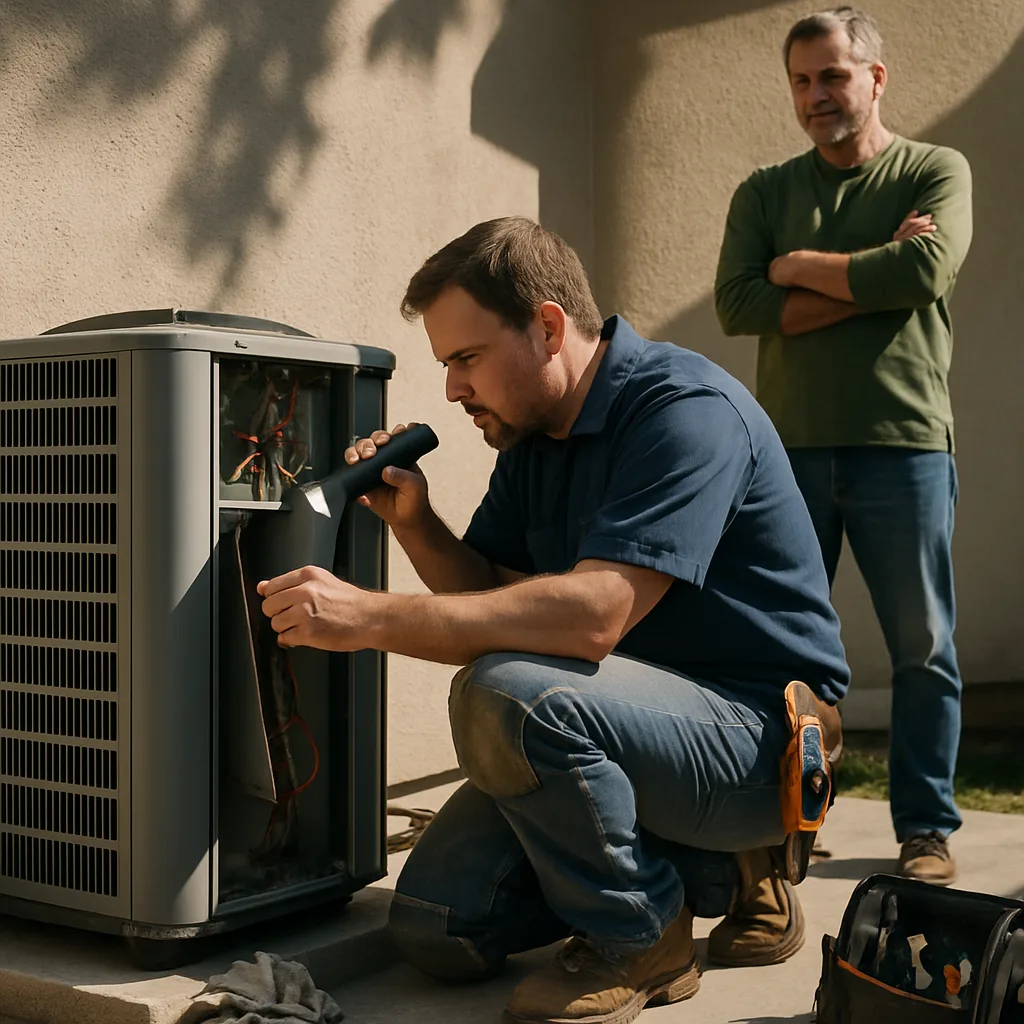
What a routine maintenance visit covers and what we find most often – clogged filters, a refrigerant charge that points to a leak, capacitors and contactors worn with age, and condensate drains that clog in cooling season.
What’s Covered on This Page
- What a Routine HVAC Maintenance Visit Covers
- Dirty or Clogged Air Filters Are the Most Common Finding
- Refrigerant Charge Questions Usually Point to a Leak, Not Normal Use
- Electrical Components Like Capacitors and Contactors Wear With Age
- Condensate Drain Lines Commonly Clog During Cooling Season
- Related Links
What a Routine HVAC Maintenance Visit Covers
A licensed, insured technician comes to your home. We look over the system. Then we walk you through what we find in plain English. No jargon, no guessing games here. The visit covers three things: the inspection, the cleaning, and a check of how the system runs (and if it’s safe).
- A full inspection of the system
- Cleaning of the key components
- A performance and safety check
- A look at your filter as part of the visit
Here’s the part people don’t always expect. If we find something during the inspection – a worn part, a failing component – that repair isn’t part of the maintenance visit itself. It gets quoted separately. You decide before we touch anything. You can see how those repair quotes typically break down on our service page.
How long a visit takes depends on a few things. A home with one system and easy attic access is a shorter visit. A home with two systems or a unit that’s been neglected a while will take longer. Some homeowners book a single visit. Others set up a preventative maintenance plan. That way, the same checks happen on a schedule instead of a one-off.
Dirty or Clogged Air Filters Are the Most Common Finding
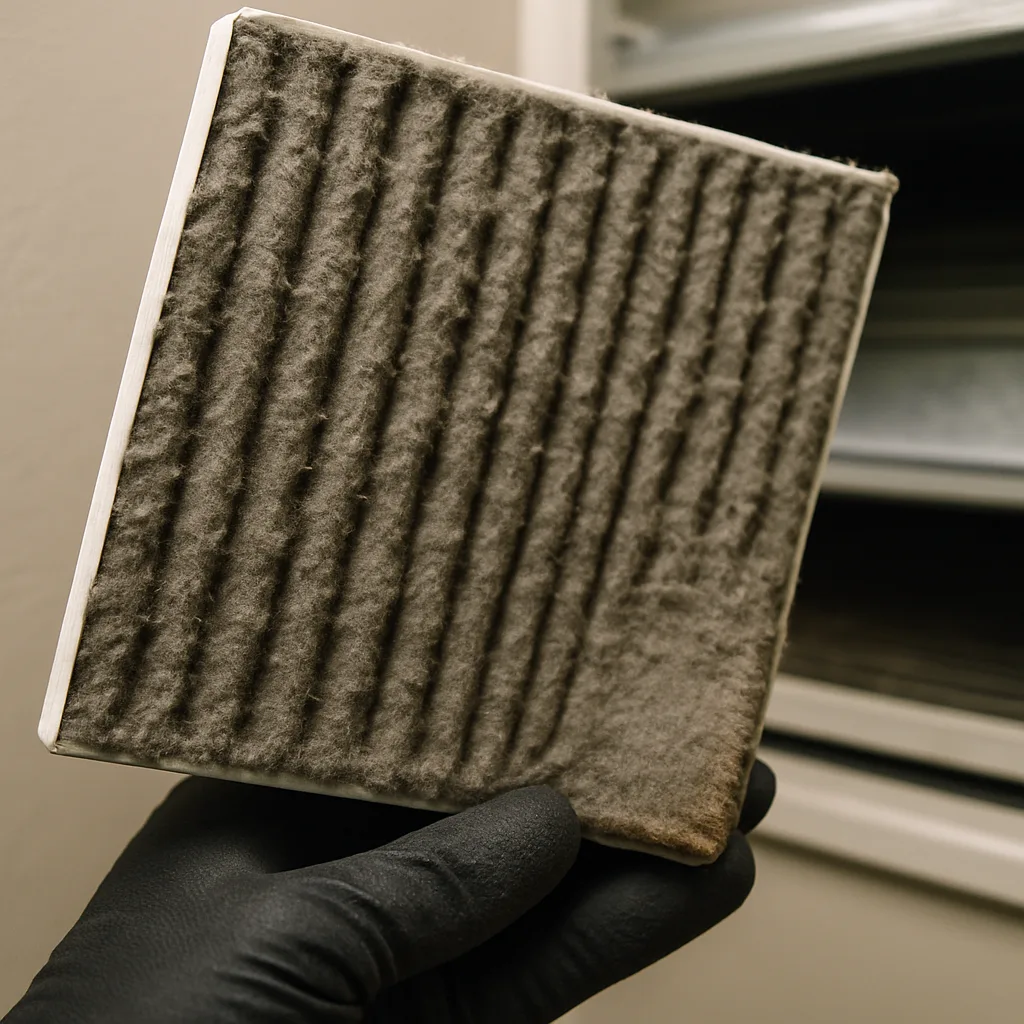
A clogged air filter shows up more than anything else we find during a routine visit. It’s the first thing a technician checks. In a lot of homes, it’s already restricting airflow before anyone even notices a problem. You might not see a symptom at all yet. The system just quietly works harder than it should.
North Texas dust is a big part of why this happens so often. Between construction dust in newer subdivisions, pollen seasons, and pet hair, a standard filter can load up faster than its printed replacement schedule. Attic-installed systems, common here, pull air through a hot, dusty space. This adds to the buildup on the filter media.
A filter that looks fine from a few feet away can still be plugged solid. Hold it up to the light to see for yourself. That’s why we check it by hand instead of by the calendar. A filter loaded with dust forces the blower to pull harder. That extra strain shows up later as higher energy use or shorter equipment life. It won’t cause a dramatic failure right away.
Here’s the part that’s not one-size-fits-all: swapping in a thicker, higher-rated filter isn’t automatically an upgrade. Some systems aren’t built to pull air through a dense filter. Forcing one in can restrict airflow worse than a dirty standard filter. What filter type and thickness make sense depends on the equipment. That’s a call we make during the visit, not something we’d tell you to guess at from a store aisle.
During a routine visit, we inspect the filter. We check airflow. We handle air filter replacement when it’s needed as part of that visit. You can see everything else a routine check covers on our maintenance page. This helps keep a system running the way it’s supposed to.
A dirty filter by itself is one of the more affordable things to find during a visit. It’s also one of the easiest problems to prevent from becoming something bigger. That’s a fair chunk of what a maintenance visit is for in the first place.
Refrigerant Charge Questions Usually Point to a Leak, Not Normal Use
A sealed refrigerant system doesn’t use up refrigerant like a car uses gas. If a technician checks your levels during a tune-up and finds them low, that’s not normal wear. It almost always points to a leak somewhere in the coils, line set, or a connection.
Homeowners usually notice the signs before anyone mentions the word refrigerant. Warm air blowing when the thermostat says it should be cold. Ice building up on the copper line outside or on the indoor coil. Or a system that runs longer than it used to. It might not seem to keep up with a hot North Texas afternoon.
Leaks tend to show up at the same few spots. Coils corrode from the inside out over years, especially on older units. Factory-brazed joints and flare fittings can loosen or corrode where two pieces of copper meet. Attic-mounted systems, common across a lot of Sunnyvale and DFW homes built in the last couple decades, take a beating from attic temperature swings. This can stress those joints faster than a system in conditioned space.
During a maintenance visit, we check refrigerant pressures against the system’s specs. This is part of the inspection. If the numbers are off, we look for where it’s escaping. We don’t just add refrigerant and send you on your way. Topping off a system with an active leak is a short-term patch. The level drops again, and you’re back to the same symptoms in a matter of months.
Here’s the part some homeowners don’t expect: a small, slow leak can sometimes take a repeat visit or two to pin down. This is especially true if it’s intermittent or hidden inside a coil. That’s the plain shape of how refrigerant diagnostics work. We’d rather tell you that upfront than pretend every leak shows up on the first pass.
Refrigerant type also matters. Older systems often use R-22. It has been phased out and costs more where it’s still available. If your system runs on it, a leak repair conversation sometimes turns into a bigger decision. It’s about the system’s age and what it would cost to keep feeding it a refrigerant that’s getting harder to source.
Refrigerant leak repair is priced separately from the maintenance visit itself. It’s corrective work, not routine inspection. You can see how that’s structured on our pricing page.
Ready when you are – get in touch today.
Call Today, Get Service Today. Xtreme Air Services is ready to help.
Electrical Components Like Capacitors and Contactors Wear With Age
A capacitor gives the compressor and fan motor the jolt they need to start. A contactor is the switch that lets power flow to the outdoor unit. Both are small parts, and both wear out with time. You’ll usually notice it as a system that hums but won’t kick on. The outdoor unit might start slow. Or you might hear a faint clicking sound at the outdoor unit that wasn’t there before.
Heat is the main reason these parts age this way. North Texas summers push outdoor units through long stretches of high heat and constant on-off cycling. This kind of heat and electrical load shortens the life of a capacitor. A contactor takes a small arc of electricity every time it closes. Over thousands of cycles, that arcing pits the metal contacts. Then they don’t make a clean connection anymore.
During a maintenance visit, we test the capacitor against its rated microfarad value. We don’t just look at it. A capacitor can look fine and still read well outside its rated range. That’s something you can’t catch by eye. We also check the contactor’s contacts for pitting or burning. We confirm it’s closing and releasing the way it should.
Here’s the part we won’t dress up: neither part has a fixed lifespan we can promise you. Some capacitors last years past when you’d expect. Some don’t. What we can tell you is this: a capacitor or contactor found weak during a maintenance check is a part we can usually address on the spot. It’s better than it turning into a no-cool call in August.
This is one of the reasons routine maintenance holds real value beyond a filter change. Our visits include this kind of electrical check as part of the full inspection. It’s not an add-on we tack on later.
If a capacitor or contactor does need replacing, that’s a repair quoted separately from the visit itself. You can see typical ranges for that kind of work on our pricing page before you ever schedule anything.
Condensate Drain Lines Commonly Clog During Cooling Season
A clogged condensate drain line is one of the most common things we find during a cooling season checkup. You’ll usually notice it as water around the indoor unit. Maybe a musty smell near a vent. Or a system that shuts itself off even though it’s still hot outside. Most newer AC units have a safety switch. It kills the system the moment the drain pan fills. So a sudden no-cool call in the middle of summer is often this, not a failed compressor.
The line clogs because of what it’s built to do. Your system pulls humidity out of the air. That water drips through a small PVC line, usually about 3/4 inch wide, on its way outside. Algae and mold grow easily in that damp, dark environment. This is especially true with how much moisture North Texas summers push through a system running eight or more hours a day. Add in dust and a little construction debris from the attic, common in Sunnyvale’s mix of older slab homes and newer subdivisions. That narrow line can slow to a trickle.
Homes with attic-mounted air handlers see this more often. That’s because the drain line runs farther and gathers more debris. We check the primary and secondary drain lines during maintenance visits. We also check the pan and the safety switch. We clear buildup before it backs up into your ceiling or shuts the system down on a 100-degree afternoon.
One thing worth saying plainly: clearing the line during a visit doesn’t mean it can’t build up again before your next appointment. Algae growth speeds up with heavy humidity and heavy runtime. So a system working overtime in August can develop new buildup faster than one running in milder weather. That’s part of why the checkup is seasonal, not a one-time fix.
This inspection is part of what’s covered in a standard system checkup, not a separate repair. Any additional work found during the visit – like replacing a cracked drain pan or a failed float switch – gets quoted separately before we touch it.
Ready to Get Started?
Call 972-288-2263 Today, Get Service Today.