

What Are the Most Common HVAC System Repair Problems We See Called In For?
Refrigerant leaks behind reduced cooling, summer capacitor and electrical failures, dirty versus frozen coils and how to tell them apart, and the flame sensor or ignitor behind most furnace ignition faults.
What’s Covered on This Page
- The HVAC Problems Homeowners Ask About Most Often
- Refrigerant Leaks Are a Common Cause of Reduced Cooling
- Capacitor and Electrical Component Failures Show Up Often in Summer
- Dirty or Frozen Coils Can Look Alike but Have Different Causes
- Furnace Ignition Issues Are Usually a Flame Sensor or Ignitor
- Related Links
The HVAC Problems Homeowners Ask About Most Often
Warm air blowing out of the vents is the one we hear about most in a Sunnyvale summer. Sometimes it’s a refrigerant issue. Sometimes it’s a failed capacitor, or a dirty condenser coil that can’t shed heat fast enough. Attic heat here in North Texas puts real stress on these systems for months at a time, so parts wear faster than in milder climates.
A system that won’t turn on at all is usually electrical before it’s mechanical. A tripped breaker, a bad capacitor, a failed contactor, or even a control board issue can all look the same from the thermostat. We test the actual components instead of guessing. Two of those fixes take ten minutes; one takes an hour.
Weak airflow shows up as rooms that never quite cool down. Or maybe a system that runs constantly without catching up. A clogged filter is the simple version. A failing blower motor or a duct problem is the less simple version. We think it’s worth ruling out both before assuming the whole system is undersized.
Noises get people calling fast, and for good reason. A grinding or squealing sound often points to a blower motor or a fan motor. Clicking on startup that doesn’t lead to the system running is a common sign of a capacitor or ignitor issue on the heating side. We’d rather explain what we find than guess out loud over the phone.
Thermostat trouble, including a screen that won’t respond or a system that short-cycles, sometimes isn’t the HVAC system at all. It might be wiring, a dead battery, or just a setting that got bumped. We handle thermostat repair and smart thermostat installation as part of regular service calls. It’s worth ruling out before assuming a bigger part failed.
High energy bills without an obvious symptom are trickier. Aging equipment, a dirty coil, or a duct leak can all quietly push a bill up over a season. It’s the kind of issue where a system inspection tells you more than a guess ever will.
Not every one of these ends in a repair. If a technician opens up a system and finds multiple major components failing at once on an older unit, we’ll say so plainly instead of pushing a repair that won’t hold. That’s a conversation, not a sales pitch. We’d rather have that conversation upfront than after you’ve paid for a part that was never going to fix the real problem.
You can see how these visits typically run, start to finish, on our HVAC system repair page.
Refrigerant Leaks Are a Common Cause of Reduced Cooling
When your AC just can’t keep up like it used to, that’s often a sign of low refrigerant. You might notice the air blowing, but it’s not cold. Or maybe the house takes hours to cool down. Low refrigerant nearly always means there’s a leak somewhere in your system.
Refrigerant stays in a sealed loop. It doesn’t get used up like gas in your car. So if the level is low, it’s escaping through a hole, a corroded spot, or a fitting that’s come loose. We see this a lot in North Texas. Things like outdoor condenser coils that have taken years of sun and hail. Copper lines running through hot attics can rub against framing and leak. Brazed joints also work loose with age and temperature swings.
You might spot ice on the copper line or the indoor coil. Sometimes there’s a hissing or bubbling sound near the outdoor unit. Another sign is an energy bill that’s climbed, even if you haven’t changed your thermostat settings. Many just notice the system runs almost nonstop to try and catch up.
Getting the leak handled correctly is what matters. Just adding more refrigerant without finding the leak only buys you a few weeks or months. That hole is still there. A proper repair means we test the system and track down the exact leak. Maybe it’s a coil, a line set connection, or a fitting. We repair or replace that part first, then recharge the system to the manufacturer’s spec. Overcharging or undercharging creates its own problems, so we always check against your equipment’s actual rating. No guessing.
Sometimes older coils with widespread corrosion just aren’t worth chasing leak by leak. We’ll tell you that plainly. We won’t patch the same coil twice in a year. You can read more about how we handle diagnosis and pricing on our HVAC system repair page.
Refrigerant is a regulated substance, by the way. It needs a licensed technician with the right recovery equipment. This isn’t a job for a DIY canister. If you’re noticing weaker cooling, talk with a local technician who can test it properly.
Capacitor and Electrical Component Failures Show Up Often in Summer
The North Texas summer often brings out capacitor failures. It’s usually why an AC hums but won’t start, or it might shut off after a few minutes. The capacitor stores and releases the electrical charge. This charge starts the compressor and fan motor. Heat wears it down faster than almost anything else.
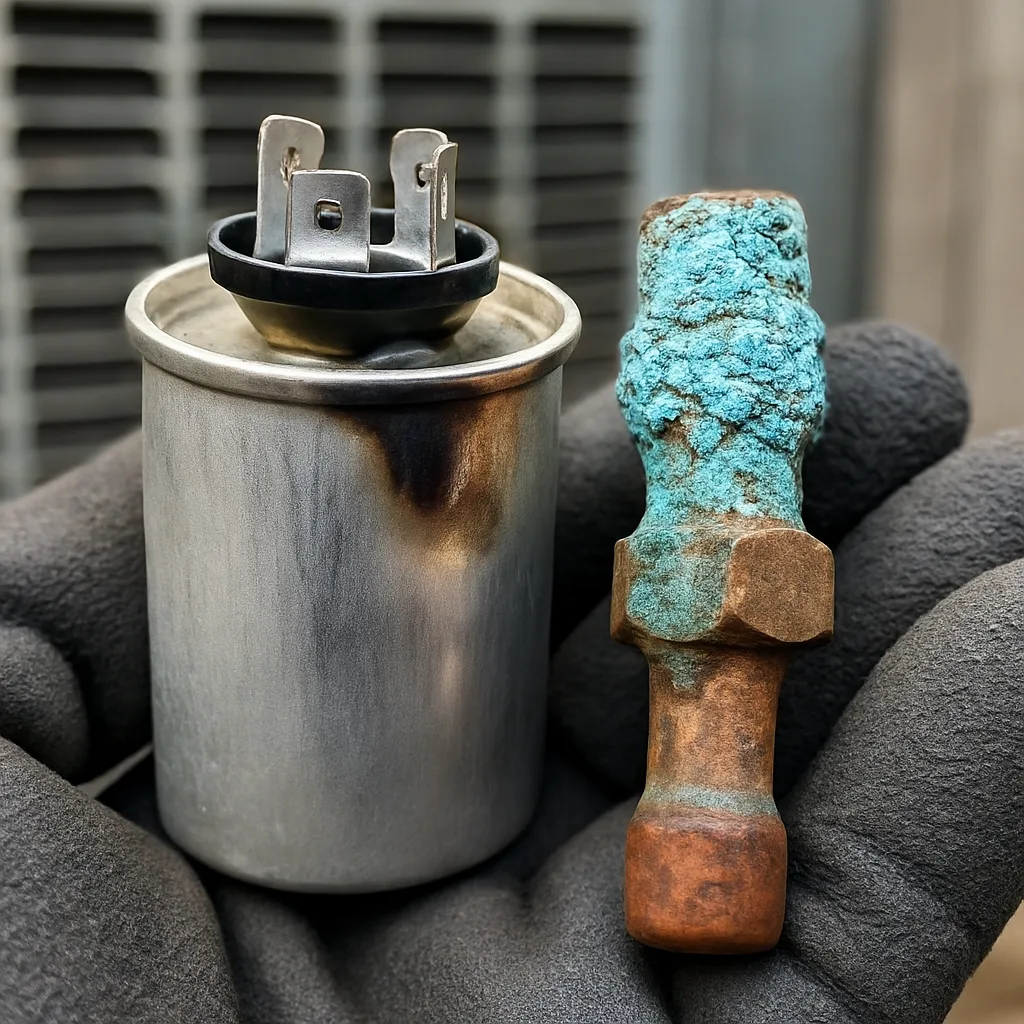
Attic units and outdoor condensers both take a beating when temperatures stay above the mid-90s. That heat stresses the capacitor’s internal parts. It can weaken over a few summers or fail all at once on a 105-degree day. Older units and those that run long hours tend to show this first.
Other electrical parts fail for similar reasons. Contactors pit and stick from repeated cycling. Power surges during storm season can damage circuit boards. We see this often across Sunnyvale and the greater Dallas-Fort Worth area. Wiring connections also loosen from years of heat expansion and contraction, especially in attics where temperatures swing wildly.
Our technicians check these parts as part of our same-day diagnostic visit. We test the capacitor’s charge and look for pitting on the contactor. We check the board and connections before we tell you what’s wrong. If it’s a capacitor or another electrical part, that’s often a straightforward repair. We can usually finish it the same visit once you approve the price.
But this isn’t always a simple swap. Sometimes a failed capacitor is the first sign of a deeper issue, maybe a compressor under strain. Or a motor could be drawing too much current. That’s why we don’t quote a price over the phone. A tech has to see the problem and rule out anything else involved before giving you a number in writing.
For a rough idea of what electrical component repairs run, our pricing guide breaks down the typical ranges. You’ll notice what moves the cost up or down there.
Have questions? We’re happy to help.
Call Today, Get Service Today. Xtreme Air Services is ready to help.
Dirty or Frozen Coils Can Look Alike but Have Different Causes
A coil covered in ice and one covered in dust can cause the same problems in your home: weak airflow, the system runs but won’t cool, or warm air mixes with cold. Homeowners across Sunnyvale and the rest of DFW ask us about this a lot. It comes up especially in the peak of a Texas summer when your AC runs nearly nonstop.
A dirty evaporator coil builds up slowly. Dust and pet hair settle on the coil fins over months, sometimes years. The coil then loses its ability to pull heat out of the air. This is a maintenance issue. It shows up gradually, not as a sudden failure.
A frozen coil is different. Ice forms when something restricts airflow across the coil or drops the refrigerant below normal levels. This often points to a clogged filter, a failing blower motor, or a refrigerant leak. Once ice forms, it insulates the coil and makes things worse. A system that seemed fine yesterday can blow barely any air today.
The two conditions can look identical to someone standing at the thermostat. Both show up as weak or warm airflow. The difference is what’s on the coil, and you can’t always tell that from outside the cabinet. That’s why we don’t guess.
Our technicians inspect the coil directly during the same-day diagnostic visit. If it’s dirty, evaporator coil cleaning restores airflow and heat transfer. If it’s frozen, we look upstream first (checking the filter, blower, and refrigerant charge). Clearing the ice without finding the cause just invites a repeat. Evaporator coil repair or frozen coil repair gets scoped based on what we find, not a guess over the phone.
One thing worth knowing: if the coil is frozen when our technician arrives, we usually need it to thaw before a full inspection is possible. That can add time to the visit. We’d rather tell you that up front than have you expect a five-minute fix.
Either way, you get a written flat-rate quote before any work starts. The cause gets explained in plain language. If cost is the first thing on your mind, our HVAC system repair pricing guide breaks down what drives the price on jobs like this.
Furnace Ignition Issues Are Usually a Flame Sensor or Ignitor
A furnace that starts and then shuts right back off is one of the most common no-heat calls we get. This happens across Sunnyvale and the rest of the DFW Metroplex. Most of the time it comes down to one of two small parts: the flame sensor or the ignitor.
The flame sensor is a thin metal rod that sits in the burner flame. It tells the control board the fire is lit. Over time, it picks up a layer of carbon and residue from normal combustion. Once that coating builds up, the sensor can’t read the flame anymore. So the board shuts the gas off as a safety step. It’s just a part that gets dirty from doing its job.
The ignitor is a different piece with a different failure pattern. On most gas furnaces built in the last couple decades, it’s a hot surface ignitor. This small ceramic element glows and lights the gas. That element is fragile. It heats and cools every cycle, and after a few years of that stress it can crack or wear out. This is similar to how a light bulb filament eventually gives out. When it fails, the furnace won’t light at all rather than lighting and dropping out.
You’ll notice one of two patterns: either the furnace tries to start, you hear a click and a brief whoosh, then it goes quiet again after a few seconds. Or nothing happens at all when the thermostat calls for heat. Both point toward the same part family. A technician can usually tell which one it is within a few minutes of testing.
Diagnosing this is part of HVAC system repair, and the process is straightforward. A technician checks the flame sensor’s signal with a meter. We clean or replace it if it’s reading weak. We test the ignitor’s resistance if the furnace isn’t lighting at all. On most calls, one of these two parts explains the whole problem. And it’s fixed on the same visit.
Older furnaces with standing pilot lights work differently and rely on a thermocouple instead. So the exact part varies by furnace age and model. We test the actual part before replacing anything. A working flame sensor or ignitor doesn’t need to come out just because it’s had a few years on it.
Cost for this kind of repair depends on which part failed and what’s involved in reaching it on your specific furnace. Our HVAC system repair pricing guide covers what typically drives that number up or down.
Ready to Get Started?
Call 972-288-2263 Today, Get Service Today.