


Furnace Replacement in Allen: What’s Included and What It Costs
An honest way to tell if your furnace is worth one more repair, and what a full replacement includes.
What’s Covered on This Page
- Know the Signs a Furnace Needs Full Replacement
- Rule Out a Simple Repair First
- What a Standard Furnace Replacement Includes
- What Drives Furnace Replacement Cost Up or Down
- Verify Licensing Before You Hire
- How long does a furnace replacement take in Allen?
- Can I keep using my furnace while I decide on replacement?
- Will a new furnace lower my gas bill?
Know the Signs a Furnace Needs Full Replacement
Not every cold night means you need a new furnace. A lot of no-heat calls come down to one worn part. Other times the whole system is telling you it’s done. Here’s how to tell which one you’re dealing with.
These signs point toward replacement:
- You’ve paid for repairs more than once in the last couple of seasons, and something new breaks each time.
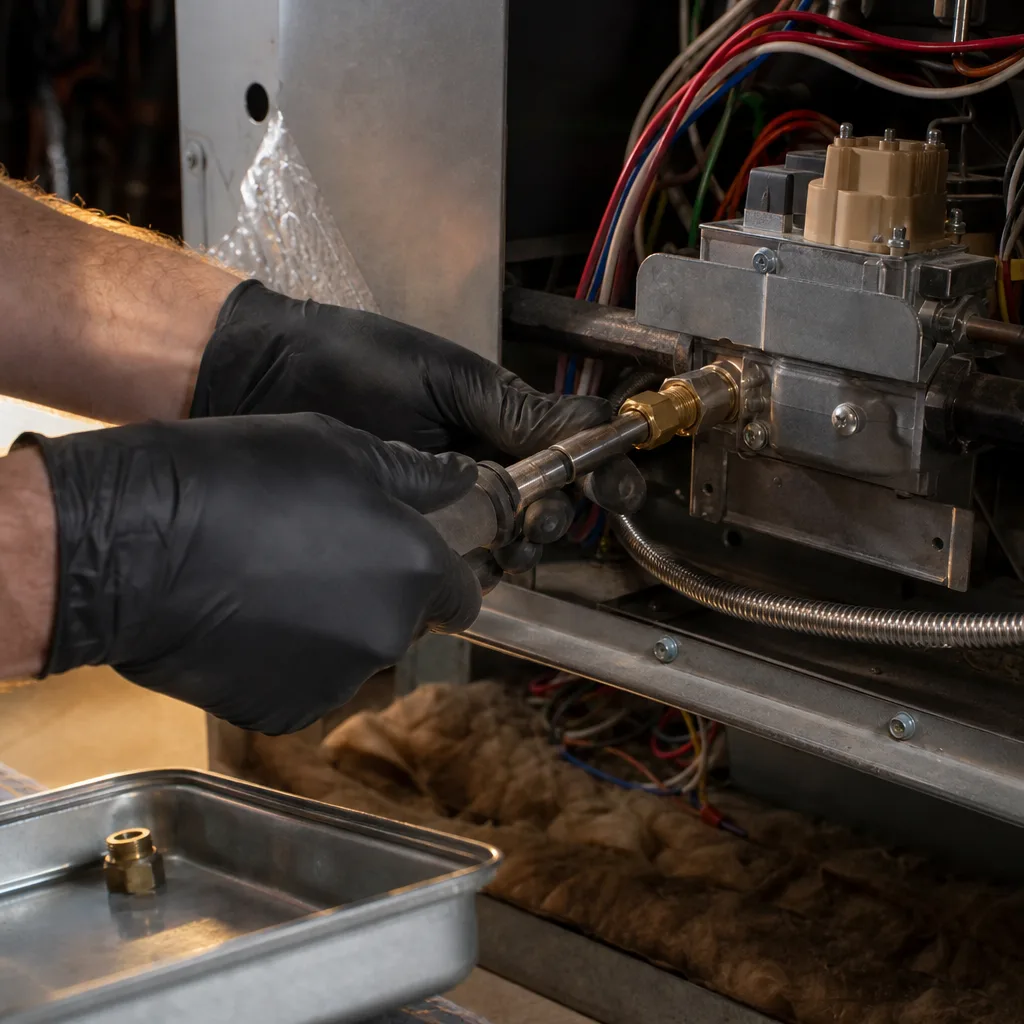
- A technician finds a cracked heat exchanger. That’s the metal chamber that keeps combustion gases separate from the air you breathe, and a crack is a safety problem, not a tune-up item.
- Some rooms stay cold while others run warm, even with clean filters and open vents.
- Your gas bills keep climbing through winter while your thermostat setting and habits haven’t changed.
- The furnace runs and runs but never quite reaches the temperature you set.
- You hear banging, rumbling, or loud rattling that keeps coming back after repairs.
- Repair parts for your model are getting hard to find, or the repair quote is a big share of what a new unit would cost.
Now the honest side. If your furnace won’t light but has been reliable, the problem may be a bad ignitor, a dirty flame sensor, or a failing control board. Those are everyday repairs, and they don’t mean the whole system is finished. The same goes for a blower motor that’s quit on a unit that’s otherwise in good shape. We do furnace ignitor replacement, flame sensor cleaning, control board replacement, and blower motor repair, and we’ll tell you straight if a repair is all you need.
Age matters too, but it isn’t the whole story. A well-kept older furnace can outlast a newer one that’s been neglected. What tips the scale is age plus repeat breakdowns plus rising bills. When all three show up together, putting more money into the old unit usually stops making sense.
Timing is worth thinking about in Allen. North Texas winters are mostly mild, then a hard cold front can drop temperatures fast and push a tired furnace to run nonstop for days. That’s often when a weak system finally gives out. Many homes here also have the furnace in the attic, where summer heat and winter cold put extra wear on the equipment. If your furnace is already showing several of the signs above, it’s easier to plan a replacement on your schedule than to scramble during a freeze.
If you smell gas or something just feels off about how your furnace is running, don’t wait it out. A furnace safety inspection or carbon monoxide testing gives you a clear answer about whether your system is safe to keep running.
Still not sure? That’s what a diagnostic visit is for. Our service-call fee is $26 to $99, and it’s credited toward the repair if you move forward with Xtreme Air Services. Our licensed and insured technicians will show you what they found and give you upfront flat-rate pricing on both options, repair or replace, so the choice stays yours.
Rule Out a Simple Repair First
Before you start pricing a new furnace, take ten minutes and check the easy stuff. A surprising number of “dead” furnaces are fine. Something small is simply stopping them from running. None of these checks need tools, and none of them mean opening up the burner area.
If you smell gas, skip this list completely and follow the safety steps above.
- Check the thermostat. Make sure it’s set to Heat, not Cool or Off, and that the temperature you set is a few degrees above what the room is now. If it runs on batteries and the screen is blank or dim, put in fresh ones.
- Look at the fan setting. If it’s set to On instead of Auto, the blower runs all the time and pushes room-temperature air between heating cycles. That can feel like the furnace is blowing cold, even when nothing is broken.
- Change the filter. A clogged filter chokes airflow, and many furnaces shut the burners off to protect themselves when they get too hot. That shows up as short bursts of heat, then nothing. With an attic furnace, the filter is often behind a return grille in a hallway ceiling or wall, not at the unit itself.
- Check the breaker. Find the furnace breaker in your panel. If it’s tripped, reset it once.
- Find the service switch. Most furnaces have an on/off switch near the unit that looks just like a light switch. In an attic, it’s easy for someone storing boxes or holiday decorations to bump it off.
- Make sure the front panel is on tight. Furnaces have a safety switch that won’t let them run if the access door is loose or sitting crooked.
- Open your vents. Closed or blocked registers can make one room feel like the furnace is failing when it’s really just an airflow problem in that room.
If you have a high-efficiency furnace, you’ll usually see white plastic pipes running from it instead of a metal flue. These units also drain water. If that drain line clogs, a small safety switch can shut the whole furnace down. A heater that quits with water pooling near the unit is often a drain problem, not a worn-out furnace.
Here’s how to read what happens next. If one of these fixes gets your heat back and it stays on, you’re done. You didn’t need a new furnace, and you didn’t need us. That’s a good outcome.
If the breaker trips again, the furnace starts and then shuts off over and over, or the heat comes back for a day and quits again, stop resetting things. Those patterns point to a real fault inside the system. Flipping switches over and over won’t fix it, and it can make the problem harder to track down. Jot down what you saw and when. A technician can use those details to tell much faster whether you’re looking at a single part or a furnace that’s reached the end of its life.
Ruling out the simple causes first means that if replacement does come up, you’ll know it’s the right call.
What a Standard Furnace Replacement Includes
Once you know replacement is the right call, the next question is simple. What am I paying for? Here’s a plain look at what our standard furnace replacement covers, what it doesn’t, and why one home’s price can land higher or lower than a neighbor’s.
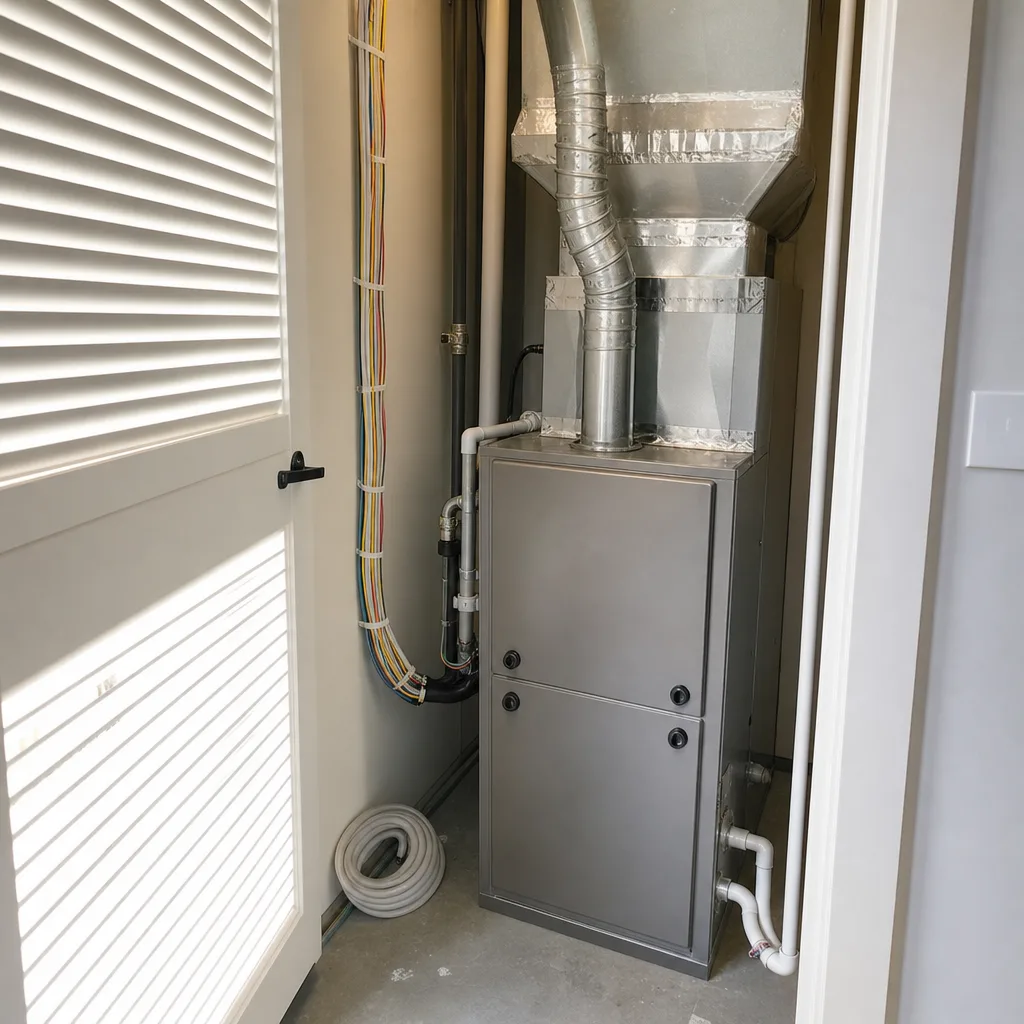
Our most common job is a like-for-like furnace replacement. That means the new furnace uses your existing connections with no major changes to the setup. For that job, our price typically runs $4,600 to $6,300. Across all the furnace replacements we do, the typical range is $3,800 to $8,000.
Here’s what’s included in a standard replacement:
- The new furnace and the materials to install it
- Professional installation by our licensed and insured technicians
- Standard connections to your existing setup
- Startup and testing, so the furnace is fired up and checked before the job is called done
- Haul-away of your old unit, so it isn’t left sitting in your garage or attic
Here’s what isn’t included unless your quote says so:
- Changes to your ductwork, electrical, or plumbing
- Code corrections
- Permits
We’re telling you this up front so nothing catches you off guard. If your home needs any of that work, it should show up as its own line on your quote. You’ll see it before anything starts.
So why does one furnace cost more than another? A few things move the price:
- Size and capacity. The furnace has to match your home. Too small and it can’t keep up on a hard freeze. Too big and it turns on and off in short bursts, which wastes fuel and wears parts faster.
- Efficiency. AFUE tells you how much of the gas you pay for turns into heat in your home. A higher AFUE furnace usually costs more up front and less to run each winter.
- Brand and model. Different furnaces come with different features and price points.
- Ease of access. A furnace in a tight attic takes more time and care to swap than one in a roomy closet.
- The shape your ductwork, wiring, and plumbing are in. If what’s there is in good condition, the job stays simple.
- Code upgrades and permits, when your home needs them.
- Custom fabrication, if parts have to be made to fit your space.
This is why a like-for-like job tends to stay in that $4,600 to $6,300 range. When the new furnace fits right where the old one was and hooks up the same way, there are fewer surprises to price in.
When you compare quotes, ask each company the same questions. Is haul-away included? Is startup and testing part of the price? What isn’t covered, and what would those extras cost? A low number that leaves out half the job isn’t really a lower price.
If the cost feels like a lot to cover at once, we offer flexible financing on qualifying installations and larger jobs, on approved credit. Either way, you get upfront flat-rate pricing before any work begins, so you know the number and can make the call that’s right for your home and your budget.
Not sure what your Furnace replacement project needs? Ask us.
Call Today, Get Service Today. Xtreme Air Services — Allen is ready to help.
What Drives Furnace Replacement Cost Up or Down
You’ve seen the list of things that move the price. Here’s how those things show up in a real house, so you can get a feel for where your job might land before anyone climbs into your attic.
Your price tends to stay near the lower end when most of these are true:
- The new furnace goes in the same spot as the old one.
- It uses the same fuel and vents the same way.
- The old furnace was the right size, so the new one can match it.
- There’s a clear path to the unit, with a decent attic walkway or an easy closet door.
- Your ducts, gas line, and wiring are in good shape.
The price climbs when the new furnace doesn’t fit the old setup. These are the most common reasons.
Going to a high-efficiency furnace. A standard furnace sends exhaust up a metal flue. A high-efficiency furnace pulls so much heat out of the exhaust that it vents through plastic pipe and makes water. That means a new vent path through the roof or wall, plus a drain line. In an attic, that water needs a safe way out, so it doesn’t drip onto your ceiling. You’ll usually pay more up front and less on gas each winter.
A tight attic. A small hatch, no walkway, or a low roofline makes it harder to get the old unit out and the new one in. Attic furnaces usually lie on their side. If the new cabinet is a different size, it may need a new platform or a sheet metal piece made to fit.
Fixing a sizing mistake. If your old furnace was too big or too small, the new one shouldn’t copy it. Getting the size right can raise or lower the price, depending on which way it goes. A load calculation measures what your home needs.
Matching your AC. Your furnace blower moves the air for your air conditioner too, and the AC’s indoor coil usually sits right on top of the furnace. If that coil doesn’t line up with the new cabinet, it needs a transition piece. If your AC is also near the end of its life, it’s worth asking about replacing both at the same time, so the two pieces work well together.
Gas, electrical, or code work. An old gas connector, a missing shutoff, or wiring that doesn’t meet today’s code has to be fixed before the new furnace can run safely. Those items aren’t part of a standard replacement, so they should show up as separate lines on your quote.
Here’s how that can play out on one street. Two neighbors in Allen both replace attic furnaces. One swaps a standard unit for the same size and type, with a good walkway and solid ducts. The other moves up to high efficiency, needs a new vent and drain line, and has a hatch that barely fits the cabinet. Same street, very different quotes, and both can be fair.
The easiest way to compare quotes is to ask for two prices. What does it cost to replace what I have now, and what changes if I go high efficiency? Also ask whether the Allen permit is in the price, because permits aren’t included unless your quote says so.
Call 469-299-8996
Watch Our Video
See How We Handle Furnace replacement in Allen
Xtreme Air Services — Allen
Verify Licensing Before You Hire
A new furnace burns gas a few feet above your bedrooms. That’s why the person installing it matters as much as the furnace itself. Before you sign any quote, take five minutes to check that the contractor is licensed, insured, and willing to put it all in writing. A good company won’t mind you asking. If someone gets cagey about it, that tells you what you need to know.
In Texas, air conditioning and heating contractors are licensed through the Texas Department of Licensing and Regulation, also called TDLR. Every licensed contractor has a license number, and you can look it up yourself on the TDLR website. You’ll see whether the license is active and whose name it’s under. Ours is HVAC License #TACLA29023C. Please look it up. We’d rather you check than take our word for it.
Here’s what to ask every company before you hire them:
- What’s your HVAC license number? Get the actual number, not “yes, we’re licensed.” Then check that it’s active and matches the company name on your quote.
- Are you insured? If a worker gets hurt in your attic or a ceiling gets damaged during the swap, insurance protects you. Ask for proof, not a promise.
- Who’s coming to my home? You’re letting someone into your house, sometimes with your family there. It’s fair to ask whether the crew is screened.
- Who pulls the permit for Allen? Permits aren’t part of a standard replacement unless your quote says so. Ask who handles it and what it costs, so it doesn’t get skipped or show up as a surprise later.
- Who handles the gas and electrical hookups? A furnace connects to your gas line and your home’s wiring. If either one needs work, find out whether the same company can do it or whether you’ll be calling in someone else.
That last question matters more than people expect. Say the technician finds an old gas connector or wiring that’s not up to code. Some installers will stop the job and tell you to find a plumber or an electrician. You’re stuck waiting, maybe in a cold house. Xtreme Air Services is a fully licensed and insured HVAC, plumbing, and electrical contractor, so one trusted team can handle those pieces when they come up. Any of that extra work still shows up on your quote as its own line before it starts.
Watch for a few red flags, too. Be careful with a quote that won’t name a license number, a price that’s way lower than everyone else’s with no clear list of what’s included, or anyone who pushes you to sign on the spot. A furnace is a big decision. You should have time to think it over.
On our end, you’ll get licensed and insured technicians who are background-checked and drug-tested team members. As a Trane Comfort Specialist, we work with Trane equipment every day. You’ll also get upfront flat-rate pricing in writing before any work begins. You’ll know who’s coming, what they’re installing, and what it costs.
Call now
Frequently Asked Questions
Common questions about Furnace replacement
How long does a furnace replacement take in Allen?
Most like-for-like furnace replacements take about half a day to a full day. If your furnace is in a tight attic or needs a new vent and drain line for a high-efficiency unit, the job can run longer. Your technician will give you a time estimate after seeing your setup.
Can I keep using my furnace while I decide on replacement?
Yes, if a technician hasn’t flagged a safety issue like a cracked heat exchanger or a gas smell. Many homeowners run a tired furnace through one more mild stretch, then schedule replacement before the next hard cold front hits North Texas. If the furnace is cycling on and off repeatedly or you smell gas, stop using it and call for a safety inspection instead of waiting.
Will a new furnace lower my gas bill?
It can, especially if you move from an older standard furnace to a higher AFUE model. AFUE measures how much of the gas you pay for turns into heat in your home, so a higher-rated furnace wastes less fuel each winter. The savings are bigger if your current furnace is old enough that parts are getting hard to find.
Ready to Get Started?
Call (469) 299-8996 Today, Get Service Today.