


Tankless Water Heater Installation in Carrollton: What to Know Before You Book
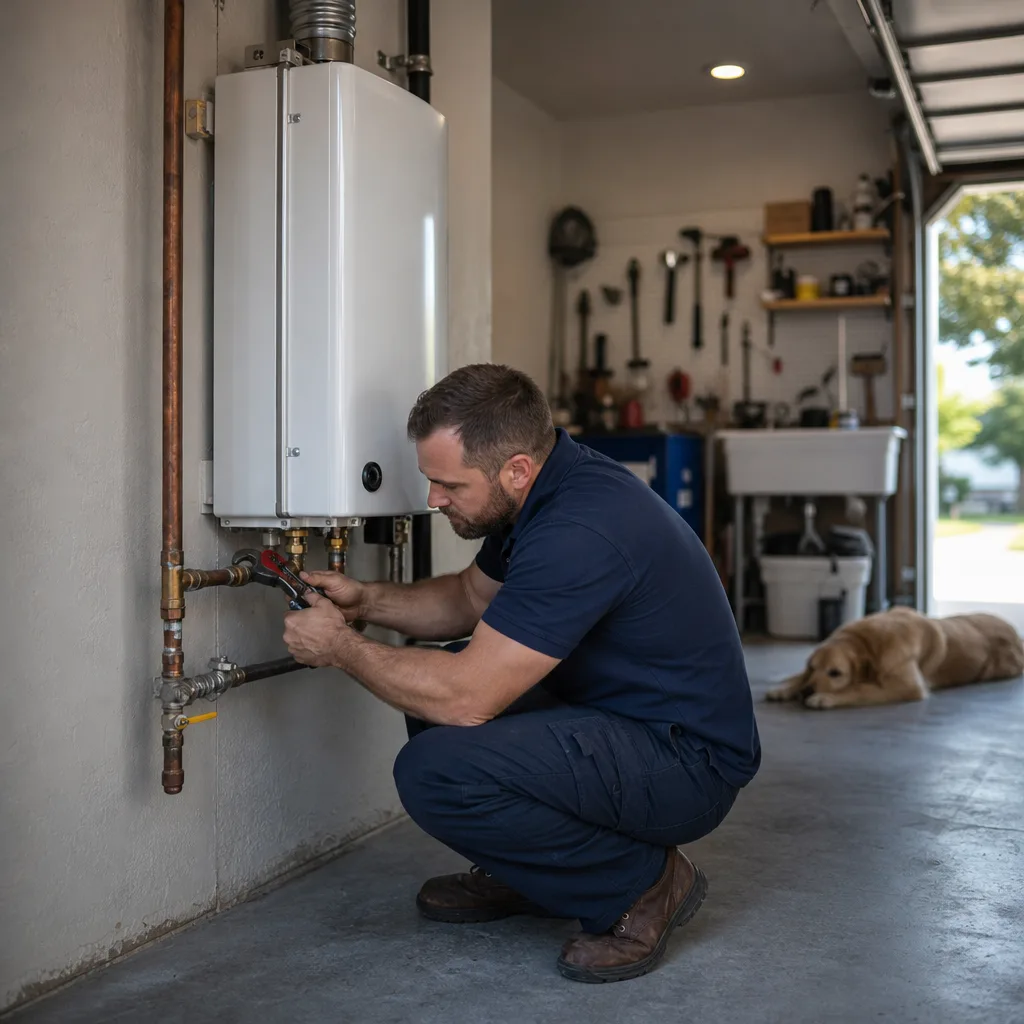
Tankless installs by licensed plumbers, with the gas line, venting, permits and inspection covered.
What’s Covered on This Page
- Tankless vs. Tank: Make the Right Call for Your Home
- Signs Your Water Heater Setup Is Ready for a Tankless Upgrade
- When a Standard Tank Water Heater Makes More Sense
- Gas vs. Electric Tankless: Why Venting Changes the Job
- Who Can Legally Install a Tankless Water Heater in Carrollton
- Should a tankless water heater go inside or outside my home?
- Do I need a plumber or an electrician for a tankless water heater?
- Is switching from a tank to tankless worth it?
Tankless vs. Tank: Make the Right Call for Your Home
A tank water heater keeps 40 or 50 gallons hot all day, whether you use them or not. A tankless unit heats water only when you turn on a tap. Water runs through a heat exchanger, warms up in seconds, and keeps flowing as long as you need it. That one difference drives almost everything else in this decision.
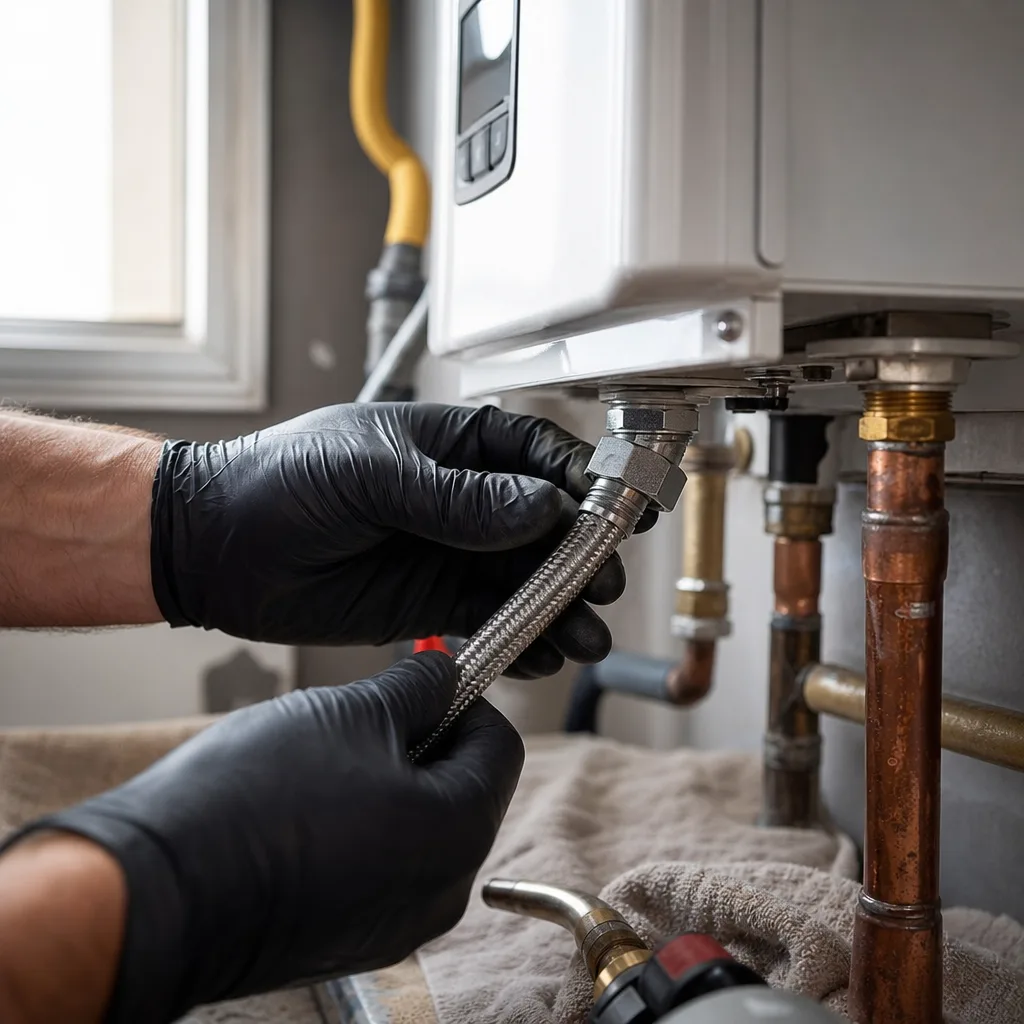
Picture a busy weekday morning. Two people shower back to back, the dishwasher’s running, and the last person in gets a cold rinse. That’s the classic sign a tank can’t keep up with your household. Tankless fixes that problem because it doesn’t run dry.
- Hot water that keeps coming, so the last shower is as warm as the first.
- A small, wall-mounted unit that frees up floor space in your garage or closet.
- No energy spent keeping a full tank hot while you’re at work or asleep.
- No big tank that can rust through and dump gallons of water on your floor.
Tankless isn’t right for every home, and we’d rather tell you that now than after the install.
- Your tank is only a few years old and working fine. Keep it. Replacing a healthy water heater rarely pays off.
- You’re planning to sell or move soon. The higher upfront cost takes time to earn back, and you may not be there long enough.
- Your budget is tight right now. A like-for-like tank swap costs less up front and still gets you hot water today.
- Your home would need major upgrades. Gas tankless units often need a larger gas line and new venting. Electric tankless units can pull a lot of power and may need panel or wiring work. Those changes add real cost.
Hard water matters here, too. North Texas water carries a lot of minerals, and that scale builds up inside any water heater. In a tank, it settles on the bottom. In a tankless unit, it coats the heat exchanger and cuts performance if you skip maintenance. That doesn’t rule out tankless. It does mean you should plan on a regular flush to clear the scale, or think about pairing the unit with a water softener.
Sizing is the other catch. A tankless unit gives you endless hot water, but only so much at once. If you run three showers and the washer at the same time, an undersized unit can’t keep up. The right size depends on how many fixtures you use at once and how cold your incoming water gets. Winter water in North Texas comes in much colder than summer water, so the unit works harder in January.
Ask yourself three questions. Do you run out of hot water now? Will you be in this home for years? Can your gas line, venting, or panel handle the unit without a big upgrade? If you answer yes to all three, tankless is probably a smart move. If not, a new tank may serve you better, and that’s a perfectly good choice.
Signs Your Water Heater Setup Is Ready for a Tankless Upgrade
You’ve decided tankless sounds right for your family. The next question is whether your house is ready for it. The fewer changes your home needs, the closer your job stays to a simple swap. Here’s what makes a setup a good fit.
Your current tank is near the end of its life. You may see rust at the base, hear rumbling or popping when it heats, or find a little water on the floor. You may also notice the hot water runs out sooner than it used to. If you’re going to buy a new water heater soon anyway, that’s the best time to switch. You’re not throwing away a healthy tank.
Your gas line has room to spare. A gas tankless unit burns a lot of gas at once, much more than a tank burning slowly all day. If the pipe feeding your water heater is too small or runs a long way from the meter, the unit can’t get enough fuel to heat water when you need it most. A line that’s already a good size, or one with a short run, keeps the job simple.
There’s a clear path for the vent. Gas tankless units need their own vent pipe, and it can’t just tie into the old tank’s flue. A water heater on or near an outside wall usually makes venting easier. One buried in the middle of the house can mean longer pipe runs and more work.
You have a good wall for it. Tankless units mount on the wall, so the spot needs solid framing and enough clearance around it. In a lot of North Texas homes, the water heater sits in the garage. A garage wall close to your existing water and gas lines is often an easy place for a new unit. Attic installs can work too, but tight space and summer attic heat make them harder to reach and service.
Your panel can handle it, if you’re going electric. Electric tankless units pull a lot of power through large, dedicated circuits. A panel with open breaker space and enough capacity is a green light. An older or full panel may need work first. We also handle electrical panel upgrades, so that’s not a dead end. It just adds to the scope.
Your plumbing is in decent shape. Working shutoff valves and water lines without heavy corrosion make the connection clean. It’s also the right moment to add service valves, which make the regular flushing we covered above quick and simple.
- Ready now: an aging tank in the garage near an outside wall, a gas line with room to spare, and solid shutoff valves.
- Ready with some work: a gas line that needs upsizing, a longer vent run, or a panel that needs more capacity.
- Probably not worth it yet: a newer tank buried mid-house with a small gas line and a full panel.
You don’t have to figure this out alone. A licensed plumber can check your gas line size, vent path, and panel and tell you which group your home falls in. Our team covers plumbing, gas line installation, and electrical work, so you’ll hear about every piece of the job from one company. You won’t get hit with a surprise call to a second contractor halfway through.
When a Standard Tank Water Heater Makes More Sense
Sometimes the honest answer is a new tank. We’ve already covered the big reasons: a young tank, a short stay, a tight budget, or a house that needs major gas or panel work. There are a few less obvious cases, too. In each one, a tank is simply the better fit for how you live.
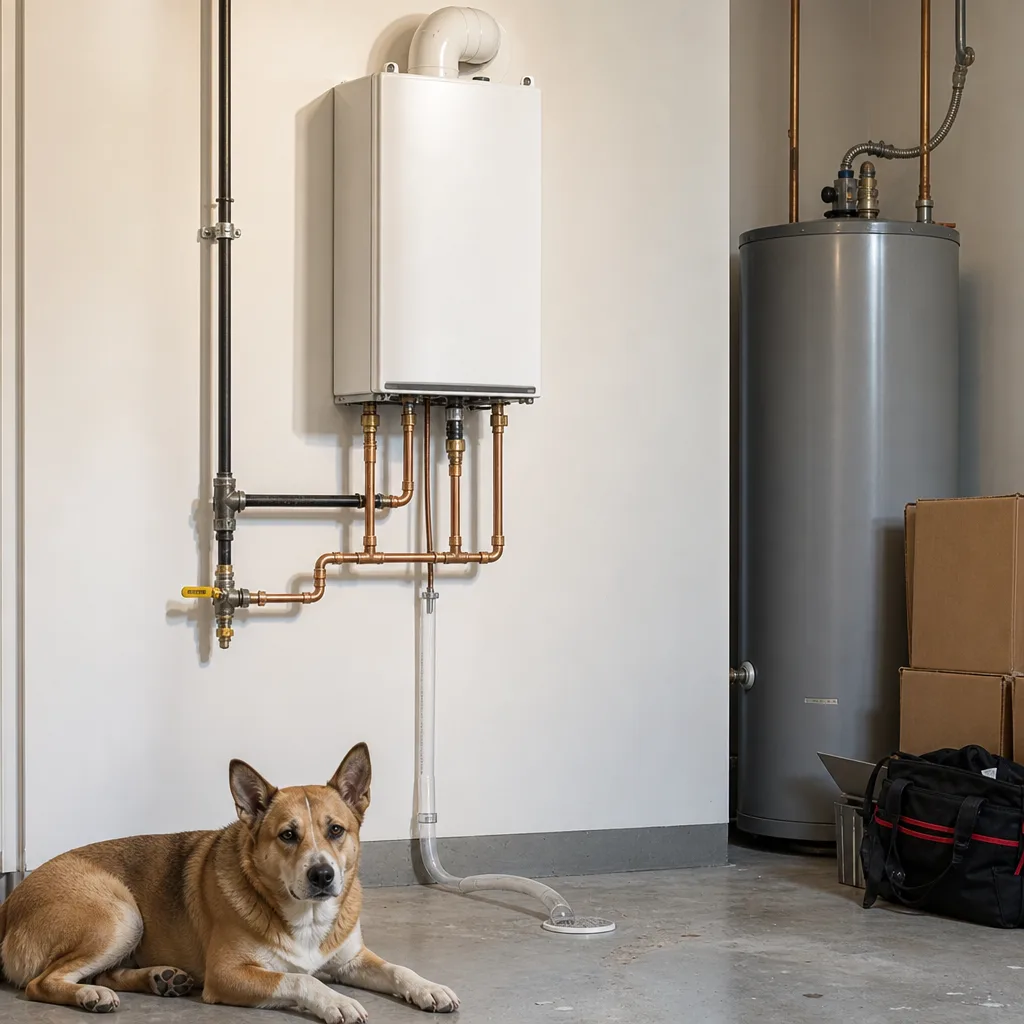
You want hot water when the power goes out. Most tankless units need electricity to run their fan, controls, and igniter. If the power’s out, you get no hot water, even with a gas unit. A standard gas tank with a standing pilot light can keep heating without power. Even after the burner stops, a full tank holds hot water for a while. North Texas gets ice storms in winter and strong thunderstorms in spring and summer, and both can knock out power. If outages are a real worry in your house, a tank keeps working. A standby generator can also cover either type, but that’s a separate cost to weigh.
Your household doesn’t use much hot water. Maybe it’s one or two people, short showers, and a few loads of laundry a week. You never run out now. In that case, the energy a tank spends staying hot is fairly small. A tankless unit would save you a little each month, but it could take many years to make up the higher upfront cost.
You mostly use hot water in small trickles. A tankless unit needs a minimum amount of water flowing before it fires up. If you like rinsing dishes under a slow drip of warm water, the burner may never kick on, so the water stays cold. You may also notice a short burst of cold water when you shut the tap off and turn it back on a minute later. Some people never notice it. Others find it annoying every single day. A tank gives you warm water at any flow, big or small.
Your tank just quit and you need hot water tonight. A like-for-like tank swap uses the same spot, the same gas line, and the same vent. A switch to tankless may mean upsizing the gas line, running a new vent, or pulling a permit. That takes more planning. If your family can’t go days without a shower, putting in a new tank now is a perfectly reasonable choice. Don’t let anyone rush you into a bigger project just because your old heater picked a bad week to fail.
You know you won’t keep up with maintenance. With North Texas hard water, a tankless unit needs the regular flushing we mentioned earlier. Skip it, and scale can choke the heat exchanger, cut your hot water, and trigger error codes. A tank also does better with flushing, but it usually handles neglect with less trouble. If you’d rather not keep a maintenance schedule, be honest with yourself about that before you pick.
None of this makes tankless a bad product. It just means your home’s needs point another way. If two or more of these sound like your house, a new tank is a smart, solid choice, and any good plumber should tell you so.
Ready when you are – get in touch today.
Call Today, Get Service Today. Xtreme Air Services — Carrollton is ready to help.
Gas vs. Electric Tankless: Why Venting Changes the Job
Gas and electric tankless units both give you hot water on demand. The work it takes to put each one in your home is very different. The biggest reason is one word: venting.
A gas unit burns fuel to heat your water, and that makes exhaust. The exhaust has to go outside, safely, every time the burner fires. An electric unit burns nothing, so it doesn’t need a vent at all. That single fact shapes where the unit can go, how much work the install takes, and what shows up on your quote.
Gas tankless units come in two main styles, and each one vents differently.
- Non-condensing units send out very hot exhaust. They need a vent pipe made of metal that’s rated for that heat, often stainless steel. That kind of pipe costs more and takes more care to install.
- Condensing units pull extra heat out of the exhaust before it leaves. They get more hot water from the same gas, and the exhaust comes out cool enough for plastic vent pipe if the maker allows it. The catch is that they make a small, steady stream of acidic water. That water needs a drain line, and many installs add a neutralizer so the acid doesn’t eat away at your drain pipes.
Where the vent leaves your house matters too. It can go out a side wall or up through the roof. The end of the pipe has to sit a safe distance from windows, doors, air intakes, and other openings so exhaust doesn’t drift back inside. Every manufacturer also limits how long the vent run can be and how many bends it can have. A water heater in the garage on an outside wall might need just a few feet of pipe. One in a hall closet in the middle of the house could need a long run up through the attic and roof. That longer path takes more parts, more labor, and more holes patched afterward.
Some gas models are built to mount outside, which skips most of the indoor vent work. In North Texas, though, a hard freeze can hit those units. They depend on built-in freeze protection that needs power, so an outage during an ice storm leaves them exposed.
Electric tankless is the simple side of the venting question. There’s no vent pipe, no roof or wall opening, and no drain line. The unit can go almost anywhere near your water lines, even under a sink. What you trade for that simple setup is power. As we covered earlier, a whole-house electric unit may mean panel or wiring work, and it has to work harder to heat cold winter water.
- Gas to gas, with a short, easy vent path: usually the closest thing to a simple swap.
- Gas to gas, with a long vent run or a new roof opening: more parts, more labor, more time.
- Gas to electric: no vent needed, but the old flue gets capped and your panel has to keep up.
- Electric to electric: no venting, with the power supply as the main question.
This is why two tankless quotes can look so far apart. Our standard job is a like-for-like install using your existing connections. New vent runs, plumbing changes, or electrical work fall outside that, so we’ll show you exactly which of these paths your home is on before any work starts.
Watch Our Video
See How We Handle Tankless water heater installation in Carrollton
Xtreme Air Services — Carrollton
Who Can Legally Install a Tankless Water Heater in Carrollton
In Texas, the water and gas connections on a tankless water heater are plumbing work, and they’re a job for a licensed plumber. If the install needs a new circuit or panel work, that part belongs to a licensed electrician. A handyman or a general “we do it all” crew without those licenses shouldn’t be connecting your gas line or wiring a 240-volt unit, no matter how good the price sounds.
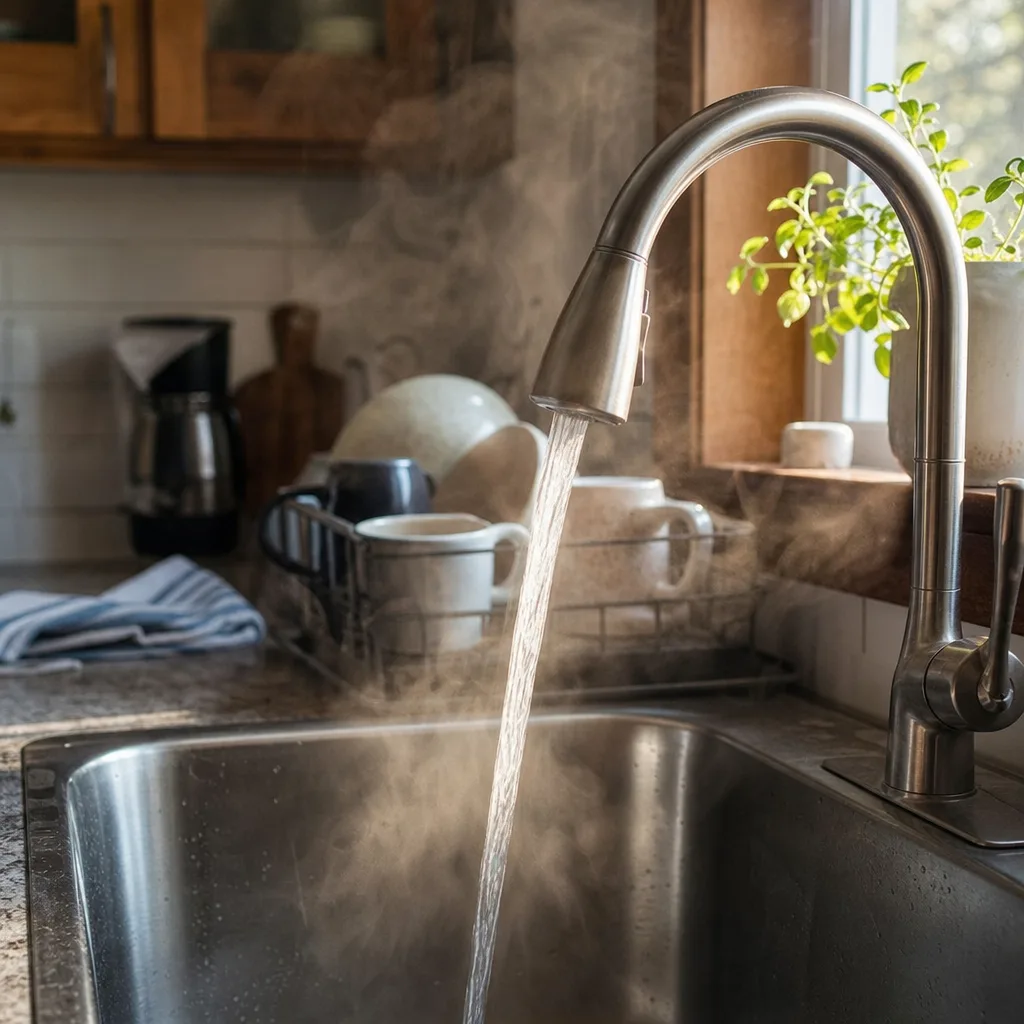
That matters more with tankless than with a simple tank swap. As we covered above, a gas tankless unit often needs a bigger gas line and a brand-new vent. An electric unit may need heavy new circuits. Those are the parts of the job where mistakes cause real harm, like exhaust leaking into your home, a gas leak at a fitting, or wiring that overheats behind a wall.
Water heater work in North Texas cities usually needs a permit, and a tankless conversion with new gas, vent, or electrical work almost always does. The permit brings a city inspector out to check the job before it’s signed off. Think of that inspection as a free second set of eyes on your installer’s work. Your plumber should know Carrollton’s rules and pull the permit for you. It shouldn’t be something you have to chase down yourself.
Texas does have narrow exceptions for owners doing some work on a home they live in. Even so, the city’s permit and inspection rules still apply. Gas sizing, vent clearances, and combustion air are hard to get right without training. If you’re handy and want to save money, you’ll get more value prepping the space or hauling out boxes than connecting the gas yourself.
Before you hire anyone, ask these questions:
- What’s your plumbing license number, and who holds the master license for your company?
- Will a licensed electrician handle any new circuit or panel work?
- Do you pull the permit, and is it included in the price?
- Who’s responsible if the job doesn’t pass inspection?
- Does your quote cover gas line upsizing, the vent run, and any electrical work, or are those extra?
- Are you insured if something goes wrong in my home?
A good contractor answers all of these without hesitating. If someone dodges the license question or suggests skipping the permit to save you a few dollars, that’s your cue to keep looking.
Here’s where we stand. Xtreme Air Services is a fully licensed and insured HVAC, plumbing, and electrical contractor, with plumbing work under Master Plumber Larry Breedlove. Our technicians are background-checked, and our Carrollton office is on East Trinity Mills Road. Because plumbing, gas line work, and electrical work all live under one roof, one accountable team handles every licensed piece of your install.
We’ll also be straight with you about permits. Under our standard pricing, permits and code corrections aren’t included unless your quote says so. We’ll tell you up front whether your job needs a permit, what it adds, and what any code fixes involve, before work starts. That way the price you approve is the price you pay, and the job is done right the first time.
Frequently Asked Questions
Common questions about Tankless water heater installation
Should a tankless water heater go inside or outside my home?
Most Carrollton homes do best with an indoor install, usually in the garage near an outside wall. That spot keeps the vent run short and protects the unit from hard freezes. Some gas models are built for outdoor mounting, but they rely on power-dependent freeze protection, which can leave you without hot water during a North Texas ice storm.
Do I need a plumber or an electrician for a tankless water heater?
You need a licensed plumber for the water and gas connections, since that’s plumbing work in Texas. If the unit is electric or needs new circuits or panel work, a licensed electrician has to handle that part. A crew without both licenses shouldn’t be touching your gas line or wiring a 240-volt unit.
Is switching from a tank to tankless worth it?
It’s worth it if you run out of hot water often, plan to stay in your home a while, and your gas line or panel won’t need major upgrades. It’s usually not worth it if your current tank is young and working fine, since a healthy water heater rarely needs replacing early just to go tankless.
Ready to Get Started?
Call (469) 269-6099 Today, Get Service Today.