


Central Air Conditioning Repair in Frisco: Fix It Right the First Time
Central AC problems diagnosed and fixed right the first time, with clear pricing on what drives the cost.
What’s Covered on This Page
- Signs Your Central AC Needs a Repair Call
- What Happens During a Central AC Repair Visit
- What Central AC Repair Costs and What Drives the Price
- When You Can Troubleshoot Before Calling for Repair
- Why Frisco Homeowners Should Confirm Licensing Before Hiring
- Should I turn off my AC if it’s not cooling?
- What is a central air conditioning system?
- What is the $5,000 rule for AC?
Signs Your Central AC Needs a Repair Call
Your AC usually tells you something’s wrong before it quits completely. The trick is knowing what each sign means. Here’s what to watch for and what’s often behind it.
- Warm or lukewarm air from the vents. The fan runs, but the air isn’t cold. This often points to a low refrigerant charge from a leak, a dirty coil, or an outdoor unit that isn’t running the way it should.
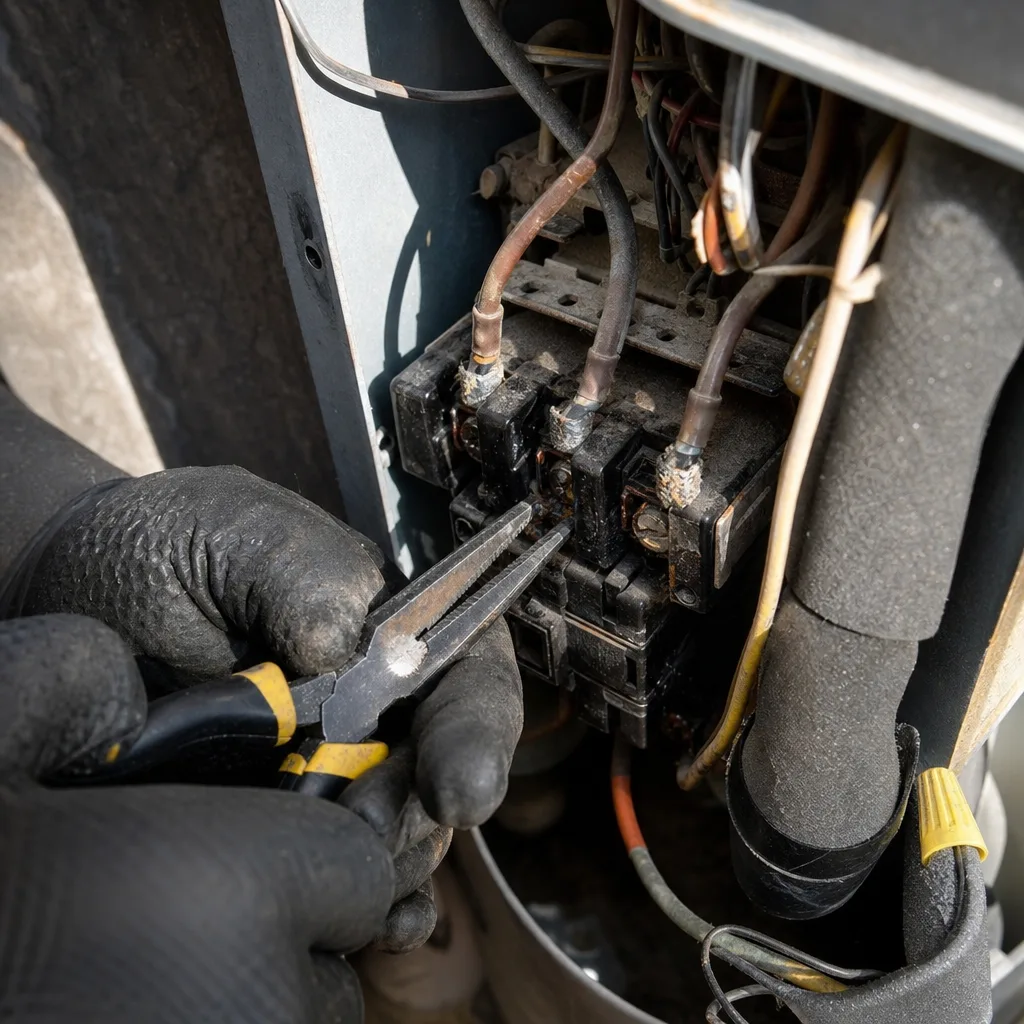
- The outdoor unit hums but the fan won’t spin. That steady hum with no movement is a classic sign of a weak capacitor, the small part that gives the motors a jolt to start. It can also mean the fan motor itself has worn out.
- Weak airflow from the vents. If the air barely pushes through, the cause could be a clogged filter, a blower motor that’s struggling, or a coil that’s starting to freeze.
- Ice on the copper lines or the indoor coil. Frost in a Texas summer looks strange, but it happens. Low refrigerant or poor airflow lets the coil get too cold, and ice builds up until cooling stops.
- Water around the indoor unit or a full drain pan. A clogged condensate drain line backs up. In homes with the air handler in the attic, that water can find its way into the ceiling below.
- Short cycling. The system turns on, runs a few minutes, and shuts off, over and over. Thermostat trouble, an electrical fault, or an overheating part can all cause it.
- New noises. Buzzing, clicking, grinding, or squealing usually means an electrical part or a motor bearing is failing.
- The house never reaches your thermostat setting. If your AC runs all afternoon and the house stays stuck several degrees warm, something is limiting its cooling power.
- Power bills climbing with no change in use. A struggling part makes the whole system work longer to do the same job.
Notice how many of those come down to one part. A capacitor, a fan motor, a clogged drain line, a refrigerant leak. That’s good news. A single failed part on a system that’s otherwise healthy is a repair, not a replacement.
Frisco summers make timing matter. Your AC runs long, hard hours from late spring into fall, and attic air handlers sit in some of the hottest air in your home. A part that’s slowly failing gets pushed harder every day. A capacitor that’s just weak today can fail outright on the next 100-degree afternoon, and a slow drain clog can turn into a stained ceiling. When you spot a sign early, you’re usually fixing one part. When you wait, that one bad part can strain the compressor or the motors around it.
You don’t need to figure out the cause yourself. Just pay attention to what you’re seeing, hearing, and feeling, and when it started. That helps our licensed technicians find the problem faster and get your home cool again.
What Happens During a Central AC Repair Visit
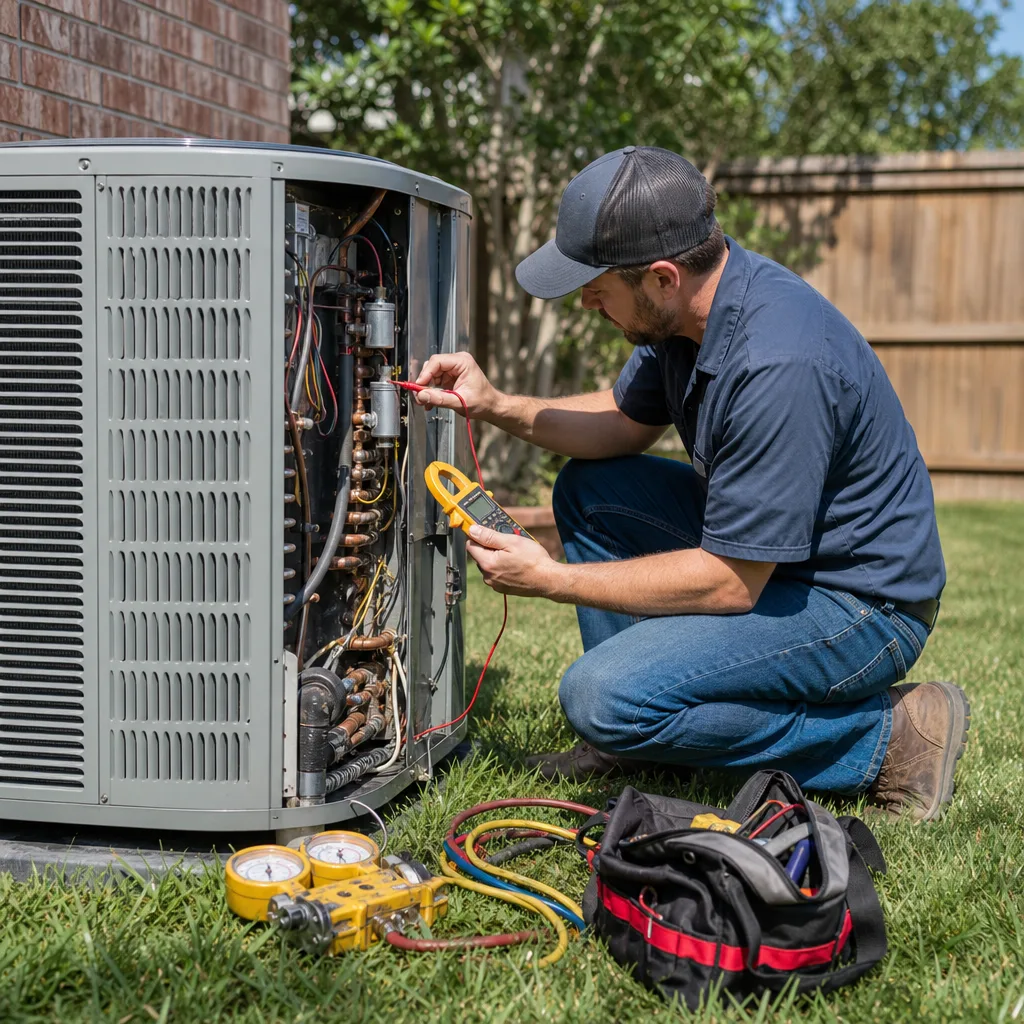
A central AC repair visit has three simple jobs: find the part that failed, fix or replace it, and prove your system is cooling right before we leave. Most calls come down to a single common failure we can fix on the first visit. Here’s how it goes, step by step.
Before we get there, a little prep saves time. Write down what you noticed from the signs above and when it started. Clear a path to your outdoor unit and to your attic access, since many Frisco homes have the air handler up in that summer heat. If your thermostat runs on batteries, check that the screen is on. Then leave the system off if it’s icing up, leaking, or making a grinding noise.
First, your technician finds the real cause. A good diagnosis doesn’t stop at the first thing that looks wrong. It works through the whole cooling path to find what failed:
- The thermostat and the signal it sends to the system
- Power, breakers, and the wiring to the indoor and outdoor units
- Capacitors and contactors, the small electrical parts that start and switch the motors
- The outdoor fan motor and the indoor blower motor
- Coils, refrigerant lines, and signs of a leak
- The condensate drain line and drain pan
Why check everything? Because a burned-out capacitor is sometimes a symptom, not the whole story. Swapping one part without asking why it failed is how people end up paying for the same repair twice.
Next, you see the price and say yes or no. You get upfront flat-rate pricing, and you approve it before any work starts. No meter running while someone works in your attic. If you go ahead, the service-call fee of $26-$99 is credited toward the repair. The repair price covers the diagnosis, labor, the standard replacement part, testing, and cleanup.
Some things aren’t part of that price, and we’ll tell you so plainly. Extra failed parts, major components, code upgrades, or permits get their own quote. If your technician finds a second problem, you’ll hear about it and decide what to do. It won’t quietly show up on your bill.
Then comes the repair itself. Your technician repairs or replaces the failed part and puts back any panels and covers that came off.
Last, we check that it works. A part going in isn’t the finish line. Your technician runs the system and checks that it starts cleanly, that both fans spin, that the air from your vents is noticeably colder than the air going in, and that the drain is flowing. Then we clean up the work area so your home looks the way it did before we came in.
The person doing all of this is one of our licensed and insured technicians, background-checked and drug-tested, who treats your home with respect. If your AC quits on a Saturday night, the visit runs the same way and costs the same. We don’t charge extra for nights or weekends.
What Central AC Repair Costs and What Drives the Price
Most central AC repairs with Xtreme Air Services fall between $150-$700. Our most common job, finding one failed part, fixing or replacing it, and making sure the system runs right, usually runs $150-$400. That’s the kind of repair most of the signs above point to, like a worn capacitor, a tired fan motor, or a clogged drain line.
You’ll know your exact price before any work starts, and the service-call fee is credited toward the repair if you go ahead, as covered above. So where does your repair land in that range? It comes down to a handful of things.
- How big the failure is. A part that’s simply worn out is a quick swap. A part that failed and damaged things around it takes more time and more parts.
- The cost of the part and how easy it is to get. Common parts are easy to find and cost less. A part for an older or less common unit can cost more and may take longer to get.
- Your system’s age and brand. Older equipment and some brands use parts that are pricier or harder to track down. A newer, common system is usually simpler to fix.
- Whether more than one part failed. One bad capacitor is one repair. If the capacitor took the fan motor down with it, you’re paying for two parts and the labor for both.
- When you call. Many companies charge more after hours. We don’t. There’s no extra charge for nights or weekends, so a Sunday evening breakdown costs the same as a Tuesday morning one.
That third and fourth point is why catching problems early pays off. A weak capacitor caught now is a small fix. The same capacitor left alone through a few more Frisco heat waves can strain the motors and push your bill toward the top of the range.
Some repairs land outside the normal range. A major component like a compressor or a coil gets its own quote, separate from a standard repair. Financing usually isn’t offered on smaller repairs like the ones above, but it is available on larger repairs and replacements. If your technician finds a big-ticket problem, you’ll get the price in writing and time to think it over. Ask about payment options then.
Whoever you call, a few questions will tell you a lot about how fairly you’ll be treated on price:
- Is the price flat-rate, or are you billing by the hour?
- Is the service-call fee credited toward the repair if I go ahead?
- Does the price include the part, labor, testing, and cleanup?
- Do you charge more for nights, weekends, or holidays?
- If you find a second problem, will you stop and tell me before you fix it?
Clear answers to those questions mean you’re in control of the decision. Vague answers usually mean the price could change once someone is already up in your attic. With upfront flat-rate pricing, you see the number, you say yes or no, and that’s what you pay for the work you approved.
Have questions? We’re happy to help.
Call Today, Get Service Today. Xtreme Air Services — Frisco is ready to help.
When You Can Troubleshoot Before Calling for Repair
Not every warm house needs a technician. Sometimes the cause is a thermostat setting, a tripped breaker, or a filter so clogged that air can’t get through. Those are worth checking yourself first. It takes about ten minutes, and it could save you the cost of a service call.
Work through these in order:
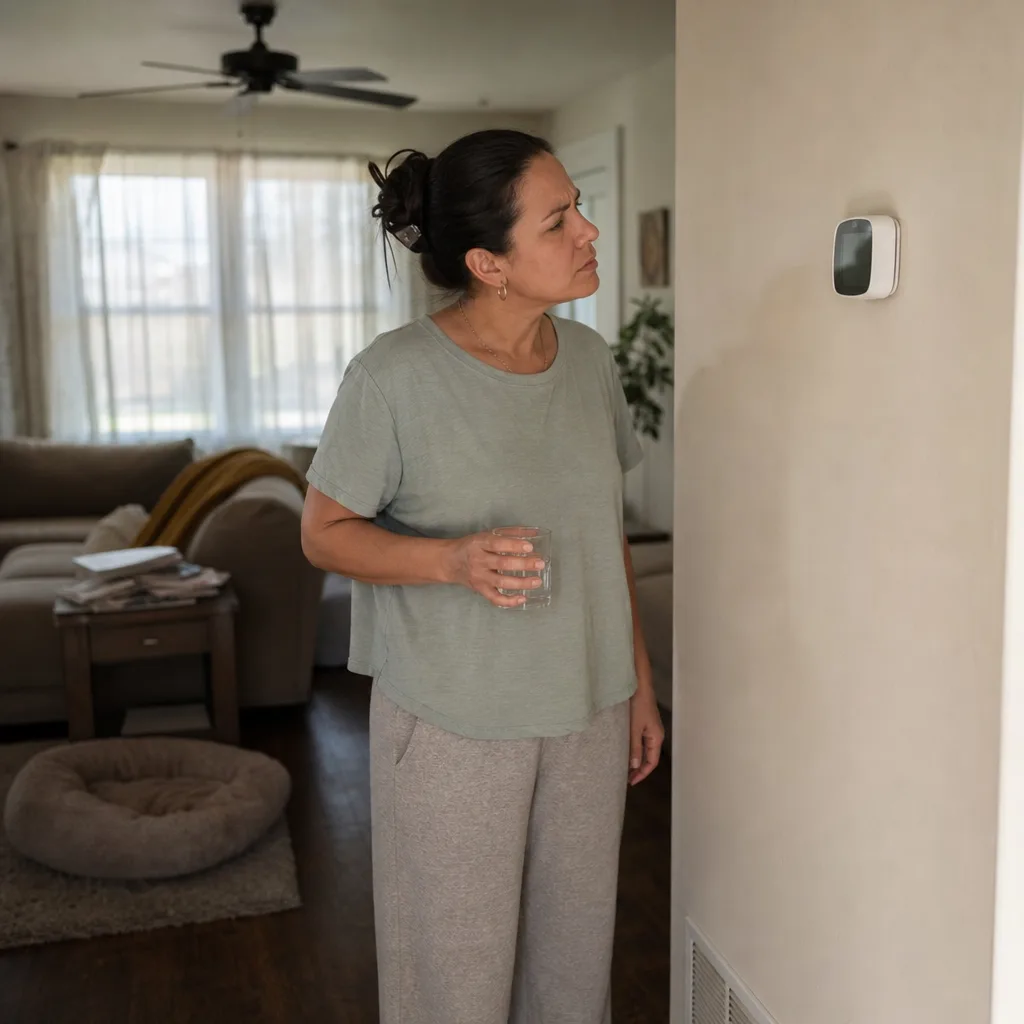
- Check the thermostat. Make sure it’s set to Cool, not Heat or Off. The temperature setting should be a few degrees below the room temperature. Set the fan to Auto. If the screen is blank, swap the batteries.
- Check the breakers. Your AC usually has two, one for the outdoor unit and one for the indoor unit. If one has tripped, flip it all the way off, then back on. Do this only once.
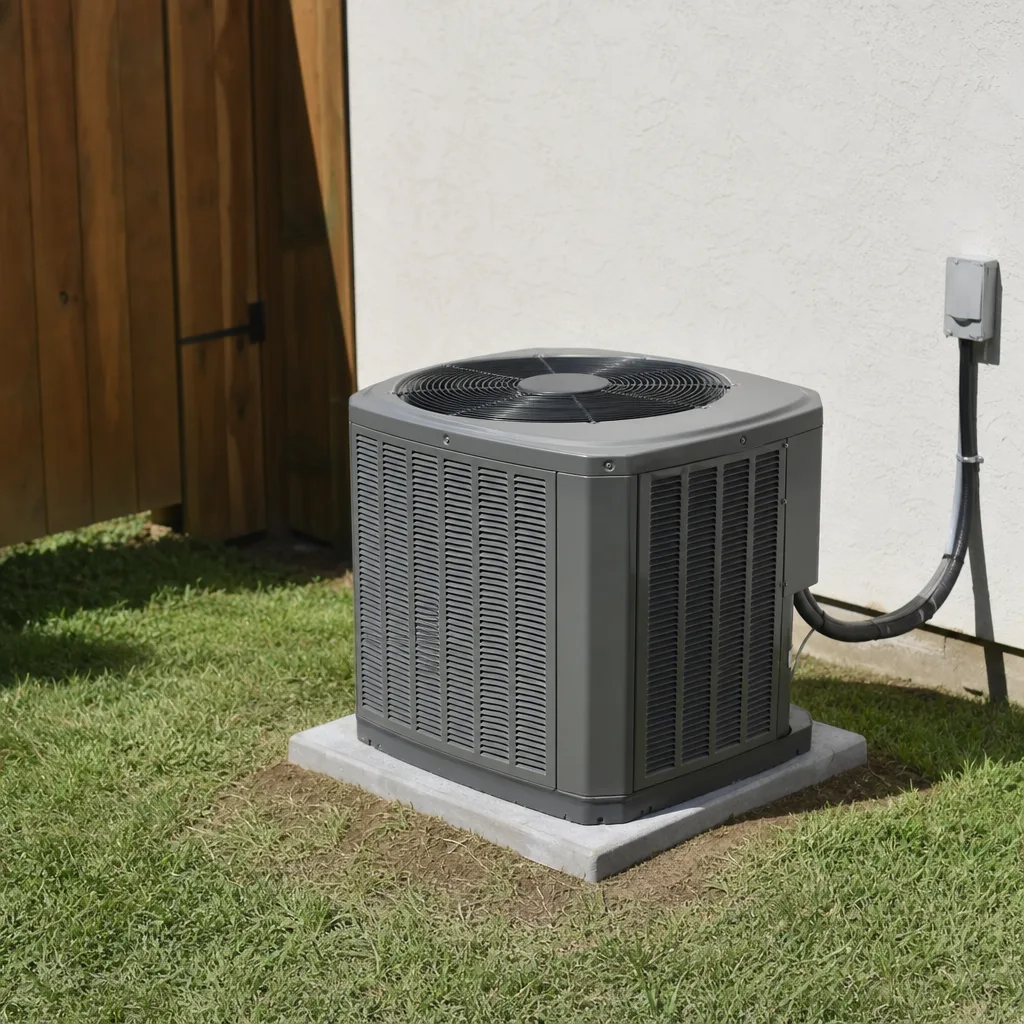
- Check the outdoor shutoff. There’s usually a small box on the wall near the outdoor unit. Make sure the switch or pull-out block is in the on position. A lawn crew or a curious kid can bump it without anyone noticing.
- Check the air filter. A filter caked with dust can choke airflow enough to cause weak air or even ice. If it’s gray and you can’t see light through it, replace it.
- Look at the outdoor unit. Clear away grass clippings, leaves, and plants pressed up against the sides. It needs open space around it to push heat out of your home.
- Give it a few minutes. After a breaker reset or a power blip, many systems wait a few minutes before the outdoor unit starts again. That pause is normal.
If you found ice on the lines, turn the cooling off and let the ice melt before you expect cold air again. A new filter may solve it. If the ice comes back, the cause is something a filter can’t fix.
If water is pooling and the system shut itself off, a safety switch in the drain pan may have tripped to protect your ceiling. Some homeowners are comfortable clearing a clogged drain line on their own. If you’d rather not crawl around a hot attic, or if the pan keeps filling up, that’s a job for a technician.
Here’s where checking ends and repair begins. Stop and call when:
- The breaker trips again after one reset. That points to an electrical fault, and resetting it over and over can damage parts or create a fire risk.
- You smell burning or see scorched or melted wires.
- The outdoor unit hums but the fan won’t spin, the capacitor or fan motor sign covered above.
- Ice comes back after a new filter, or you see oily spots on the copper refrigerant lines. Both can point to a refrigerant leak.
- The fix means opening the panels on the outdoor unit. Capacitors can hold a charge even with the power off, and refrigerant work requires a certified technician.
If you’ve gone through all of this and your house still isn’t cooling, you haven’t wasted your time. Tell your technician what you checked and what you saw. It rules out the simple stuff right away and gets straight to the part that failed.
Watch Our Video
See How We Handle Central air conditioning repair in Frisco
Xtreme Air Services — Frisco
Why Frisco Homeowners Should Confirm Licensing Before Hiring
When your house is 85 degrees and climbing, it’s tempting to call the first number that answers. Take two minutes first and confirm the person coming out is licensed. It’s the easiest way to protect your home, your wallet, and your system.
In Texas, air conditioning contractors are licensed by the Texas Department of Licensing and Regulation, also called TDLR. You can look up any contractor’s license on the TDLR website. You just need the name or the license number. A real company will give you that number without any hesitation.
Why does it matter so much for a repair? Think about what the job really involves. Your technician works on high-voltage wiring and parts like capacitors, and may handle refrigerant, which takes a certified tech as covered above. In a lot of Frisco homes, that work happens in a hot attic, right above your bedroom ceiling. If something goes wrong up there, you want to know the person was trained, licensed, and covered by insurance. Otherwise you could be left paying for the damage yourself.
A newer home doesn’t change that. A two-year-old system in a Frisco subdivision can still lose a capacitor or clog a drain line. A sloppy repair on new equipment can cause problems that are much harder to sort out later.
Here’s what to ask anyone before you let them into your home:
- What’s your TDLR air conditioning license number?
- Are you insured, and can you show proof?
- Will the person who comes out be your own employee?
- Are your technicians background-checked?
- Will I get the price before any work starts?
Watch out for a few red flags. Be careful if someone can’t give you a license number, only takes cash, pushes you to decide on the spot, or knocks on your door right after a storm offering a deal. That doesn’t make every small outfit a bad choice. But a licensed company should be glad to answer every one of those questions.
Here are our answers, so you don’t even have to ask. Xtreme Air Services holds HVAC License #TACLA29023C, and you can check it with TDLR. We’re licensed and insured. Our technicians are background-checked and drug-tested before they ever step into your home. We’re a Trane Comfort Specialist. Your neighbors across North Texas have given us a 4.8-star reputation across more than 2,900 reviews on Google, Angi, and HomeAdvisor.
None of that matters if we can’t get to you. That’s why same-day service is available, and there’s no extra charge for nights or weekends. When you call, you’ll talk to a real person, get a licensed technician headed your way, and see your price before any work starts.
Call 469-490-3595
Frequently Asked Questions
Common questions about Central air conditioning repair
Should I turn off my AC if it’s not cooling?
Yes, turn it off if you see ice on the lines, water pooling, or hear grinding noises. Running a system with ice on the coil or a backed-up drain can push a small problem into a bigger one, like a strained compressor or ceiling damage from overflow. If the air is just warm but nothing looks or sounds wrong, you can leave it off and check the thermostat, breakers, and filter first. Once something is clearly broken, switching it off protects the rest of the system until a technician can look at it.
What is a central air conditioning system?
A central air conditioning system cools your whole house from one set of equipment, usually an outdoor unit and an indoor air handler connected by ducts. The outdoor unit has the compressor and fan, while the indoor unit has the coil and blower that push cold air through your vents. In a lot of Frisco homes, that indoor air handler sits in the attic, which runs hotter than the rest of the house in summer. That’s one reason attic-mounted systems in Frisco see extra wear on parts like capacitors and drain lines.
What is the $5,000 rule for AC?
The $5,000 rule is a quick way to decide between repairing or replacing an AC: multiply the age of your system by the repair cost, and if that number tops $5,000, replacement may make more sense than repair. For most of the common repairs covered here, like a failed capacitor, fan motor, or clogged drain line, you’re well under that number even on an older system. It’s a rule of thumb, not a hard cutoff, and it only applies to the bigger-ticket repairs, not the single-part fixes most AC calls turn out to be.
Ready to Get Started?
Call (469) 490-3595 Today, Get Service Today.