


Emergency HVAC Service in Frisco: Know What It Costs Before You Call
Real emergencies handled fast – with simple checks to try first and the cost explained before anyone is dispatched.
What’s Covered on This Page
- What Counts as a True HVAC Emergency
- Checks to Try Before Paying for an Emergency Dispatch
- Common Failures That Trigger an Emergency Call
- What Happens During an Emergency Repair Visit
- Emergency HVAC Pricing and What Drives the Cost
- My AC is out and I rent my home in Frisco. Should I still call for emergency service myself?
- Is it normal for my heat pump to blow cold air and make a hissing noise in winter?
- How fast can someone get to my house in Frisco for an emergency?
What Counts as a True HVAC Emergency
Not every HVAC problem has to be fixed tonight. Some do, though, and knowing the difference helps you make the call with confidence instead of guessing.
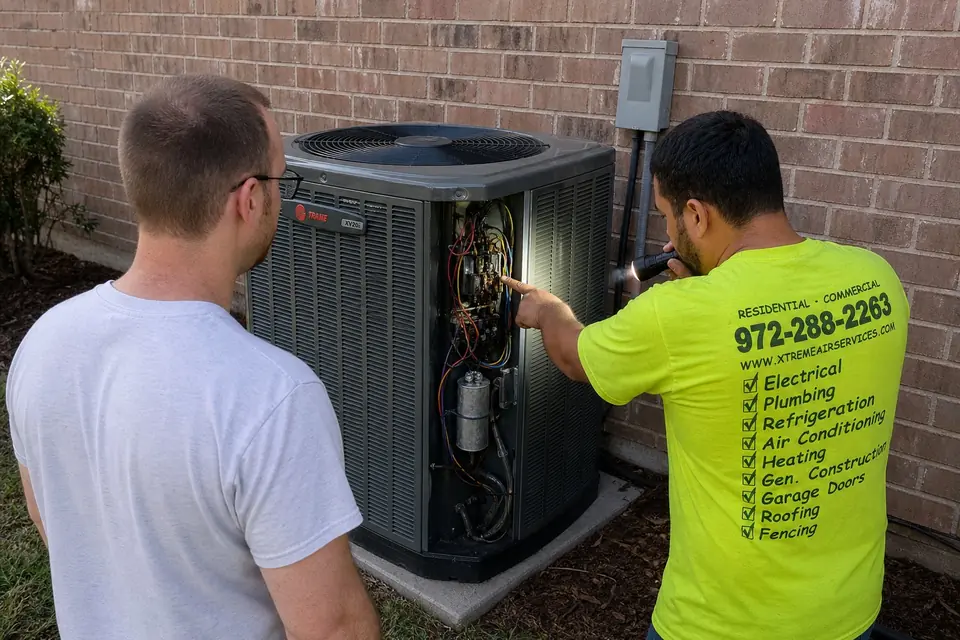
Call for same-day help if any of these sound like your home right now:
- Your AC is out on a hot North Texas day. A closed-up house can heat up fast in triple-digit weather. That’s a bigger concern if you have a baby, an older parent, someone with health issues, or pets at home.
- Your heat is out during a hard freeze. A cold house is miserable, and it can also put your water pipes at risk.
- Water is dripping from your ceiling or pooling around the indoor unit. Many North Texas homes have the air handler in the attic. A clogged drain line or an overflowing pan up there can soak drywall and insulation before you notice.
- You smell burning or hot plastic, or the breaker for your system keeps tripping. Turn the system off and leave it off until it’s checked.
- Your business depends on cooling. A server room, a walk-in cooler, or a store full of customers can’t wait until Monday.
Here’s when it can usually wait. If one room upstairs runs a few degrees warmer, the system still cools but not as well as it used to, or you hear a new noise while everything keeps working, book a regular repair. The same goes for a mild spring or fall day when you can open windows and stay comfortable. You’ll still want it looked at soon, because small problems tend to grow, but you don’t need someone at your door at 10 p.m.
Before you call anyone, take two minutes to try these checks. They solve more problems than you’d think:
- Make sure the thermostat is set to cool or heat, not off, and that its batteries aren’t dead.
- Pull the air filter. If it’s caked with dust, a clogged filter can choke airflow and even freeze the coil.
- Check the breaker panel for the HVAC breakers. If one has tripped, you can reset it once. If it trips again, leave it off and call.
- Look at the outdoor unit. If the fan isn’t spinning while the system is calling for cooling, that points to a part failure you’ll need a technician for.
If those checks don’t fix it and your situation matches the first list, treat it as urgent. One more thing that makes the decision easier: with Xtreme Air Services, there’s no extra charge for nights or weekends. You don’t have to sweat through a Saturday night just to avoid an overtime bill. The price is the same whether we come Tuesday morning or Sunday evening, so you can decide based on what your home needs, not the clock.
Checks to Try Before Paying for an Emergency Dispatch
You’ve already run through the thermostat, filter, breaker, and outdoor fan. If the system is still down, a few more spots can shut it off for simple reasons. None of these checks need tools or opening anything up. If one of them brings your system back, you just saved yourself a visit.
Many newer Frisco homes have the air handler in the attic. That setup comes with a small safety part most people never think about. It’s a float switch on the drain pan or drain line. When water backs up, the switch cuts power to the system so the pan doesn’t overflow into your ceiling. A system that suddenly goes dead with no warning is often a full drain pan, not a broken AC.
- Look at the drain pan under the indoor unit if you can reach it safely. Standing water there means the drain line is clogged, and the float switch has probably shut things off on purpose.
- Find the gray disconnect box on the wall next to your outdoor unit. A lawn crew or a curious kid can bump it to off. Make sure it’s switched on or the pull-out block is pushed fully in.
- Check the front panel on your furnace or air handler. Most units have a door switch that won’t let the blower run if the panel is loose or sitting crooked.
- Look for ice on the copper line going into the outdoor unit or on the indoor coil. Ice means there’s an airflow or refrigerant problem. Switch cooling off so the ice doesn’t get worse, and let a technician find the cause.
- Glance at your smart thermostat after a power blip or a Wi-Fi drop. It may have gone back to a schedule, an away mode, or an eco setting that’s holding the temperature where you don’t want it.
In winter, one thing looks scary but is usually normal. A heat pump will sometimes stop its outdoor fan and puff out steam for a few minutes. That’s a defrost cycle clearing frost off the coil. If heat comes back after that, you don’t need anyone tonight.
Know where to stop, too. If you smell burning, if the float switch keeps tripping, or if ice keeps coming back, don’t keep resetting things. Those point to a real problem, and running the system can turn a small repair into a bigger one.
If you do end up calling, tell us what you’ve already checked. It helps the technician start in the right place. Xtreme Air Services in Frisco works out of our office on Warren Parkway, and the cost to get someone out is spelled out up front. Our service-call fee is $26-$99, and it’s credited toward the repair if you go ahead with the work. Diagnosis, labor, the standard replacement part, testing, and cleanup are included in the repair price. Extra failed parts, major components, code upgrades, or permits are quoted separately before anything happens, so you won’t get surprised later.
These checks are worth a few minutes, not an hour. If nothing here changes the picture and your home is getting too hot or too cold, it’s time for a professional to take over.
That same focus carries through the practical xtreme air services – frisco guidance our team provides to local families.
Common Failures That Trigger an Emergency Call
When a system quits all at once, it feels like the whole thing died. Usually it didn’t. Most emergency calls come down to one worn-out part, and that part can often be found and replaced on the first visit. Here’s what tends to fail, and what each one looks like from your side of the thermostat.
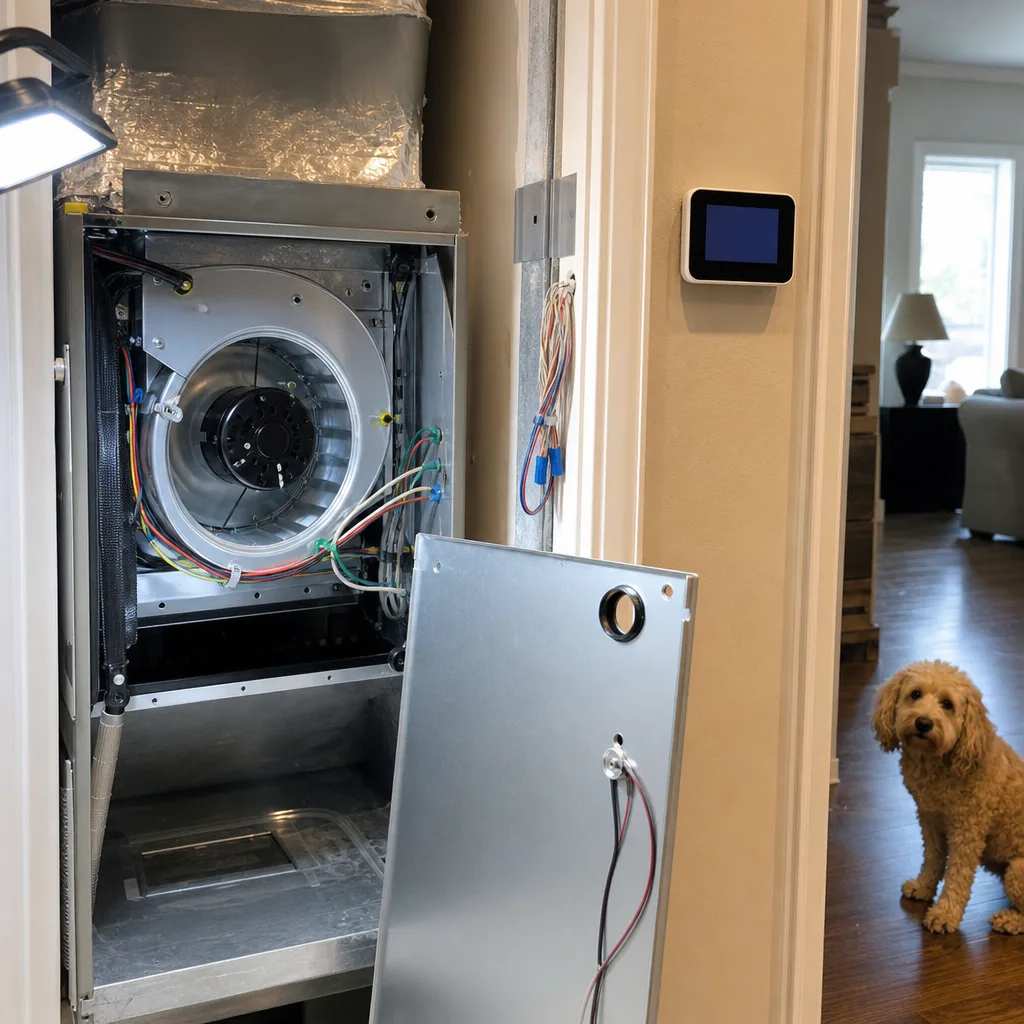
- A bad capacitor. This small part gives the outdoor motors the kick they need to start. Long stretches of North Texas heat wear it down. You’ll notice the outdoor unit humming but not starting, or the fan sitting still while the system calls for cooling. It’s one of the most common reasons an AC stops cold, and it’s usually a quick swap.
- A failed contactor or other electrical part. The contactor is a switch that tells the outdoor unit to turn on. When its contacts burn or stick, the unit either won’t start or won’t shut off. Loose or scorched wires cause similar trouble.
- A worn condenser fan motor. If the fan on top of the outdoor unit stops, heat has nowhere to go. The system may run for a bit, then shut itself off to protect the compressor.
- A blower motor problem. The indoor fan pushes air through your vents. When it fails, you hear the system running but feel little or no air coming out.
- A clogged drain line. As covered above, a backed-up line can shut the whole system down. Clearing it is often the entire fix.
- A refrigerant leak. Low refrigerant means warm air from the vents and long run times. A leak needs to be found and repaired, not just topped off, or you’ll be back in the same spot soon.
- A furnace ignitor or dirty flame sensor. In winter, these two are frequent reasons a gas furnace clicks, tries to light, and gives up. A flame sensor often just needs cleaning. A cracked ignitor gets replaced.
Those are the everyday failures. A few are bigger jobs. A failed compressor, which is the pump at the heart of your outdoor unit, or a fried control board costs more in parts and time. If several parts have gone at once, that adds up too. Age matters as well. On an older system, a technician should tell you plainly whether a repair makes sense or whether you’re putting money into equipment that’s near the end.
So what does this mean for your wallet? For Xtreme Air Services, the most common emergency job, which is finding the failed part, repairing or replacing it, and making sure the system runs right, typically runs $200-$525. Emergency HVAC work overall typically falls in the $200-$900 range. What moves the price is the extent of the failure, the cost and availability of the part, your equipment’s age and brand, and whether more than one component has failed.
If the problem turns out to be a major component like a compressor, you’ll hear that before any work starts, along with the price. Financing is available on larger repairs and replacements, so a big failure doesn’t have to mean an impossible choice on the spot.
The point is simple. A system that won’t run in July or January is stressful, but the cause is usually one part, the fix is usually one visit, and you get to know the cost before anyone picks up a tool.
Have questions? We’re happy to help.
Call Today, Get Service Today. Xtreme Air Services — Frisco is ready to help.
What Happens During an Emergency Repair Visit
Once you’ve made the call, it helps to know what a normal visit looks like. That way you know what to expect and what to ask. Our job on an emergency call comes down to three things. We find the part that failed, repair or replace it, and make sure your system runs right before we leave. Most calls turn out to be one common failure that gets fixed on the first visit.
A few minutes of prep makes the visit go faster:
- Clear a path to the indoor unit. In a lot of Frisco homes, that means the attic. Move boxes away from the pull-down stairs and make sure the attic light works.
- Unlock the side gate. Move anything stacked against the outdoor unit, like patio furniture, trash cans, or kids’ bikes.
- Put pets in another room. Doors will open and close while the technician goes back and forth.
- Jot down what you noticed. Note when it stopped, any sounds or smells, and any blinking lights or codes on the thermostat or the unit.
The person at your door will be one of our licensed and insured technicians. Every one of our team members is background-checked and drug-tested. If you’ve got kids at home, or you’re letting someone in late in the evening, that matters.
Next comes finding the real problem, not guessing at it. The technician starts with the parts that match what you saw. A silent outdoor unit points toward the electrical parts. Weak airflow points toward the blower. A dead system with a wet pan points toward the drain. Some of that work happens in the attic. On a July afternoon, an attic over a Frisco garage can get much hotter than the air outside. Careful testing up there isn’t stalling. It’s how you avoid paying for a part you didn’t need.
Before any work starts, you’ll hear what failed and what it costs to fix. That’s an upfront flat-rate price, and you approve it first. There’s no meter running. A part that’s hard to reach or a repair that takes longer won’t change what you pay. If the technician finds something bigger, like a failed compressor, you’ll get that price separately, as covered above. You still decide what happens next.
Testing and cleanup are part of the repair. Before the technician packs up, it’s fair to ask a few questions so you know the job is really finished:
- Is cool air, or warm air in winter, coming from the vents again?
- Did the outdoor fan and compressor start up and keep running?
- Is water flowing out of the drain line instead of sitting in the pan?
- Can I see the old part? Many people like to, and a good tech won’t mind.
- Is there anything on my system I should keep an eye on?
Done right the first time means your home is comfortable again when the technician leaves. You should know what broke, why it broke, and what you paid for. You shouldn’t be left wondering if the same problem will come back next week.
Watch Our Video
See How We Handle Emergency HVAC service in Frisco
Xtreme Air Services — Frisco
Emergency HVAC Pricing and What Drives the Cost
You’ve already seen what our most common emergency repair costs. What helps more on a stressful night is knowing how HVAC companies price this kind of work in general. Then you can judge any quote you hear, from us or anyone else, before you say yes.
Most companies use one of two models. With flat-rate pricing, you get one price for the whole job before work starts. If the repair takes longer than planned, that’s the company’s problem, not yours. With time and materials, you pay an hourly labor rate plus parts. That can look smaller on the phone, but the total isn’t known until the job is done. On a tricky attic repair at midnight, the clock keeps running while you wait.
After-hours rates are the other big swing. Many HVAC companies charge more for nights, weekends, and holidays. Sometimes that’s a higher trip fee, and sometimes the whole job is marked up. That’s why our same-price policy, mentioned above, matters. Always ask about it before anyone heads your way.
Even with a set price, the same problem can cost different amounts in different homes. Here’s what tends to cause it:
- Part type. Some parts fit almost any system. Others are made for one brand or model and cost more, or take longer to get.
- Heat waves. When North Texas sits in triple-digit heat for days, a lot of systems fail at once. Common parts like capacitors and fan motors can run short.
- Older equipment. Systems built years ago may use parts that are hard to find. Some also use an older refrigerant that’s no longer made, so a leak repair can cost a lot more.
- One failure leading to another. A fan that quits can overheat other parts. A technician should test the whole system so you aren’t paying for a second visit next week.
Before you agree to anything, ask these questions. A good company will answer them on the phone without fuss:
- Is there a trip or service-call fee, and does it count toward the repair?
- Is your price flat, or is it hourly plus parts?
- Do you charge more because it’s night or a weekend?
- Is testing and cleanup part of the price?
- If you find a bigger problem, will I get a new price before you do more work?
Watch out for a price that sounds too low over the phone with nothing in writing. Watch out, too, for someone who starts work before telling you the total. A low hourly rate can still turn into a big bill.
Age matters when the price is high. If your system is old and the repair is a major part, it’s fair to ask, “Is this worth fixing?” An honest technician will tell you plainly, even when the answer is a smaller job for them.
When your home is too hot or too cold and you want a clear price before any work starts, talk to a real person at Xtreme Air Services. Our licensed and insured technicians serve Frisco from our office on Warren Parkway, with same-day service available.
Call 469-490-3595
Frequently Asked Questions
Common questions about Emergency HVAC service
My AC is out and I rent my home in Frisco. Should I still call for emergency service myself?
Yes, you can call us directly even if you rent. We’ll diagnose the problem and give you a flat price before any work starts, so you’ll have clear information to share with your landlord if the repair cost needs to be worked out between you. If the unit truly can’t keep the home safe, like no cooling during a triple-digit stretch, that’s worth treating as urgent no matter who owns the house.
Is it normal for my heat pump to blow cold air and make a hissing noise in winter?
Yes, that’s usually a defrost cycle, not a breakdown. Heat pumps sometimes pause the outdoor fan and release steam for a few minutes to clear frost off the coil. If warm air comes back through your vents afterward, you don’t need to call anyone that night. If it keeps happening or heat never returns, that’s when it’s worth a technician’s look.
How fast can someone get to my house in Frisco for an emergency?
We offer same-day service six days a week out of our office on Warren Parkway, with no extra charge for nights or weekends. Exact arrival time depends on how many urgent calls are already in queue that day, but a true emergency, like no cooling on a dangerously hot day, gets priority over a routine repair.
Ready to Get Started?
Call (469) 490-3595 Today, Get Service Today.