


Commercial Refrigeration in Irving: Keep Your Walk-In and Ice Machine Running
Walk-in coolers, freezers and ice machines repaired by licensed refrigeration technicians – usually one part, not a whole new system.
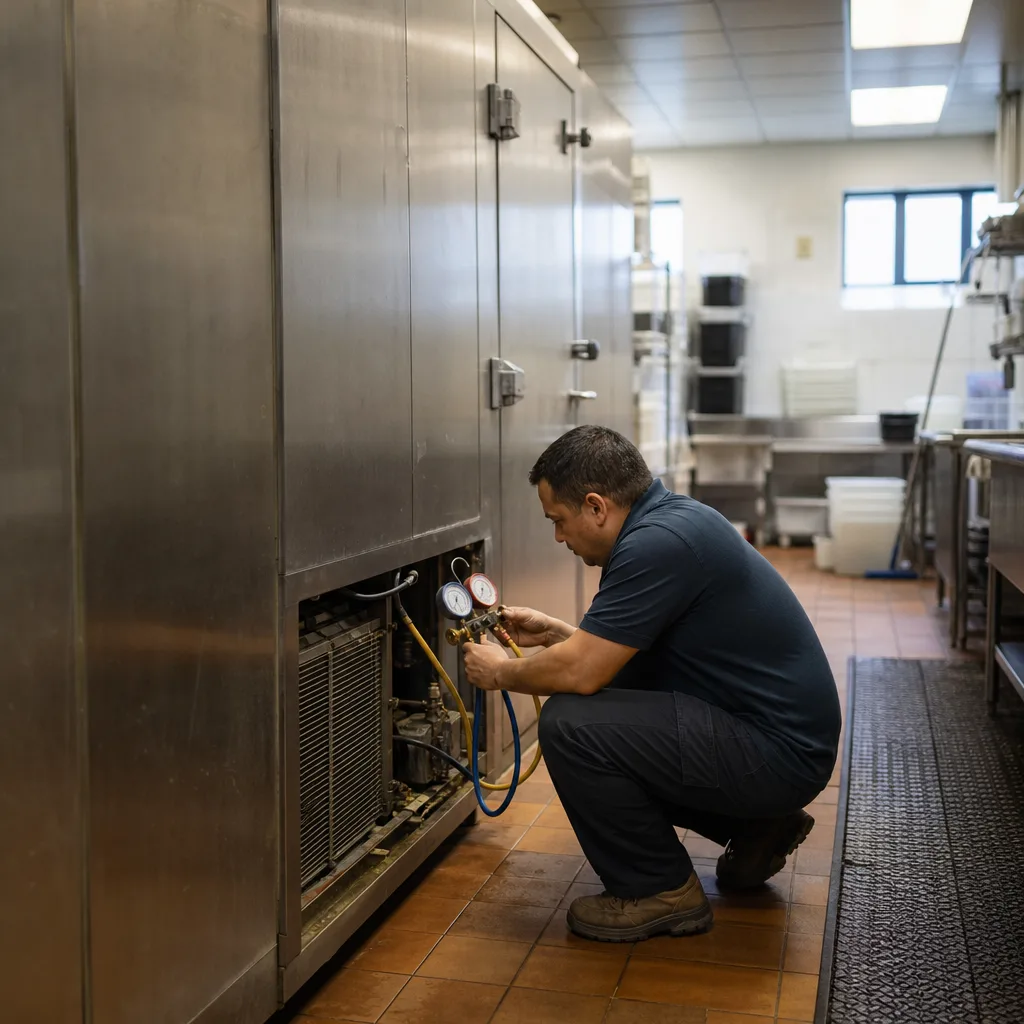
What’s Covered on This Page
- Deciding If Your Refrigeration Problem Needs a Same-Day Call
- Checking a Few Things Before You Call
- What Happens During a Commercial Refrigeration Repair Visit
- Understanding Repair Costs and What’s Included
- Choosing a Qualified Commercial Refrigeration Technician
- Who certifies the technician working on my refrigerant lines?
- Is a walk-in cooler repair different from fixing a home refrigerator?
- Can one technician fix both the refrigeration unit and an electrical problem causing it?
Deciding If Your Refrigeration Problem Needs a Same-Day Call
Not every warm cooler is an emergency. Before you call anyone, take five minutes and walk through what you can safely check yourself. Some of these fixes cost you nothing.
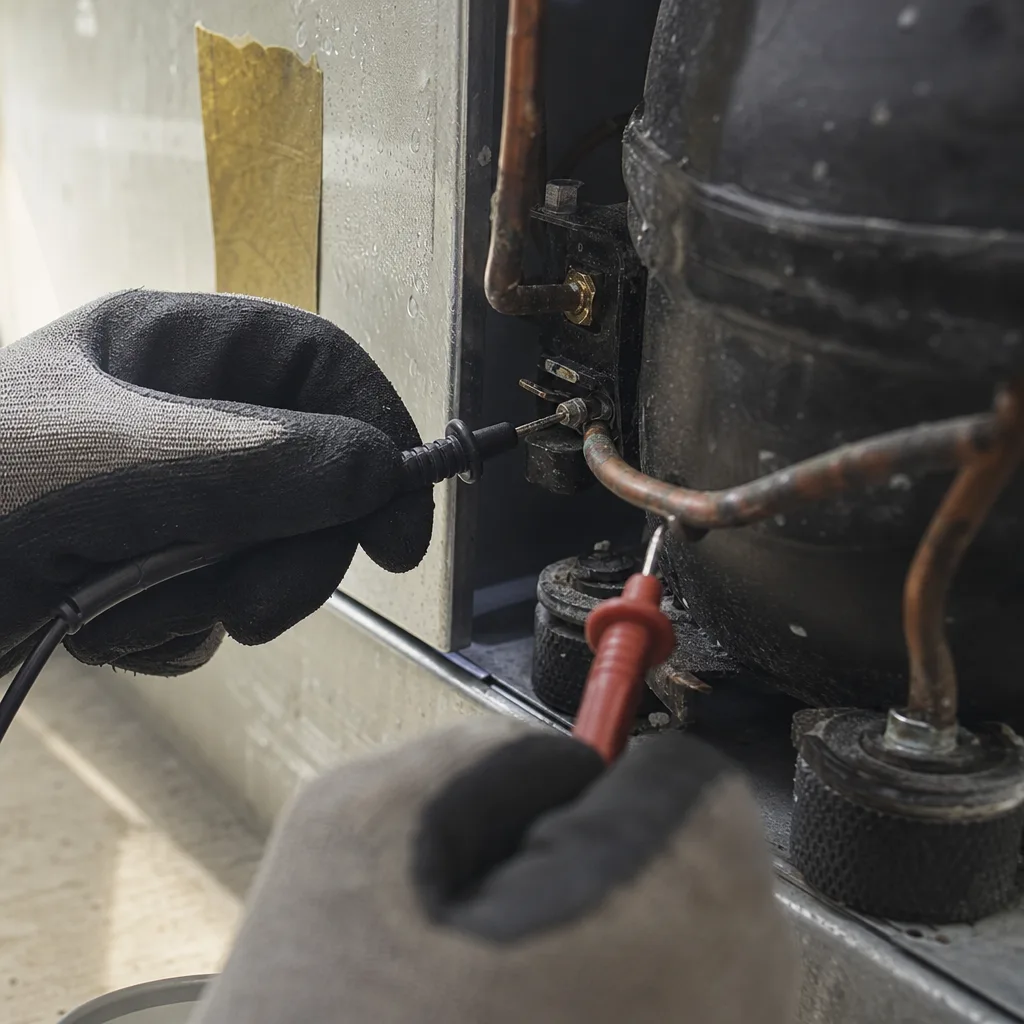
- Power: Is the unit plugged in, and is the breaker on? If a breaker tripped, you can reset it once. If it trips again, leave it off and call. A breaker that keeps tripping is telling you something’s wrong.
- Thermostat setting: Make sure nobody bumped the dial or changed the control while cleaning or stocking.
- The door: Check for a door that didn’t latch, a strip curtain pushed aside, or a torn gasket letting warm air in. During a busy lunch rush in a North Texas summer, a walk-in door left open for a few minutes can warm the box faster than you’d think.
- Airflow inside: Boxes stacked tight against the fan or blocking the vents can starve the cooler of air. Move them and give it time to recover.
If one of those was the problem and the unit pulls back down to temperature, you’re done. You don’t need us, and we’d rather you know that.
Some problems are real but not urgent. If the unit is still holding temperature, you can usually book a regular visit instead of an emergency one. That covers a new rattle or hum, a gasket that’s cracked but still sealing, light frost on the coil, or an ice machine that’s running a little slow but keeping up with demand. Don’t let these sit for months, though. Small problems tend to get bigger when the equipment works hardest, and that’s usually the hottest week of the year.
Call for same-day service when you see any of these:
- The box temperature keeps rising even after you’ve checked the door, the setting, and the airflow.
- The compressor runs nonstop but the cooler isn’t getting colder.
- The unit has power but the compressor or fans won’t start at all.
- Heavy ice is building on the evaporator coil, or the walk-in freezer won’t stay frozen.
- Water is pooling on the floor around an ice machine or under a cooler.
- You notice oily spots on the refrigerant lines or fittings, which can point to a leak.
- You smell something burning or hear grinding or loud clicking from the compressor.
Here’s the simple test. Ask yourself whether you could move the product to another cooler and wait until tomorrow without losing any of it. If you can’t, it’s a same-day call. Don’t let the clock talk you out of it, either. We charge no extra for nights or weekends, so a Saturday evening breakdown costs the same as a Tuesday morning one. That makes the decision about your inventory, not about the time of day.
Checking a Few Things Before You Call
You’ve ruled out the quick fixes above and decided you need help. A few minutes of prep now can save real time once the technician arrives. Most commercial refrigeration calls come down to one common failed part, and the more we know before we get there, the better the odds of fixing it on the first visit.
Here’s what’s worth having ready when you pick up the phone:
- The make, model, and serial number. Look for a metal or sticker data plate. On a walk-in, check the evaporator inside the box and the condensing unit outside. On a reach-in, it’s often behind the front grille or on the back. On an ice machine, check behind the front panel. A phone photo of the plate works fine.
- The temperature right now, and again 30 minutes later. Two readings tell us whether the box is slowly drifting or climbing fast. That changes how we plan the visit.
- When it started and what changed. Was there a power flicker, a storm, a big delivery that went in warm, or a deep clean the night before? Small details like these often point straight at the cause.
- Any codes or blinking lights on the controller. Write them down exactly as they show, even if they don’t mean anything to you.
- Photos of anything odd, like the frost pattern on the coil, a puddle under the unit, or oily spots on the lines.
- What you’ve already tried, including any breaker resets. That keeps us from repeating your steps.
Next, think about access. A lot of condensing units sit on the roof or behind the building, not next to the box. If you lease space in a shopping center or office building, find out now who has the roof key or ladder access, and give the property manager a heads-up. If the kitchen will be in full service when we arrive, let us know so we can work around your line.
While you wait, protect what you can. Keep the door shut as much as possible, because every opening lets warm air in. If you have a second cooler or freezer that’s working, move your most valuable product there first. Don’t load more stock into the failing unit, and don’t keep resetting it hoping it’ll catch up. That can make a weak part fail completely.
When you call, it’s fair to ask a few questions of anyone you hire. Will I get the price before the work starts? Do nights or weekends cost extra? Are your technicians licensed and insured? With us, you get upfront flat-rate pricing that you approve before any work begins. There’s no extra charge for nights or weekends, and our licensed and insured technicians are background-checked and drug-tested. You’ll talk to a real person who can start sorting out your problem right then.
What Happens During a Commercial Refrigeration Repair Visit
The repair itself comes down to three jobs. We find the failed part, repair or replace it, and then confirm the system runs correctly before we call it done. Most calls are a single common failure fixed on the first visit. That matters when you’ve got a walk-in full of product and a dinner service coming.
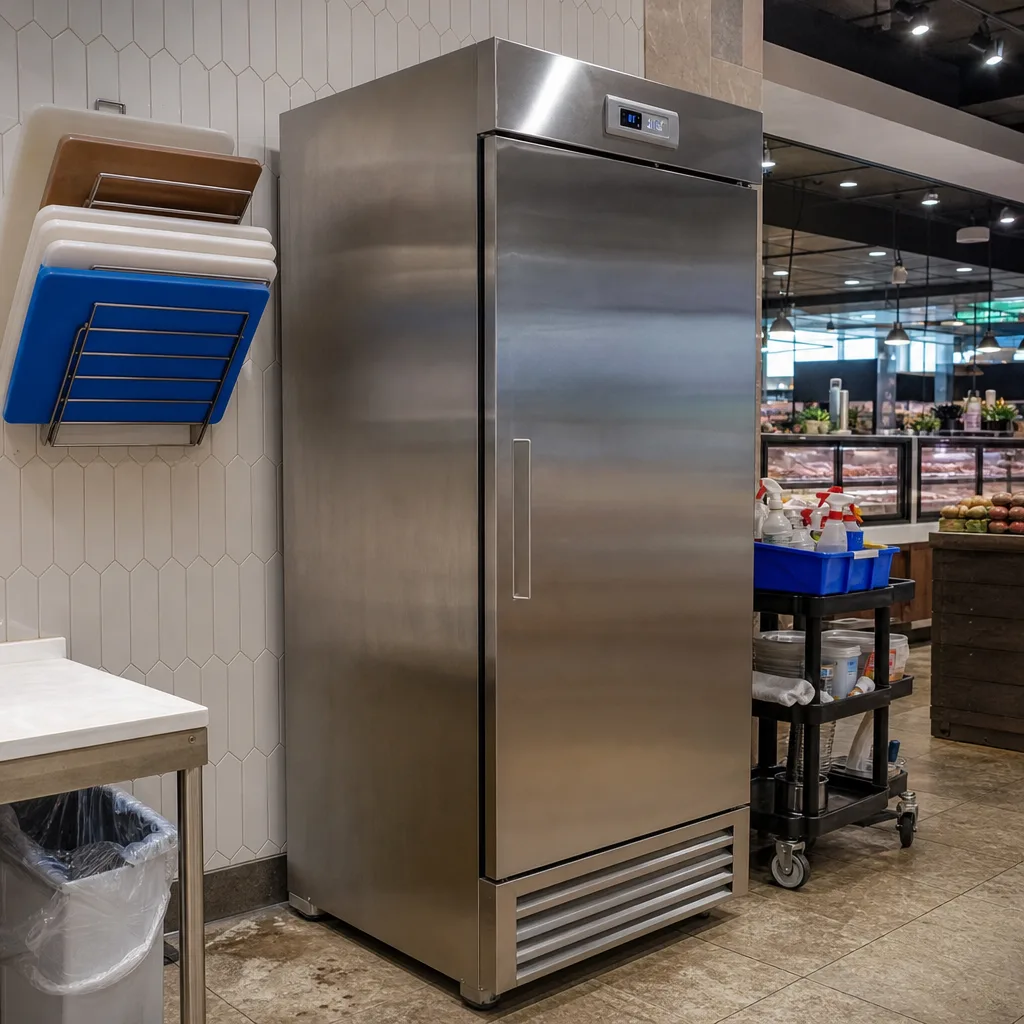
Finding the real cause is the step that saves you money. A warm cooler can look the same from the outside no matter what broke. It could be a fan motor that quit, a bad start capacitor or relay, a stuck defrost control, a condenser coil packed with dirt, or a slow refrigerant leak. Swapping parts until something works gets expensive fast. A good diagnosis traces the symptom back to the one part that failed. In North Texas, that search often leads outside to the condensing unit. Units sitting on a rooftop or behind the building bake in summer sun, and a dirty coil makes them work much harder on the hottest days.
Once we know what’s wrong, you get the price before any work starts. It’s upfront flat-rate pricing that you approve, so there’s no meter running while we work. For the most common job, finding and fixing one failed part, the price runs $300 to $2,400. Commercial refrigeration work overall ranges from $300 to $5,000. The service-call fee is $26 to $99, and it’s credited toward the repair if you go ahead with Xtreme Air Services.
Here’s what that repair price covers and what it doesn’t:
- Included: diagnosis, labor, the standard replacement part, plus testing and cleanup.
- Not included unless quoted separately: additional failed parts, major components, code upgrades, or permits.
So if we find a second part that’s also failing, you’ll hear about it and get a separate price. You decide whether to fix it now or later. Nothing gets added to your bill without your say.
A few things move the price up or down. These include how far the failure has spread, what the part costs, and whether it’s easy to get. The equipment’s age and brand matter too, along with whether more than one component quit. Some brand-specific parts for older units are harder to find, which can affect both cost and timing. If that’s the case, ask about it when you approve the quote. As covered above, the time of day isn’t one of those factors.
Sometimes the honest answer is that an old compressor or condensing unit isn’t worth another repair. If you’re facing a bigger job like a replacement or a new commercial refrigeration installation, flexible financing is available on qualifying installations and larger jobs, on approved credit. That way one bad week doesn’t have to wreck your cash flow.
The visit wraps up with testing. A repair isn’t finished when the part goes in. It’s finished when the system is running correctly and your box is headed back to safe temperature. Then we clean up, so your kitchen or stockroom is ready to get back to business.
Not sure what your Commercial refrigeration project needs? Ask us.
Call Today, Get Service Today. Xtreme Air Services — Irving is ready to help.
Understanding Repair Costs and What’s Included
You won’t know your exact number until the failed part is found. You will know it before any work starts, and the ranges above show where most jobs land. Knowing how to read that number helps you more than a ballpark figure. It also helps to weigh it against what the breakdown is already costing your business.
In commercial refrigeration, contractors usually bill one of two ways. With time and materials, you pay an hourly rate plus parts. Night and weekend hours often cost more, and you don’t see the final total until the job’s done. With flat-rate pricing, you agree on one price for the job before anyone picks up a tool. That difference matters with refrigeration. Climbing to a rooftop condensing unit or tracking down a slow leak can take longer than expected. On an hourly bill, that extra time is your problem. On a flat-rate price, it isn’t. That’s why we price up front and why the clock doesn’t change your total.
A clear quote should tell you these things in plain words:
- Which part failed and what likely caused it, so you know whether it could happen again.
- Whether it’s a standard replacement part or a major component, like a compressor.
- How the technician will confirm the fix worked, such as the box pulling back down to temperature.
- Any other worn parts that were spotted, each priced on its own so you can choose.
- Whether a permit or code upgrade applies to your job.
Next, put the quote next to what you stand to lose. Think about a walk-in full of meat, dairy, and prepped food, plus a Friday dinner service you can’t run. Together, those can cost more than many repairs. The useful question isn’t just “How much is the fix?” It’s “How much does waiting cost me?”
Sometimes repair isn’t the smart money. Replacement starts to make more sense when a few things line up. The unit is getting old, it’s needed several repairs in a short time, and this repair is a big share of what new equipment would cost. Older systems can also run on refrigerants or brand-specific parts that are getting harder to find. That can raise the price of every future repair. It’s fair to ask your technician three things. How old is this unit? What else is wearing out? Will this repair fix the problem, or just buy some time?
Keep every invoice in one folder or one email thread. When the next breakdown comes, that history shows whether you’ve got a one-time failure or a pattern. A pattern is your sign to start planning a replacement before the hottest stretch of a North Texas summer forces the decision. If you’d rather catch worn parts early, ask about our commercial preventive maintenance.
Call 469-200-2166
Watch Our Video
See How We Handle Commercial refrigeration in Irving
Xtreme Air Services — Irving
Choosing a Qualified Commercial Refrigeration Technician
A walk-in cooler isn’t a big home fridge, and it isn’t a house AC either. It runs longer hours, holds colder temperatures, and has parts most home techs rarely touch, like defrost timers, evaporator fans inside the box, and remote condensing units on the roof. So the most important question isn’t just “Can you come today?” It’s “Do you work on commercial refrigeration, and do you know my kind of equipment?”
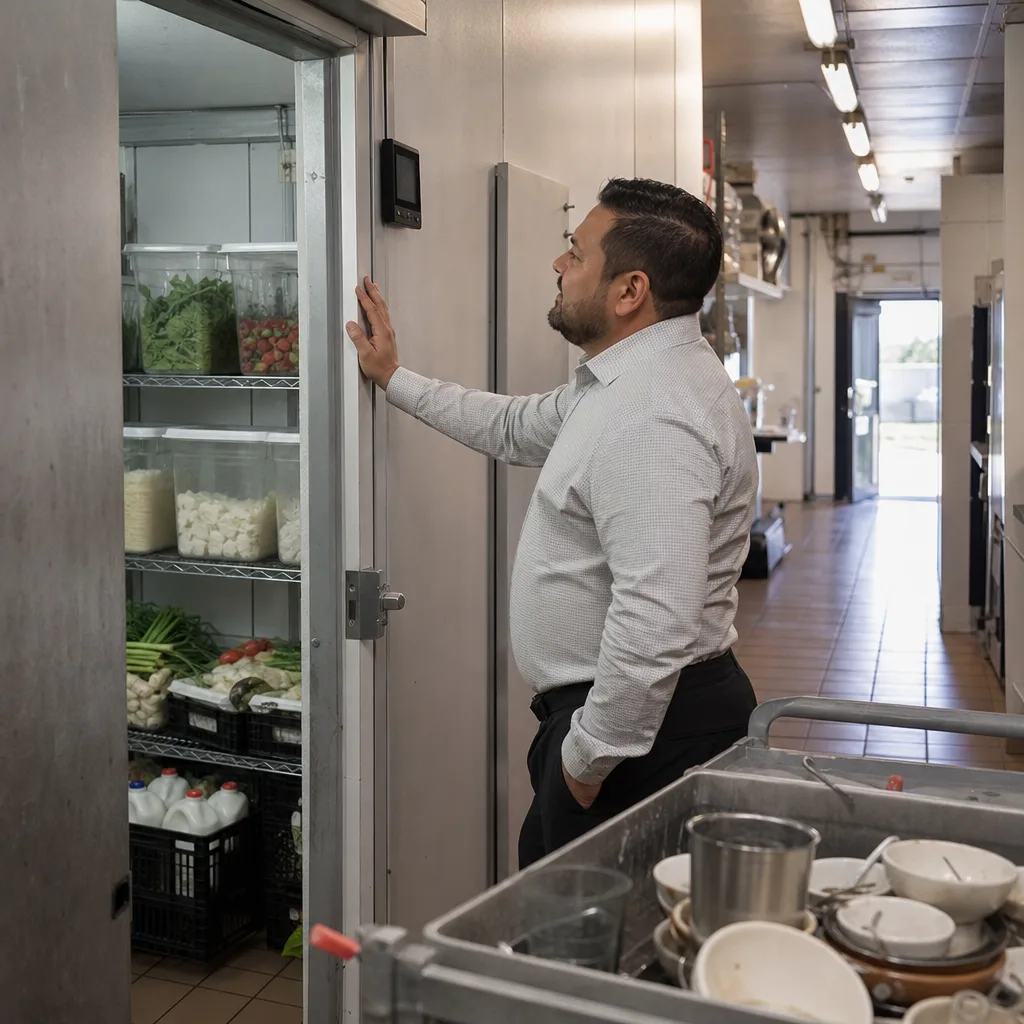
You already know to ask about price, after-hours charges, and insurance. Here’s what else separates a qualified tech from someone learning on your dime:
- Refrigerant certification. Federal rules say anyone who opens a refrigeration system and handles refrigerant must be certified by the EPA. If someone wants to “top it off” and can’t tell you they’re certified, that’s your sign to stop.
- A Texas license. In Texas, air conditioning and refrigeration contractors are licensed by the Texas Department of Licensing and Regulation. Ask for the license number. A real contractor will give it to you right away. Ours is HVAC License #TACLA29023C.
- Commercial experience with your equipment. Ask if they work on walk-in coolers and freezers, reach-ins, and ice machines. A tech who knows how a low-temperature freezer defrosts will find the problem faster than one guessing.
- A clear diagnosis before parts. A good tech tells you what failed and why. If you hear “Let’s try a new compressor and see,” be careful. That’s often the most expensive guess there is.
- Testing before they leave. Ask how they’ll confirm the fix worked. The answer should involve watching the box pull back down to temperature, not just hearing the unit turn on.
Think about who handles the problems that cross trades, too. A cooler that keeps tripping its breaker might have an electrical issue at the circuit, not inside the unit. An ice machine leaking on the floor might be a drain or water line problem. When the refrigeration company can’t touch the wiring or the plumbing, you end up making three calls and waiting on three schedules while your product sits warm. Our team handles HVAC, plumbing, electrical, and refrigeration, so one visit can follow the problem wherever it leads.
Reviews help, but read them the right way. Skip the star count for a minute and look for business owners describing a cooler, freezer, or ice machine that got fixed, and whether the price matched what they were told. Those stories tell you more than a pile of five-star ratings from home AC tune-ups.
Last, pick someone close enough to show up. Our office is right here in Irving at 5000 Riverside Drive, and our technicians are licensed, insured, background-checked, and drug-tested. Your neighbors trust us, too. We’ve earned a 4.8-star rating across more than 2,900 reviews on Google, Angi, and HomeAdvisor.
Call 469-200-2166
Frequently Asked Questions
Common questions about Commercial refrigeration
Who certifies the technician working on my refrigerant lines?
The EPA requires anyone who opens a refrigeration system and handles refrigerant to be certified. Before letting someone touch your walk-in or ice machine, ask for proof of that certification. If they can’t show it, don’t let them work on the unit. This protects you from bad repairs and from violating federal rules on refrigerant handling.
Is a walk-in cooler repair different from fixing a home refrigerator?
Yes, it’s a different job entirely. A walk-in runs longer hours, holds colder temperatures, and uses parts a home appliance tech rarely sees, like defrost timers, in-box evaporator fans, and a remote condensing unit on the roof. A technician who only works on home fridges may not know how these parts fail or how to test them properly. Always ask if the tech has specific experience with commercial units like yours.
Can one technician fix both the refrigeration unit and an electrical problem causing it?
It depends on whether the company handles more than one trade. A cooler that keeps tripping its breaker might be an electrical issue at the circuit, not a problem inside the refrigeration unit itself. If the refrigeration company can’t touch wiring, you end up calling an electrician separately and waiting on two schedules while your product sits warm. Ask upfront whether the company you’re calling can follow the problem across trades in one visit.
Ready to Get Started?
Call (469) 200-2166 Today, Get Service Today.