


A/C System Repair in Dallas: Fix the Failed Part, Not the Whole System
Warning signs explained, quick checks to try first, and a repair price that tells you what's included.
What’s Covered on This Page
- Signs Your System Needs A Repair Call
- What Happens During A Repair Visit
- What A Repair Typically Costs
- When You Do Not Need A Repair Call
- Why Licensing Matters For This Repair
- How fast can someone get to my house in Dallas if my A/C breaks down?
- Can I just add refrigerant to my A/C instead of fixing the leak?
- Is it normal for my A/C to take a few minutes to restart after the power goes out?
- Why does my A/C freeze up in Dallas when it’s over 100 degrees outside?
Signs Your System Needs A Repair Call
Your A/C usually tells you something’s wrong before it quits all the way. The trick is knowing which signs mean a quick fix and which mean a part has given out. Here’s what to watch for, and what each sign tends to point to.
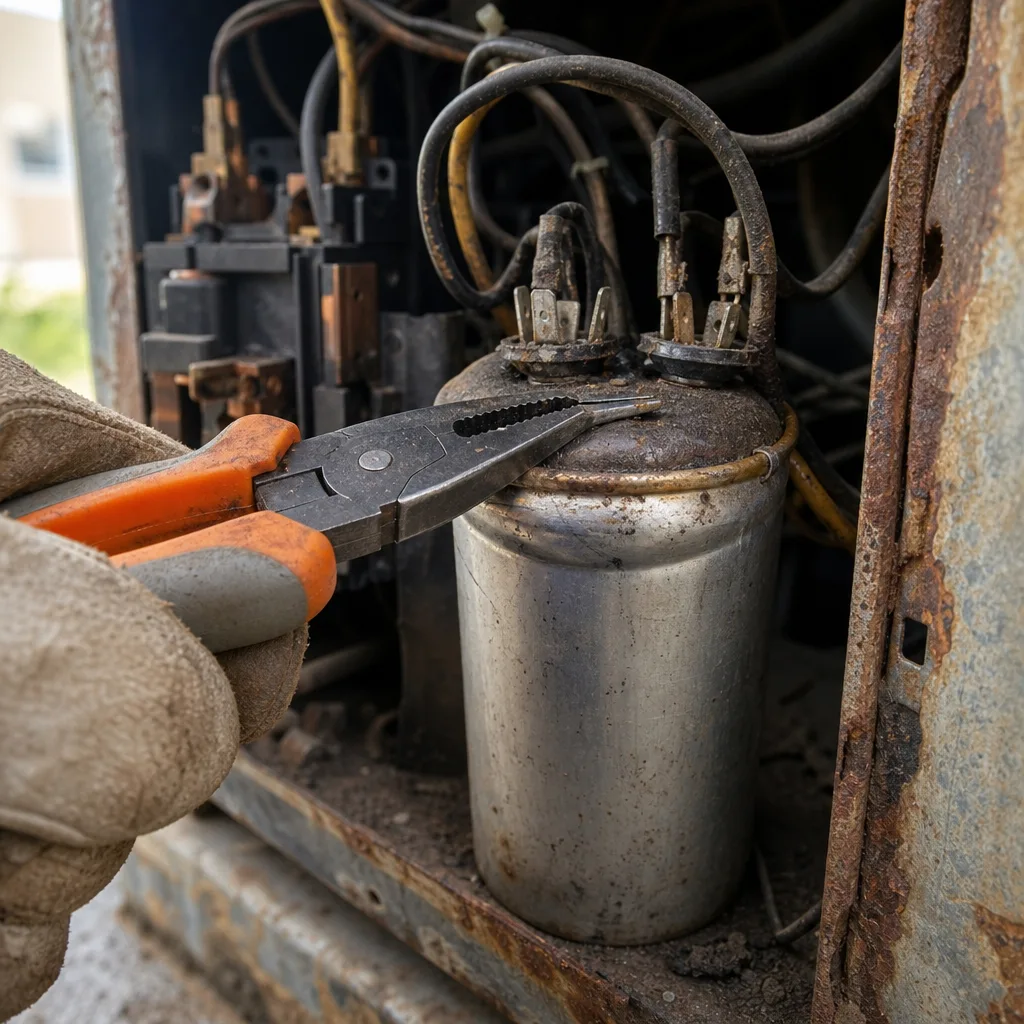
- Warm air from the vents. The system runs, but the air isn’t cool. This often points to a bad capacitor, a compressor that isn’t starting, a refrigerant leak, or a dirty coil.
- The outdoor unit hums but the fan won’t spin. That’s a classic sign of a failed capacitor or fan motor. It needs attention soon, because the system can’t get rid of heat without that fan.
- Weak airflow at the registers. If the air coming out feels thin, the cause could be a clogged filter, a frozen coil, or a blower motor that’s wearing out.
- Ice on the copper lines or the indoor coil. Ice in a Dallas summer sounds strange, but it happens. It usually means low refrigerant, poor airflow, or a dirty evaporator coil.
- Water around the indoor unit or a ceiling stain. Many Dallas homes have the air handler up in the attic. When the drain line clogs, water can back up and spill onto the ceiling below.
- Short cycling. The system turns on and off every few minutes and never finishes a full cooling run. Causes include a bad sensor, an electrical problem, or a unit that’s struggling to keep up.
- New noises. Grinding, squealing, buzzing, or loud clicking at startup often means a motor, a bearing, or an electrical part is failing.
- A breaker that keeps tripping. One trip can be a fluke. Repeat trips point to an electrical fault in the system that should be checked.
- Power bills that jump without a reason. If your usage climbs and nothing else has changed, your system may be working much harder than it should.
Before you call anyone, check three things. Make sure the thermostat is set to cool and the temperature is set below the room temperature. Look at your air filter, and change it if it’s gray and packed with dust. Then check your electrical panel for a tripped A/C breaker. Sometimes one of those is the whole problem, and you won’t need us at all.
If you’ve checked all three and the house is still warming up, the trouble is inside the equipment. Dallas summers make this worse. Your system runs for hours on end, and an attic unit sits in some of the hottest air in your home. A weak part that might hold on in mild weather often fails when the heat peaks.
The good news? Most of these signs trace back to one failed part, not a dead system. A capacitor, a fan motor, a clogged drain line, or a dirty coil can usually be found and fixed on the first visit. Catching it early can keep a small repair from becoming a bigger one, and it gets your family cool again faster.
What Happens During A Repair Visit
An A/C repair visit has three jobs. We find the part that failed, repair or replace it, and then make sure your system runs the way it should before we leave. Most calls come down to one common failure that gets fixed on the first visit. You’ll know what’s wrong and what it costs before anyone picks up a tool.
Here’s how it goes, step by step.
- You call and talk to a real person. Tell us what you’re noticing and when it started. Same-day service is available, and there’s no extra charge for nights or weekends, so a Saturday breakdown costs the same as a Tuesday one.
- A licensed technician arrives. Our technicians are background-checked and drug-tested, and they’ll treat your home with respect.
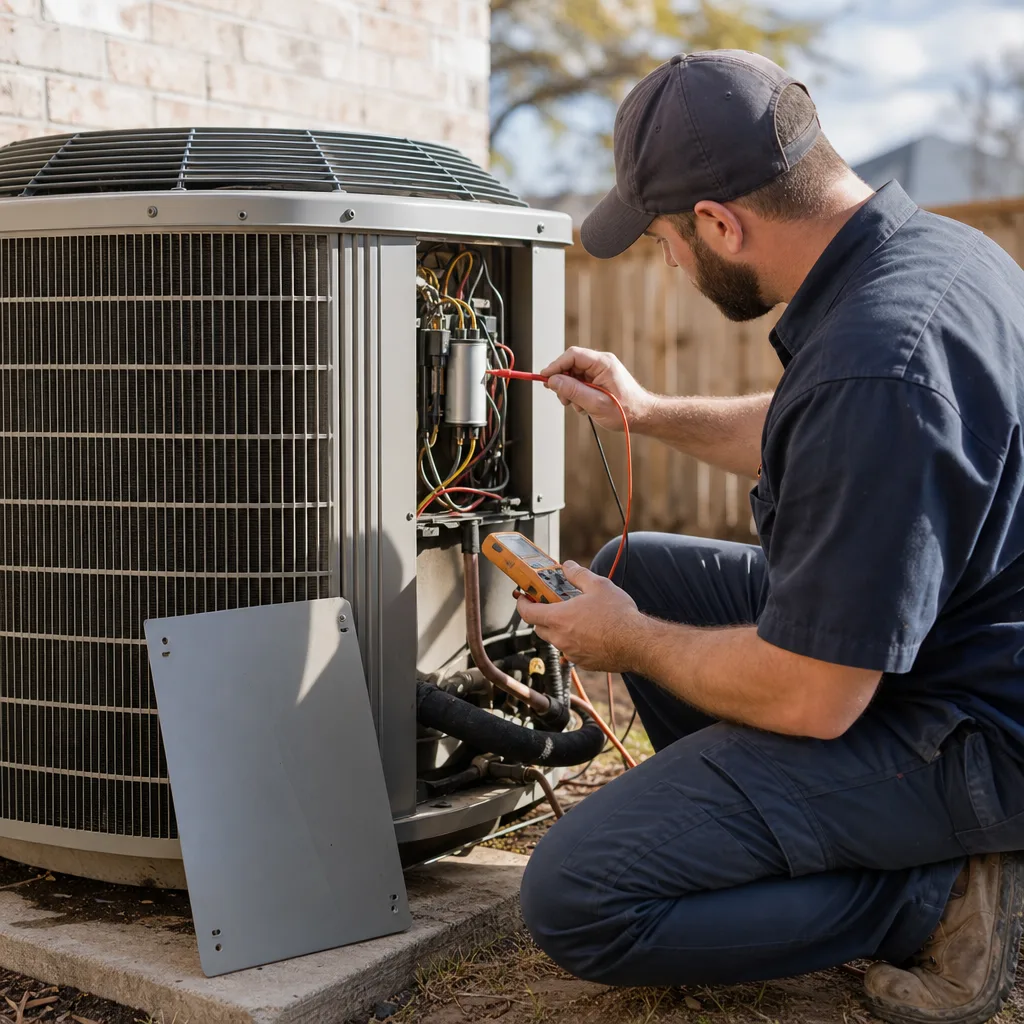
- The technician finds the cause. Diagnosis usually means checking the outdoor unit, the indoor unit, the thermostat, and the electrical parts in between. A good tech tests parts like the capacitor and motors instead of guessing, because swapping parts until something works costs you money.
- You get an upfront, flat-rate price. The technician explains what failed and what the fix will cost. Nothing gets done until you say yes, and there’s no meter running while you decide.
- The repair gets done. The failed part is repaired or replaced with a standard replacement part.
- The system gets tested. Once the work is finished, the technician runs your system to confirm it’s cooling right, then cleans up the work area.
There’s a service-call fee of $26 to $99. If you go ahead with the repair through Xtreme Air Services, that fee is credited toward the repair. The repair price covers diagnosis, labor, the standard replacement part, testing, and cleanup.
Some things aren’t included unless they’re quoted separately. These are additional failed parts, major components, code upgrades, and permits. Say the technician replaces a bad capacitor and then finds the fan motor is also failing. That second part gets its own price, and you decide whether to fix it now. You stay in control of the decision the whole way through.
If your system is older and the diagnosis turns up a major failure, the technician will lay out your options plainly. That includes whether a big repair still makes sense. Financing is available on larger repairs and replacements, but nobody will push you toward a new system when one fixed part gets your family cool again.
What A Repair Typically Costs
Most A/C repairs with Xtreme Air Services cost between $150 and $700. The most common job runs $150 to $400. That job means finding the one failed part, repairing or replacing it, and making sure the system runs right. Most calls come down to a single common failure fixed on the first visit, so that lower range is where a lot of Dallas homeowners land.
Your exact price depends on what the technician finds. You’ll get it as an upfront flat-rate price before any work starts. The number doesn’t grow while the tech works, and it doesn’t change if the job takes longer than expected.
Here’s what moves the price up or down:
- How bad the failure is. A part that simply wore out is a simpler fix than one that failed and stressed other parts along the way.
- Part cost and availability. Some parts cost little and are easy to get. Others cost more or take longer to find.
- Your equipment’s age and brand. Older systems and some brands use parts that cost more or are harder to track down.
- How many parts failed. One bad part is one repair. If a second part is going too, it’s priced on its own, and you choose whether to fix it now.
- Time of day. This one won’t raise your price with us. There’s no extra charge for nights or weekends. If your A/C quits at 9 p.m. on an August Sunday, you pay the same as you would on a Tuesday morning.
Flat-rate pricing matters more than it sounds. With hourly billing, every extra minute adds to your bill, whether it’s a slow diagnosis or a run to the supply house. Flat-rate pricing ties the cost to the job, not the clock. You know what you’re paying before you agree to anything.
If you’re getting more than one quote, ask every company the same questions. That’s the only way to compare fairly:
- Is the price flat-rate or hourly?
- Does the service-call fee count toward the repair? With us, it’s credited when you go ahead with the repair.
- Does the price cover the part, labor, testing, and cleanup, or just the part?
- If you find a second bad part, will you stop and price it before doing the work?
- Do you charge more for nights, weekends, or holidays?
- Are your technicians licensed and insured?
A low quote that leaves out labor or adds an after-hours fee can end up costing more than a higher flat price that covers everything.
Sometimes the price goes beyond the typical range. That happens when the problem is a major component, like a compressor, rather than a small part. Major components are quoted separately. This is when the age of your system really counts. After years of long Dallas summers running for hours at a time, an older unit may not be worth a big repair. Financing usually isn’t offered on smaller repairs, but it is available on larger repairs and replacements. You’ll have real numbers in front of you before you decide anything.
Not sure what your A/C system repair project needs? Ask us.
Call Today, Get Service Today. Xtreme Air Services — North Dallas is ready to help.
When You Do Not Need A Repair Call
Not every warm afternoon means a part has failed. Sometimes your system is doing exactly what it was built to do. Other times the fix takes you five minutes and costs nothing. Beyond the thermostat, filter, and breaker checks above, here are the times you can skip the repair call or hold off.
- The house runs a few degrees warm on the hottest afternoons. Most home systems are built to keep you comfortable on a typical hot day, not to hold 70 degrees when it’s 105 outside. If the system runs steady, the vent air feels cool, and the house catches up after sunset, your system is at its limit. That’s different from a broken part. Closing the blinds on west and south windows in the afternoon helps more than cranking the thermostat way down.
- The thermostat screen is blank. Many thermostats run on batteries. Fresh ones may bring it right back to life.
- The system didn’t start right after a power blip. Many systems wait a few minutes before the outdoor unit kicks back on. This delay protects the compressor. Give it some time before you worry.
- Water is dripping outside near your foundation. A small line dripping outdoors in summer is the drain doing its job. It carries away the moisture your system pulls out of the air. Water inside your home is a different story. A puddle near the indoor unit or a stain on the ceiling needs attention.
- One room stays hotter than the rest. If the rest of the house cools fine, make sure the vent in that room is open. Then check that furniture or a rug isn’t blocking the return grille. If the room is still hot after that, the cause is usually the ductwork or the layout of your home, not a failed part. Duct repair or zoning is a separate fix from a repair visit.
- The outdoor unit is boxed in. Shrubs, fences, trash cans, or stored items pushed up against the unit choke its airflow. Clearing a few feet of space around it helps it get rid of heat.
- Everything works, and you just want peace of mind. If your system cools well and you’d like it checked before summer hits, you need a tune-up, not a repair.
Some problems can wait. If your system still cools, runs smoothly, and only lags at the peak of the day, a regular appointment is fine. You don’t need to pay for anything urgent, and you don’t need to lose sleep over it.
That changes when you see the signs covered in the first section. Watch for warm air from the vents, ice on the lines, an outdoor fan that won’t spin, water inside the house, or a breaker that trips again after you reset it. These problems don’t fix themselves. Running the system hard through a Dallas heat wave with a weak part can turn one small repair into two.
If one of the simple fixes above turns out to be your whole problem, good. Your system is working, and that’s money you keep.
Watch Our Video
See How We Handle A/C system repair in Dallas
Xtreme Air Services — North Dallas
Why Licensing Matters For This Repair
An A/C repair looks simple from the outside. A part fails, someone swaps it, and the air turns cold again. But the parts behind that cold air are high-voltage electrical parts and a sealed refrigerant system. Having the right person working on them protects your safety, your equipment, and your wallet.

In Texas, air conditioning contractors are licensed through the Texas Department of Licensing and Regulation, also called TDLR. That license tells you the contractor has met the state’s training and testing rules for this work. It also means there’s a state agency you can go to if something goes wrong. Xtreme Air Services holds HVAC License #TACLA29023C, and you can look it up yourself.
Here’s why it matters for the repairs on this page:
- Capacitors hold a charge. A capacitor can still hold a strong electrical charge even after the power is off. A trained tech knows how to discharge it safely and test it before replacing it.
- Refrigerant isn’t a do-it-yourself job. Federal rules require anyone who handles refrigerant to be certified. Adding refrigerant without finding the leak just puts off the next breakdown.
- Electrical faults need real testing. A breaker that keeps tripping or a system that short cycles could point to a wiring problem. Guessing wastes money, and a wrong fix can damage the equipment.
- Bigger work can need a permit. If the job turns into a major component or a code upgrade, a licensed contractor can handle the permit as part of a separate quote.
Insurance matters just as much as the license. Many Dallas homes have the indoor unit up in a hot attic, where a slip or a dropped tool can mean an injury or a damaged ceiling. If the contractor isn’t insured, that cost can land on you. Our technicians are licensed and insured, and every team member is background-checked and drug-tested before they ever step inside your home.
Before you let anyone work on your system, ask these questions:
- What’s your TDLR license number?
- Are you insured if someone gets hurt or something gets damaged at my house?
- Is the technician coming to my home certified to handle refrigerant?
- Will you test the part before you replace it?
A good contractor answers all four questions without hesitating. If someone dodges them, or offers a price that seems too good to be true with no license to back it up, that’s your sign to keep looking.
Licensing is also what makes a first-visit fix possible. A trained tech who tests parts instead of guessing finds the one part that failed, quotes you a flat price, and gets your home cool again. As a Trane Comfort Specialist with a 4.8-star reputation across more than 2,900 reviews on Google, Angi, and HomeAdvisor, we’ve built our name across North Texas by doing right by our customers, one repair at a time.
Call 469-213-3107
Frequently Asked Questions
Common questions about A/C system repair
How fast can someone get to my house in Dallas if my A/C breaks down?
Same-day service is available 6 days a week, so most Dallas breakdowns get seen the day you call. This matters most in summer, when an attic air handler can sit in extreme heat and a weak part can fail fast. There’s no extra charge for nights or weekends, so a weekend breakdown costs the same as a weekday one.
Can I just add refrigerant to my A/C instead of fixing the leak?
No, adding refrigerant without finding the leak just delays the next breakdown. Federal rules require anyone handling refrigerant to be certified, because it’s a sealed system, not a simple top-off. A licensed technician tests for the actual leak source so the fix holds instead of repeating in a few weeks.
Is it normal for my A/C to take a few minutes to restart after the power goes out?
Yes, many systems wait a few minutes before the outdoor unit kicks back on after a power blip. This delay protects the compressor from damage, so it’s not a sign of a failed part. Give it a little time before assuming something’s broken.
Why does my A/C freeze up in Dallas when it’s over 100 degrees outside?
Ice on the coil or copper lines during a Dallas summer usually means low refrigerant, poor airflow, or a dirty evaporator coil. It sounds backwards, but a struggling system can freeze even in extreme heat. This isn’t a sign to wait it out, since running it more can push a small issue into a bigger repair.
Ready to Get Started?
Call (469) 213-3107 Today, Get Service Today.