


Central Air Conditioning Repair in Dallas
Central AC problems diagnosed and fixed right the first time, with clear pricing on what drives the cost.
What’s Covered on This Page
- Signs Your Central AC Needs a Repair Call
- Why Dallas Heat Wears Out AC Parts Faster
- Check These Three Things Before You Call
- What Happens During a Repair Visit
- What a Repair Costs and What’s Included
- Can a central AC repair wait until morning, or should I call right away?
- Do most central AC problems come from one bad part or a bigger system failure?
- Is it normal for a Dallas AC to struggle more in the afternoon than the morning?
Signs Your Central AC Needs a Repair Call
Your AC almost always tells you something’s wrong before it quits. You just have to know what you’re looking at. Here’s what to watch for and what it usually means.
- Warm or room-temperature air from the vents. The blower is running, but the air isn’t cooling. That often points to a failed capacitor, a refrigerant leak, or an outdoor unit that isn’t running at all.
- The outdoor unit hums but the fan won’t spin. A humming condenser with a still fan is a classic sign of a bad capacitor or a failing fan motor.
- Weak airflow, even with a clean filter. If air barely moves out of the registers, the blower motor, a frozen coil, or a duct problem could be the cause.
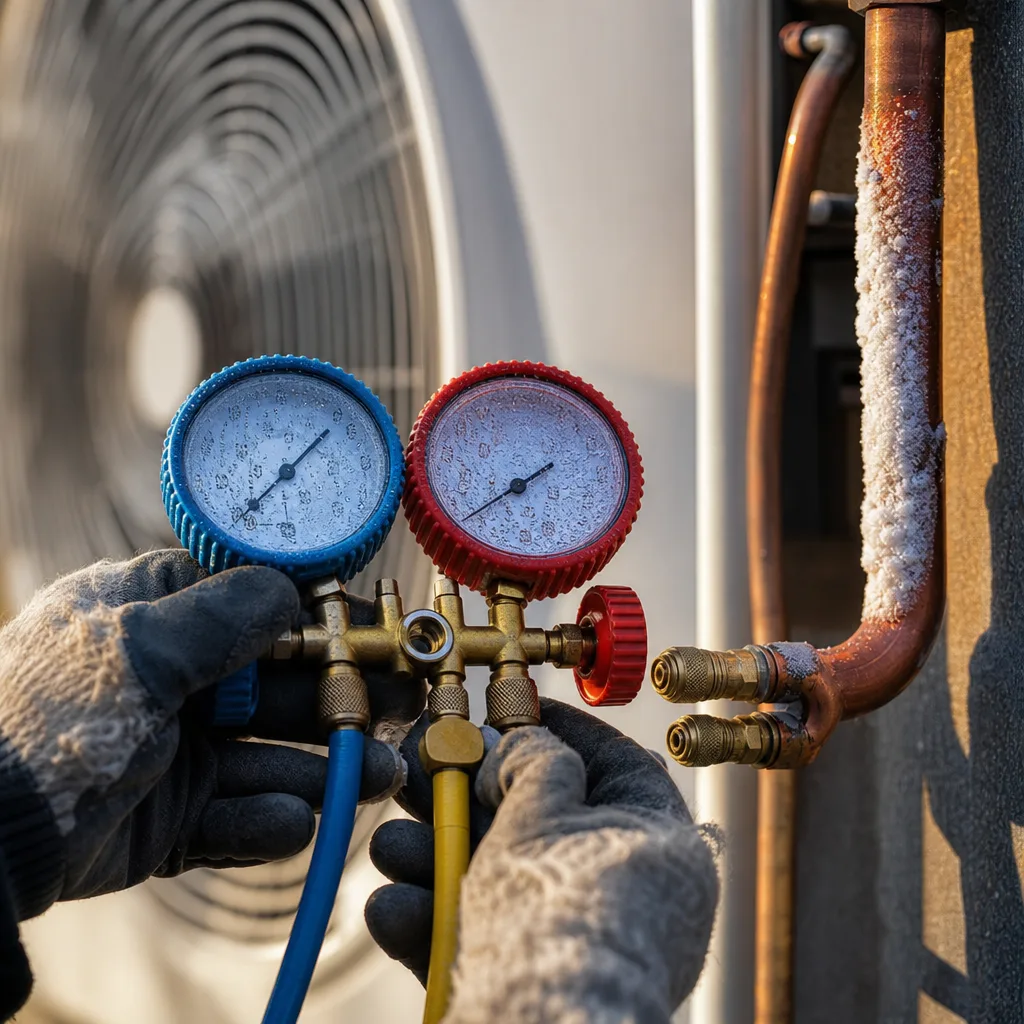
- Ice on the copper lines or the indoor coil. Frost on an AC in July sounds strange, but it’s real. It usually means low refrigerant or poor airflow across the coil.
- The system won’t turn on, or it trips the breaker. That’s an electrical issue, like a bad contactor, capacitor, or control board, and it needs a trained eye.
- Short cycling. If the AC kicks on, runs a few minutes, shuts off, and repeats all day, something’s wrong with the thermostat, the refrigerant charge, or a sensor.
- New noises. Buzzing, clicking, grinding, or squealing all mean something. Buzzing is often electrical. Grinding or squealing usually means a motor or bearing is wearing out.
- Burning or musty smells. A hot, electrical smell from the vents is never normal. A musty smell can mean water is sitting where it shouldn’t.
- A power bill that jumps without a reason. When your usage climbs but your habits haven’t changed, the system is likely working harder to do the same job.
In a lot of Dallas homes, the indoor unit and air handler sit up in the attic. That’s important. When the condensate drain line clogs, water backs up into the pan and can overflow. You won’t see it in the attic. You’ll see it as a brown stain or a soft spot on the ceiling below. If you notice one near a hallway or a closet under the attic unit, your AC drain is a likely suspect.
There’s one more sign Dallas homeowners know too well. The house holds fine in the morning, then the indoor temperature creeps up all afternoon and never comes back down. A healthy system should keep up on a hot day. If yours keeps falling behind, a weak part is often the reason, and summer heat is exactly what exposes it.
Most of these signs trace back to one failed part, not a dying system. A warm-air call or a humming outdoor unit sounds scary, but it’s often a fix that gets your home cool again the same day. Knowing the sign helps you describe it on the phone, and that helps the technician come prepared.
Why Dallas Heat Wears Out AC Parts Faster
Your AC doesn’t wear out evenly. Dallas summers put the most stress on a handful of specific parts, and those are the parts that give out first. That’s good news for you. When one part fails because the heat beat it up, replacing that part usually gets the whole system running right again.
Here’s what’s going on behind the scenes. In a lot of the country, an AC runs in short bursts and rests in between. Here, on a run of triple-digit afternoons, it can run for hours with barely a break, and the nights don’t always cool off enough to let it catch up. Every extra hour adds heat and wear to the same few components.
- Capacitors. This small part gives the motors a jolt to start and keeps them running. Heat breaks it down from the inside, so it slowly gets weaker until one hot afternoon it can’t do the job anymore. It’s one of the most common reasons an AC quits in summer.
- Contactors. This switch clicks on and off every time your system cycles. Long seasons of heavy use pit and burn the contact points until they stop connecting cleanly.
- Fan and blower motors. Motors that run nearly nonstop wear their bearings faster, and outdoor fan motors bake in direct sun on top of that.
- The compressor. It’s the heart of the outdoor unit, and it works hardest when it’s hottest outside. A weak capacitor or a dirty coil makes it strain even more, which is why catching the small part early protects the big one.
Where your equipment sits matters too. Many Dallas homes, older ranch houses and newer subdivisions alike, have the air handler up in the attic. On a summer day that attic gets far hotter than outside. The blower motor, the wiring, and the control board all sit in that heat every day, and it shortens their life. It’s the same space where a clogged drain line can overflow without you seeing it, as covered above.
North Texas weather adds a few hits of its own:
- Hail can flatten the thin metal fins on your outdoor coil. Bent fins block airflow, so the unit runs hotter and longer to do the same work.
- Thunderstorms bring power flickers and surges. Those spikes are hard on capacitors, contactors, and circuit boards.
- Our clay soil swells when it’s wet and shrinks when it’s dry. Over time, that can tilt the pad your outdoor unit sits on and put strain on the refrigerant line connections.
Put it all together and you can see why so many summer breakdowns trace back to one tired part. It’s rarely a mystery and it’s rarely the whole system. Usually the heat found the weakest link. If your house starts losing ground in the afternoon, the way described above, it often means one of these parts is fading, not that your AC is finished.
This is also why age alone doesn’t tell you much. A 10-year-old system with a fresh capacitor and a clean coil can outlast a newer one that’s been ignored. A good technician finds the part the heat wore down, fixes it, and checks that the rest of your system isn’t straining to keep up.
Check These Three Things Before You Call
Before you pick up the phone, take five minutes and check three things. Sometimes the fix is one you can make yourself, and we’d rather you know that up front. If none of these solves it, you’ve still ruled out the easy stuff, and that helps the technician get to the real problem faster.
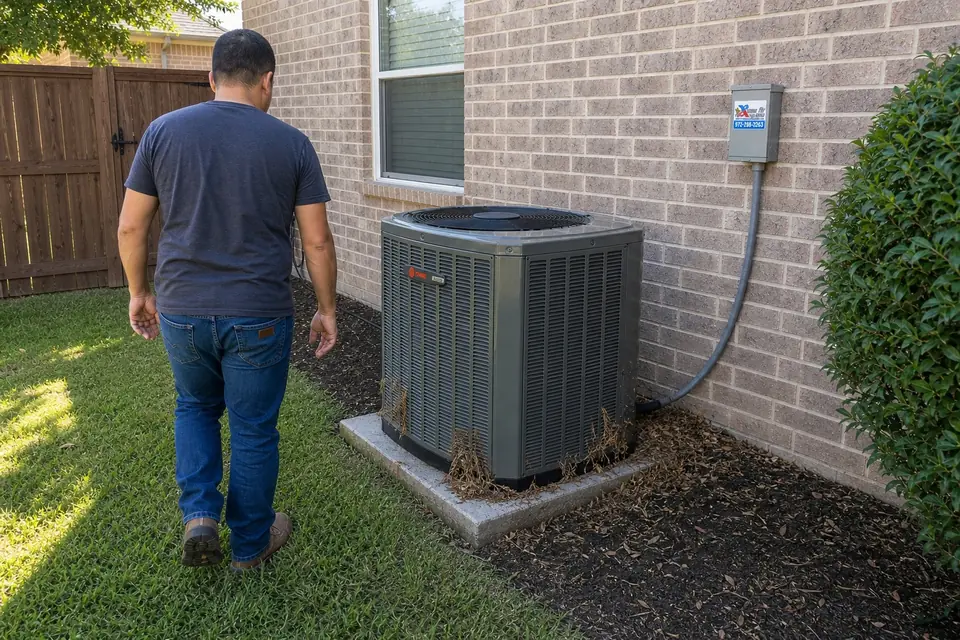
1. Your thermostat.
- Make sure it’s set to Cool, not Heat, Off, or Fan only.
- Set the temperature a few degrees below what the room is now.
- If the screen is blank or dim, replace the batteries. A lot of thermostats run on AA or AAA batteries, and a dead set can make it look like the whole AC died.
- If it’s a smart thermostat, check for a schedule, an away mode, or an app setting that’s holding the temperature up.
2. Your breakers and outdoor switch.
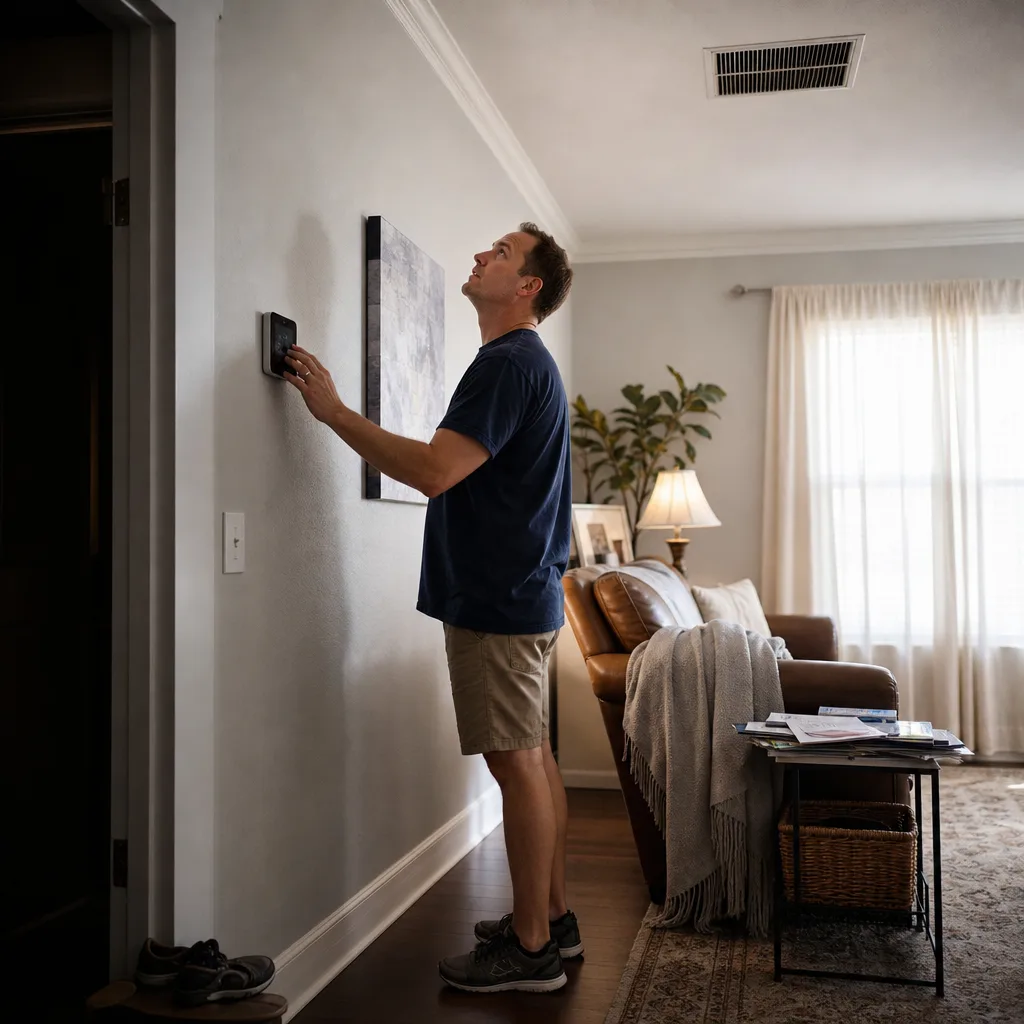
Your central AC usually has two breakers in the main panel, one for the outdoor unit and one for the indoor air handler. Look for one that’s tripped to the middle or Off position. Flip it fully off, then back on. Also check the shutoff box mounted on the wall near your outdoor unit. Sometimes a yard crew or a curious kid bumps it.
Here’s the honest limit on this one. If the breaker trips again right away, or soon after the AC starts, leave it off. A breaker that keeps tripping is telling you something electrical is wrong, and resetting it over and over can make the damage worse.
3. Your air filter.
Pull the filter and hold it up to a light. If you can’t see light through it, it’s choking your system. A clogged filter can cut airflow enough to freeze the coil and leave you with warm air from the vents. In a Dallas summer, when your AC runs for hours a day, filters load up faster than the date on the package suggests. If your air handler is in the attic, the filter may be in a return grille in a hallway or ceiling instead of up by the unit.
If you swap a dirty filter and see ice on the lines, turn the system off and let the ice melt before you run it again. Running a frozen system can strain the compressor.
If one of these three gets you cool air again, that’s great. You don’t need us today. Keep an eye on it over the next day or two. If the same problem comes back, or none of these checks made a difference, it’s time for a technician to find the part that failed.
Have questions? We’re happy to help.
Call Today, Get Service Today. Xtreme Air Services — North Dallas is ready to help.
What Happens During a Repair Visit
A repair visit has one goal: find the part that failed, fix it, and make sure your system runs right before we leave. Most calls are a single common failure fixed on the first visit. Here’s how that goes, step by step, so nothing catches you off guard.
It starts with the phone call. You’ll talk to a real person, not a phone menu. Tell them what you noticed, like warm air, a humming outdoor unit, or a water stain on the ceiling, and what you already checked. That gives the technician a head start. Same-day service is available, and there’s no extra charge for nights or weekends. If your AC quits on a Saturday evening in August, you pay the same as you would on a Tuesday morning.
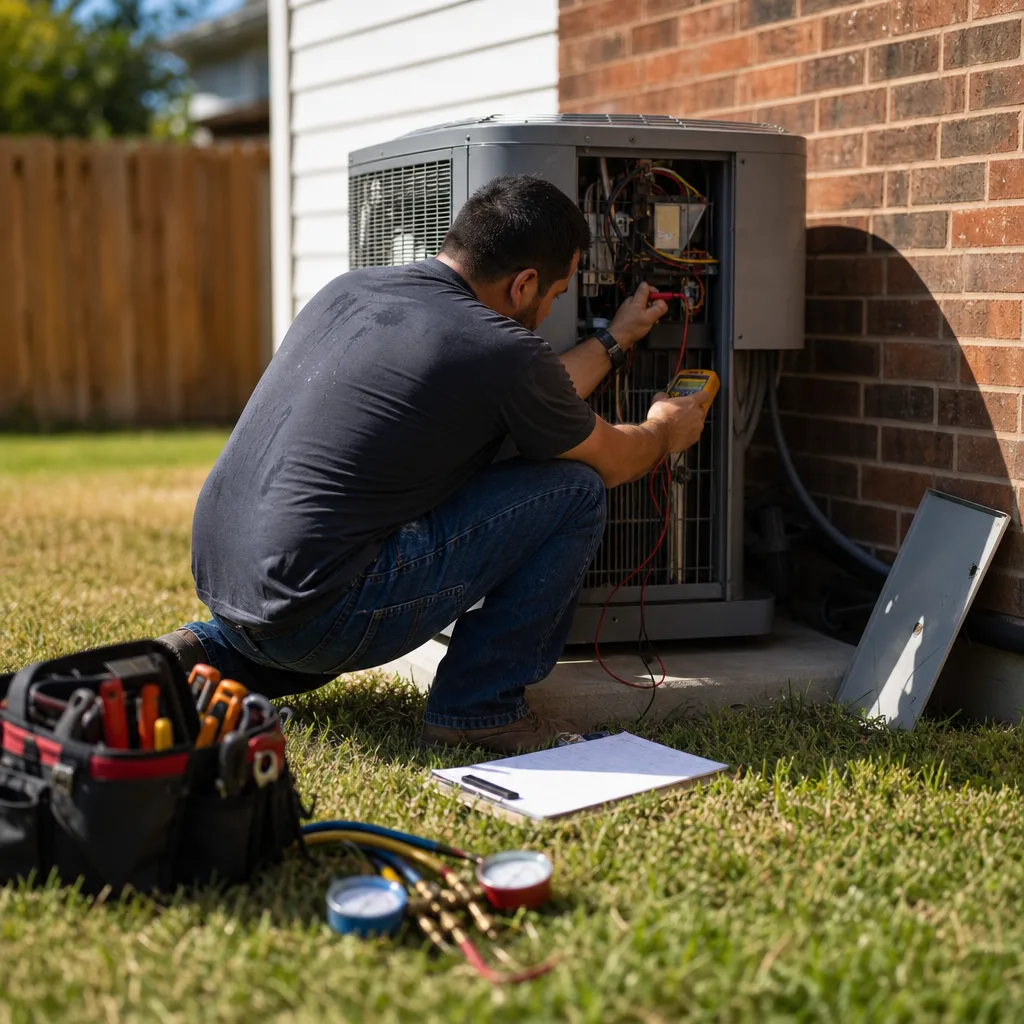
Next, the technician finds the cause. The person at your door is a licensed and insured, background-checked, and drug-tested member of our team. Our HVAC license is TACLA29023C. In many Dallas homes, that means a trip into a hot attic to look at the air handler, plus a look at the outdoor unit. The job is to track the symptom back to the part that failed. A good technician doesn’t guess and swap parts until something works.
Before any work starts, you get a clear answer and a price. The technician tells you what failed and why, in plain English, and gives you an upfront flat-rate price. You approve it before any work begins. There’s no meter running while someone works. The $26-$99 service-call fee is credited toward the repair if you go ahead with us, so it isn’t money spent on a visit that goes nowhere.
Here’s what your repair price covers:
- Included: diagnosis, labor, the standard replacement part, testing, and cleanup.
- Not included unless quoted separately: additional failed parts, major components, code upgrades, or permits.
That second line matters. Dallas heat sometimes wears down two parts at once. A weak capacitor can leave a fan motor strained, for example. If the technician finds more than one problem, you’ll hear about it and see a separate price before anything extra gets done. You decide. If the problem turns out to be a major component like the compressor, financing is available on larger repairs and replacements. You won’t need it for a typical single-part fix.
After the repair, the system gets tested. Replacing the part isn’t the finish line. The technician runs your system and checks that it’s cooling the way it should. You want cold air at the vents and a system that keeps up, not one that cools for ten minutes and then falls behind again.
Last comes cleanup. Your home should look the way it did when we got there, attic access, hallway, and yard included.
The whole point is that you understand the problem, agree to the price, and get your house cool again, usually in that one visit. No surprise invoice shows up later. Every repair is done right the first time and backed by our 100% satisfaction guarantee.
Watch Our Video
See How We Handle Central air conditioning repair in Dallas
Xtreme Air Services — North Dallas
What a Repair Costs and What’s Included
Here’s the straight answer. Most central AC repairs from our team fall between $150 and $700. The most common job is a single failed part that we find, replace, and test on the first visit, and that usually runs $150 to $400. Because most breakdowns come down to one worn part and not a dying system, most repair bills stay toward the lower end.
That price covers the part, the labor, and making sure your system works before we leave, as laid out in the visit section above. The service-call fee is $26 to $99, and it’s credited toward the repair if you go ahead with us.
So why does one repair land at $180 and another closer to $700? A few things move the number:
- How far the failure went. A part caught early is one fix. A part that failed and strained the parts around it can mean more work.
- The part itself. Some parts cost more than others, and some are easier to get. If a part is harder to find, the price reflects that.
- Your equipment’s age and brand. Older systems and certain brands can need parts that cost more or take longer to track down.
- More than one failed part. If the heat wore down two parts at once, each one is priced so you can see it.
- When you call. Many companies charge more after hours. We don’t. Nights and weekends cost the same as a weekday.
If the problem turns out to be a major part like the compressor, that’s quoted on its own, outside these ranges. You’ll know that before any work starts, not after.
Whoever you call, a few questions will tell you a lot about how they price their work. Ask them before anyone climbs into your attic:
- Is the price a flat rate for the job, or am I paying by the hour?
- Do I get the price and approve it before work begins?
- Is there a trip or diagnostic fee, and does it go toward the repair?
- Do you charge extra for nights, weekends, or holidays?
- What exactly does the price include, and what would cost extra?
Clear answers to those five questions mean you can make a calm decision, even with a warm house. If a contractor won’t give you a price until the work is done, that’s your cue to keep looking.
With us, you’ll hear what failed, see an upfront flat-rate price, and decide for yourself. Our licensed and insured, background-checked technicians would rather earn your trust than rush you into a bill you didn’t expect. If your AC is blowing warm air or falling behind this afternoon, give us a call. You’ll talk to a real person, and same-day service is available.
Call 469-213-3107
Frequently Asked Questions
Common questions about Central air conditioning repair
Can a central AC repair wait until morning, or should I call right away?
It depends on what the system is doing. If the breaker keeps tripping or you smell something hot and electrical, turn the system off and call right away instead of resetting it again. If it’s just blowing warm air or running weak, it’s safe to wait a few hours, but in Dallas summer heat an attic air handler and the rest of the system keep straining the longer it runs that way, so same-day service is worth using instead of waiting it out overnight.
Do most central AC problems come from one bad part or a bigger system failure?
Most of the time it’s one worn part, not a dying system. Dallas heat tends to wear down the same handful of components first, like capacitors, contactors, and fan motors, so a single-part fix usually gets your home cool again the same day rather than pointing to a full system failure.
Is it normal for a Dallas AC to struggle more in the afternoon than the morning?
No, and it’s one of the clearest signs something’s wearing out. A healthy system should keep your house cool through the hottest part of the day. If the indoor temperature creeps up all afternoon and never recovers, a weak part is usually the reason, and the summer heat is what’s exposing it.
Ready to Get Started?
Call (469) 213-3107 Today, Get Service Today.