


Generator Repair in Dallas: Know What’s Wrong Before You Pay
Standby and portable generators diagnosed and repaired, starting with the four failures we see most.
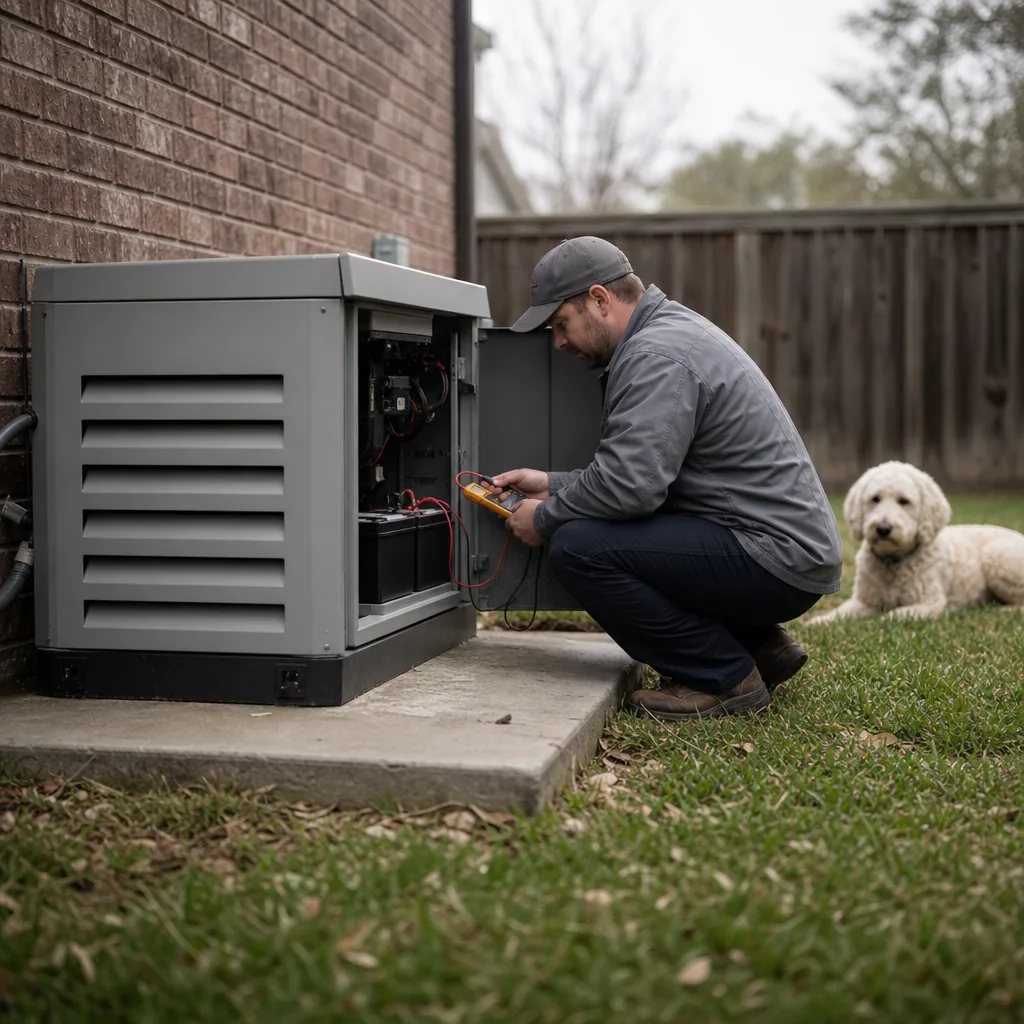
What’s Covered on This Page
- Most Generator Failures Trace Back to a Few Known Causes
- What a Repair Visit Includes
- Standby Generator Repair Is Not the Same as a Small-Engine Fix
- Repair Versus Annual Maintenance: Know the Difference
- Check These Before You Call for Repair
- Is it worth repairing a generator or should I just replace it?
- What is the most common problem with generators?
- Can I take my portable generator to a hardware store for repair?
Most Generator Failures Trace Back to a Few Known Causes
It’s a bad feeling. The power drops, you wait for the generator to kick on, and nothing happens. Or it starts, runs a few minutes, and dies right when you need it. It’s easy to think the whole machine is shot. Usually it isn’t. A generator is a simple system at heart, and when it fails, it tends to fail in a few known spots.
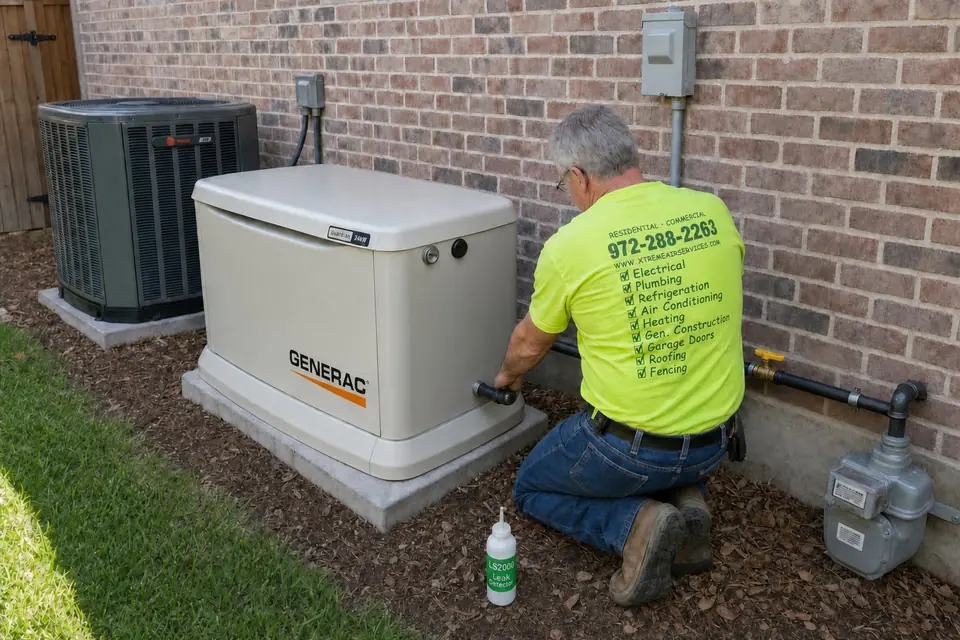
When our technicians diagnose a generator, these are the four areas they work through:
- Battery. A standby generator needs a healthy battery to crank the engine. A weak or worn-out battery is one of the most common reasons a unit clicks or does nothing when the power goes out. Loose or corroded battery connections can cause the same thing.
- Fuel. The engine can’t run without a steady fuel supply. On a portable unit, old gas left sitting in the tank can gum up the fuel system. On a standby unit tied to natural gas or propane, a supply problem, a closed valve, or a pressure issue can keep it from starting or make it stall under load.
- Controls. Today’s standby generators run on a control board that watches the power, starts the engine, and manages the switch to generator power. If a board, sensor, or setting fails, the generator may throw an error code, refuse to start, or start but never take over your home’s circuits.
- Starting system. Even with a good battery and fuel, a bad starter or a related part can keep the engine from turning over.
North Texas is hard on all four. A generator sitting outside through a Dallas summer bakes in its enclosure for months. Then a hard winter freeze or a spring storm hits, and it’s asked to fire up cold and carry the whole house. That’s often the first time anyone finds out a battery got weak or a part wore out while the unit sat waiting.
What you notice can point the way. A generator that won’t crank at all often leads us to the battery or starting system. One that cranks but won’t catch points toward fuel. One that runs fine but never powers your house, or shows a warning light, often points to the controls. These are only clues, not a final answer. That’s why the diagnosis comes first.
Knowing the likely causes should make you feel better, not worse. A focused diagnosis means we’re not guessing or swapping parts to see what sticks. We find the fault, replace the part that failed, and then check that the generator starts and carries load before we call it done. Most calls are fixed on the first visit. If the problem turns out to be a major component, you’ll hear that plainly before any work goes forward. And if your unit hasn’t been looked at in a while, ongoing generator maintenance is the best way to catch a tired battery or a fuel issue before the next outage.
What a Repair Visit Includes
When your generator lets you down, the next worry is usually the bill. You want to know what you’re paying for before anyone picks up a wrench. Here’s how a standard generator repair visit with Xtreme Air Services is put together, so nothing catches you off guard.
A standard repair visit covers four things:
- Diagnosis, so the real fault is found before parts get ordered.
- Labor to do the repair.
- The standard replacement part for the failed piece.
- Testing, so you know the unit starts and carries load before the technician leaves.
That’s the most common job we handle, and it typically runs $200-$525. Across all generator repairs, the typical range is $200-$900. You’ll get upfront flat-rate pricing and approve it before work starts, so there’s no meter running while the technician works.
There’s a $26-$99 service-call fee to get a technician to your door. If you go ahead with the repair through Xtreme Air Services, that fee is credited toward the repair. You won’t pay for the visit and then pay again for the fix.
Some work falls outside a standard repair. These items are quoted separately, so you see the cost before you decide:
- Major components
- Full unit replacement
- Code upgrades
- Permits
None of this gets added quietly. If the diagnosis shows your generator needs a major part or has reached the end of its life, you’ll get that news straight, along with a separate quote. Then the choice is yours.
Two generators with the same symptom can still end up at different prices. Here’s what moves the number:
- Cause of failure. A worn battery is a different job than a failed control board.
- Generator brand and size. Bigger units and some brands use pricier parts.
- Parts availability. Common parts are easy to get. Less common ones can take longer and cost more.
- Access. A unit tucked in a tight side yard or behind a fence takes more time to work on than one sitting out in the open.
- After-hours timing. This is the one that won’t hurt you here. Xtreme Air Services charges no extra for nights or weekends.
That last point matters in Dallas. Outages here don’t wait for business hours. A spring thunderstorm can knock out power on a Saturday night, and a hard freeze can hit over a holiday weekend. If your generator fails then, you shouldn’t have to choose between a cold or dark house and an overtime bill. With us, a Sunday call is priced the same as a Tuesday call.
Financing usually isn’t offered for a smaller repair like this one. If your generator needs a larger repair or a replacement, financing is available, and we’ll walk you through the options when you get that quote.
The point of laying it all out is simple. You should know what’s included, what isn’t, and why the price is what it is. Our licensed, background-checked technicians explain the fix and the price at your door, and you decide from there.
Standby Generator Repair Is Not the Same as a Small-Engine Fix
A standby generator isn’t a lawn mower engine in a box. It sits on a pad outside your home, it’s tied into your gas line, and it’s wired into your electrical panel through a transfer switch. The transfer switch senses the outage and moves your home’s circuits over to generator power. When Oncor restores utility power, it moves everything back.
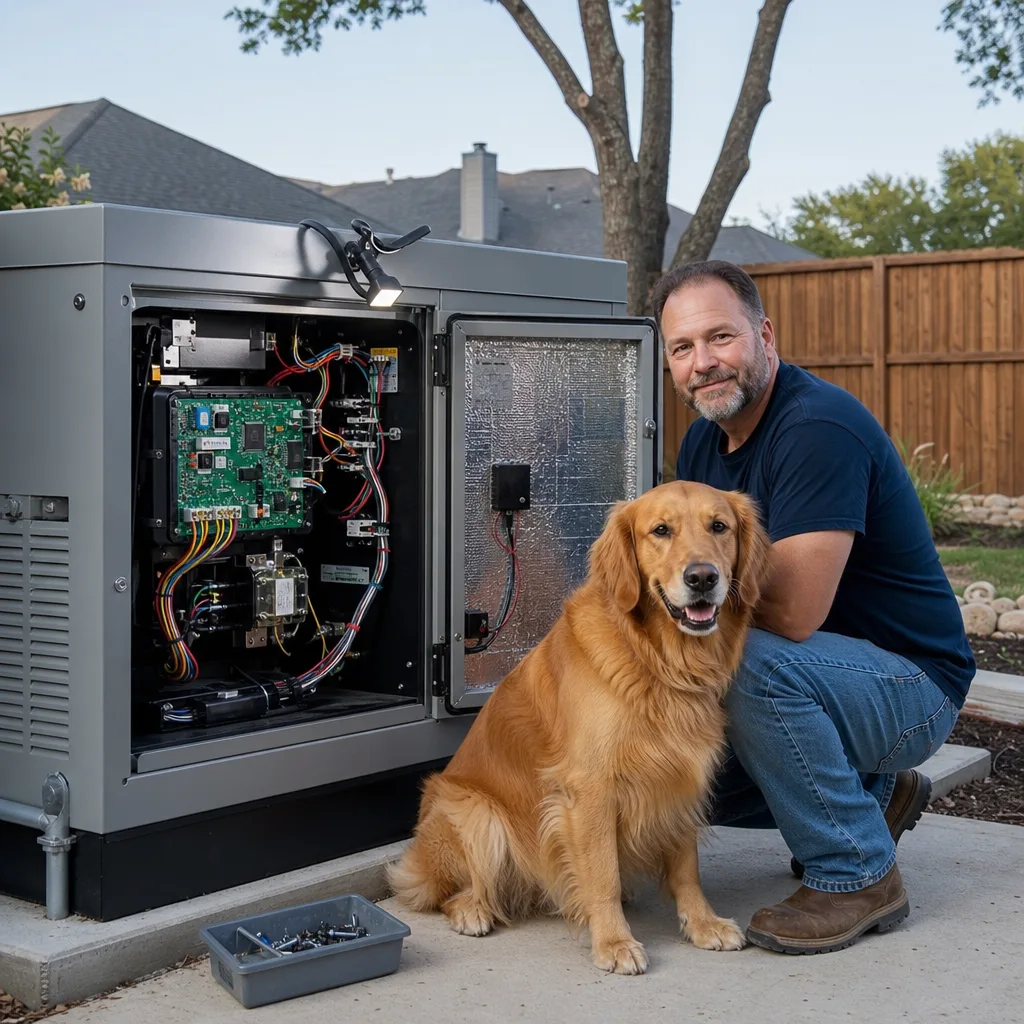
So a standby repair is really three jobs in one: the engine, the fuel supply, and the electrical connection to your house. A small-engine shop may be great with carburetors and pull cords. You still don’t want them opening your panel or working on a gas connection.
These are the signs your problem goes past the engine and needs a licensed contractor:
- The generator runs, but your house stays dark. The trouble may be in the transfer switch or the wiring between the generator and your panel.
- Breakers trip or lights flicker the moment the generator takes over.
- You smell gas near the unit, or the fuel connection looks damaged.
- The control panel shows an error tied to the transfer switch or the utility power sensing.
This is where one company handling more than one trade really helps you. Xtreme Air Services is a licensed and insured electrical and plumbing contractor, so the electrical side and the gas side can be covered by one team. You don’t have to wait on a second company while your power is still out.
Your home matters too. Plenty of Dallas houses built between the 1950s and the 1990s still have their original electrical panels. A generator wired into one of those panels has to work with what’s already there. If a repair shows the panel itself is the issue, that falls under the code upgrades quoted separately.
Now for the honest part. You may not need us at all. Say you own a portable generator that isn’t connected to your house, and the problem is clearly the engine. Maybe it sat all summer with old gas, it won’t pull-start, or it runs rough and then quits. A local small-engine repair shop may be the simpler, lower-cost fix. That’s a fair choice, and it’s the one we’d point you toward.
Things change once a portable generator is tied into your home. If it plugs into an inlet box or a transfer switch, or you’d like it to, that connection is electrical work and needs to be done right. Portable generator hookup and transfer switch installation are separate services we offer, and each one has its own page.
Here’s the simple test. If the problem lives only in the engine of a stand-alone portable unit, a small-engine shop can handle it. If it touches your panel, your gas line, or the switch that powers your home, call a licensed contractor.
Not sure what your Generator repair project needs? Ask us.
Call Today, Get Service Today. Xtreme Air Services — North Dallas is ready to help.
Repair Versus Annual Maintenance: Know the Difference
A repair fixes something that has already failed. Maintenance looks for the weak spot before it fails. Both matter, but they answer different questions. If your generator won’t start or won’t power your house right now, you need a repair. If it worked during the last outage but nobody has looked at it in a year or more, you want maintenance.
Here’s where people get mixed up. A repair visit finds the part that failed, replaces it, and checks that the generator starts and carries load. That tells you the unit works today. It doesn’t mean every other part got serviced. The oil, the filters, and a battery that’s getting tired can all still be waiting to cause the next problem.
Book maintenance instead of a repair when your generator seems fine, but:
- It hasn’t been serviced in over a year, or you can’t remember the last time.
- You moved into a home that already had a generator and you don’t have any service records.
- You don’t know how old the battery is.
- It sat outside all summer and storm season or winter is coming.
- Someone in your home depends on powered medical equipment, or your business can’t afford to go dark.
Generator maintenance usually means checking the battery and its connections, changing the oil and filters, looking over the fuel line and connections, and making sure the controls and transfer switch respond the way they should. Many standby units run a short self-test on their own. A quiet weekly hum is a good sign, but that test often runs without your home’s full load on it. A generator can pass its self-test and still struggle when the whole house is counting on it. That’s what generator load testing is for. It’s a separate service with its own page.
Maintenance won’t make a generator unbreakable. Parts still wear out, and nobody can promise a unit will never fail. What maintenance does change is when you find out. Finding a weak battery on a calm April afternoon is a small, planned fix. Finding it at 2 a.m. during an ice storm, with the house getting colder, is a very different night.
In Dallas, timing makes it easier. Schedule maintenance during a calm stretch before spring storm season or before the first hard freeze, not in the middle of an outage when everyone is calling at once. If you’d rather not keep track of it yourself, generator annual service puts that check on the calendar for you.
So the rule is simple. If it’s broken, call for a repair. If it works but hasn’t been checked, call for maintenance. If you’re not sure which one you need, tell us what the generator is doing and we’ll help you sort it out.
Call 469-213-3107
Watch Our Video
See How We Handle Generator repair in Dallas
Xtreme Air Services — North Dallas
Check These Before You Call for Repair
Before you pick up the phone, take five minutes and look at a few things yourself. Sometimes the fix is a switch in the wrong spot, and you won’t need us at all. If it’s not that simple, what you find still helps our technician get to the real problem faster.

One rule comes first. If you smell gas near the generator, skip this list. Don’t open the enclosure or touch the unit. Move away from it and get a professional out to look at it.
If there’s no gas smell, here’s what to check:
- Is the power really out? Look at Oncor’s outage map or ask a neighbor. If only part of your house is dark, you may have a tripped breaker inside your panel, not a generator problem.
- Is the generator set to Auto? Most standby units have Auto, Off, and Manual settings. After a service visit, a storm cleanup, or a curious kid, it’s easy for the switch to end up on Off. In Off mode the generator won’t start when the power drops.
- Is the generator’s own breaker on? Many units have a main breaker on the generator itself. If it’s tripped or switched off, the engine can run while your house stays dark.
- Is fuel getting to it? On a natural gas unit, make sure the shutoff valve on the line feeding the generator is open. On a propane unit, check the tank gauge. A tank that ran low during the last outage won’t carry you through the next one.
- What does the display say? Write down any error code or warning light exactly as it shows, or snap a photo. That one detail can save a lot of time on the diagnosis.
- Is anything blocking the unit? Leaves, grass clippings, or storm debris packed against the vents can make a generator shut itself down to keep from overheating.
There’s one more thing that surprises people. A standby generator keeps its battery charged using your home’s utility power. If the circuit that feeds the battery charger got switched off or tripped, the battery can slowly drain while the unit sits there looking fine. You won’t know until the next outage, when it clicks and won’t crank. If you find that breaker off, turn it back on. Just know the battery may already be too weak to start the engine.
Stop there. Don’t open the engine compartment, pull wires, or reset the control board over and over hoping it catches. Resetting a fault code without fixing what caused it just hides the clue our technician needs. Repeated start attempts can also wear down a battery that might have been fine.
If flipping the switch back to Auto or opening the fuel valve brings it back, you’re done. Let the unit run its next self-test and keep an eye on it. If it still won’t start or won’t power your home, call us and tell us what you checked and what the display showed. You’ll get a faster, more focused visit because of it.
Frequently Asked Questions
Common questions about Generator repair
Is it worth repairing a generator or should I just replace it?
In most cases, repair is worth it. Generators are built around a few core systems, and a failed battery, fuel issue, or control board can usually be fixed without replacing the whole unit. Replacement only makes sense when a major component fails on an older unit, or when the diagnosis shows the generator has reached the end of its working life. You’ll hear that plainly before any work moves forward, so you’re never guessing.
What is the most common problem with generators?
The battery is the most common culprit. A weak or corroded battery often shows up as a generator that clicks or does nothing when the power drops. Fuel problems come in close behind, especially old gas gummed up in a portable unit’s tank, or a closed valve on a natural gas or propane line feeding a standby unit. Control board faults and starter issues round out the usual list.
Can I take my portable generator to a hardware store for repair?
Some hardware stores handle small-engine work, but it depends on the location and the problem. If your portable generator is a stand-alone unit and the issue is clearly in the engine, like it won’t pull-start or runs rough after sitting with old gas, a local small-engine repair shop can be the simpler, lower-cost fix. Once that generator is wired into an inlet box or transfer switch, or you want it to be, that’s electrical work and needs a licensed contractor instead.
Ready to Get Started?
Call (469) 213-3107 Today, Get Service Today.