


Central Air Conditioning Repair in Plano: Get Your System Fixed Right
Central AC problems diagnosed and fixed right the first time, with clear pricing on what drives the cost.
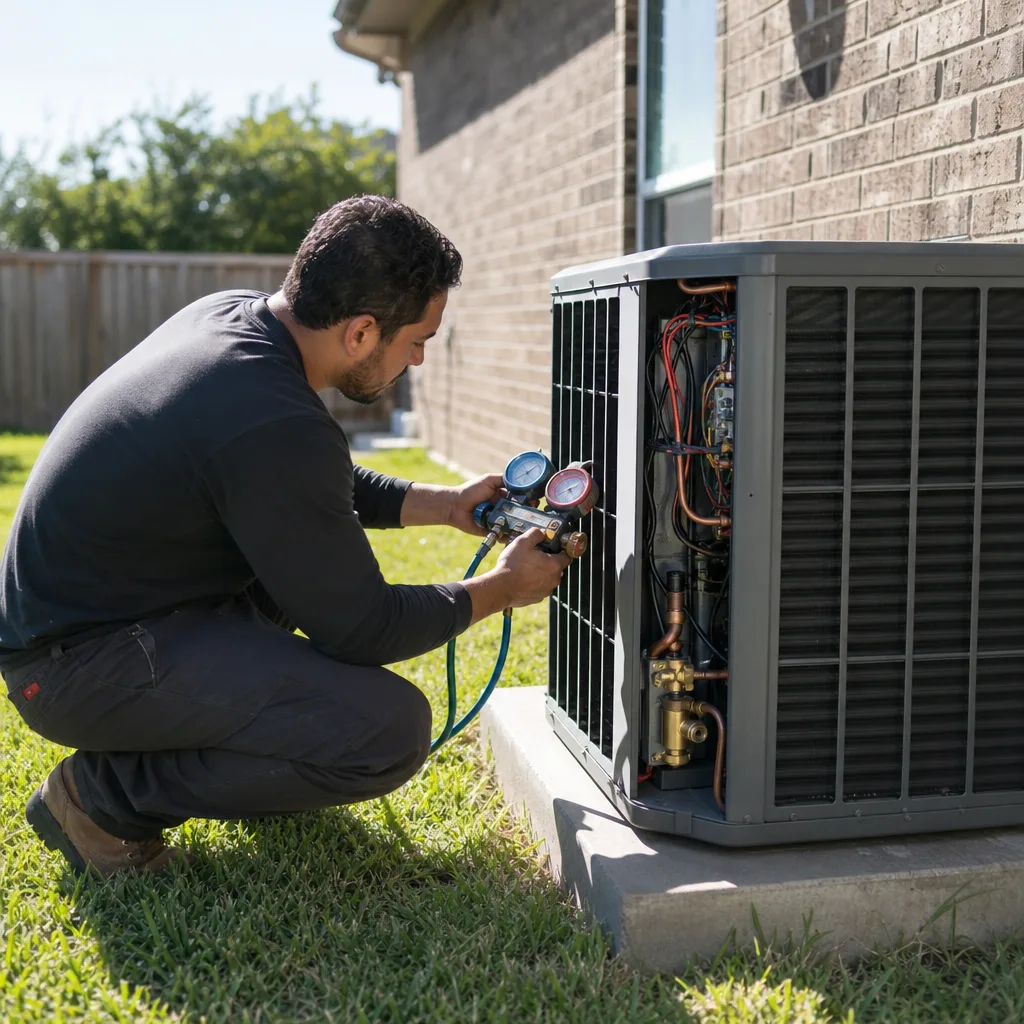
What’s Covered on This Page
- Signs Your Central AC Needs a Repair Call
- Why Plano’s Climate Wears Out AC Components Faster
- When You Don’t Need a Repair Call Yet
- What Happens During a Repair Visit
- Why Licensing Matters for Refrigerant and Electrical Repairs
- How fast can you get a technician to my Plano home?
- Is it safe to just add refrigerant myself to save money?
- Can I keep running my AC if the breaker keeps tripping?
- What should I do if I see water dripping near my attic AC unit?
Signs Your Central AC Needs a Repair Call
Your AC usually tells you something’s wrong before it quits for good. If you’re reading this because the house feels warmer than the thermostat says, you’re in the right place. Most central air conditioning repair starts with one of the signs below. Each one tends to point to a specific part, and that’s good news. A single failed part is usually something a technician can find and fix.
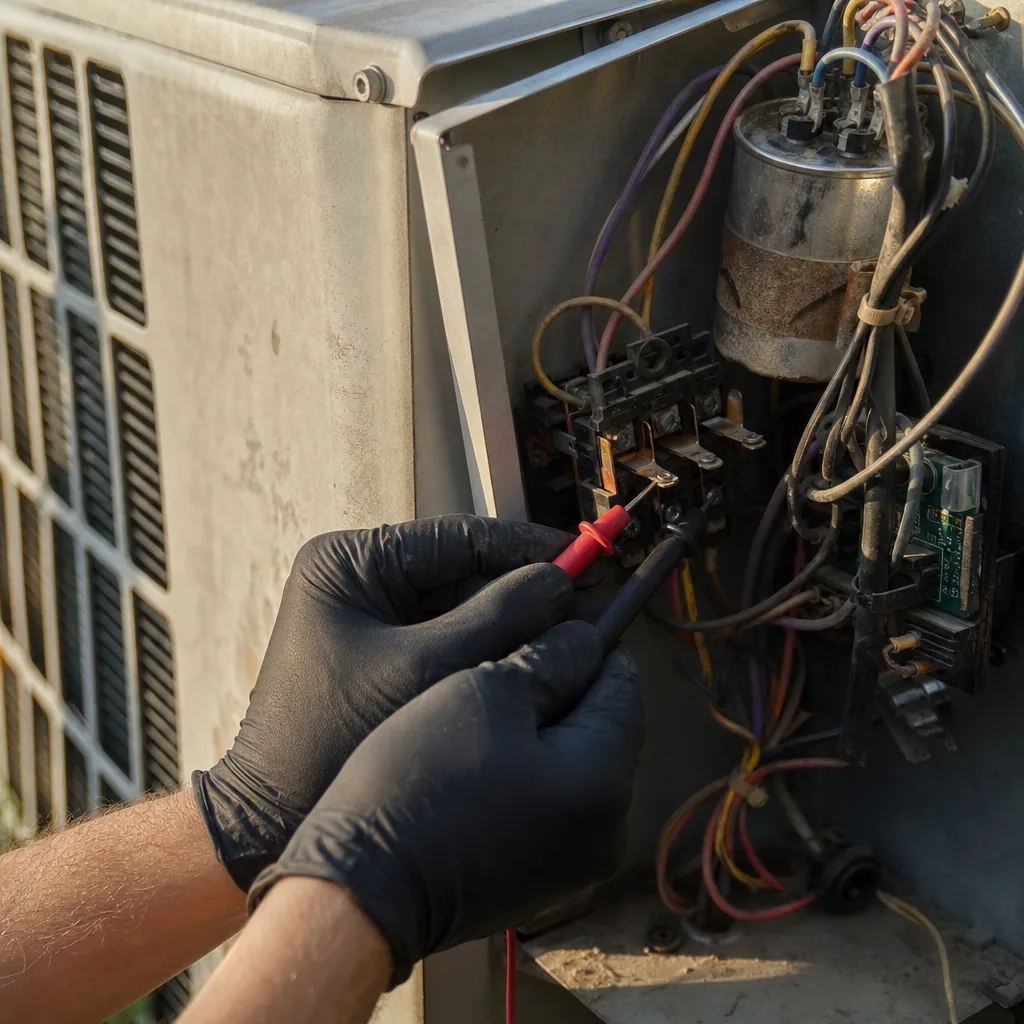
- Warm or barely cool air from the vents. This often points to a refrigerant leak, a failed capacitor, or an outdoor unit that isn’t running.
- The outdoor unit hums, but the fan won’t spin. A worn capacitor or fan motor is a common cause. Turn the system off so the motor doesn’t overheat.
- Weak airflow, even with a clean filter. This can mean a blower motor problem, a frozen coil, or a duct issue.
- Ice on the copper line outside or on the indoor coil. Frozen coils usually come from low refrigerant or poor airflow. Running the system frozen can hurt the compressor.
- Water near the indoor unit or a wet spot on the ceiling below it. That’s often a clogged drain line.
- The system turns on and off every few minutes. This short cycling wears parts out fast and can point to electrical, sensor, or refrigerant trouble.
- New noises like grinding, squealing, buzzing, or loud clicking. Each one points to a different worn part.
- The breaker for the AC keeps tripping. Don’t keep resetting it. Repeat trips mean an electrical fault that needs a technician.
- Your Oncor bill jumps while your comfort drops. A system that runs longer to do less is often low on refrigerant or losing efficiency to a failing part.
The water and ice signs matter more than usual in Plano. In many North Texas homes, the indoor unit and its drain line sit in the attic. A clog or a frozen coil up there can leak into the ceiling before you notice anything wrong with the cooling. If you see a stain or drip below the attic unit, shut the system off and call.
Before you call, take a minute to check the simple stuff. Make sure the thermostat is set to cool and the temperature is below the room’s. If it runs on batteries, try fresh ones. Check the air filter, because a clogged filter can cut airflow and even freeze the coil. If the breaker tripped once, you can reset it one time. If one of these fixes it, you don’t need us, and that’s a fine outcome.
If none of that helps, or you’re seeing more than one sign at once, it’s time for a technician. Texas heat is hard on a struggling system. A weak capacitor or a slow leak puts more strain on the compressor every hot afternoon it keeps running. A part that’s failing today is often a simple repair. Waiting until something bigger fails is how a small fix turns into a larger one.
Why Plano’s Climate Wears Out AC Components Faster
Your AC isn’t failing because you did something wrong. North Texas is simply hard on cooling equipment. The good news is that the heat doesn’t wear out your whole system at once. It wears out certain parts first, and those are the parts a technician can usually replace on the spot.
Here’s where Plano’s weather does the most damage, and the part it tends to hit.
- A long, hot cooling season wears out capacitors and contactors. Your system may run most of the day for months, starting and stopping over and over. The capacitor gives the motors a jolt to start, and heat slowly weakens it. The contactor is the switch that turns the outdoor unit on, and its contacts wear down with every cycle. Both are small, common parts, and both are among the most frequent causes of a unit that hums but won’t run.
- Attic heat works the indoor parts hard. In many Plano homes, the air handler sits in an attic that gets far hotter than the air outside on a summer afternoon. The blower motor and control board have to run in that oven all season. Heat is tough on motor bearings and electronics, so these parts often give out sooner than they would in a cooler spot.
- Dust, pollen, and spring cottonwood fluff clog the outdoor coil. The condenser coil is how your system dumps heat outside. When it’s packed with debris, grass clippings, or fluff, the system can’t shed heat well. Then the compressor runs hotter and longer. A coil cleaning is a simple fix, but a coil left dirty puts strain on the most expensive part you own.
- Clay soil can shift the outdoor unit. North Texas clay swells when it’s wet and shrinks when it dries out. Over time, that can tilt the pad your condenser sits on. A tilted unit vibrates more and stresses the copper refrigerant lines, which can lead to slow leaks at joints and fittings.
- Storm season hits the electrical side. Hail can flatten the thin metal fins on the outdoor coil and choke airflow. Lightning and power flickers during spring storms can damage capacitors, contactors, and circuit boards. If your AC quit right after a storm, an electrical part is a good first suspect.
Plano’s housing mix plays a role too. Older homes may still run equipment that has been through many Texas summers, with worn wiring connections and tired motors. Newer homes have newer systems, but they still deal with the same attic heat, dusty yards, and storms. Age changes how many parts are worn. It doesn’t change which parts wear first.
That’s why a good repair visit starts with testing, not guessing. A technician checks the capacitor’s rating, looks at the contactor, measures how hard the motors are working, and checks the coils and refrigerant lines. When one part tests weak, replacing it usually gets you cooling again, and the rest of your system stops carrying that extra strain.
There’s one thing you can do yourself. Keep plants, mulch, and grass clippings away from your outdoor unit so it can breathe. If storms knock out your power often, ask about a whole-house surge protector. It can help protect your AC’s electronics from the next big flicker.
When You Don’t Need a Repair Call Yet
Not every warm afternoon means something’s broken. Sometimes your AC is doing exactly what it was built to do, and a repair visit would only cost you a service fee. Here’s when it’s fine to wait, watch, or fix it yourself.
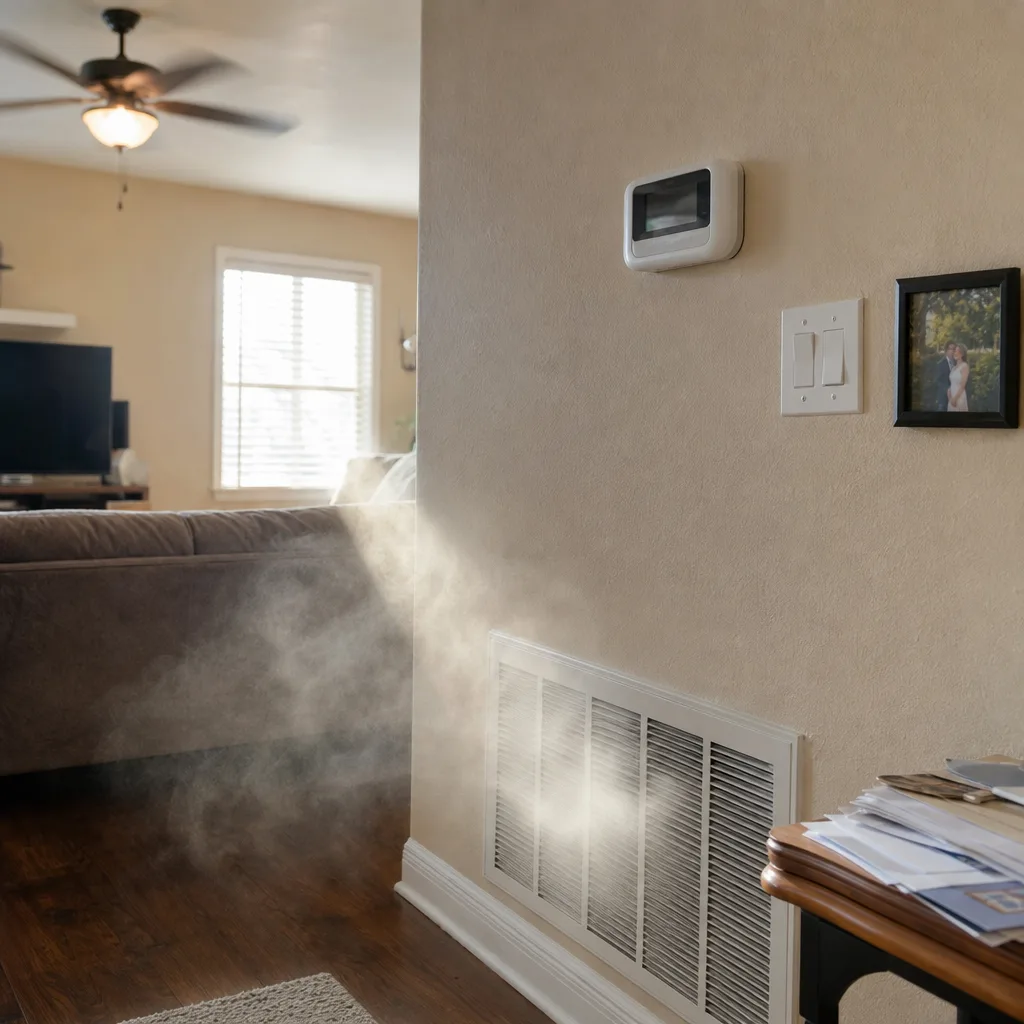
Your house runs a few degrees warm on the hottest days, then catches up at night. On a triple-digit Plano afternoon, many systems can’t hold the setting you’d get in May. If the air from your vents still feels cool, the unit runs steady without short cycling, and the house comes back down after sunset, that’s normal. It’s a limit of the system’s size, not a failed part.
Some other things look like problems but usually aren’t:
- The air feels room temperature between cycles. Check whether your thermostat fan is set to On instead of Auto. On keeps the blower running after cooling stops, so it moves air that isn’t being cooled. Switch it to Auto.
- The outdoor unit waits a few minutes before starting. Many systems have a built-in delay after a power flicker or a thermostat change. It protects the compressor. Give it a few minutes before you worry.
- Water is dripping from a small pipe outside near the foundation. That’s the condensate line doing its job, carrying moisture pulled from your indoor air. Water outside is fine. Water inside, near the attic unit or on a ceiling, is the problem we covered above.
- One room is warm because its vent is closed or blocked. Couches, rugs, and curtains can choke a supply vent or the return grille. Open the registers and give them some clearance.
- Your bill went up in July. A bigger bill during a heat wave is normal. It’s only a warning sign when your comfort drops at the same time.
There’s another case where a repair call isn’t the right answer. In many two-story Plano homes, the upstairs stays warmer than the downstairs all summer, even when the system is working fine. Heat rises, and the upstairs sits right under a hot attic. A repair won’t change that. If it bothers you, the real fix is usually a duct or airflow change, like duct sealing or a zoning system that lets each floor have its own setting. That’s a different conversation, and it can wait for a cooler week.
If your system is older and you’re weighing whether to keep fixing it, you don’t need an emergency visit to think it over. A planned look at the system on a normal day gives you time to decide without the pressure of a hot house.
Here’s a simple rule. If the air is cool, the system runs in normal cycles, and nothing is leaking, freezing, tripping, or making new noises, you can wait and keep an eye on it. If one of those things shows up, or the house keeps getting warmer through the evening, that’s when a technician is worth the call.
Have questions? We’re happy to help.
Call Today, Get Service Today. Xtreme Air Services — North Plano is ready to help.
What Happens During a Repair Visit
A repair visit has one goal: find the part that failed, fix it, and prove your system cools again before the technician leaves. Most central AC calls come down to a single common failure fixed on the first visit. Here’s how it goes, step by step.
- You call and talk to a real person. Tell us what you’re noticing, like warm air, a humming outdoor unit, or water near the attic unit. We work to get a licensed, background-checked technician to you the same day. There’s no extra charge for nights or weekends, so a Saturday breakdown costs the same as a Tuesday one.
- The technician finds the failed part. Instead of guessing, they test the system, as we covered above, until they know which part is causing the trouble.
- You get the price before any work starts. We use upfront flat-rate pricing. You see what the repair costs and you approve it first. No meter is running while you think it over.
- The part gets repaired or replaced. Your price covers the diagnosis, labor, and the standard replacement part.
- The technician checks the system and cleans up. They make sure your AC runs correctly and cools your home before they pack up, and they clean up the work area.
The service-call fee is $26-$99. If you go ahead with the repair with Xtreme Air Services, that fee is credited toward the repair. If you decide not to, you still know exactly what’s wrong with your system.
Sometimes the problem is bigger than one part, like a worn-out compressor or more than one failed component. In that case, the technician explains what they found and what your options are. You decide what makes sense for your home and budget. Financing is available on larger repairs and replacements, so a big fix doesn’t have to come out of your pocket all at once.
A few small things on your end can make the visit go faster:
- Clear a path to the attic access. In many Plano homes, the indoor unit sits in the attic, often reached by a pull-down ladder in a hallway or garage. Move boxes or cars out of the way if you can.
- Make sure the technician can reach the outdoor unit. Unlock the side gate and put pets inside.
- Jot down what you’ve noticed and when it started. A note like “it hummed but the fan didn’t spin after last night’s storm” helps point the technician the right way.
- Know where your breaker panel is, in case the technician needs to check the AC circuit.
That’s the whole process. You know the price before work begins, you approve every step, and the job isn’t done until your house is cooling again.
Watch Our Video
See How We Handle Central air conditioning repair in Plano
Xtreme Air Services — North Plano
Why Licensing Matters for Refrigerant and Electrical Repairs
Two of the most common AC failures, a refrigerant leak and an electrical fault, are also the two jobs most likely to go wrong in the wrong hands. In Texas, HVAC work is licensed through the Texas Department of Licensing and Regulation, or TDLR. Here’s why that matters to you and not just to the state.

Refrigerant isn’t something you just top off. Your AC is a sealed system. If it’s low, the refrigerant went somewhere, which means there’s a leak. Adding more without finding that leak buys you a few cool days, and then you pay for it again. Federal rules limit who can buy and handle most refrigerants, and they don’t allow venting it into the air. A licensed tech also checks which refrigerant your system was built for. Some older Plano homes still run equipment that uses a refrigerant that’s been phased out, so the right repair can look different for those systems. Mixing the wrong refrigerant in, or overfilling the system, can strain the compressor, the most expensive part you own.
The electrical side can hurt someone. Central AC runs on a high-voltage circuit. The capacitor that starts the motors can hold a strong charge even after you switch off the breaker. A trained technician knows how to discharge it safely and test the circuit before touching anything. A bad wire connection or the wrong size part can lead to repeat breaker trips, burned contacts, or a fire risk in a hot attic, where the indoor unit sits in many Plano homes.
Insurance protects your home, too. Repairs happen in your attic, above your ceilings, and next to your wiring. If a ladder slips or a drain line gets knocked loose, a licensed and insured contractor is covered. An uninsured worker may leave you holding the bill.
Before you let anyone work on your system, it’s fair to ask a few quick questions:
- What’s your HVAC license number? You can look it up on the TDLR website in a couple of minutes.
- Are you insured for work in my home?
- Will you find the leak, or just add refrigerant?
- Will I see the price before you start?
A good contractor will answer all four without hesitating. If someone dodges the license question or offers to just add refrigerant for cash, that’s your sign to keep looking.
We’re happy to answer them. Xtreme Air Services is fully licensed and insured, and our HVAC license is #TACLA29023C. You’re welcome to look it up. Our technicians are background-checked and drug-tested, because they’re coming into your home and around your family. When we fix a refrigerant leak or an electrical fault, we do it the way the rules require, so the repair is safe and it lasts.
Call 469-527-5131
Frequently Asked Questions
Common questions about Central air conditioning repair
How fast can you get a technician to my Plano home?
We offer same-day service, six days a week, so you’re not stuck waiting through a hot afternoon. You’ll talk to a real person when you call, and we work to get a licensed, background-checked technician out the same day you reach out.
Is it safe to just add refrigerant myself to save money?
No, and in Texas it’s not legal for most people to buy or handle refrigerant on their own. Your AC is a sealed system, so low refrigerant always means a leak somewhere. Adding more without fixing the leak only buys you a few cool days before the problem comes back.
Can I keep running my AC if the breaker keeps tripping?
No, don’t keep resetting a breaker that trips repeatedly on your AC. That’s a sign of an electrical fault, and resetting it again and again can lead to burned contacts or a fire risk, especially in a hot attic where many Plano indoor units sit. Shut the system off and call a technician instead.
What should I do if I see water dripping near my attic AC unit?
Shut the system off and call right away, since water near an attic unit usually means a clogged drain line. In many Plano homes the indoor unit and drain line sit in the attic, so a clog can leak into your ceiling before you notice any cooling problem at all.
Ready to Get Started?
Call (469) 527-5131 Today, Get Service Today.