


Refrigerant Recharge / Leak Repair in Plano: Recharge or Replace?
The leak found and repaired before any refrigerant goes in – because a recharge alone won't keep your home cool.
What’s Covered on This Page
- Signs Your AC Has a Refrigerant Leak
- Why Refrigerant Loss Always Means a Leak, Not Normal Use
- Recharge and Leak Repair vs. Full System Replacement: How to Tell
- When You Don’t Need a Refrigerant Recharge
- What Happens During a Recharge and Leak Repair Visit
- Can I recharge my home AC’s refrigerant myself?
- Can a refrigerant leak in my AC be fixed, or do I need a new system?
- Will my AC need a refrigerant top-off every year?
Signs Your AC Has a Refrigerant Leak
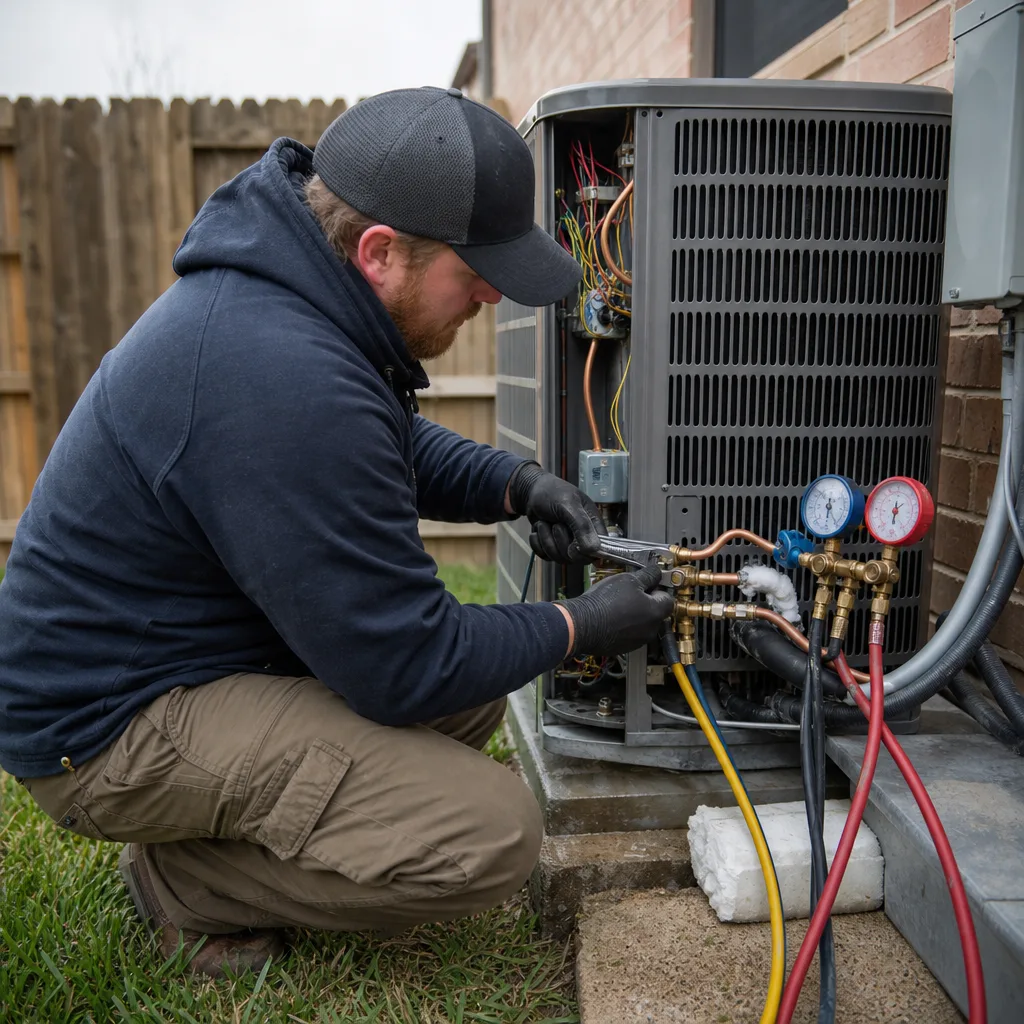
Here’s the thing most folks don’t know. Your AC doesn’t use up refrigerant over time. It moves the same charge around a sealed loop for years. So if a technician says you’re low, that refrigerant went somewhere. Adding more without finding the leak is like pumping up a tire with a nail in it.
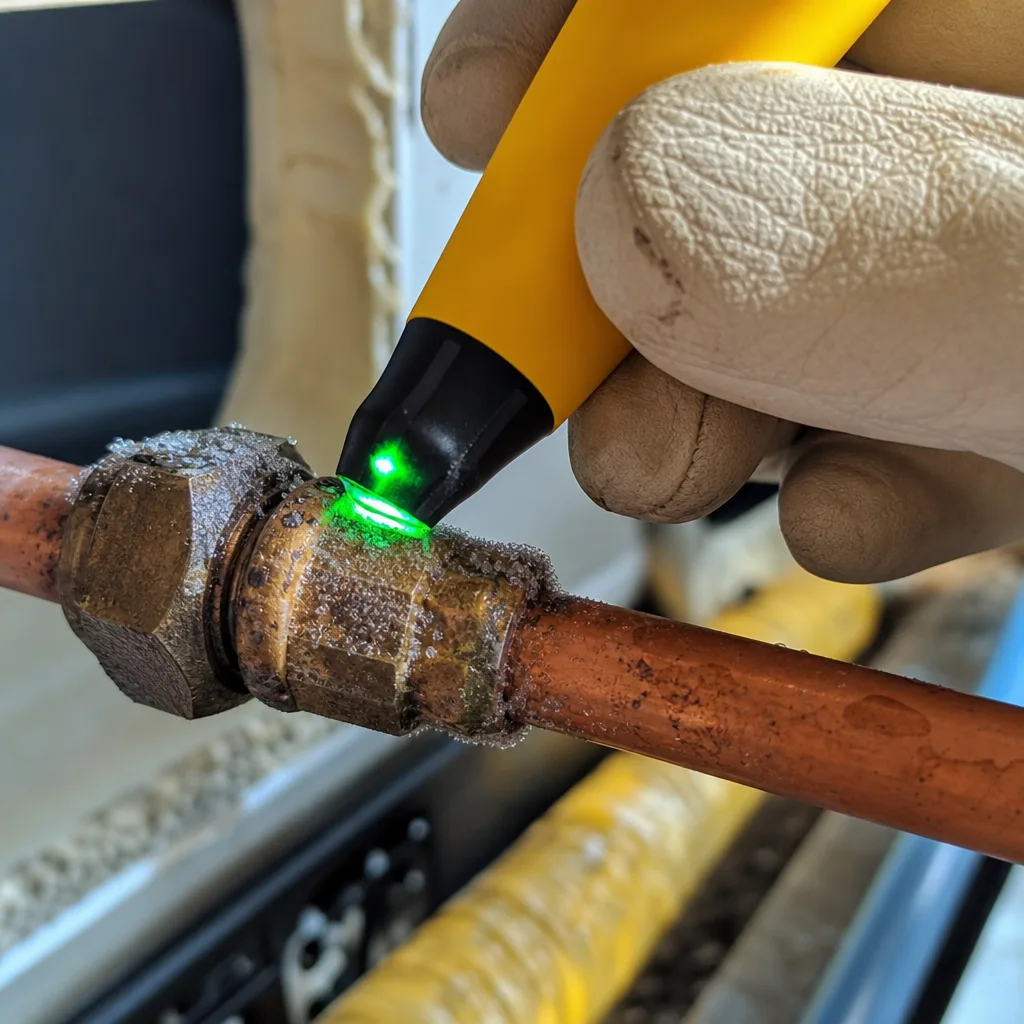
These are the signs worth paying attention to:
- The air from your vents feels cool but not cold, or it’s flat-out warm, even though the system is running.
- The AC runs and runs on a hot afternoon and never reaches the temperature you set.
- Ice or frost forms on the copper line going into your outdoor unit, or on the indoor coil near your air handler.
- You hear a hiss or a soft bubbling sound near the indoor or outdoor unit, even when the system is off.
- You see an oily film around a pipe joint, valve, or coil. Refrigerant carries oil with it, so the oil often marks the spot where it escaped.
- Your house feels sticky and damp. A system that’s low on refrigerant can’t pull moisture out of the air the way it should.
- Your electric bill jumps over last summer’s bill, even though your habits haven’t changed.
In Plano, summer is when these signs show up loudest. A small leak can go unnoticed in spring when your AC barely works. Then July hits, the system runs nonstop, and that small loss turns into a house that won’t drop below 80. If your air handler sits in the attic, it’s easy to miss frost or oily spots up there, so the warm vents are often the first clue you get.
Hail is worth a mention too. North Texas storms can bend the thin fins and tubing on your outdoor coil. If your cooling went downhill right after a hailstorm, tell your technician. That’s a useful lead on where to look.
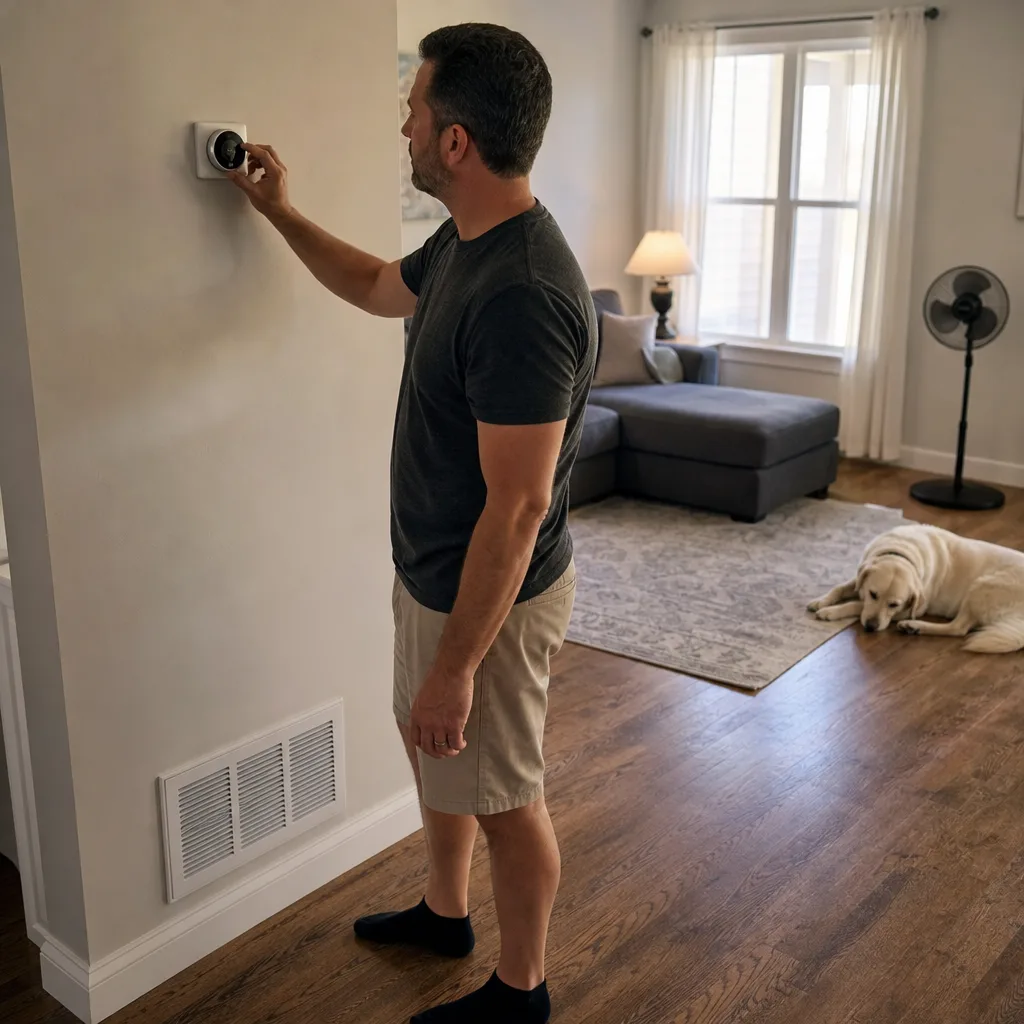
Before you assume it’s refrigerant, check two easy things yourself. A filthy air filter can choke airflow and make your coil freeze, which looks a lot like a leak. Swap the filter if it’s gray and clogged. Then make sure your thermostat is set to Cool and the fan is on Auto, not On. If you fix either one and the cold air comes back, you just saved yourself a service call.
If the filter’s clean, the settings are right, and you’re still seeing ice, hearing a hiss, or feeling warm air, it’s time to have a pro find the leak. Turn the system off if you see heavy ice. Running it frozen puts extra strain on the compressor, and that’s the most expensive part to replace. The goal is simple. Find where the refrigerant is getting out, fix that spot, then refill the system so the cold air lasts all summer, not just a few weeks.
Why Refrigerant Loss Always Means a Leak, Not Normal Use
Since your AC runs on a sealed loop, low refrigerant has only one explanation: there’s a hole somewhere. The real questions are where it is and why it showed up. Knowing that helps you see why a quick refill and a real repair aren’t the same job.
Most leaks start in a few common places:
- Tiny pinholes in the indoor coil. Copper coils can slowly corrode from the inside out, often from chemicals in normal household air. The holes can be smaller than a pin tip, so they’re hard to see but steady enough to drain a system over a season.
- Joints and fittings. Every time your AC kicks on and off, the metal heats up, cools down, and shakes a little. Over years, that can loosen a fitting or crack a joint where two pipes were joined.
- Service valves. Your system has small valves, a lot like the valve stem on a tire, where a technician connects gauges. A worn valve core or a missing cap can let refrigerant seep out.
- The outdoor coil and copper lines. Hail damage, a line rubbing against a wall or bracket, or a weed trimmer nick can all open a slow leak.
Plano’s weather works on all of these. Long, hot summers keep your system cycling for months at a stretch, and an attic air handler sits in some of the hottest air in your home. That’s a lot of heating, cooling, and vibration on the same joints, year after year.
Here’s why a top-off alone usually doesn’t hold up. If the hole is still there, the new refrigerant leaks out the same way the old charge did. You might get cold air for a few weeks or a few months, then the warm vents come back and you’re paying for refrigerant again. Meanwhile, the system spends that time running low, which is hard on the compressor, as we covered above.
There’s also the refrigerant itself. Many homes in Plano have systems that use R-410A, and newer systems use a different type called A2L refrigerant. Each system is built for one kind, and they can’t be mixed or swapped. Your refrigerant needs to match what your equipment was designed for, and it should be filled to the amount the manufacturer calls for, not by guesswork.
A proper leak repair follows a simple order. Find the leak, repair or replace the failed part, make sure the system is sealed, then recharge it and confirm it’s cooling the way it should. When our team does refrigerant recharge and leak repair, that’s the job: locate the failed part, repair or replace it, and verify your system runs correctly. Most calls turn out to be a single common failure that gets fixed on the first visit.
One honest note. If the leak is in an old indoor coil that’s corroded in more than one spot, patching it may not be the smartest money you spend. A good technician should show you what they found and walk through your options, so you can decide with the facts in front of you.
Recharge and Leak Repair vs. Full System Replacement: How to Tell
Most of the time, a refrigerant leak is a repair, not a reason to buy a new AC. A loose fitting, a worn valve core, or a nicked line can be fixed, sealed, and recharged, and your system can keep cooling for years. Replacement only starts to make sense when the leak is a symptom of a system that’s wearing out all over.
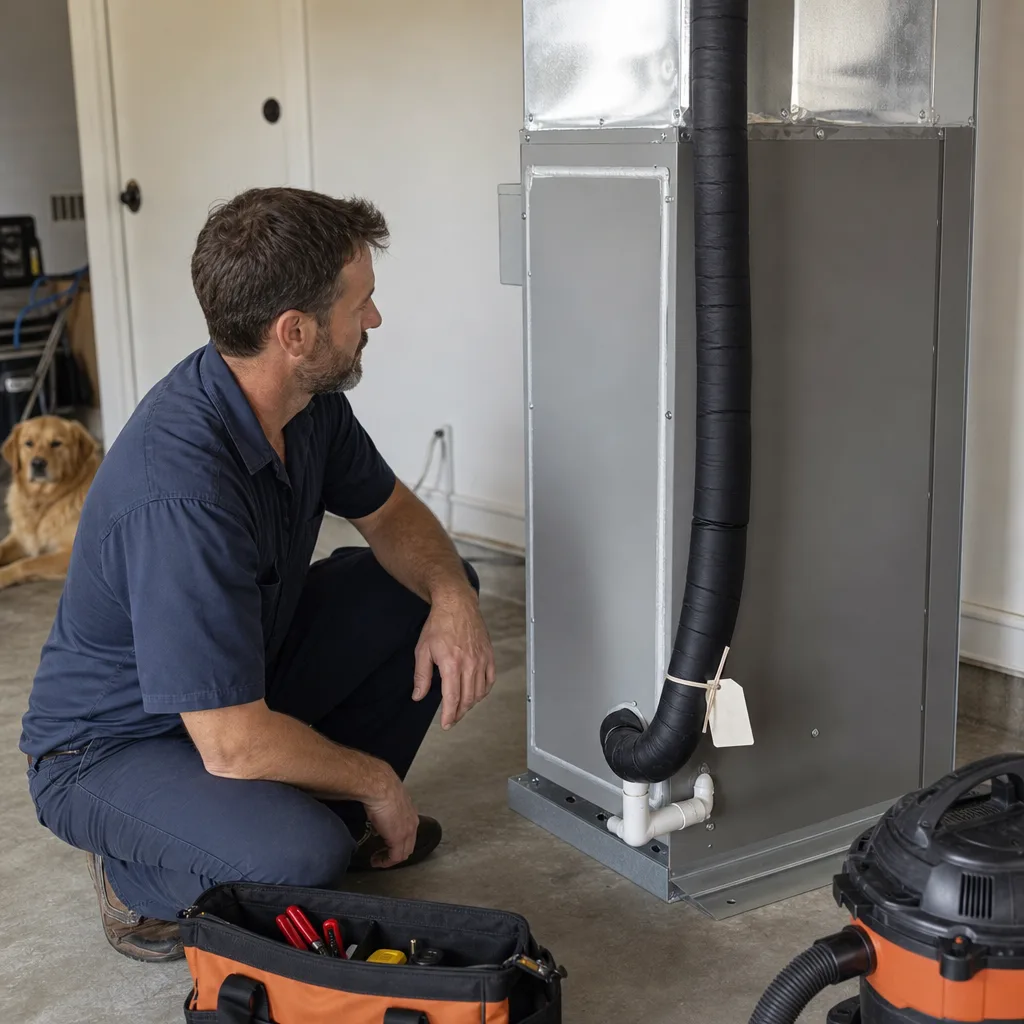
Here’s how to tell which side of that line you’re on.
- Repair fits when the leak is in one spot, like a fitting, valve, or a section of copper line, and the rest of the system is in good shape.
- Repair fits when this is the first time you’ve had a refrigerant problem and the AC cooled fine until recently.
- Repair fits when the compressor still runs strong. That’s the heart of the system, and a healthy one is worth keeping.
- Replacement is worth talking about when the indoor coil has corrosion in several places, so fixing one pinhole just means waiting for the next.
- Replacement is worth talking about when you’ve paid for refrigerant more than once in the last few summers.
- Replacement is worth talking about when the system is older, runs loud, struggles every July, and your bills keep creeping up even after repairs.
- Replacement is worth talking about when the leak caused the system to run low long enough that the compressor is now failing too.
Think about it this way. If your car has a flat, you patch the tire. If the tires, brakes, and transmission are all going at once, you start doing different math. Your AC works the same way.
Age matters, but it isn’t the whole story. A well-kept older system with one bad joint can be a great candidate for repair. A newer system with a badly corroded coil might not be. That’s why a real diagnosis beats a guess based on the year on the label.
There’s a middle option too. Sometimes the fix is replacing a major part, like the indoor coil or the condenser coil, instead of the whole system. It costs more than sealing a fitting, but much less than starting over. With this kind of repair, the new part has to match your equipment and the refrigerant it was built for. On our end, major components aren’t part of a standard leak repair. They’re quoted separately, so you see that number before anything changes.
In Plano, timing plays into this. A system that limps through May can fall apart once the long run of hot days starts. If your technician finds a small, clean leak, fixing it before peak summer is usually smart. If they find a system that’s barely holding on, it’s often better to plan a replacement on your terms than to have it quit during a heat wave.
Whatever we find, you’ll get a straight answer and the choice stays yours. If repair is the right call, we’ll say so. If replacement makes more sense, we can talk through options as a Trane Comfort Specialist. Financing is available on larger repairs and replacements, so a bigger job doesn’t have to be decided on the spot.
Ready when you are – get in touch today.
Call Today, Get Service Today. Xtreme Air Services — North Plano is ready to help.
When You Don’t Need a Refrigerant Recharge
A lot of AC problems look like low refrigerant but aren’t. If your system has its full charge and no leak, adding more won’t help. Too much refrigerant can make an AC run worse. Here are the cases where a recharge isn’t the answer.
You don’t need a yearly top-off. Some people get told their AC needs a little refrigerant every spring, like an oil change. It doesn’t. A healthy system holds its charge for life. If someone tops you off every year, either there’s a leak nobody has fixed or you’re paying for refrigerant you didn’t need. Either way, the yearly top-off is the wrong fix.
Beyond the filter and thermostat checks we covered earlier, these problems often get blamed on refrigerant:
- A dirty or blocked outdoor unit. Grass clippings, leaves, and dirt packed into the outdoor coil trap heat, so your AC can’t get rid of it. Clearing the area around the unit and keeping plants and clutter a couple of feet back can make a real difference.
- A tripped breaker. If the outdoor unit is silent while the indoor fan blows, check your panel. A breaker that trips once may just need a reset. If it trips again, leave it off. That points to an electrical problem, not refrigerant.
- A clogged drain line. Your AC pulls water out of the air and drains it away. If that line backs up, a safety switch can shut the system off to keep water from spilling. That’s a drain cleaning job, not a recharge.
- A failed capacitor or fan motor. If the outdoor fan isn’t spinning, or the unit hums but won’t start, a worn electrical part is the likely cause. Your refrigerant can be perfectly fine.
- Closed or blocked vents. Shutting vents in rooms you don’t use, or blocking them with furniture or rugs, cuts the airflow your system was built around. The house can feel warm even with a full charge.
Some warm afternoons are normal, too. On a Plano day near 100 degrees, even a healthy AC that’s fully charged may run all afternoon and fall a few degrees behind your setting, then catch up after sunset. That’s a system working at its limit, not a leak. A leak looks different. It gets worse week by week, cools poorly even on milder days, and often brings the ice, hissing, or oily spots described above.
If your AC is newer and cooled fine until one specific event, like a storm, a power flicker, or a tripped breaker, start with the simple stuff before you assume refrigerant. A lot of no-cool calls come down to a part that stopped working, not refrigerant that escaped.
The bottom line is simple. Refrigerant should only go into a system after someone has measured the charge and found it low. If a technician wants to add refrigerant without checking pressures and temperatures first, or without talking about where the missing refrigerant went, ask why. You deserve to know what you’re paying for and why it fixes the problem.
Watch Our Video
See How We Handle Refrigerant recharge / leak repair in Plano
Xtreme Air Services — North Plano
What Happens During a Recharge and Leak Repair Visit
A good leak repair visit follows a clear order: measure, find, fix, refill, and prove it works. Here’s what that looks like from your side of the front door.
It starts with a phone call, and you’ll talk to a real person. Same-day service is available, and there’s no extra charge for nights or weekends, so you don’t have to wait until Monday to save money. The service-call fee is $26-$99, and it’s credited toward the repair if you go ahead with Xtreme Air Services.
A few small things help the visit go faster:
- Clear a path to your outdoor unit and to the attic hatch or closet where your air handler sits. In a lot of Plano homes the indoor unit is in the attic, and that’s where many leaks hide.
- Think back to when the cooling started slipping. Was it right after a hailstorm, or did it fade slowly over a few weeks?
- Tell your technician if anyone has added refrigerant before, and when. Past top-offs are one of the best clues that a leak has been there a while.
The first real step is checking the charge. A proper diagnosis measures your system’s pressures and temperatures before any refrigerant goes in. That tells you whether the system is low, or whether the problem is something else entirely.
If it’s low, the next job is finding where it’s getting out. That means looking at the usual suspects: the indoor coil, the joints and fittings, the service valves, and the copper lines running to the outdoor unit. Technicians look for the oily marks that refrigerant leaves behind and use leak-detection tools to narrow down the spot. Some leaks show up in minutes. A tiny pinhole in a coil can take longer to pin down.
Once the leak is found, you get the price before any work starts. That’s our upfront flat-rate pricing, and nothing moves forward until you approve it. Your price includes diagnosis, labor, the standard replacement part, testing, and cleanup. If the visit turns up another failed part, a major component, a code upgrade, or a permit, that gets quoted separately, so you see each number and decide.
Then comes the repair itself. The failed part is repaired or replaced. A proper repair then confirms the system holds its seal and clears out air and moisture before new refrigerant goes in. After that, the system is charged with the right refrigerant for your equipment, filled to the amount the manufacturer calls for.
The last step is the one that matters most to you, which is making sure the system runs correctly. That means checking the readings again, feeling for cold air at your vents, and making sure the outdoor unit and air handler are doing their jobs. Your technician should also be able to tell you, in plain English, where the leak was and what was done to fix it. If they can’t explain it, you’re right to ask.
When you shut the door behind your technician, you should know three things: what failed, what it cost, and why the cold air will last this time.
Frequently Asked Questions
Common questions about Refrigerant recharge / leak repair
Can I recharge my home AC’s refrigerant myself?
You shouldn’t, and in most cases you legally can’t. Home AC systems use refrigerant that’s regulated, and handling it requires EPA certification and the right gauges to measure pressure safely. Beyond the legal side, adding refrigerant without finding the leak first just means it escapes again, often within weeks. A trained technician measures your system’s pressures, finds the actual leak, and fills it to the exact amount your equipment needs.
Can a refrigerant leak in my AC be fixed, or do I need a new system?
Yes, most refrigerant leaks can be fixed without replacing the whole system. A single bad fitting, worn valve, or small line leak is usually a straightforward repair, and the system can keep cooling for years afterward. Replacement only becomes the smarter move when the coil has corrosion in multiple spots or you’ve paid for refrigerant more than once in recent summers. A technician should show you exactly what they found before you decide.
Will my AC need a refrigerant top-off every year?
No, a healthy AC system should never need a yearly top-off. Your system runs on a sealed loop and holds the same refrigerant charge for the life of the equipment unless there’s a leak. If you’ve been told your AC needs refrigerant added every spring, that’s a sign a leak was never found and fixed, not a normal maintenance step.
Ready to Get Started?
Call (469) 527-5131 Today, Get Service Today.