


Generator Repair in Plano: Get a Fast, Honest Fix
Standby and portable generators diagnosed and repaired, starting with the four failures we see most.
What’s Covered on This Page
- Four Fault Areas Explain Most Generator Failures
- A Failed Self-Test or No-Start During an Outage Needs Same-Day Attention
- Checks to Make Before Calling for Repair
- What Happens During a Generator Repair Visit
- What Drives Generator Repair Cost
- Can a portable generator be repaired, or should I just replace it?
- What do you call someone who repairs generators?
- Can a regular electrician fix my generator?
Four Fault Areas Explain Most Generator Failures
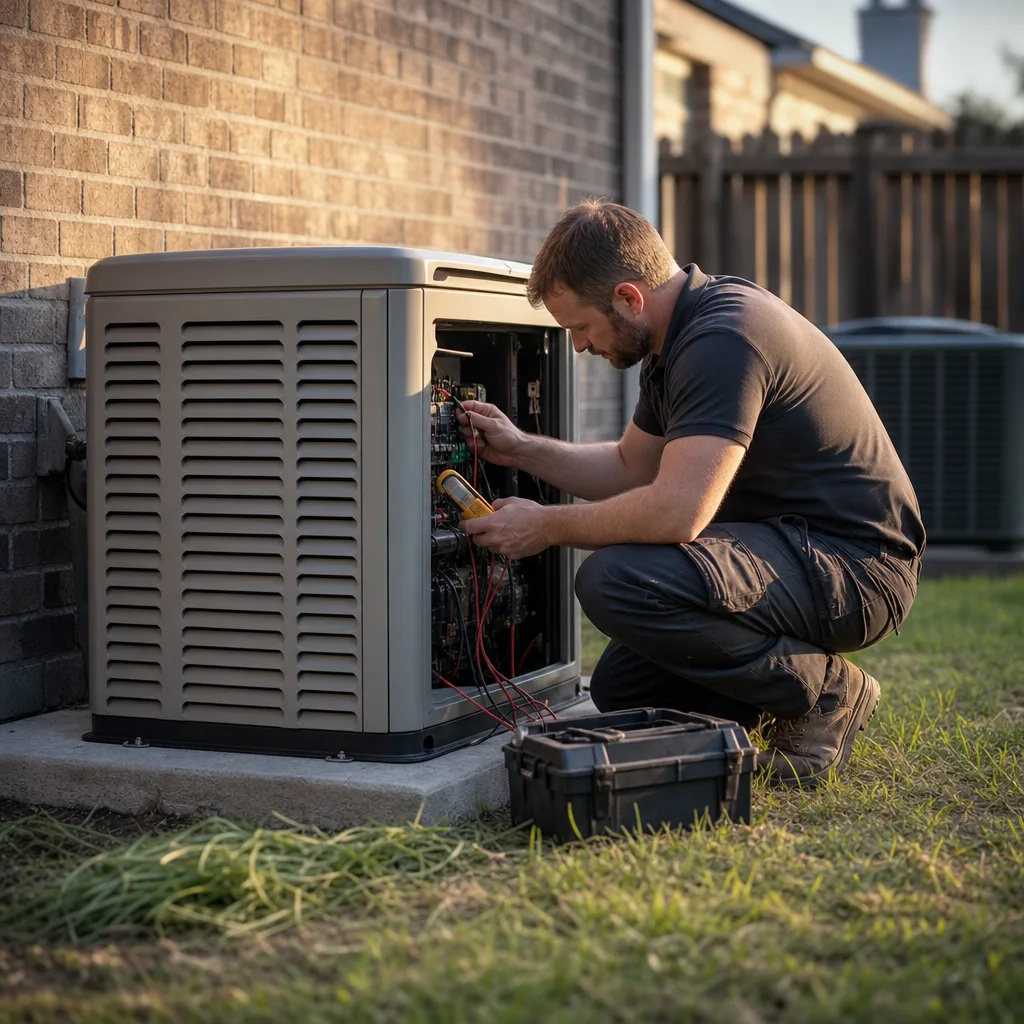
When your generator lets you down, it feels like the whole machine has failed. It usually hasn’t. Our team checks four areas on a repair call: battery, fuel, controls, and starting. We replace the part that failed, then make sure the generator starts and carries load before we leave. Most calls are fixed on the first visit.
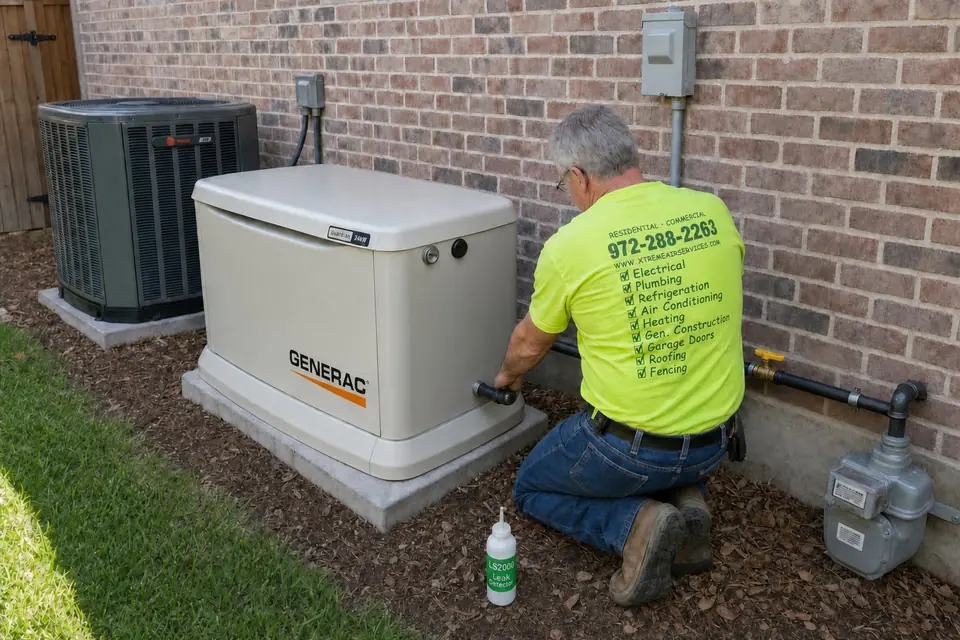
Here’s how each problem tends to look from your side.
- Battery: You press start or the power drops, and you get nothing, or you hear a weak click. A standby generator needs a healthy battery to turn its engine over. North Texas summer heat is hard on batteries, so one that tested fine last year can come up short now. Corroded terminals or a bad battery charger can drain it while the unit just sits.
- Fuel: The engine cranks but won’t catch, or it runs rough and then quits. On a portable unit, gasoline that sat for months can gum up the carburetor. On a natural gas or propane standby unit, look for a closed valve, a regulator problem, or a fuel line issue that keeps the engine from getting enough gas.
- Controls: The display shows an error code, the unit shuts itself off, or it runs but your house never switches over. The controller is the generator’s brain. It watches sensors like oil pressure and temperature, and it works with your transfer switch. One bad sensor or board can stop a good engine cold.
- Starting: The battery’s strong and fuel is getting through, but the engine still won’t fire. Most of the time that’s the starter motor, the spark plugs, or another ignition part. These wear out over years of weekly exercise runs, the short automatic test starts most standby units do on their own.
Why does this matter to you? Because it tells you what a repair really looks like. A generator that won’t start in a storm almost always has one worn or failed part, not a dead engine. Swapping a battery, a sensor, or a starter is a very different job from replacing the whole unit.
It also explains why problems stay hidden until you need the power. Your generator can sit quietly through a Plano summer, then get asked to run for hours when a storm knocks out the lines or a hard freeze strains the grid. A weak battery or a fuel problem won’t show until that moment. That’s the worst time to find out.
Write down what you noticed before you call. Did it click, crank, run and die, or show a code? Did your lights ever come back on? Those details point our technician toward the right fault area faster and help get your backup power working again sooner.
A Failed Self-Test or No-Start During an Outage Needs Same-Day Attention
Some generator problems can wait for a convenient day. Two shouldn’t: a failed self-test and a generator that won’t start or won’t hold your home during an outage. Both mean your backup power isn’t there for you right now, and you can’t predict when the next outage will hit.
A failed self-test is easy to brush off, because the lights are still on. But that weekly exercise run is your generator’s way of telling you it’s ready. When it fails, the same problem will be waiting the moment the grid goes down. In North Texas, that moment often comes fast. A spring thunderstorm can roll through Plano in the afternoon and knock out lines before dinner. A hard winter freeze can strain the grid for days. You want the fix done on a calm Tuesday, not discovered in the dark.
Call the same day if you notice any of these:
- The weekly self-test didn’t run, or it started and quit.
- A red alarm light or error code is showing on the controller.
- The power went out and the generator never started.
- The generator is running, but your house never switched over to it.
- The generator carried your home for a while, then shut itself down mid-outage.
- You hear grinding, knocking, or loud new noises during a run, or you smell fuel near the unit.
Each of these points back to one of the four fault areas above. The difference is timing. If you’re already in an outage, every hour without power costs you something real. Food in the fridge and freezer starts to spoil. Your home heats up quickly in a Texas summer or loses heat in a freeze. If anyone in your home depends on powered medical equipment, or you work from home, the stakes go up fast.
For businesses, it’s about staying open. A generator that won’t pick up the load can mean lost inventory in a cooler, a closed front door, and tenants or customers left waiting. Getting backup power working again the same day protects all of that.
Our phones are answered around the clock, and you’ll talk to a real person. We work to get a licensed, background-checked technician to you the same day. You’ll get upfront pricing before any work starts, so there’s no meter running while you wonder what the bill will be. And there’s no extra charge for nights or weekends, so you don’t have to wait until Monday to save money. A breakdown at 9 p.m. on a Saturday costs the same as one on a weekday morning.
If your generator just failed a test or left you in the dark, don’t sit and hope it sorts itself out. Jot down what you saw or heard, then give us a call.
Call now
Checks to Make Before Calling for Repair
Not every generator problem needs a technician. A few quick checks take about five minutes, and sometimes they’re all it takes. If one of them gets you running again, great. You just saved yourself a service call, and we’d rather you know that up front.
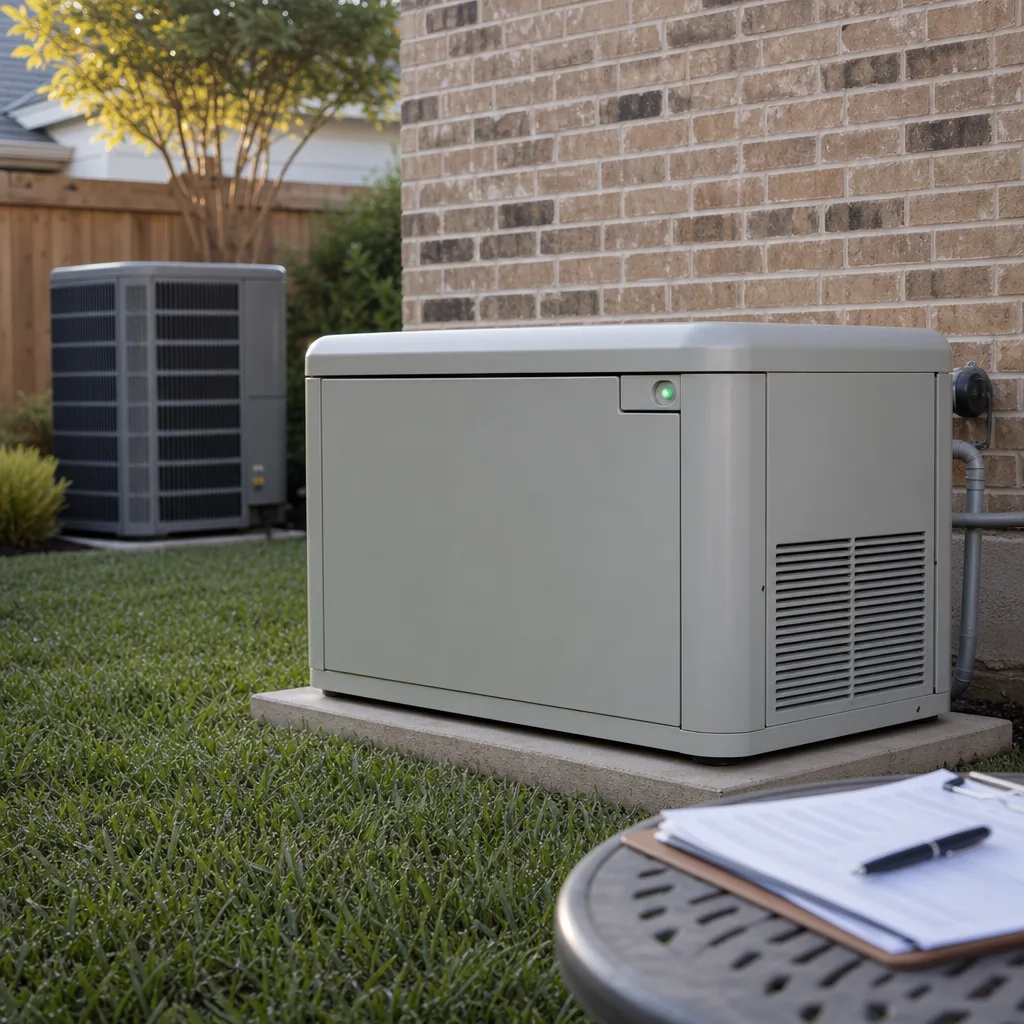
- Look at the mode switch. Most standby generators have a switch or button marked Auto, Manual, and Off. It needs to be in Auto to start on its own when the power drops. These switches get bumped more often than you’d think, especially after yard work or a maintenance visit.
- Check the generator’s own circuit breaker. Many standby units have a main breaker on the unit itself, usually under the lid. If it’s tripped, the engine can run while your house gets nothing. You can reset it once. If it trips again, leave it off and call, because something is pulling more than it should.
- Confirm fuel is reaching the unit. On a propane system, check the tank gauge and make sure the valve is open. On natural gas, see if your stove or gas water heater still works. If none of your gas appliances work, the problem is the gas supply, not your generator. In Plano, that’s a call to Atmos Energy, not to us.
- Read the controller display. Look up the code in your owner’s manual. Some messages are just reminders, like a maintenance-due notice, and don’t mean anything has failed.
- For a portable generator, check the basics. Use fresh gas, set the choke, and check the oil. Many portables have a low-oil shutoff that won’t let the engine run until you top it off.
There’s one thing that looks like a problem but usually isn’t. After the power comes back, many standby units keep running for a few minutes before shutting down. That’s a normal cool-down. It doesn’t mean something is stuck. If your generator is running and your lights are on, it’s doing its job. Report the outage to Oncor and let the generator carry you until the grid is back.
If you’ve worked through these checks and the generator still won’t start, won’t switch your house over, or keeps showing the same code, you’ve already narrowed it down. That’s a real repair, and it’s time for a licensed technician to find the failed part. Tell us which checks you tried when you call, so our technician doesn’t repeat work you’ve already done.
Not sure what your Generator repair project needs? Ask us.
Call Today, Get Service Today. Xtreme Air Services — North Plano is ready to help.
What Happens During a Generator Repair Visit
You’ve done your checks and the generator still won’t cooperate. Here’s what a repair visit looks like, so you know what you’re paying for before anyone touches a tool.
It starts with a $26-$99 service-call fee. If you go ahead with the repair, that fee is credited toward it. You’re not paying twice for the same trip.
Next, our technician finds the fault. They work through the four areas covered above: battery, fuel, controls, and starting. The notes you jotted down about clicks, cranks, or codes help here, because they point straight to where to look first.
Once the failed part is found, you get an upfront flat-rate price, and you approve it before work starts. There’s no meter running while the technician works, and you won’t find a surprise line on the bill later. If the number doesn’t work for you, you can say no.
Then comes the fix. The technician replaces the failed part and runs the generator to make sure it starts and carries load. That second part matters. A generator that starts but can’t pick up your house isn’t fixed. Most calls are fixed on the first visit.
Here’s what the repair price covers and what it doesn’t:
- Included: diagnosis, labor, and the standard replacement part, plus testing.
- Not included unless quoted separately: major components, full unit replacement, code upgrades, or permits.
So what will you pay? Generator repair with Xtreme Air Services typically runs $200-$900. The most common job, where we diagnose the fault, replace the failed part, and verify the generator starts and carries load, runs $200-$525.
Where your repair lands in that range depends on a few things:
- Cause of failure. A battery is a smaller job than a control board.
- Your generator’s brand and size. Larger units and some brands use pricier parts.
- Parts availability. Some parts are easy to get, and others take longer to come in.
- Access. A unit tucked tight between a fence and the side of your house takes more time to work on than one sitting in the open.
- After-hours timing. This one won’t change your price with us, because there’s no extra charge for nights or weekends.
Sometimes the problem is bigger than one part. A failed engine or a unit that’s worn out may need a major component or a full replacement. If that’s what the technician finds, you’ll get a separate quote and a plain explanation of why, and the decision stays yours. Financing usually isn’t offered on a smaller repair, but it is available on larger repairs and replacements. That can make a big job easier to manage when you’d rather not pay it all at once.
Either way, you’ll know the price before the work begins, and you won’t be left guessing about what comes next. Your licensed and insured technician will treat your home like family and work to get it done right the first time.
Call 469-527-5131
Watch Our Video
See How We Handle Generator repair in Plano
Xtreme Air Services — North Plano
What Drives Generator Repair Cost
You’ve seen the range. The next question is where your generator lands in it. Most of the answer comes down to the part that failed and how hard it is to get to. Neither has anything to do with the hour you call.
The part is the biggest swing. A battery or a set of spark plugs is a common part that fits a lot of units, and it goes in fast. A sensor or a starter motor takes more time and costs more. A control board is usually made for one brand and model, so it sits at the high end and sometimes has to be ordered. That’s why two generators with the same symptom, like a no-start, can end up with very different bills.
Size matters too. A small air-cooled standby unit built for a house is simpler than a large liquid-cooled unit that runs a big home or a business. Bigger engines have more parts, and those parts cost more to replace.
Timing affects parts, not our labor rate. After a big North Texas storm or a hard freeze, a lot of generators get pushed hard at once. Common parts can get harder to find for a while. If your unit needs something that has to be ordered, the wait may be longer than usual.
You have more control over the cost than you might think. These steps help:
- Fix a failed self-test while the lights are still on. A weak battery found on a calm day is the same small job. You just haven’t lost power over it yet.
- Keep the area around the unit clear. Trim back shrubs and move stored items, so the technician isn’t working around a fence line or a pile of patio furniture.
- Share what you saw and which checks you already tried. Less time spent searching means less time on the job.
- Stay on top of upkeep. We offer generator maintenance and annual service, which can catch a worn battery or old plugs before they turn into a no-start.
Before you approve any repair, from us or anyone else, it’s fair to ask a few questions:
- Which part failed, and how do you know?
- Is this a standard replacement part or a major component?
- Is the service-call fee credited if I go ahead?
- Will you test the generator under load before you leave?
- Does this job need a permit or a code upgrade?
A good technician answers all of these in plain English without blinking.
Sometimes the honest answer is that a repair isn’t worth it. If an older generator needs a major component, compare that cost to replacing the whole unit. Also think about how many more years of service the old one has left. If the repair is a big share of the cost of a new unit and the generator is near the end of its life, you’ll hear that from us straight. Either way, you make the call.
Call 469-527-5131
Frequently Asked Questions
Common questions about Generator repair
Can a portable generator be repaired, or should I just replace it?
Yes, most portable generator problems can be repaired. The most common issue is old gasoline that gums up the carburetor after sitting for months, which keeps the engine from catching. A low-oil shutoff can also stop a portable from starting if the oil is low, so check that first. If fresh gas, a clean carburetor, and topped-off oil don’t fix it, a technician can usually track down the failed part.
What do you call someone who repairs generators?
We call ourselves generator repair technicians, and the work covers both standby and portable units. The job means finding which of four systems failed, the battery, fuel, controls, or starting system, then replacing that part and testing the generator under load. A licensed technician handles the electrical side too, since standby units tie into your home’s transfer switch.
Can a regular electrician fix my generator?
An electrician can handle some generator issues, especially problems with wiring, the transfer switch, or the connection to your home’s electrical panel. But generators also have engine-side problems like fuel, battery, and starting issues that call for someone familiar with both the mechanical and electrical sides. A technician who works on generators regularly can diagnose all four common fault areas in one visit instead of needing two different trades.
Ready to Get Started?
Call (469) 527-5131 Today, Get Service Today.