


Whole-Home Water Filtration Installation in Plano
Point-of-entry filtration for every tap in the house, compared honestly with softeners and reverse osmosis.
What’s Covered on This Page
- Whole-Home Filtration Treats What Plano’s Municipal Water Leaves Behind
- Water Filtration and Water Softening Are Not the Same Fix
- Signs Your Home’s Water Needs Whole-Home Treatment
- When a Smaller Fix Solves the Problem Instead
- What Happens During Installation at Your Home’s Main Line
- How long does a whole-home water filtration install take?
- Will a whole-home filter lower my water pressure?
- Can I still install a water softener later if I only get a filter now?
- What if my Plano home doesn’t have a plumbing loop for the system?
Whole-Home Filtration Treats What Plano’s Municipal Water Leaves Behind
Let’s start with the honest part. If you’re on Plano city water, your water is already treated before it gets to you. It has to meet federal drinking water rules. A whole-home filter isn’t about making unsafe water safe. It’s about the stuff the city’s treatment leaves in, or the stuff your water picks up on the long trip from the plant to your kitchen.
Here’s what that usually means for you day to day:
- A pool-like smell or taste. Most North Texas utilities disinfect with chlorine or chloramine. That’s good for safety, but a lot of folks don’t like drinking it or showering in it.
- Grit and cloudiness. Water can pick up fine sediment from the miles of pipe between the plant and your home. That’s more likely after main breaks or line work in your area.
- Dry skin and hair after a shower. Disinfectant in hot shower water bothers some people more than drinking water does.
- Off flavors in coffee, tea, and ice. Carbon filtration takes a lot of the taste and odor out of the picture.
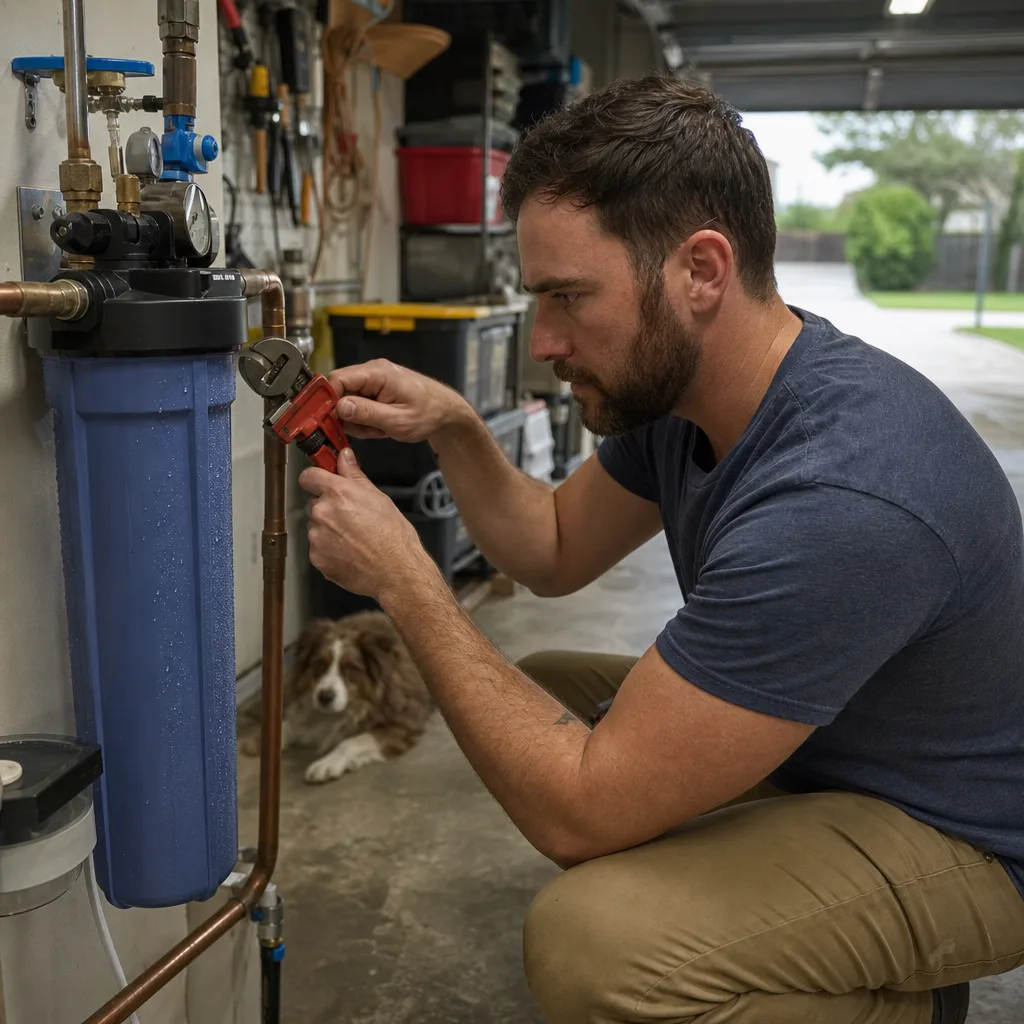
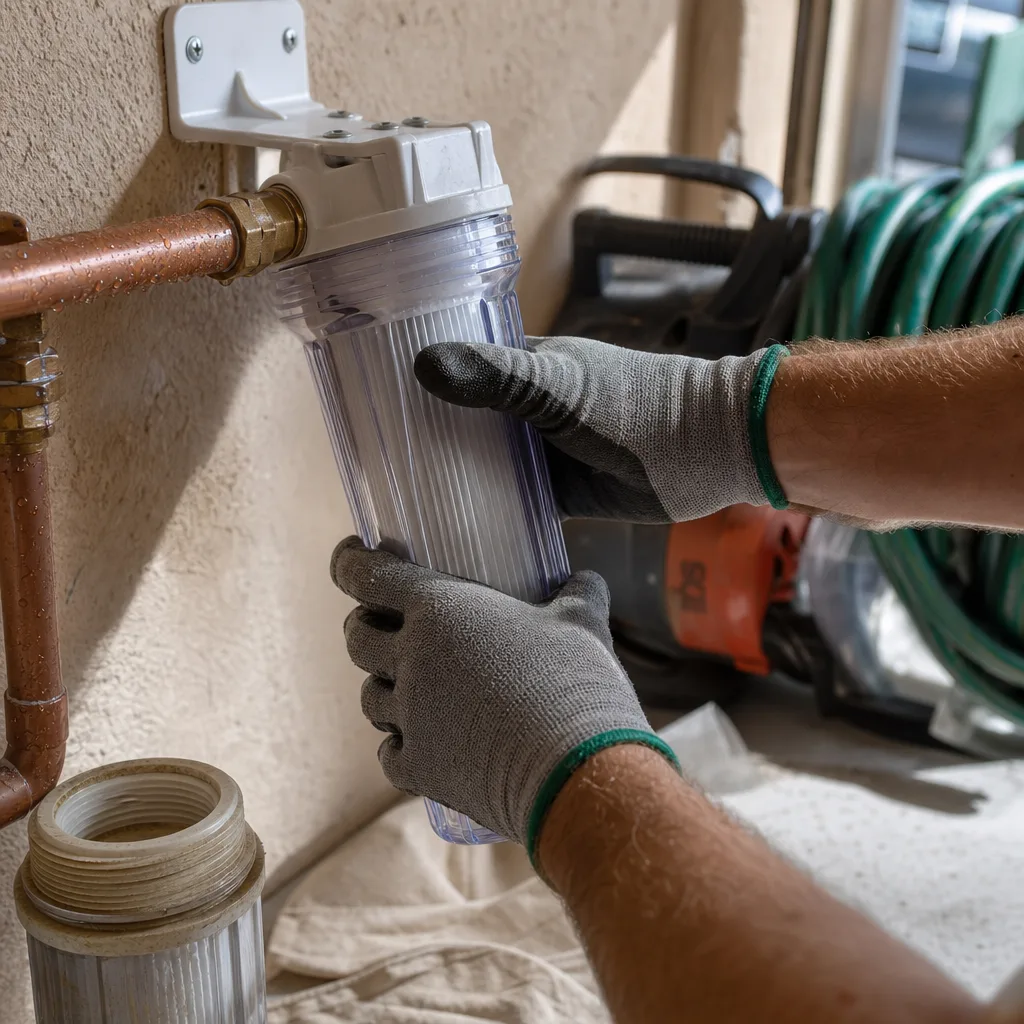
A whole-home system is also called a point-of-entry system. It goes in where your main water line comes into the house, so every tap gets filtered water. That’s the big difference from a pitcher or an under-sink unit. Those only clean the water at one spot. A whole-home filter handles your showers, your laundry, your ice maker, and your water heater too.
Now the part some companies skip. A standard whole-home filter does not soften your water. Hard water is common across North Texas. If your real complaint is white crust on faucets, spots on dishes, or scale building up in your water heater, that’s minerals, and minerals call for a softener. We handle water softener installation too, and plenty of homes do best with both a filter and a softener working together. But you shouldn’t pay for a filter expecting it to fix a hardness problem it was never built to fix.
The same goes for drinking water. If you want the cleanest possible water for drinking and cooking, a reverse osmosis system under the kitchen sink is a separate job that pairs well with a whole-home filter. It doesn’t replace one.
That’s why the system you pick should match your water, not a sales sheet. Filter type and number of stages matter. So does flow rate. A filter that’s too small for a busy household can leave you with weak pressure when the shower and dishwasher run at the same time. If you’re not sure what’s in your water, a water test is the easiest place to start.
Once you know what you’re treating, the choice gets simple. You get a system sized for your home, installed at the main supply, and every faucet in the house benefits.
Water Filtration and Water Softening Are Not the Same Fix
Start with what’s bugging you. Your answer usually points to one system or the other before anyone opens a toolbox.
- Points to a filter: your water smells like a pool, tastes off in coffee or ice, looks cloudy, or leaves grit in faucet screens.
- Points to a softener: white crust builds up on faucets and shower heads, dishes come out spotted, soap won’t lather well, or your water heater is collecting scale.
- Points to both: you notice something from each list. That’s common in North Texas, where city water carries both disinfectant and hard minerals.
The two systems work in completely different ways. A whole-home filter catches things. A sediment stage screens out sand and grit. A carbon stage grabs chlorine, chloramine, and the compounds behind bad taste and smell. Calcium and magnesium, the minerals that make water hard, go right through it.
A softener works by trading. Water runs through a tank of resin beads that pull out calcium and magnesium and swap in a small amount of sodium or potassium. Every so often, the softener rinses those beads with salt water to recharge them. That’s called regeneration, and it’s the reason a softener needs salt and a place to drain.
That difference shows up on install day. A softener needs a drain nearby and usually a power outlet for its control head. Some filter setups need a drain too, depending on the type. Both connect at a plumbing loop, a set of pipes near where your main line enters the house so the system can treat all your water. Plenty of newer Plano homes were built with a loop already in place, often in the garage. Older homes may not have one.
This matters for your budget. Drain access is one of the things that moves the cost of a whole-home filtration install up or down. Adding a plumbing loop where none exists isn’t part of a standard install price, so it’s worth asking about before you commit. We’ll check for a loop and a drain when we look at your setup, so you know about any extra work up front.
Upkeep is different too. A filter needs fresh cartridges or media on a schedule, and how often depends on the system and how much water your household uses. A softener needs its salt topped off, plus an occasional check to make sure it’s regenerating the way it should.
If you’re putting in both, order matters. The filter goes first in line, ahead of the softener. Chlorine and chloramine can wear down softener resin over time, so letting the carbon catch them first helps protect the softener. Sediment stays out of the resin tank too. Get the order wrong and the softener can wear out sooner than it should.
The bottom line is simple. Taste, smell, and grit are filter jobs. Crust, spots, and scale are softener jobs. Once you know which problems you have, you can pay for the fix that solves them instead of guessing.
Signs Your Home’s Water Needs Whole-Home Treatment
Some water problems stay at one faucet. Others show up all over the house. The signs below point to water that needs treating where it enters your home, not just at the kitchen sink.
- You go through filters fast. Your fridge filter or faucet-mount filter clogs or loses flow well before the date on the box. That tells you your water carries more than those small filters were built to handle.
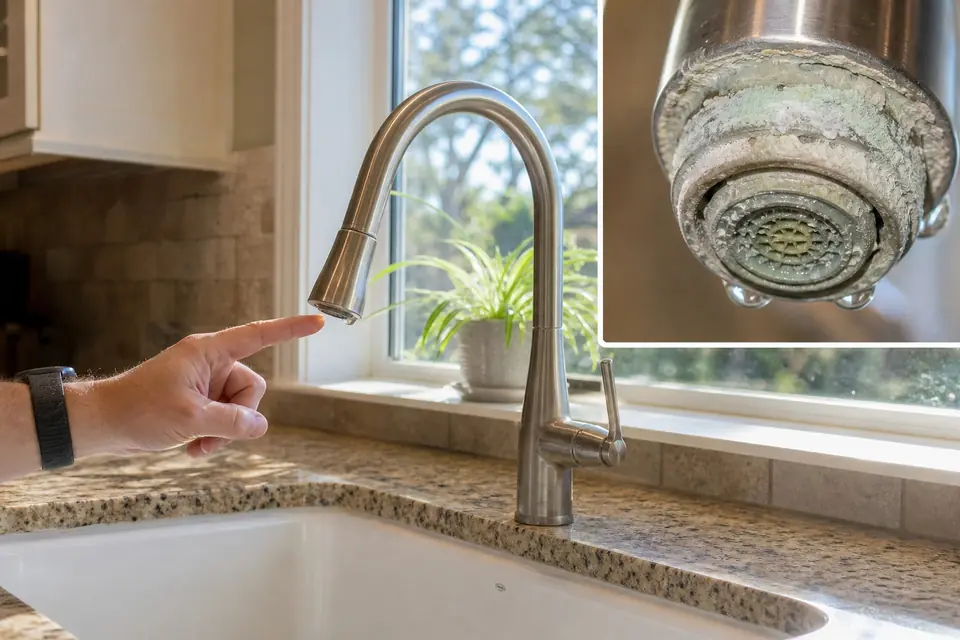
- Faucet screens and shower heads keep clogging. You unscrew an aerator and find specks or gritty bits, and it happens again a few weeks later. A one-time cleanup is no big deal. A repeat problem means sediment is reaching every fixture, including the ones you don’t check.
- The whole family notices, and not just at the sink. If one person dislikes the drinking water, that’s a single-tap issue. If people complain about the shower, the bath, and the smell of the laundry too, the problem is in all your water.
- You see stains in tubs, toilets, or sinks. Reddish-brown stains often point to iron or rust. Dark gray or black rings can point to manganese. These need the right kind of filter media, so it pays to know what’s causing them first.
- You just moved in and don’t know the plumbing’s history. A water test gives you a baseline, so you’re not guessing about what’s coming out of the taps.
Picture this. You swap your fridge filter in the spring, and by midsummer your ice tastes off and the water dispenser trickles. You’ve also cleaned the bathroom shower head twice. That’s not bad luck with one appliance. That’s the same water wearing on everything it touches, which is exactly what a whole-home filter is for.
Now the times a whole-home system probably isn’t your answer:
- The bad smell only comes from hot taps. A rotten-egg smell from hot water but not cold usually starts inside the water heater, not in your supply line. A whole-home filter won’t fix that. Have the water heater looked at instead.
- Your water looks milky, then clears from the bottom of the glass up. That’s tiny air bubbles. It’s harmless and needs no treatment.
- Something changed right after work on your street. Cloudy or off water after a main break or line repair is often short-lived. Give it time and check with the city’s water department before you buy anything.
- Only your drinking water bothers you. If the showers and laundry seem fine, treating one tap may be all you need.
- Your main complaint is crust and spots. As covered above, that’s a softener job, not a filter job.
If two or more signs from the first list sound familiar, a whole-home system is worth a serious look. If you’re stuck in between, start with a water test. It turns “something seems off” into a clear answer about what to treat and how much system your home needs.
Not sure what your Whole-home water filtration installation project needs? Ask us.
Call Today, Get Service Today. Xtreme Air Services — North Plano is ready to help.
When a Smaller Fix Solves the Problem Instead
A whole-home filter is a big step. It’s a real install at your main line, and it comes with ongoing filter changes. If your problem is small or limited to one spot, a smaller fix can do the job for a lot less money and hassle. Here’s when that’s true.
- You only care about how your drinking water tastes. A pitcher filter or a faucet-mount carbon filter takes a lot of the pool smell out of the water you drink. If your family fills glasses at one sink and the showers don’t bother anyone, that may be all you need.
- You want better water for drinking and cooking, not the whole house. An under-sink filter or a reverse osmosis system treats the kitchen tap where you fill pots and coffee makers. It’s a smaller job than a whole-home install, and it’s yours to use every day.
- Your fridge water tastes off. Check when you last changed the fridge filter. A lot of people forget it for a year or more. A fresh one often brings the ice and water back to normal.
- Only your showers bother you. If dry skin or the disinfectant smell in hot water is the main complaint, a filtered shower head is worth trying first. Read the label to see what it’s rated to reduce. Some are built for chlorine and don’t do as much with chloramine.
- One faucet sputters or runs weak. Unscrew the aerator at the tip, rinse out the screen, and put it back. If it stays clear for months, you had a one-time bit of debris, not a whole-house sediment problem.
- You rent, or you’re moving soon. A whole-home system is plumbed into the house and stays with it. If you won’t be there long, point-of-use filters you can take with you make more sense.
Think about a couple in a smaller Plano home who mostly notice the taste of their tap water. They drink filtered water at the kitchen sink and like their showers just fine. For them, a good under-sink filter fixes the problem. A whole-home system would treat a lot of water that was never bothering anyone.
Smaller fixes do have limits, and it helps to know them going in. Each one only treats the water at that one spot. Your washing machine, dishwasher, water heater, and the other bathrooms still get untreated water. Each also needs its own filter changes, and those small cartridges add up if you’re running three or four of them around the house.
So try the small fix first if it matches your problem. Give it a fair shot, and pay attention to how often you’re swapping cartridges. If you end up with filters on several taps and still aren’t happy, or the grit and smell keep showing up in places a small filter can’t reach, that’s your sign the problem lives in all your water. Until then, there’s no reason to treat the whole house for a one-faucet problem.
Watch Our Video
See How We Handle Whole-home water filtration installation in Plano
Xtreme Air Services — North Plano
What Happens During Installation at Your Home’s Main Line
A whole-home filter install is a plumbing job, but it’s not a messy one. Most of the work happens in one spot, where your main water line comes into the house. In a lot of Plano homes, that’s the garage. Here’s what a typical install looks like from start to finish.

- Water off. The installer shuts off your main supply so nothing flows while the lines are open. Plan on no running water in the house for part of the day.
- Mount the system. The filter tank or housings get set on the floor or mounted to the wall near the loop, with enough room around them so filter changes are easy later.
- Add a bypass valve. This is a simple valve setup that lets you send water around the filter. If the system ever needs service, you flip the bypass and still have water in the house.
- Make the connections. The inlet and outlet get tied into your plumbing so all the water headed into your home passes through the filter first. If you’re adding a softener too, the filter goes ahead of it in line, for the reasons covered above.
- Run the drain, if needed. Systems that rinse themselves clean need a drain line. Cartridge-style filters usually don’t.
- Turn it on and test. The water comes back on slowly. Every connection gets checked for leaks while the system is under pressure.
That last step matters more than people think. New carbon media sheds fine black dust at first, so the system gets flushed until the water runs clear. If you skip it, that dust ends up in your faucet screens and your water heater. Air in the lines can also make your taps sputter for a little while after the water comes back on. That’s normal, and it settles down quickly.
After the flush, it’s smart to run a couple of fixtures at once, like a shower and the kitchen sink. Your pressure should feel about the same as it did before. If it drops off noticeably, the system may be too small for your home’s flow, which is why sizing matters before anything gets installed.
With Xtreme Air Services, a standard install covers the system and materials, professional installation, connections, startup and testing, and haul-away of your old unit if you have one. A few things fall outside that and are worth knowing about ahead of time:
- A plumbing loop, if your home doesn’t already have one.
- Electrical work. Some systems have a control head or UV light that needs power, and not every garage has an outlet in the right spot.
- Code corrections, if the existing plumbing near your main line isn’t up to current code.
- Permits, unless your quote states they’re included.
You can make install day go smoother with a little prep. Clear a few feet of space around where your main line comes in. Move cars, storage bins, or shelving away from that wall. If you know where your main shutoff is, point it out. If anyone in the house will need water during the work, fill a few jugs or schedule laundry and showers around it.
Once it’s done, the only thing you should notice is better water at every tap. Ask your installer to show you the bypass valve and how the filters come out, so you’re not guessing the first time a change is due.
Frequently Asked Questions
Common questions about Whole-home water filtration installation
How long does a whole-home water filtration install take?
Most installs are finished in part of a day. Your main water line gets shut off while the system is mounted and connected, so plan for a stretch without running water, then the flush and pressure test take a bit more time before every tap is back online.
Will a whole-home filter lower my water pressure?
It shouldn’t, if the system is sized right for your home. A filter that’s too small for a busy household can cause weak pressure when the shower and dishwasher run together, which is why checking your flow rate before install matters. Run two fixtures at once after install to confirm pressure feels normal.
Can I still install a water softener later if I only get a filter now?
Yes, and plenty of homes end up running both. If you add a softener down the road, it goes after the filter in line, since the carbon stage protects the softener’s resin from chlorine and chloramine. Just let your installer know you may add one later so the bypass and connections leave room for it.
What if my Plano home doesn’t have a plumbing loop for the system?
You can still get a whole-home filter, but adding a loop is extra work beyond a standard install. Newer Plano homes often already have a loop in the garage near the main line, while older homes may need one added, so it’s worth asking about during your quote.
Ready to Get Started?
Call (469) 527-5131 Today, Get Service Today.