


Chiller Installation in Dallas for Commercial Buildings
Chiller installation for commercial and industrial buildings, with the permits and licensing explained.
What’s Covered on This Page
- Chiller Installation Is Built for Commercial and Industrial Buildings
- Signs Your Building Needs a New Chiller
- What Happens During a Commercial Chiller Installation
- Permits and Licensing for Chiller Installation in Dallas
- What Drives Chiller Installation Cost
- How long does a commercial chiller installation take from start to finish?
- Can I keep my building cool while the new chiller is being installed?
- Will I need to involve Oncor for my chiller installation?
- What happens to the old chiller once the new one is installed?
Chiller Installation Is Built for Commercial and Industrial Buildings
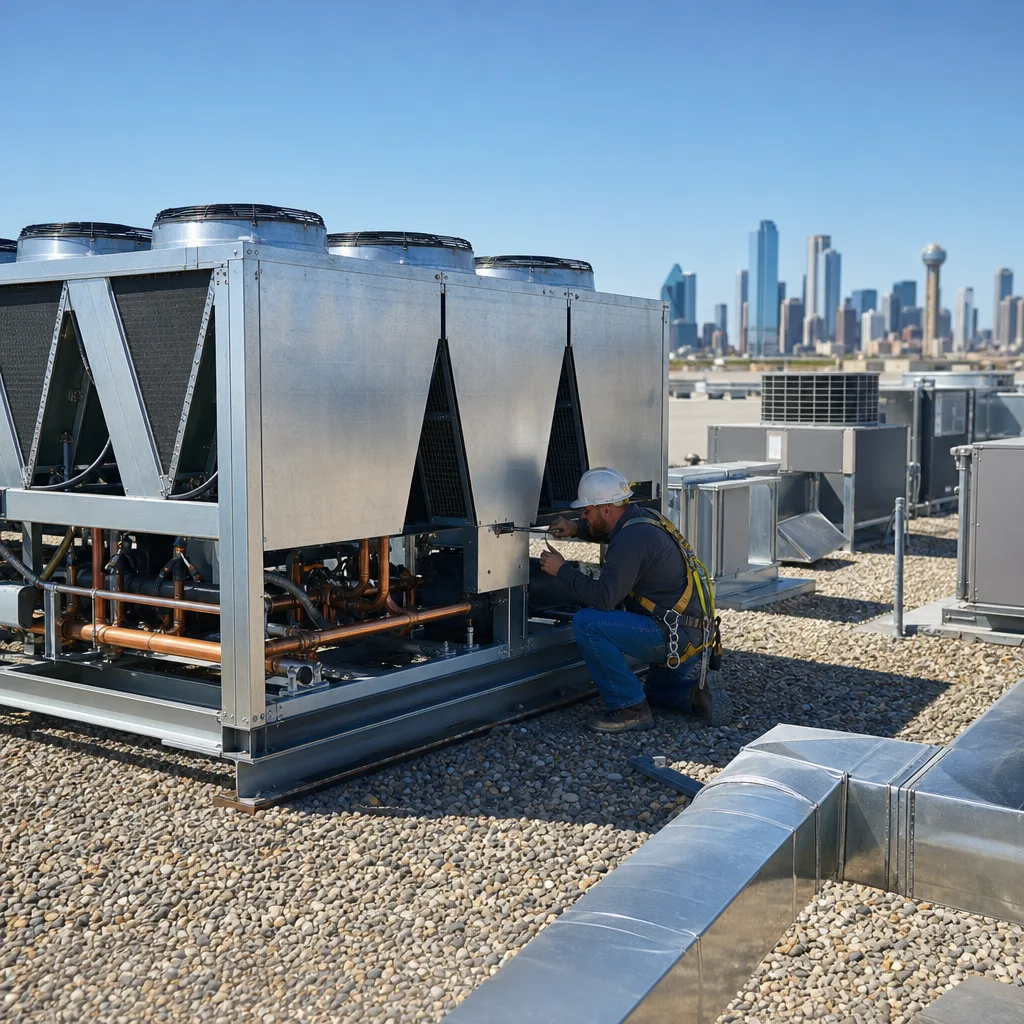
Let’s start with the honest answer, because it saves a lot of people time. Chiller installation is a commercial and industrial job. A chiller doesn’t blow cold air the way your home AC does. It chills water, then pumps that water through pipes to air handlers and coils all over a building. That setup makes sense when you’ve got a lot of square feet, a lot of floors, or equipment that has to stay cool around the clock.
If you’re a homeowner, you don’t need a chiller. That’s true even if your house is big and your summer bills hurt. A well-sized central air system, a high-efficiency heat pump, or a ductless mini-split is the right tool for a home. Putting a chiller in a house would cost far more and add parts you’d have to maintain for no real gain. The same goes for most small retail spaces and single-story offices that run fine on rooftop units.
Here’s where a chiller usually does earn its place:
- Multi-story office buildings where one central plant is easier to run than dozens of separate units
- Schools, churches, and large event spaces with big crowds and big cooling swings during the day
- Hospitals, clinics, and labs that need steady temperature and humidity control
- Data centers and server rooms where heat never takes a day off
- Manufacturing and food processing plants that need process cooling for machines or products
- Larger apartment and mixed-use buildings already designed around chilled water
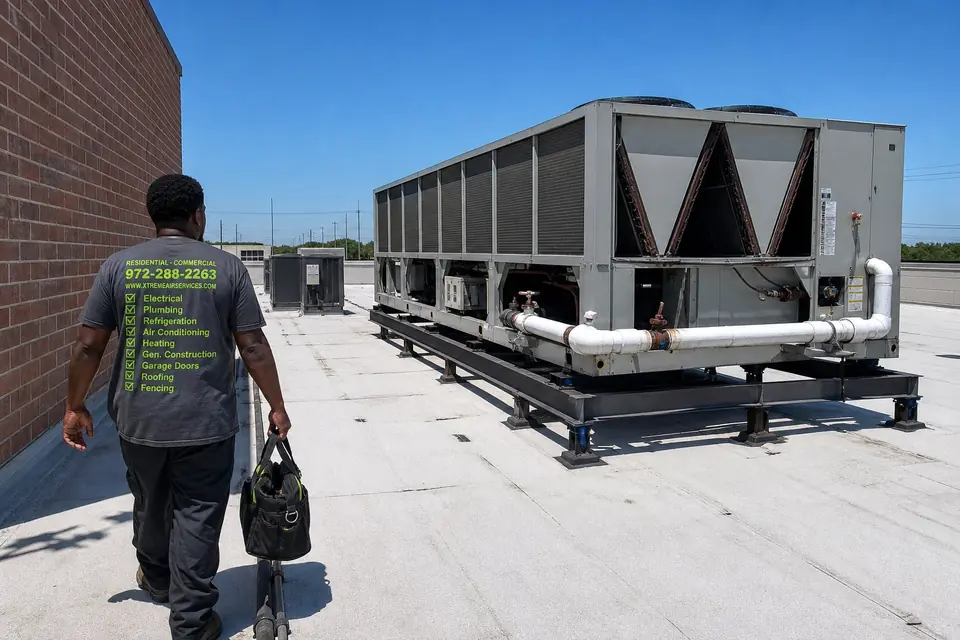
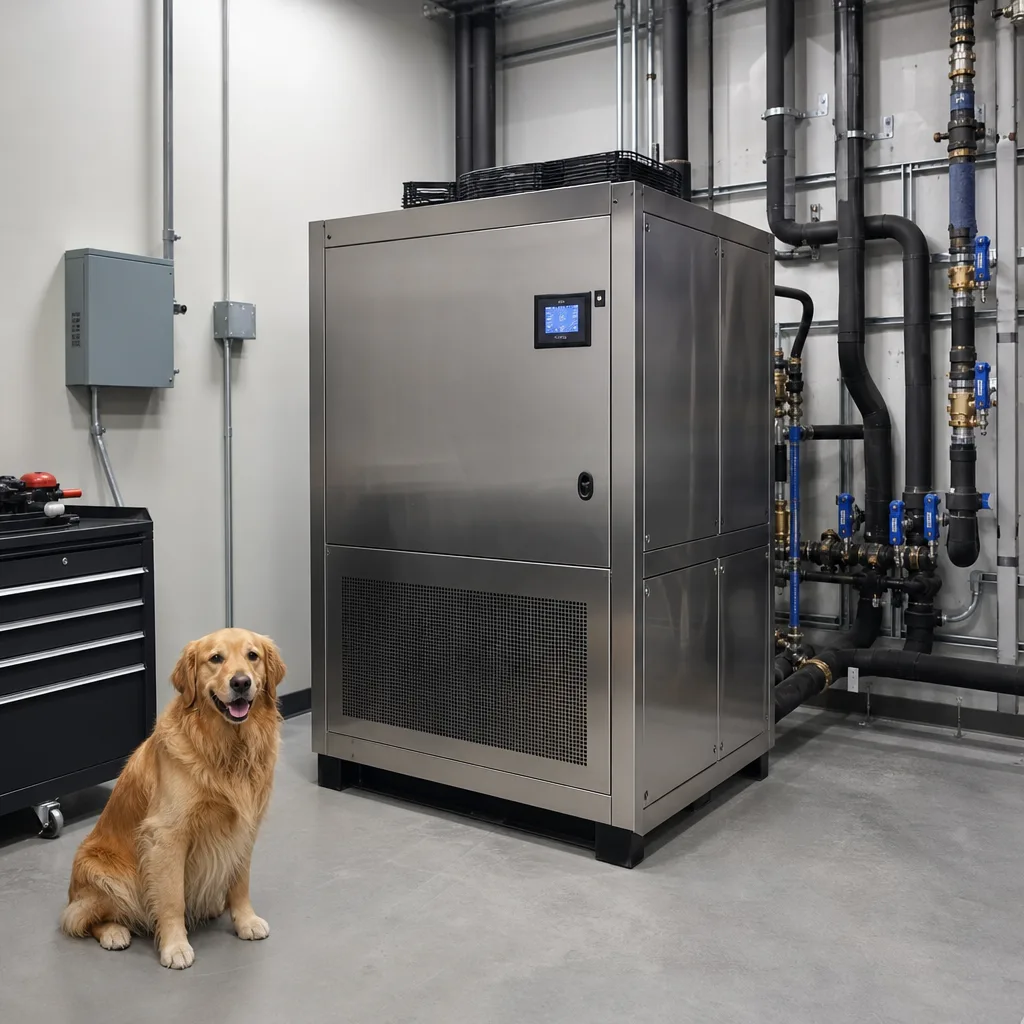
There are two main types, and the building often decides for you. An air-cooled chiller sits outside, often on a roof or a pad, and dumps heat straight into the air. It’s simpler and needs less equipment. A water-cooled chiller usually sits in a mechanical room and pairs with a cooling tower that gets rid of heat through water. It tends to suit bigger loads, but it brings more moving parts, from tower to pumps to water treatment.
That’s the bigger point to keep in mind. A chiller isn’t a box you drop in and plug up. It’s the heart of a whole system: the chiller, the pumps, the piping, the cooling tower if you have one, the electrical service feeding it, and the controls that tell it all how to work together. In Dallas, where long, hot summers keep commercial cooling running hard for months at a time, a weak link anywhere in that chain shows up fast as hot floors, tenant calls, or a production line that has to slow down.
So if your building fits the list above, the real question isn’t just which chiller to buy. It’s whether the team putting it in can handle the whole plant around it. Xtreme Air Services lists chiller installation alongside cooling tower installation, pump installation and repair, piping installation, commercial electrical, and building automation, so you can keep the full system under one accountable local team.
Signs Your Building Needs a New Chiller
Chillers rarely die all at once. Most give you months of warning, and the clues usually show up in your bills, your repair log, and your tenant calls before the machine quits. If you know what to look for, you can plan a replacement on your schedule. That beats scrambling during a heat wave.
Here are the signs worth taking seriously:
- It can’t keep up on the hottest afternoons. The building feels fine in May, but by late July some floors run warm from about 3 to 6 p.m. That often means the chiller has lost capacity it used to have.
- Your energy bills keep climbing while your use stays about the same. Older chillers lose efficiency as compressors wear and heat exchanger tubes build up scale. You pay more to get the same cooling.
- The repair calls are stacking up. One compressor repair is normal. A new failure every season, plus emergency calls, means you’re paying to keep a machine alive instead of putting that money toward one that works.
- You keep adding refrigerant. A leak that comes back isn’t a one-time fix. Some older chillers run on a refrigerant that has been phased out, which makes every top-off cost more and makes parts harder to find.
- Parts take weeks to show up, or can’t be found at all. When the maker no longer supports your model, a simple breakdown can turn into a long shutdown.
- The controls are outdated. If your chiller can’t talk to your building automation system, you’re missing easy savings and early warnings.
- New noise, vibration, or alarms. Grinding, knocking, or frequent safety trips point to wear inside the compressor or motor.
There’s one more sign people miss: your building changed, but your chiller didn’t. Maybe you added a server room, turned warehouse space into offices, or filled empty floors with new tenants. The chiller sized for the old building may now be running flat out every day. That’s a sizing problem, and no amount of repair will fix it.
Dallas puts this to the test every year. Long, hot summers keep commercial chillers working hard for months on end, so a tired machine shows its weak spots fast. A chiller that barely got through last August is unlikely to get easier this year.
If your chiller still has good years left, the smart move is repair and steady upkeep. Xtreme Air Services also offers commercial HVAC repair and maintenance and mechanical system troubleshooting, so you’re not pushed toward a new unit you don’t need.
What Happens During a Commercial Chiller Installation
A chiller install isn’t one big day of work. It happens in stages, and most of the work that protects your building comes before the new machine ever shows up. When you know the steps, you can plan around your tenants, your staff, or your production schedule instead of guessing.
- Sizing and site survey. The first step is figuring out how much cooling your building really needs today. A cooling load calculation looks at your square footage, people, equipment, and sun exposure. This step catches the sizing problem mentioned earlier, so you don’t simply replace an old chiller with a new one that’s just as wrong for your building.
- Picking the equipment and ordering it. Commercial chillers often aren’t sitting on a shelf. Lead times can stretch for weeks or longer, so ordering early matters.
- Permits and planning the shutdown. A commercial job like this usually needs permits and inspections. This is also when you plan the cutover. That means choosing the timing, deciding whether you need temporary cooling, and figuring out how to keep critical spaces like server rooms running. Dallas summers keep commercial cooling working hard for months, so many owners aim to finish before peak heat if they can.
- Removing the old chiller. The refrigerant has to be recovered properly before the old unit is disconnected and taken out. Getting a chiller off a roof or out of a basement mechanical room may take a crane or careful rigging.
- Setting and connecting the new unit. The chiller goes onto its pad, roof curb, or mechanical room floor. Then it’s tied into the chilled water piping, the condenser water piping if you have a cooling tower, and the electrical service. If the new unit needs more power than your building has now, that work may involve coordinating with Oncor.
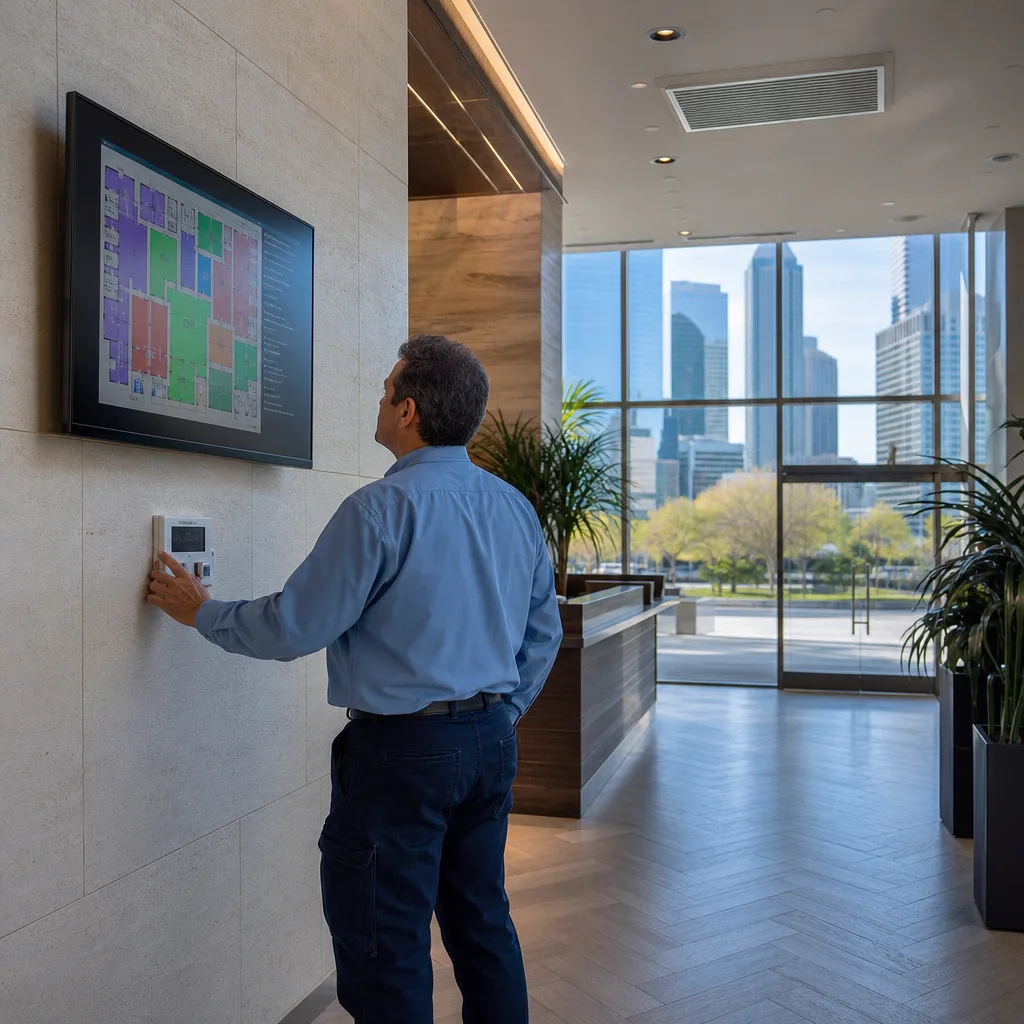
- Controls. The chiller gets wired into your building automation system, so it can stage up and down with demand and send alerts before small problems grow.
- Flushing, filling, and startup. The water loop is cleaned and filled. Then the chiller is started and tested under real load to confirm temperatures, pressures, flow, and safety controls all check out.
That last step is the one you shouldn’t let anyone rush. A chiller that turns on isn’t the same as a chiller that’s set up right. Startup and testing is where you find out whether the pumps, piping, tower, and controls are really working together. That’s the whole-system point this page keeps coming back to.
Here’s what’s covered when Xtreme Air Services handles a chiller installation: the equipment and materials, professional installation, standard connections, startup and testing, and haul-away of the old unit. Duct, electrical, or plumbing modifications, code corrections, and permits aren’t included unless they’re stated in your quote. Ask about those up front. In an older Dallas building, the condition of the existing piping and electrical service is often what decides whether the job stays a simple swap or needs more work.
Before any work starts, you should have a clear picture of each stage and what it means for your building. That includes how long cooling will be down, which spaces stay cool, and what happens if the crew opens something up and finds a surprise. If a contractor can’t walk you through that plainly, keep asking until one can.
Ready when you are – get in touch today.
Call Today, Get Service Today. Xtreme Air Services — Oak Lawn is ready to help.
Permits and Licensing for Chiller Installation in Dallas
A chiller swap in Dallas isn’t something you do quietly over a weekend. It touches refrigerant, high-voltage power, water lines, and sometimes the roof itself. Each of those comes with its own rules. If the paperwork’s handled right, you barely notice it. If it isn’t, it can stall your project or come back to bite you years later.
Most commercial chiller jobs in the city need some mix of these permits and inspections:
- Mechanical permit. This covers the chiller itself, the refrigerant work, and the chilled water connections.
- Electrical permit. A new chiller often needs a new disconnect, new wiring, or a bigger feed. If your building needs more power from Oncor, that adds time to plan for.
- Plumbing work. Water-cooled systems have a makeup water line feeding the cooling tower. That line typically needs backflow protection so tower water can’t flow back into the city supply.
- Structural review. A heavier unit on a roof, a new curb, or a new pad may need an engineer to confirm the structure can carry it.
- Street or right-of-way approval. If a crane has to sit on a public street or block a sidewalk to lift the old unit out, the city may need to sign off first. That’s common on tight lots in denser parts of Dallas.
Not every job needs all five. A like-for-like air-cooled swap on an existing pad is simpler than a new water-cooled plant with a tower on the roof. Your contractor should tell you which ones apply to your building before work starts, not halfway through.
Licensing matters just as much. In Texas, air conditioning and refrigeration contractors are licensed through the Texas Department of Licensing and Regulation, or TDLR. Electrical work needs a licensed electrician. Anyone who recovers or charges refrigerant has to hold EPA certification to handle it. Xtreme Air Services holds HVAC License #TACLA29023C, and you can check any contractor’s license yourself through TDLR before you sign.
Why does this matter for you? Your insurance carrier, your lender, or a future buyer may ask whether the work was permitted and inspected. Unpermitted mechanical work can slow a sale, complicate an insurance claim, or force you to open things back up for a late inspection. A permitted job also gets a second set of eyes from the inspector, which is one more check on the whole system working the way it should.
Since permits aren’t part of a standard installation price unless your quote says so, ask these questions up front:
- Whose name and license number will be on the permit?
- Which permits does my building need, and who’s pulling them?
- Are permit fees and any engineering costs in the quote, or billed separately?
- Who meets the inspector, and what happens if something fails inspection?
- How do the permit and inspection dates fit into my shutdown plan?
A good contractor answers all five without hesitating. If you get vague answers or a suggestion to skip the permit and save some money, that tells you a lot about how the rest of the job will go.
Watch Our Video
See How We Handle Chiller installation in Dallas
Xtreme Air Services — Oak Lawn
What Drives Chiller Installation Cost
Let’s talk numbers, because you can’t plan a project without them. A chiller installation with Xtreme Air Services typically runs $15,000-$150,000. That’s a wide range, and it should be. A small air-cooled unit swapped onto an existing pad is a very different job from a large water-cooled plant in a downtown mechanical room.
Our most common job is a standard like-for-like chiller installation. It uses your existing connections and needs no major modifications. That job runs $42,000-$96,000, and it covers the equipment and materials plus professional installation, startup, and testing.
So what pushes your project toward one end of the range or the other? Here are the factors that matter most:
- Size and capacity. Chillers are rated in tons of cooling. A bigger building or a heavier load needs more tons, and more tons cost more. That’s why the cooling load calculation matters. Oversizing means you pay for capacity you’ll never use.
- Efficiency. A higher-efficiency machine usually costs more up front. It can pay you back in lower energy bills, especially in a city where commercial cooling runs hard for months every year.
- Brand and model. Different makers and model lines come at different price points, with different features and controls.
- Ease of access. A unit on a ground-level pad is simpler to reach than one on a roof or in a basement. If the job needs a crane or tight rigging, that adds cost.
- Condition of what’s already there. Worn piping, an electrical service that can’t carry the new load, or old connections that don’t match can turn a simple swap into a bigger job.
- Code upgrades and permits. Older equipment may have been installed under older rules. Bringing things up to current code can add work, and permit costs depend on what your building needs.
- Custom fabrication. If new piping runs, supports, or connections have to be built to fit your space, that’s extra labor and materials.
Notice something about that list. Most of the big swings don’t come from the chiller itself. They come from the system around it, meaning the piping, the power, the access, and the structure. That’s why two quotes for the same machine can land far apart. One contractor may have priced the whole job. The other may have priced only the box. Since modifications and permits aren’t part of a standard installation unless your quote says so, ask every bidder to spell out what they’ve priced and what they haven’t.
There’s a $26-$99 service-call fee to come out and look at your system. If you move forward with Xtreme Air Services, that fee is credited toward the work. We use upfront flat-rate pricing, so you’ll see the price and approve it before anything starts. No meter running, no surprises halfway through.
A chiller is a big investment, and you don’t always have it sitting in the budget all at once. Flexible financing is available on qualifying installations and larger jobs, on approved credit.
Call 469-269-6373
Frequently Asked Questions
Common questions about Chiller installation
How long does a commercial chiller installation take from start to finish?
It depends on your building, but the equipment order is often the longest part. Commercial chillers can have lead times stretching for weeks or longer, so most of the calendar time comes from waiting on the unit, not the install work itself. Once the chiller arrives, removal of the old unit, setting the new one, and startup testing happen in a planned sequence so you know what to expect for shutdown time.
Can I keep my building cool while the new chiller is being installed?
Yes, this is something you plan for before the shutdown starts. Part of the planning stage includes deciding whether you need temporary cooling and figuring out how to keep critical spaces, like server rooms, running during the swap. Raising this early lets your contractor build a plan around your tenants or operations instead of leaving you without cooling during the work.
Will I need to involve Oncor for my chiller installation?
You might, if your new chiller needs more electrical capacity than your building currently has. A larger or more efficient unit can require a bigger power feed, and coordinating that upgrade with Oncor Electric Delivery takes extra lead time. It’s worth asking your contractor early whether your current electrical service can handle the new equipment.
What happens to the old chiller once the new one is installed?
It gets properly removed, with refrigerant recovered first and the old unit hauled away. Getting a chiller off a roof or out of a mechanical room can take a crane or careful rigging, especially in tighter building layouts. Haul-away of the old unit is part of a standard chiller installation, so you don’t have to arrange separate disposal.
Ready to Get Started?
Call (469) 269-6373 Today, Get Service Today.