


Generator Repair in Dallas: Fast, Honest Fixes That Get Your Power Back
Standby and portable generators diagnosed and repaired, starting with the four failures we see most.
What’s Covered on This Page
- Most Generator Failures Trace to One of Four Causes
- Know When a Generator Problem Can’t Wait
- What Happens During a Generator Repair Visit
- What Drives Generator Repair Cost Up or Down
- Decide Whether Repair or Replacement Makes Sense
- Is it worth repairing a generator instead of replacing it?
- What is the most common problem with generators?
- Can I take my portable generator to a hardware store for repair?
Most Generator Failures Trace to One of Four Causes
A generator can seem like one big machine that either works or doesn’t. It’s really a handful of systems that all have to do their job at the same moment the power drops. When one of them slips, the whole thing goes quiet. Here’s what each problem tends to look like from where you’re standing.
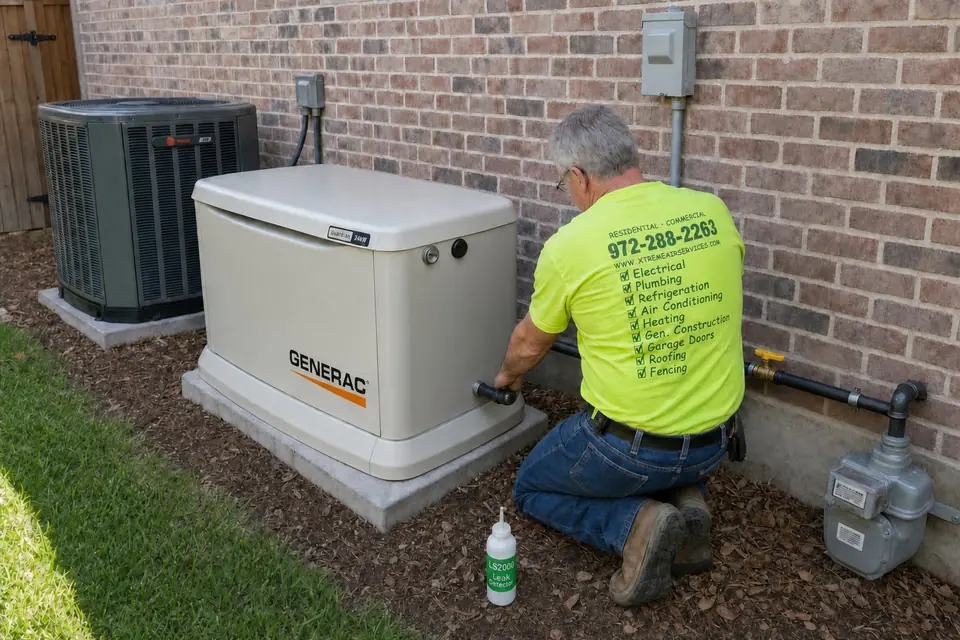
1. The battery. Your standby generator starts the same way your car does, with a battery that has to crank the engine. Dallas summers are hard on batteries, and heat can wear one down well before it looks bad. A battery can also pass a quick glance and still not have enough power to turn the engine over. If you hear clicking, get a slow crank, or see a low-battery warning on the control panel, start your suspicion here.
2. The fuel. No fuel, no power. On a natural gas standby unit, that can mean a closed valve, a regulator problem, or a supply line issue. On a portable unit, gasoline that sat in the tank for months can go stale and gum up the carburetor, so the engine sputters or won’t catch at all. If the engine turns over fine but never fires, or it runs a minute and dies, fuel is a likely suspect. If the trouble is in the gas line itself, that’s handled through our gas line repair service.
3. The controls. Modern generators have a controller, which is a small computer that watches sensors, runs the weekly self-test, and decides when to start. Storm season can be rough on these electronics. Watch for these signs:
- An error code or warning light on the generator’s display
- The generator skips its usual self-test run
- The engine runs, but your home or business never gets power, which can point to the transfer switch, the part that moves your power source from the utility to the generator
- The unit starts on its own at odd times or shuts down for no clear reason
4. The starting system. Beyond the battery, the engine needs a working starter motor, good spark plugs, and healthy ignition parts to fire. Many generators also have a low-oil sensor that shuts the engine off to protect it. That’s a good feature, but a faulty sensor or low oil can stop the engine just as it gets going. If the engine cranks strong but won’t stay running, or it shuts down within seconds, this is a common place to look.
Why does sorting this out matter so much? Because the symptoms overlap. A generator that won’t start could have a weak battery, bad fuel, a failed sensor, or a worn starter, and swapping parts until something works costs you time and money. A careful diagnosis tests each system and points to the one part that failed. That’s how a repair stays focused on your real problem, and how your backup power is ready the next time a North Texas storm or hard freeze knocks out the lights.
Know When a Generator Problem Can’t Wait
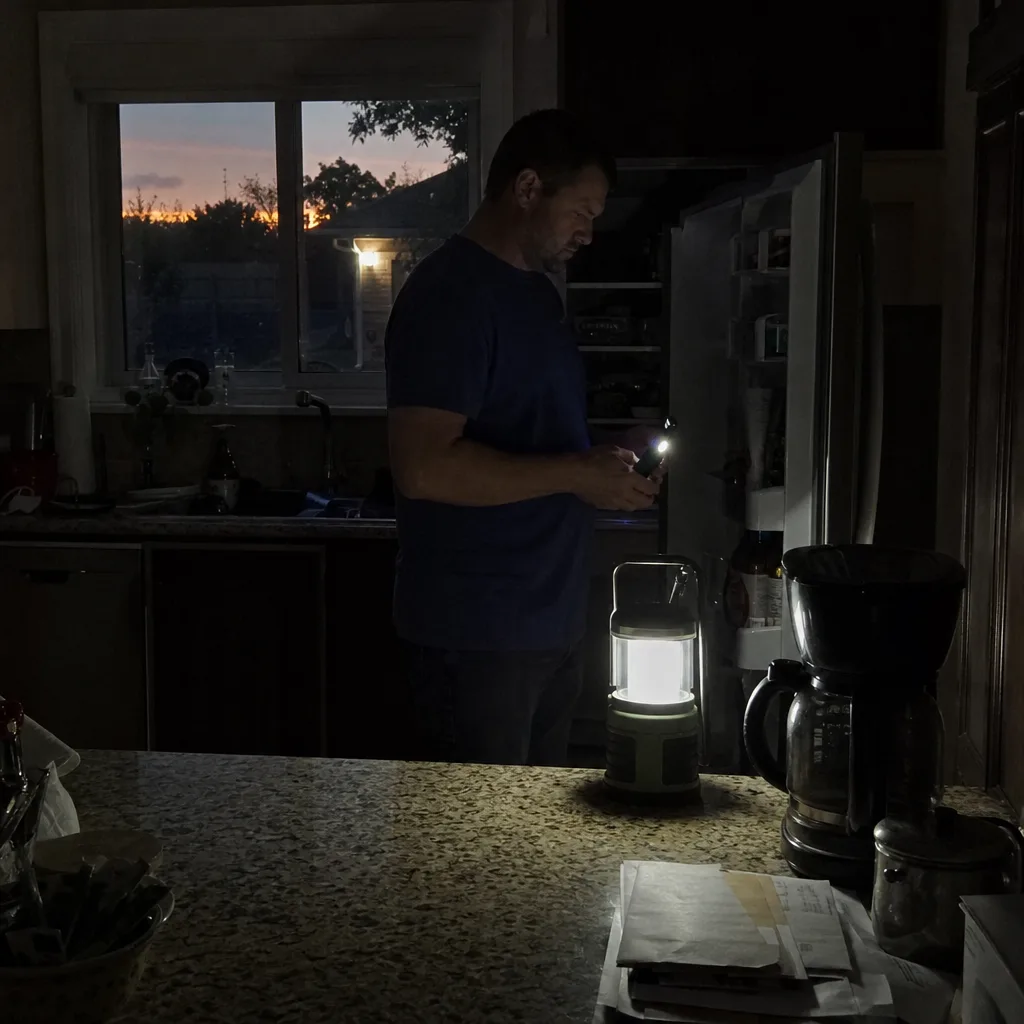
Not every generator hiccup is an emergency. Some problems mean you should stop and get help today. Others can wait for a visit later in the week. Knowing which one you’re facing saves you stress, and it can save you money too.
Treat these as urgent, no matter what the weather is doing:
- You smell natural gas near the generator or its fuel line. Don’t try to start the unit or keep working on it. Gas is a safety problem first and a repair problem second.
- You notice a burning smell, smoke, melted wire coating, or scorch marks on the generator or the transfer switch.
- Your lights surge, flicker hard, or buzz while the generator is running. Unsteady power can damage your appliances and electronics, so it needs a look today, not next week.
- The transfer switch makes loud buzzing or clicking sounds, or it feels hot to the touch.
Some problems aren’t dangerous on their own, but timing turns them into a today problem. Move your call to the top of the list if any of these fit:
- A storm or hard freeze is in the Dallas forecast. Spring thunderstorms and winter cold snaps are when Oncor outages tend to hit, and that’s exactly when you need your backup ready.
- The power is already out and your generator failed to pick up the load.
- Someone in your home depends on powered medical equipment, like an oxygen concentrator or a CPAP machine.
- You run a business with refrigerated stock, a walk-in cooler, or equipment that can’t sit without power for long. A few dead hours can cost you more than the repair.
Now for the honest part. Plenty of generator issues can wait a few days, and you don’t need to pay for a rushed visit to handle them:
- A maintenance reminder pops up on the display, but the utility power is on and the generator still runs its self-test.
- The unit skipped a weekly self-test once, and the skies are clear for the next several days.
- A portable generator has been sitting with old gas in the tank and you won’t need it soon.
- You just want someone to check things over before storm season.
If the grid is up, nobody at home depends on powered equipment, and the forecast is calm, a scheduled visit is the smart move. You get the same careful diagnosis without the rush, and you’ll have time to fix the real problem before you need the backup.
When it can’t wait, you shouldn’t have to choose between your family’s safety and your budget. Xtreme Air Services offers same-day service and charges no extra for nights or weekends. If your generator quits at 9 p.m. on a Saturday in the middle of a storm, the bad timing won’t cost you more.
What Happens During a Generator Repair Visit
A generator repair visit has one goal. You should end it with backup power you can trust, and you should know the price before any work starts. Here’s how it goes from the moment our technician arrives.
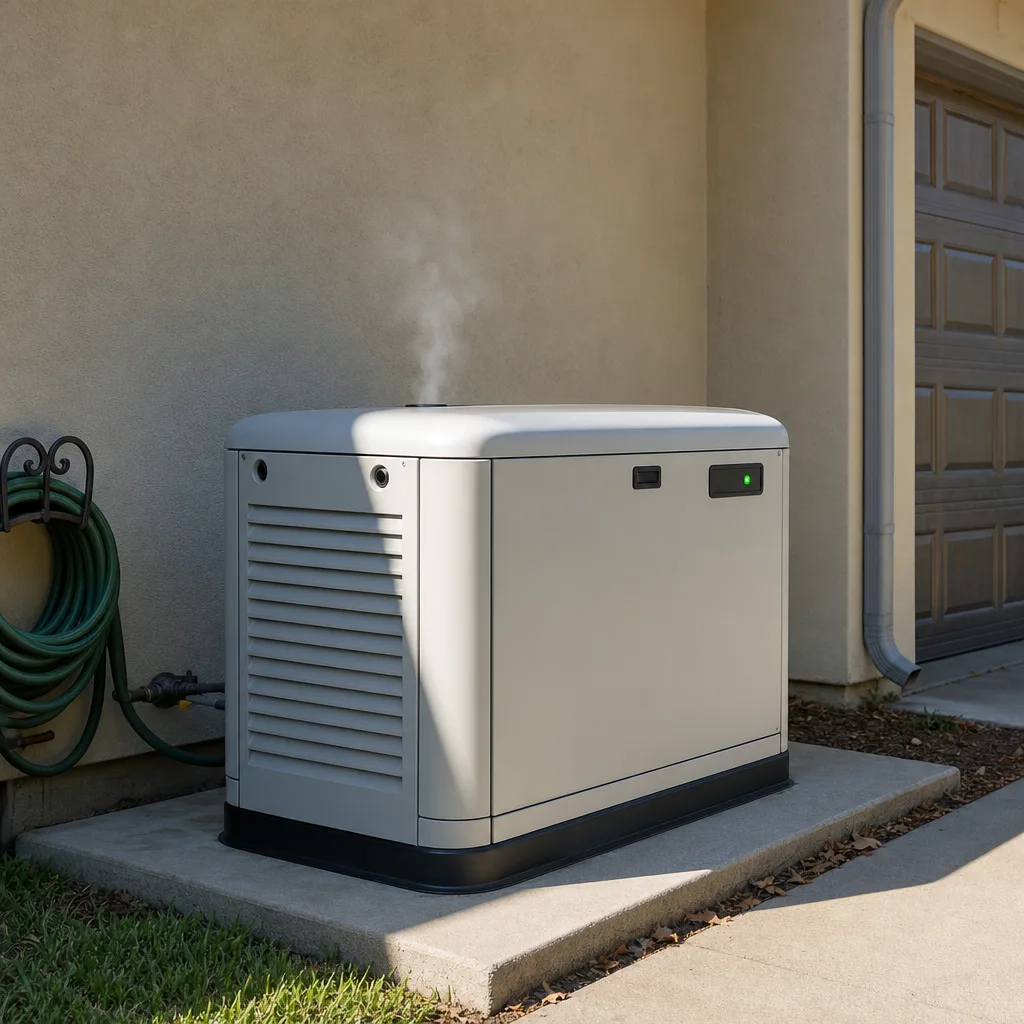
You can make the visit faster before we get there. Write down what you noticed, like a clicking sound, an error code on the display, or a unit that runs but never sends power to your home. If you can, snap a photo of the control panel. Make sure there’s a clear path to the generator and the transfer switch. Then unlock any gate in the way. These small things help the technician get to the real problem sooner.
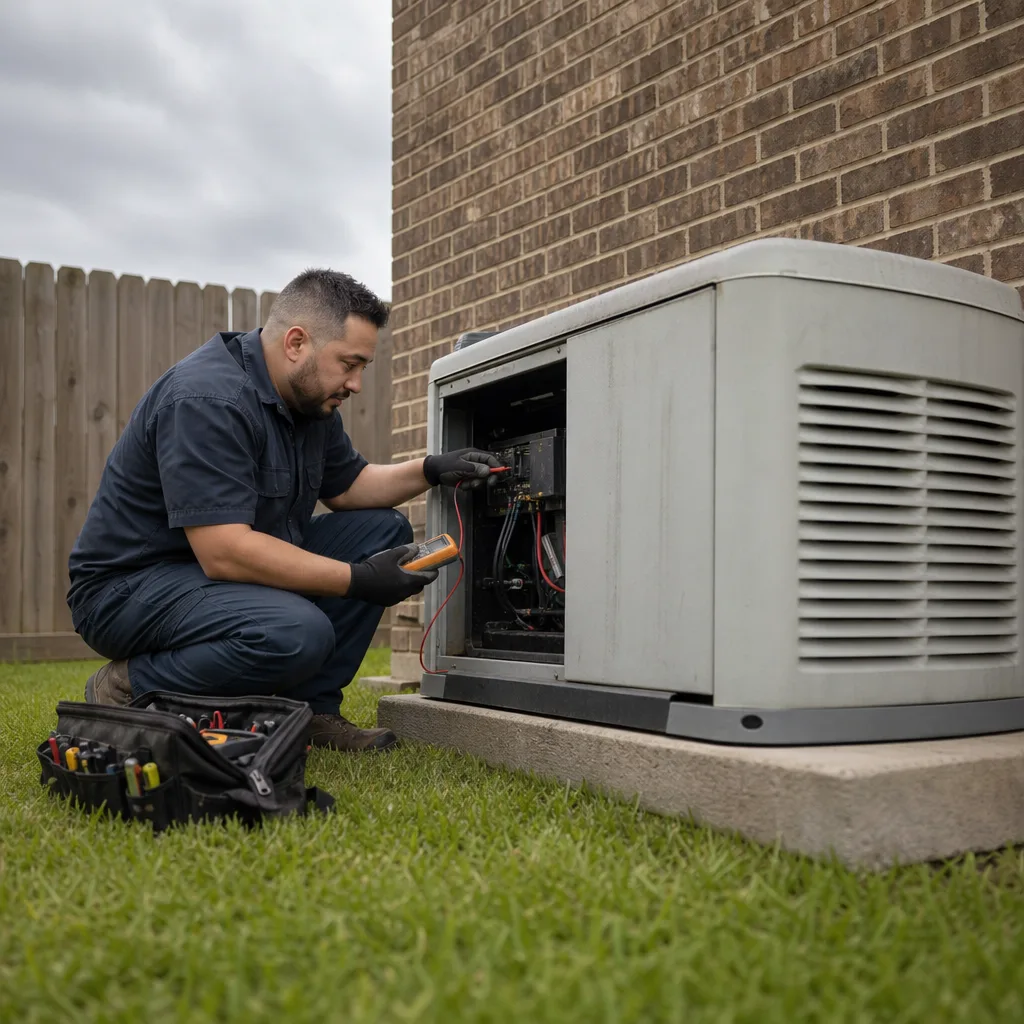
- Diagnose the fault. Your technician checks the four systems covered above, the battery, the fuel supply, the controls, and the starting system. The goal is to find the one part that failed instead of guessing.
- Explain what’s wrong and give you the price. You’ll hear what failed in plain English, and you’ll get an upfront flat-rate price to approve before any work begins. No meter running, no surprise at the end.
- Replace the failed part. Once you say yes, the standard replacement part goes in. Diagnosis, labor, the standard part, and testing are all part of that repair.
- Prove it works. The technician makes sure the generator starts, then confirms it carries load. That means it powers your home’s circuits under real demand, not just idles in the yard.
That last step matters more than most people think. A generator that starts but can’t carry your fridge, your lights, and your AC fan at the same time won’t help you much when an Oncor outage hits in July or during a hard freeze. Testing under load is how you know the fix holds.
Most calls are fixed on the first visit. If the problem turns out to be bigger, like a major component, a full unit replacement, a code upgrade, or a permit, we’ll quote it separately. You decide whether to go ahead, and nothing gets added to your bill without your okay. Financing is available on larger repairs and replacements, though it isn’t usually needed for a smaller fix like a battery or a sensor.
The person at your door is a licensed, background-checked technician who treats your home like family and explains the fix before touching anything. You stay in control of every decision, and you get a generator that’s been tested to do its job when the lights go out.
Not sure what your Generator repair project needs? Ask us.
Call Today, Get Service Today. Xtreme Air Services — Oak Lawn is ready to help.
What Drives Generator Repair Cost Up or Down
Here’s the number you’re probably looking for. At Xtreme Air Services, generator repair typically runs $200-$900. The most common job falls in the $200-$525 range. That job is diagnosing the fault in the battery, fuel, controls, or starting system, replacing the failed part, and confirming the generator starts and carries load.
Where your repair lands in that range comes down to a few things you can understand before anyone shows up.
- What failed. A worn battery or a bad sensor is a much smaller fix than a failed controller or a transfer switch problem. This is the biggest factor, and it’s why a real diagnosis matters more than a guess over the phone.
- Your generator’s brand and size. A large whole-home unit or a commercial generator usually needs bigger, pricier parts than a smaller standby unit. Some brands also use parts that cost more than others.
- Parts availability. Common parts are easier to get. A part for an older or less common model may take longer to track down and cost more. After a big storm, demand for generator parts can rise across North Texas, which can affect how fast a part arrives.
- Access. A generator on an open pad beside the house is quick to work on. One squeezed into a narrow side yard, boxed in by a fence, or blocked by landscaping takes more time to reach and repair.
- Timing. Many companies charge more after hours. We don’t. Xtreme Air Services charges no extra for nights or weekends, so a generator that quits during a Friday night storm won’t cost you more because of the clock.
If the problem is bigger than a standard part, like a major component, a full unit replacement, a code upgrade, or a permit, that’s quoted separately, as covered above. You’ll see that number before anything happens. You can say yes, say no, or take time to think. Financing is available on those larger repairs and replacements.
Whoever you call, a few straight questions will tell you a lot about how you’ll be treated:
- Will I get a firm price before the work starts, or is the meter running?
- Is the service-call fee credited toward the repair if I go ahead?
- Do you charge more for nights, weekends, or holidays?
- Will you test the generator under load before you leave, or just make sure it starts?
- Are your technicians licensed and insured?
A good company won’t dodge any of these. You should hear clear answers, in plain English, before anyone touches your generator.
With us, you’ll get an upfront flat-rate price that you approve first. The service-call fee is credited toward your repair when you move forward. A licensed, background-checked technician will make sure your generator is ready to carry your home or business the next time Oncor’s power goes out.
Call 469-269-6373
Watch Our Video
See How We Handle Generator repair in Dallas
Xtreme Air Services — Oak Lawn
Decide Whether Repair or Replacement Makes Sense
Most of the time, the answer is repair. A generator that won’t start because of a tired battery, a bad sensor, or a clogged fuel part doesn’t need to be replaced. It needs that one part fixed. One failure, even at a bad moment, isn’t a sign your whole unit is done.
Repair usually makes sense when:
- The problem traces to a single part, like the battery, a sensor, spark plugs, or a fuel valve.
- The engine runs smooth once it starts, with no knocking, heavy smoke, or oil leaks.
- Parts for your model are still easy to get.
- The generator still powers what you need during an outage.
- This is the first real problem you’ve had in a long while.
Replacement is worth a real conversation in a few cases. These aren’t sales lines. They’re the situations where putting more money into an old unit stops making sense for you.
- The same generator keeps failing, one part after another. If you’ve paid for several repairs in a short stretch, those bills add up, and you still can’t count on the unit when a storm rolls through.
- A major part like the engine or the alternator has failed. The alternator is the part that makes electricity. When the repair quote gets close to a big share of what a new unit costs, you’re better off comparing the two side by side.
- Parts for your model are hard to find or no longer made. An older generator can sit waiting on a part for a long time, and that’s time you’re without backup.
- Your home has outgrown the generator. Maybe you added a bigger AC system, an EV charger, a home office, or a pool pump. A unit that was sized right years ago may not carry your home’s load today, even when it’s working fine.
- You’re running a portable generator with extension cords and want backup that turns on by itself when the power drops.
That fourth point catches a lot of people off guard. Your generator can pass every test and still fall short, because the house it’s protecting changed. If your lights dim or breakers trip when everything kicks on during an outage, the generator may be undersized rather than broken. That’s a sizing question, not a repair, and our generator sizing and backup power assessment services exist to answer it.
Here’s what you should expect from any honest technician. They’ll tell you what failed and what it costs to fix. If they think replacement is worth considering, they’ll tell you why in plain English. Then they’ll let you decide. You shouldn’t feel rushed into a new unit because the old one had a bad day.
That’s how we handle it. If your generator is worth fixing, we’ll fix it and test it under load. If it’s near the end of its useful life or too small for your home, we’ll explain your options, from a targeted repair to whole-home standby generator installation. Bigger jobs are quoted separately and can be financed, as covered above. The choice stays yours either way.
Not sure which side of the line you’re on? Start with a real diagnosis. Once you know what failed and why, the repair-or-replace decision usually gets a lot clearer.
Frequently Asked Questions
Common questions about Generator repair
Is it worth repairing a generator instead of replacing it?
Yes, in most cases repair is worth it. A single failed part, like a battery, sensor, or fuel valve, doesn’t mean your whole unit is done. Repair usually makes sense if the engine runs smooth once started and parts for your model are still easy to find. Replacement only becomes the better choice when the same unit keeps failing or a major part like the engine or alternator goes out.
What is the most common problem with generators?
The most common problems trace back to four areas: the battery, the fuel supply, the controls, or the starting system. A weak battery is especially common in Dallas because summer heat wears batteries down faster than owners expect. Stale fuel sitting in a portable generator’s tank is another frequent cause of a unit that cranks but won’t fire.
Can I take my portable generator to a hardware store for repair?
Many hardware stores don’t offer full diagnostic and repair service for portable generators, so it’s worth calling ahead before you haul yours in. A technician who tests the battery, fuel system, controls, and starting system can usually find the exact failed part instead of guessing. That matters most with a portable unit, since stale gasoline and carburetor gum-up are common issues that need more than a quick look.
Ready to Get Started?
Call (469) 269-6373 Today, Get Service Today.