


Emergency / Same-Day AC Repair in Plano
Know which AC problems can't wait, what to check first, and what happens when a technician comes the same day.
What’s Covered on This Page
- What Counts as an AC Emergency and What Can Wait
- Common Breakdowns That Bring Technicians Out Same Day
- How the Same-Day Repair Visit Works
- What Emergency AC Repair Costs and Why
- Why Plano Homeowners Should Confirm Licensing Before Letting a Technician In
- Can I just add refrigerant myself to get through the night?
- My outdoor unit is humming but the fan isn’t spinning. Is that an emergency?
- Will I be charged if the technician can’t fix my AC the same day?
- Does a clogged drain line really stop my whole AC from running?
What Counts as an AC Emergency and What Can Wait
Not every AC problem needs a technician at your door tonight. Here’s how to tell the difference.
Treat it as urgent if:
- Your AC is out on a hot Plano afternoon and someone at home is a baby, an older adult, someone who’s sick or pregnant, or a pet that can’t cool off. Heat builds fast in a closed-up house, and at that point it’s about more than comfort.
- You smell burning or see smoke coming from a vent, the indoor unit, or the outdoor unit. Turn the system off at the thermostat and leave it off until it’s checked.
- Water is dripping through a ceiling or pooling around the indoor unit. In a lot of North Texas homes, the air handler sits in the attic. A clogged drain line up there can soak the insulation and drywall right above your living room.
- You see ice on the copper lines or the indoor coil. That usually points to low refrigerant, blocked airflow, or a failing blower. If it keeps running while frozen, it can hurt the compressor, which is the most expensive part of the system.
- The AC breaker trips again after you’ve reset it once. One trip can be a fluke. A second trip means something is pulling too much power, and resetting it over and over isn’t safe.
- The outdoor unit hums or buzzes but the fan won’t spin. That’s often a failed capacitor, and letting it sit puts strain on the motor.
It can probably wait, and you may not need anyone at all, if:
- The thermostat screen is blank. Put in fresh batteries first. Plenty of “broken” ACs turn out to be dead AA batteries.
- The breaker tripped once, and the system runs normally after a single reset.
- The air filter is gray and clogged. Swap it, give the system an hour, and see if the airflow comes back.
- One room runs a few degrees warmer than the rest of the house. That’s usually an airflow or duct balance issue. It’s worth a scheduled visit, but it isn’t an emergency.
- The system keeps up fine at night but can’t quite hold your setting on a 105-degree afternoon. Most home systems aren’t built to hold a very low temperature in peak Texas heat. If the air is still cold and the house is livable, book a regular check instead.
- You notice a new, mild noise, but the cooling is normal. Note when it happens and bring it up at your next service.
On the fence? Ask yourself two things. Is the house still getting cooler? Is anything leaking, smoking, freezing, or tripping? If it’s cooling and nothing looks damaged, a daytime appointment is fine. If the house keeps getting warmer, or you saw any of the warning signs above, don’t wait it out.
Common Breakdowns That Bring Technicians Out Same Day
Here’s the good news when your AC quits: most same-day calls come down to one worn-out part, not a dead system. A few parts take most of the beating in a long Plano summer. Knowing them helps you guess what’s wrong before anyone shows up, and it helps you understand the fix when your technician explains it.
- Capacitor. This small part gives the compressor and fan motors a jolt to get them started. Weeks of triple-digit heat wear it down until one day it can’t do its job. It’s one of the most common reasons an outdoor unit stops working. It’s also one of the simplest parts to swap.
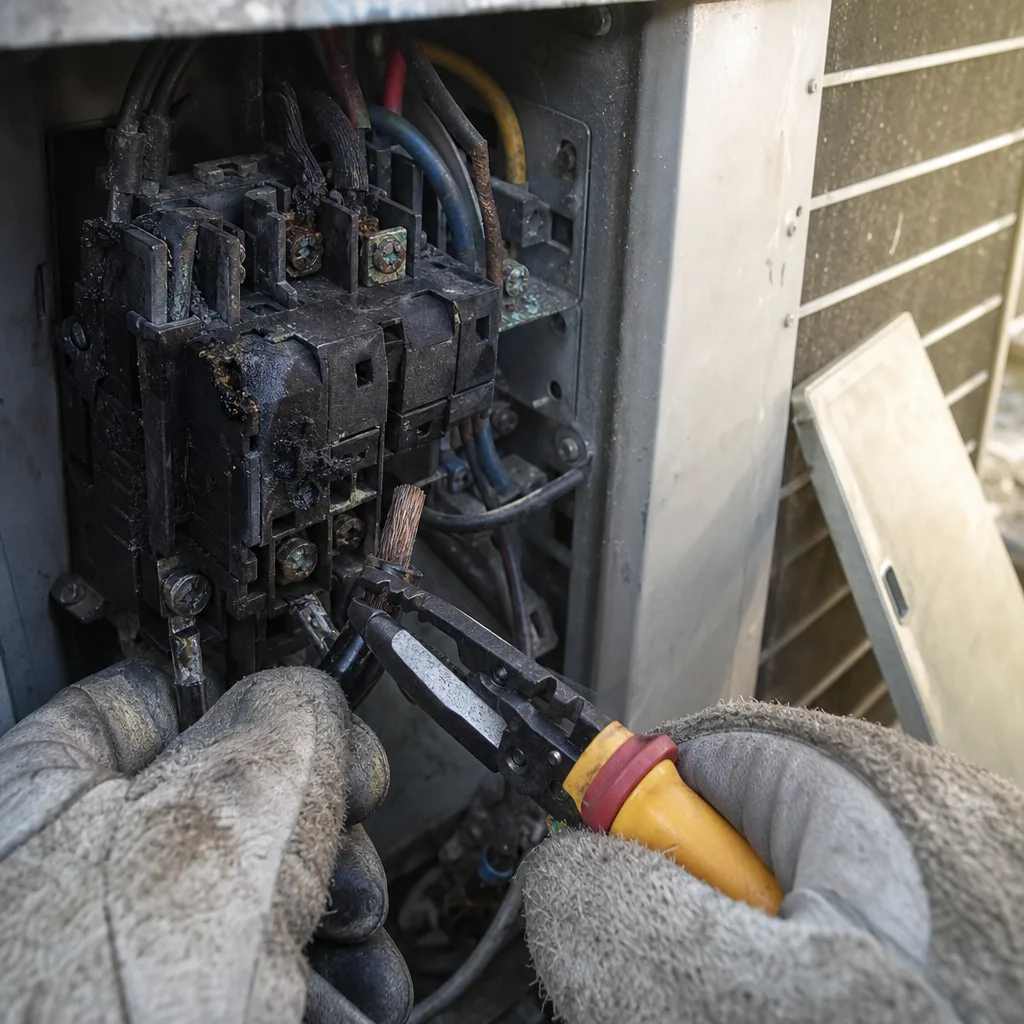
- Contactor and wiring. The contactor is the switch inside the outdoor unit that turns it on when your thermostat calls for cooling. Its contacts can burn and pit over time, and bugs sometimes get inside and block it. A failed contactor or a loose wire can leave the outdoor unit sitting silent while the fan inside keeps blowing.
- Outdoor fan motor. This fan pulls heat out of the system. When it fails, the unit can’t shed that heat. It runs hot, then shuts itself off to protect itself. Swapping the fan motor fixes the problem.
- Indoor blower motor. If the outdoor unit is running but you barely feel air at the vents, the blower in your air handler may be failing. Without good airflow, the house won’t cool, even when everything outside works fine.
- Clogged drain line or tripped float switch. Many systems have a safety switch that shuts the AC off when condensate water backs up. You get a quiet system and a warm house. Clearing the line and checking the switch usually gets you cooling again.
- Refrigerant leak. Air that’s cool but not cold, long run times, and the icing covered above can all point to low refrigerant. Refrigerant doesn’t get used up like gas in a car. If it’s low, there’s a leak. The right fix is finding and repairing it, not just topping it off and hoping.
- Thermostat or control board. Sometimes the equipment is fine and the signal never reaches it. A failed thermostat, sensor, or circuit board can keep a healthy system from turning on.
North Texas weather adds a few of its own problems. Hail can flatten the thin metal fins on your outdoor coil and choke off airflow. Attic temperatures in summer are rough on the wiring and motors in an air handler, and many Plano homes have one up there.
Most of these repairs share something useful: they’re single-part fixes. That’s why most of our emergency and same-day calls are one common failure fixed on the first visit. Your technician finds the part, repairs or replaces it, and runs the system to make sure it cools before leaving. Diagnosis, labor, the standard replacement part, testing, and cleanup are all part of the repair price you approve before any work starts.
Not every breakdown is small, and you deserve to hear that straight. A failed compressor or a damaged coil is a major repair. So is finding a second failed part once the first one’s replaced. Those get quoted separately so you can decide with the full picture in front of you. On those bigger repairs, financing is available if it helps. Either way, you’ll know what failed, what it takes to fix it, and what it costs before anything moves forward.
How the Same-Day Repair Visit Works
It starts with one phone call. When you call Xtreme Air Services, you talk to a real person, not a phone tree. Tell us what you’re seeing. Is the outdoor unit silent, or humming without the fan spinning? Is the air warm, weak, or not coming out at all? Did you notice water, ice, or a burning smell? Those details help us understand how urgent your call is and where to start looking.
Let us know if someone at home is a baby, an older adult, or someone who’s sick. Let us know about pets that can’t handle the heat, too. That helps us know how fast your home is heating up for the people in it.
Our Plano location is on W Park Blvd, and we’ll get a technician to you the same day. It doesn’t matter whether your AC quits on a Tuesday morning or a Saturday night. There’s no extra charge for nights or weekends, so you don’t have to sweat it out until Monday to save money.
While you wait, a few small things make the visit go faster and keep the house more bearable:
- Clear a path to the attic access and the outdoor unit. In a lot of Plano homes, the air handler sits in the attic behind pull-down stairs in the garage or a hallway. Move any boxes or cars out of the way.
- Put pets in a closed room so the technician can move in and out freely.
- Close the blinds on sunny windows, keep the doors shut, and run your ceiling fans to slow the heat buildup.
- Jot down when the AC stopped and any sounds or smells you noticed before it quit.
The person who knocks on your door is a licensed and insured technician who has been background-checked and drug-tested before ever setting foot in a customer’s home. Our HVAC work is done under Texas license #TACLA29023C, and you’re welcome to look it up.
Here’s how the money works, because nobody should have to guess. There’s a $26 to $99 service-call fee. If you go ahead with the repair, that fee is credited toward it. Once your technician finds the problem, you get an upfront flat-rate price before any work starts. That price covers the items listed earlier, and there’s no meter running while the technician works.
For the most common emergency and same-day AC repairs, that price usually lands between $200 and $525. Across all the repairs we handle, the typical range is $200 to $900.
You stay in control the whole time. If the price works for you, the technician gets your system running again. If you want a minute to think, or the problem turns out to be one of the bigger repairs covered above, that’s your call to make. You won’t be charged for a repair you didn’t approve.
Call 469-217-9095
Need help with Emergency / same-day AC repair?
Call Today, Get Service Today. Xtreme Air Services — West Plano is ready to help.
What Emergency AC Repair Costs and Why
The price ranges covered above are a good starting point, but your exact number comes down to what broke inside your system. It doesn’t depend on what time you called or how hot it is outside. Here’s what moves the price up or down.
- What failed, and how badly. A burned-out capacitor is a small part and a quick swap. A fan motor costs more. A damaged coil is a much bigger job. The part and the work it takes drive most of the price.
- Part cost and availability. Common parts cost less and are easier to get. Less common parts cost more, and some take longer to track down.
- Your equipment’s age and brand. Some systems use parts made only for that brand or model. Older systems can use parts that are harder to find, and harder-to-find parts usually cost more.
- More than one failed part. One bad part can wear out another. For example, a weak capacitor makes the fan motor strain every time it starts. If your technician finds two problems, you’ll hear about both.
- Time of day. This one doesn’t change your price with us. There’s no extra charge for nights or weekends, so a Saturday night repair costs the same as a Tuesday morning one.
Some things aren’t part of the standard repair price: additional failed parts, major components, code upgrades, and permits. If your repair needs any of these, they get quoted separately. You see that number before anything happens, and you decide whether to move forward.
It also helps to know how AC companies charge in general. Some bill by the hour, so the clock runs while the technician works, and many charge higher rates after hours. Others quote a flat price for the job before they start. With a flat price, a tricky repair or a slow attic climb won’t raise your bill halfway through. That’s why we use upfront flat-rate pricing. You agree to one number, and that’s the number you pay for that repair.
Whoever you call, ask these questions before anyone starts working:
- Is there a trip or service-call fee, and does it go toward the repair?
- Is the price flat for the job, or billed by the hour?
- Do nights, weekends, or holidays cost more?
- What does the price include, such as parts, labor, testing, and cleanup?
- What happens if you find a second problem once you start?
A good company won’t mind any of these questions. If the answers are vague, take that as a sign to keep looking.
If a major part like the compressor fails on an older system, ask for two numbers: the cost to repair it and the cost to replace the system. Sometimes the repair makes sense. Sometimes putting that money toward a new system is the better choice. Your technician can walk you through both options, and the decision stays with you.
Call 469-217-9095
Watch Our Video
See How We Handle Emergency / same-day AC repair in Plano
Xtreme Air Services — West Plano
Why Plano Homeowners Should Confirm Licensing Before Letting a Technician In
When your house is 88 degrees and climbing, it’s tempting to say yes to the first person who can come tonight. That’s exactly when a quick license check matters most. A one-minute lookup protects your home, your wallet, and your family, and any honest company will be glad you asked.

Here’s why it matters. An AC repair isn’t just swapping a part. Your technician works with high-voltage wiring at the outdoor unit, pressurized refrigerant lines, and an air handler that’s often up in a hot attic, right above your ceiling drywall. In Texas, HVAC contractors are licensed through the Texas Department of Licensing and Regulation, or TDLR. A license means the contractor has met the state’s standards to do this work and answers to the state if something goes wrong.
Insurance matters for the same reason. If an uninsured worker gets hurt in your attic or a mistake floods your living room, you could be left sorting out the cost yourself. Don’t be shy about asking whether a company is insured.
North Texas hail and storm season adds another wrinkle. After a big storm, out-of-town crews and door knockers sometimes show up offering fast, cash-only repairs. Some do fine work. Some are gone by the time you need them to come back. A license you can look up and a local address you can drive past help you tell the difference.
Checking takes less time than waiting on hold:
- Ask for the license number on the phone, before anyone heads your way. A real contractor can give it to you right away.
- Look it up on the TDLR website. You can search by license number or company name, and the search shows whether the license is active.
- Make sure the name matches. The company on the license should match the name on the truck, the paperwork, and the invoice.
- Ask about insurance, and ask whether the technician has been background-checked before they come into your home.
- Get the price before work starts. A written, upfront number is the norm with a legitimate company.
A few red flags are worth walking away from, even on a hot night. Watch for cash-only payment, no written price, pressure to replace your whole system before anyone has diagnosed it, or a plan to add refrigerant every summer without looking for the leak. None of that means you have to sweat it out. It just means you should call someone else.
We make this part easy because we’d want the same for our own families. Xtreme Air Services is a fully licensed and insured HVAC, plumbing, and electrical contractor and a Trane Comfort Specialist. Our HVAC license number is listed above, and you’re welcome to check it before we ever pull into your driveway. Your neighbors across North Texas trust us with their homes because we show up, explain the fix in plain English, and do the job right the first time.
Call now for same-day service
Frequently Asked Questions
Common questions about Emergency / same-day AC repair
Can I just add refrigerant myself to get through the night?
No, adding refrigerant on your own won’t fix the real problem. Refrigerant doesn’t get used up like gas in a car, so if your system is low, there’s a leak somewhere in the lines or coil. Topping it off only masks the issue for a short while, and it can mean paying for refrigerant twice. The right fix is finding and repairing the leak, which is something a technician checks during your same-day visit.
My outdoor unit is humming but the fan isn’t spinning. Is that an emergency?
Yes, treat that as urgent and shut the system off if you can. A humming unit with a still fan usually points to a failed capacitor, and letting it keep running strains the motor further. This is one of the most common same-day calls, and it’s also one of the simplest repairs since swapping the capacitor usually gets the fan moving again.
Will I be charged if the technician can’t fix my AC the same day?
You won’t pay for a repair you didn’t approve. There’s a $26 to $99 service-call fee for the visit, and if you move forward with the repair, that fee gets credited toward it. For bigger jobs, like a failed compressor or a second problem found during the visit, you’ll get a separate quote before any work starts, so you always know the cost first.
Does a clogged drain line really stop my whole AC from running?
Yes, many systems have a safety float switch that shuts the AC off completely when the drain line backs up. You’ll notice a quiet system and a warming house, even though nothing else seems broken. This is common in Plano attics where the air handler sits above a condensate line that can clog with debris over time. Clearing the line and checking the switch usually brings the cooling right back.
Ready to Get Started?
Call (469) 217-9095 Today, Get Service Today.