


When Slab Leak Repair Isn’t the Right Fit for Your Home
The slab leak jobs we turn down, and when what looks like a leak is really a foundation problem.
What’s Covered on This Page
- When Slab Leak Repair Isn’t the Right Call
- Who We’re Not the Best Fit For
- What We’d Tell You to Do Instead
- Why a Single Repair Isn’t Always the Full Picture
- How do I tell a slab leak from a foundation problem?
- The wet spot is out near the street. Is that still my repair to pay for?
- This is my second slab leak. Does that mean I need a whole repipe?
- What actually goes wrong if the work isn’t permitted?
- Why won’t you install pipe or fittings I already bought?
When Slab Leak Repair Isn’t the Right Call
Slab leak repair means finding the leak under your slab, then fixing or rerouting the line to stop it. That’s a specific job. And it’s not always the right call for everyone. We’d rather say so plainly upfront than take the appointment and figure it out on your driveway.
Distance is the first thing we look at. We cover Sunnyvale and the greater Dallas-Fort Worth area, including Dallas, Fort Worth, Plano, Frisco, Allen, Irving, Carrollton, and the towns around them. That’s a radius of about 60 miles. If your home sits past that, we won’t send a truck for a job we can’t easily come back to for a follow-up visit.
- Properties more than about 60 miles from Sunnyvale. We can’t reliably show up again for warranty or follow-up work.
- Anyone looking for off-the-books or unpermitted slab work. Repairs that need permits and inspections get them. If the request is to skip that, we’ll pass.
- Labor-only installs of a repair method or materials someone else already picked out and sourced. We stand behind what we install, so we install what we can verify ourselves.
There’s also something we see more often than people expect: what looks like a plumbing leak is actually foundation movement. North Texas sits on a lot of expansive clay soil. Slab-on-grade homes here shift with the wet and dry cycles every year. That movement can stress a pipe until it fails, but it can also cause cracking and unevenness that plumbing repair alone won’t fix. If we get to a property and the slab itself needs structural attention, that’s a foundation repair specialist’s call, not ours. We’ll tell you that instead of working around it.
If you’re still trying to figure out if what you’re noticing even points to a slab leak, our slab leak repair page walks through what that typically looks like and how we locate and fix it.
Who We’re Not the Best Fit For
Most homeowners searching for slab leak repair in Sunnyvale are exactly who we built our business to serve. But advertising means telling you upfront when we’re not the right call. We’d rather do that than send a truck out and figure it out on your driveway. There are three specific situations where we’ll say so directly.
- Properties outside our roughly 60-mile radius of Sunnyvale, TX. We cover Sunnyvale plus the greater Dallas-Fort Worth Metroplex, including Dallas, Fort Worth, Plano, Frisco, Allen, Irving, and Carrollton.
- Any request to perform work off the books, without permits, or by skipping code requirements to save time or money.
- Labor-only installation of pipe, fittings, or slab leak equipment a customer has already purchased from another supplier.
Distance matters more with slab leak repair than with a lot of plumbing work. Slab leaks often require follow-up. That could mean a re-check after tunneling, a moisture reading a few weeks post-repair, or warranty service if a nearby section of pipe develops a new leak. If your property is well outside that 60-mile ring, we won’t have a technician who can realistically get back to you fast. We’d rather refer you to a local contractor than promise something we can’t deliver.
On permits and code, this one isn’t negotiable. Slab leak repairs in Sunnyvale and surrounding Dallas County and Collin County jurisdictions often trigger inspection requirements. This is especially true for re-routes, repipes, or work that involves cutting into a foundation slab. Every technician we send is licensed. Every applicable job gets the correct permit and inspection. If a customer is looking for a contractor willing to skip that step to save a few days or a permit fee, that’s a mismatch with how we operate. It’s not a judgment call we make on a case-by-case basis.
On materials, our workmanship guarantee is tied to equipment and pipe we source and verify ourselves. When customers bring their own PEX, copper, or fittings purchased elsewhere, we lose the ability to stand behind that material if it fails. So we generally decline labor-only installs. We are happy to source comparable materials and back the job with our warranty instead.
Outside these three situations, difficult access, extensive slab damage, or an unusual leak pattern is exactly the kind of job we take on. This is the part people overthink.
What We’d Tell You to Do Instead
Not every water problem under a Sunnyvale home is a slab leak we should be the ones fixing. We’d rather tell you that upfront. We don’t want to send someone out to diagnose a job that isn’t ours to do.
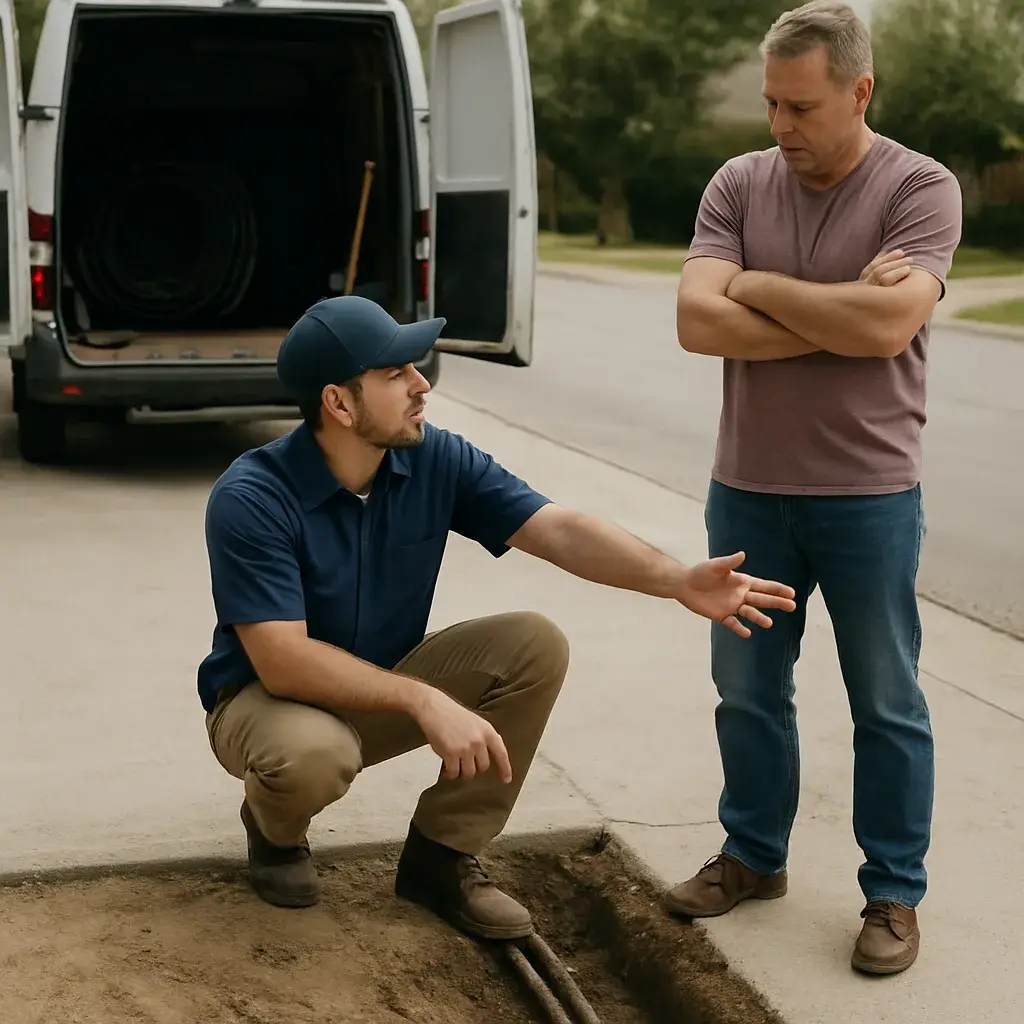
If the water main meter box near your curb is spinning even with everything in the house shut off, and the wet spot is between that meter and the street, that’s utility-side infrastructure. The City of Sunnyvale or your water provider owns that line. They’re equipped to repair it without you footing the bill for a plumber’s visit that would just end in a referral anyway.
Sometimes what looks like a slab leak is a foundation or drainage issue. Cracked slabs, doors that stick, and soil that shifts after a wet North Texas winter can mimic the signs of a plumbing leak. You might see uneven floors, hairline cracks in tile, or damp baseboards. If our inspection points to settling or poor grading rather than a compromised pipe, we’ll say so. We’ll recommend a structural engineer or foundation specialist instead of cutting into concrete that doesn’t need it.
We serve Sunnyvale and the surrounding DFW Metroplex within roughly a 60-mile radius. If your property falls outside that range, we’ll tell you directly. We won’t book a visit we can’t realistically stand behind if a follow-up repair or warranty issue comes up later.
We also pass on jobs that ask us to skip the permit process or install pipe, fittings, or fixtures a homeowner has already purchased elsewhere. Sunnyvale’s building department requires permits for slab leak repairs. These involve structural concrete and pressurized water lines. Unpermitted work can complicate a home sale or insurance claim down the road. Self-sourced materials also void our workmanship warranty. That’s because we can’t verify their rating or install history. If that’s what you’re looking for, there are plumbers who work that way, and we’d rather point that out than pretend to be a fit.
None of this is about turning away business for its own sake. It’s about making sure the people we do take on get a repair that holds up. This comes from a process that’s on the record with the city and backed by an actual warranty.
Have questions? We’re happy to help.
Call Today, Get Service Today. Xtreme Air Services is ready to help.
Why a Single Repair Isn’t Always the Full Picture
When a technician finds and fixes a slab leak in a Sunnyvale home, the work is scoped to that specific failure point. This means the section of copper or PEX line that cracked, corroded, or pinholed under the concrete slab, and the access path needed to reach it. That repair answers one question completely: is this leak fixed? It does not answer a different question some homeowners are quietly turning over in their minds. Especially if this is the second or third slab leak they have dealt with in the same house: does a pattern like this mean the whole plumbing system is nearing the end of its life?
Those are truly separate decisions. A single repair is a targeted, localized fix. A repiping evaluation is a whole-house question. It looks at pipe material, age, water chemistry, soil conditions common in the area, and the history of failures across the entire system. One is about a leak. The other is about your home. Sunnyvale has many homes built from the 1950s through the 1970s with original copper supply lines running under the slab. In some of those homes, soil conditions and water minerality have accelerated pinhole corrosion over decades. That context matters for the repiping question, but it has no bearing on whether today’s specific leak gets repaired correctly.
- One leak, first time in the home: usually a straightforward case for a single, targeted repair.
- Second or third leak in a few years, same general plumbing era: a signal worth discussing with a plumber, but a separate conversation from today’s repair.
- Leaks appearing in different rooms or on different lines: relevant to a repiping discussion, not something this repair addresses on its own.
- Visible pipe age or known corrosive water conditions: background context for a future decision, not a factor in fixing the current leak.
This page focuses on the first question, since that is what a slab leak repair solves. For details on what a single repair covers, from detection through patching and concrete restoration, the Slab Leak Repair service page lays out the process and what to expect. If a pattern of repeat leaks is on your mind, that is worth raising directly with a plumber as its own topic, separate from getting the current leak taken care of.
Frequently Asked Questions
Common questions about Slab leak repair
How do I tell a slab leak from a foundation problem?
You often cannot from the symptoms alone, which is the honest answer. North Texas sits on expansive clay soil, and slab-on-grade homes shift through the wet and dry cycles every year. That movement can stress a pipe until it fails, but it can also cause uneven floors, sticking doors and hairline cracks in tile all by itself. If our inspection points to settling or poor grading rather than a compromised pipe, we will say so and recommend a structural engineer instead of cutting into concrete that does not need it.
The wet spot is out near the street. Is that still my repair to pay for?
Probably not. If the meter box near your curb is spinning with everything in the house shut off, and the wet spot sits between that meter and the street, that is utility-side infrastructure. Your water provider owns that line and is equipped to repair it. We would rather tell you that than charge you for a visit that ends in a referral.
This is my second slab leak. Does that mean I need a whole repipe?
It is worth asking, but it is a separate question from fixing today’s leak. A repair is targeted at one failure point. A repiping evaluation looks at pipe material, age, water chemistry, local soil conditions and the history of failures across the whole system. Plenty of Sunnyvale homes built between the 1950s and 1970s still run original copper under the slab, and repeat leaks in different rooms or on different lines are the signal worth raising as its own conversation.
What actually goes wrong if the work isn’t permitted?
It follows the house. Slab leak repairs involve structural concrete and pressurised water lines, so re-routes, repipes and any work cutting into the slab commonly trigger an inspection requirement. Unpermitted work can complicate a home sale or an insurance claim later. That is why it is not a case-by-case judgment for us: every applicable job gets the correct permit and inspection.
Why won’t you install pipe or fittings I already bought?
Because our workmanship guarantee is tied to material we source and verify ourselves. When PEX, copper or fittings come from elsewhere we lose any way to confirm the rating or how they were stored before they went under your slab, so we cannot stand behind the joint if it fails. We are happy to quote comparable materials and back the whole job under one warranty instead.
Ready to Get Started?
Call 972-288-2263 Today, Get Service Today.