


Slab Leak Repair: Should We Repair, Reroute, or Replace the Line?
How we choose between a spot repair, a reroute and a wider repipe, and what each one costs.
What’s Covered on This Page
- What Decides Between Repair and Replace
- When We’d Repair or Reroute the Line Instead of Replacing It
- When We’d Recommend a Broader Repipe
- What’s Included in a Slab Leak Repair Price – and What Isn’t
- How We Help You Decide
- How do I know whether to repair or replace the line?
- What’s the biggest mistake homeowners make when deciding between repair and repipe?
- When would you tell me a repair isn’t the smarter move?
- Does the $2,000 to $3,800 quote change once you start the job?
- Why does one house get a reroute and another get a slab cut?
What Decides Between Repair and Replace
A slab leak repair means finding the break in a water line under your foundation. We stop the leak by repairing that exact spot or rerouting the line around it. A typical job runs $2,000 to $3,800. The wider range for slab leak work lands between $2,000 and $6,000. It depends on what we find once we start. A technician runs a leak location test and confirms depth and access before anything gets quoted.
- Where the leak sits: a line under a hallway or bathroom is a different access job than one under an open slab in a garage or utility room.
- How deep the pipe runs: deeper lines mean more slab cutting and more labor. This moves the price toward the higher end.
- Spot repair vs. reroute: sometimes it’s faster and cheaper to reroute the line through a wall or attic than to cut the slab at all.
- History of the line: a first leak in copper pipe is a different conversation than a second or third leak in the same old line.
- Access through the slab: garage and exterior access repairs usually cost less than repairs under finished living space.
If it’s one leak in a line that’s otherwise held up, a spot repair or reroute is almost always the right call. It’s what we quote first. Things get more complicated when a home has older galvanized or problem-prone copper, and this isn’t the first leak we’ve found under that slab. Another spot repair might hold for a while. But if a line has already failed once, patching the same run again isn’t always the smarter money. That conversation happens before you approve anything. It’s part of our written, flat-rate quote from our slab leak repair service, not after the slab is already cut open.
The service call fee, $26 to $99, gets credited toward the repair if you move forward. We offer financing on qualifying jobs if a bigger reroute or repipe conversation comes up. The quote covers leak location, the repair or reroute, and testing. It doesn’t cover slab or flooring restoration, additional lines, or permits, since those depend on what your home needs and if you add extra work.
When We’d Repair or Reroute the Line Instead of Replacing It
Most of the time, we repair or reroute the line. A full repipe of the house is the exception. Once we find the leak under your slab, the job usually runs between $2,000 and $3,800. That covers locating the leak, fixing or rerouting that pipe section, and testing it before we leave.
What decides if we repair or reroute comes down to three things: where the leak sits, how deep it is, and how much of the slab we’d need to open up. A leak near an exterior wall is often easier to reroute above the slab or through an attic. (Many North Texas homes have attic-run water lines.) A leak in the middle of the house, under a load-bearing area, usually means going through the slab itself. This changes the labor and access work involved.
We’ll tell you plainly when a spot repair doesn’t make sense. If your pipe is old galvanized line and you’re on your second or third slab leak, patching one spot just buys you time. Another section will likely fail nearby. We see this often in older slab-on-grade homes across places like Mesquite and Balch Springs, where the original plumbing is decades old. In that situation, rerouting a longer run, or even repiping affected sections, saves you from paying for repairs twice.
Clay soil movement is part of why North Texas sees so many of these leaks. It’s also why we look at more than just the one leak point. A single spot repair on a line that’s shifted once can shift again. So part of our job is telling you what we see under there, not just fixing the one hole.
- Leak location and depth under the slab drive most of the price and the approach
- A reroute avoids cutting concrete when the pipe path allows it
- Repeated leaks on old galvanized line point toward rerouting more of the run, not just patching one spot
- Slab and flooring restoration, additional lines, and permits aren’t part of the base repair price
That same service call fee gets credited toward the repair if you move forward. Financing is available on qualifying larger jobs, so a bigger reroute doesn’t have to happen all at once. If you want the full breakdown of what moves the price up or down, our slab leak repair page walks through it in more detail.
When We’d Recommend a Broader Repipe
Most slab leaks get fixed with a repair, not a whole-house repipe. If we find one leak in one spot on a line that looks decent otherwise, we locate it, repair or reroute around that section, and test it out. That job typically runs $2,000 to $3,800. It depends on how deep the leak sits, if we can spot-repair it or need to reroute, and how much work the slab requires to get to it.
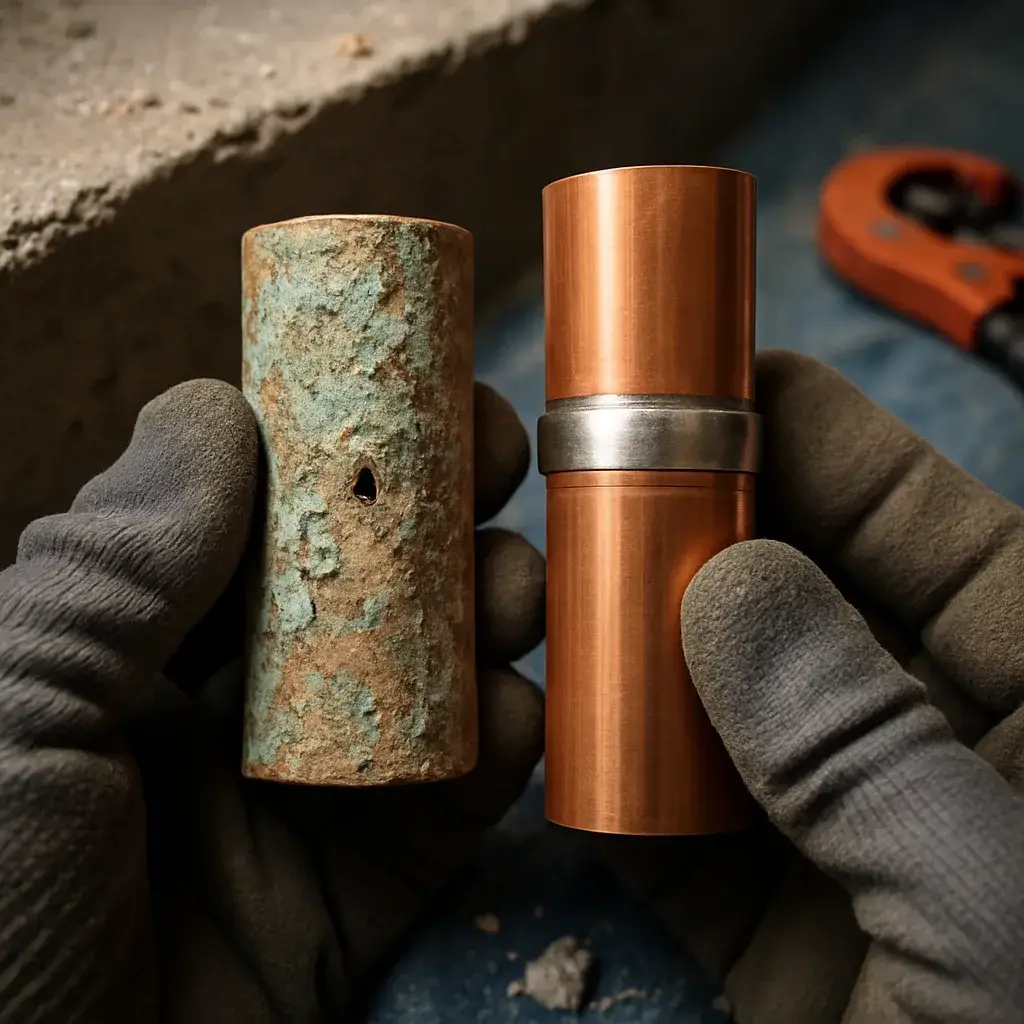
A repipe is a different story. We’d suggest it when the leak you called us for isn’t really the main problem. (It’s often the pipe itself.) That means the home has had a few separate slab leaks over the years. Maybe the water lines are old galvanized or copper and are nearing the end of their normal life. Or the pipe condition and mineral buildup in the house point to a line failing in many places, not just the one that finally leaked. Homes built on older slab-on-grade foundations – common across Sunnyvale, Mesquite, and Forney – sometimes fall into this category. Especially where the expansive clay soil under North Texas foundations has shifted enough over the decades to stress the pipe in multiple spots, not just the one that finally broke.
If your leak is isolated and the rest of the line looks good, we won’t talk you into repiping your whole house. A repipe costs a lot more and disrupts much more of your home. Pushing one on a customer who just needs a $2,000 to $3,800 repair isn’t how we want to earn your call next time.
- One leak, newer pipe, good history: repair is usually the right call
- Multiple leaks in different spots over time: a repipe conversation makes sense
- Old galvanized or aging copper lines throughout the slab: worth discussing a repipe before another leak shows up
- Repair or reroute work includes leak location, the fix, and testing, but not slab or flooring restoration, extra lines, or permits unless we’ve said so upfront
Either way, the visit starts the same. The service call fee runs $26 to $99. We credit that toward the repair if you move forward with our slab leak repair service. For a repipe, or for a repair job that runs larger than expected, we offer financing on qualifying work. That way, the decision isn’t just about what you can pay this week.
Have questions? We’re happy to help.
Call Today, Get Service Today. Xtreme Air Services is ready to help.
What’s Included in a Slab Leak Repair Price – and What Isn’t
A typical slab leak repair runs $2,000 to $3,800. Bigger or harder jobs can push that range to $2,000 to $6,000. That price covers finding the leak under your slab, then fixing it. We either repair the pipe right where it’s leaking or reroute the line around the damaged section. It also covers testing the repair before we call the job done.
- Leak location using diagnostic equipment to pinpoint where the pipe is failing under the foundation
- The repair itself, either a spot repair at the leak or a full reroute of the line
- Testing after the work is finished to confirm the leak is stopped
What that price doesn’t cover: slab or flooring restoration, extra lines beyond the one leaking, and permits. We’ll quote those separately for your job if they apply. If we have to cut through tile, concrete, or hardwood to reach the pipe, putting your floor back is a separate cost. We’ll spell that out in writing before we start.
Three things move the price inside that range. First is how deep and how far under the slab the leak sits. A leak near an exterior wall is a different job than one under a load-bearing interior wall. Second is whether a reroute or a spot repair makes more sense for that pipe. Third is access. Cutting through a garage slab is not the same as cutting through a tiled kitchen floor. (We’ve noticed these can make a big difference for your budget.)
We charge a service call fee of $26 to $99 to come out and diagnose the leak. If you move forward with us on the repair, that fee gets credited toward the job. So you’re not paying twice. For larger jobs, financing is available on approved credit if you’d rather spread the cost out.
You can get more detail on how we handle these repairs on our slab leak repair page, including what a same-day visit looks like from the first phone call to the final test.
How We Help You Decide
Most slab leaks get repaired, not fully rerouted. A straight repair fixes the specific spot where the line failed. A reroute runs a new line around the damaged section, usually through the attic or a wall. This skips cutting the slab a second time later. We decide between the two after we find the leak, not before.
Three things drive that decision on every job. First, where the leak sits and how deep it runs under the slab. A leak near an edge or under a hallway is easier to reach. One under a load-bearing wall or a kitchen island is harder. Second, whether a spot repair leaves the rest of that line vulnerable. Older copper near one failure point sometimes has more thin spots nearby. Third, how much slab or flooring access the job needs. This affects both labor and what you’ll deal with afterward.
- Leak location and depth under the slab
- Condition of the rest of the line, not just the failure point
- Access needed through slab, flooring, or attic space
- Whether the home sits on clay soil common in the Dallas-Fort Worth area, where ground movement can put stress back on a repaired spot
On pricing, our slab leak repair jobs typically run $2,000 to $6,000. The common repair or reroute lands between $2,000 and $3,800. That covers locating the leak, repairing or rerouting the line, and testing it once we’re done. It doesn’t cover slab or flooring restoration. It also doesn’t cover additional lines beyond the one that failed, or permits unless we tell you a permit applies to your job. That same service call fee applies for the visit, and we credit it toward the repair if you move forward with us.
A spot repair almost always costs less up front. But if the same line has other thin spots from age, a reroute can save you from paying for slab access twice. We’ll tell you which situation we’re looking at once we’ve located the leak – not before. Guessing at that point isn’t fair to your wallet.
We offer financing on qualifying jobs if the larger reroute option makes more sense for your home. You can read more about how the process works on our slab leak repair page before you call.
Frequently Asked Questions
Common questions about Slab leak repair
How do I know whether to repair or replace the line?
We look at three things: where the leak sits, how deep it runs, and whether it’s the first leak in that line. If it’s a single leak in a line that has held up otherwise, a spot repair or reroute is almost always the right call. If we find repeated leaks in the same old galvanized or copper line, we’ll talk about rerouting or repiping more of the run. That conversation happens before you approve any work.
What’s the biggest mistake homeowners make when deciding between repair and repipe?
Homeowners often think the age of the house alone should decide it, but we look at the leak history first. A 40-year-old slab with one clean leak in a line that’s otherwise fine usually just needs a spot repair or reroute. A newer home with a second or third leak in the same run points toward a bigger reroute instead. Age matters less than what the line has done.
When would you tell me a repair isn’t the smarter move?
We’ll say so plainly if your line is old galvanized or copper and this isn’t the first leak we’ve found under that slab. Patching one more spot might hold for a while, but another section can fail nearby. In that case, rerouting a longer run, or repiping affected sections, can save you from paying for two separate repairs down the road. We’d rather flag a line likely to leak again elsewhere than quote a single spot repair on it.
Does the $2,000 to $3,800 quote change once you start the job?
The range covers most jobs, but the exact number depends on what we find once we open things up. Leak depth, whether we can spot-repair or need to reroute, and how much slab access is required all move the price within that range. The service call fee, $26 to $99, gets credited toward the repair if you move forward. Anything outside the base scope, like slab restoration or added lines, gets discussed before we do the work.
Why does one house get a reroute and another get a slab cut?
It comes down to where the leak sits and what path the pipe can take. A leak near an exterior wall can often be rerouted through an attic or wall, avoiding the slab entirely. A leak under a load-bearing area near the middle of the house usually means going through the slab itself. That’s one reason two homes with a similar leak can end up with different quotes.
Ready to Get Started?
Call 972-288-2263 Today, Get Service Today.