


Repair or Replace: What to Know Before Tankless Water Heater Installation
Repair or replace a tankless unit – which failures are worth fixing, which mean replacement, and why conversion is a different job entirely.
What’s Covered on This Page
- The Short Answer on Repair vs. Replacement
- The Factors That Decide It
- Problems That Are Usually Repairable
- Problems That Usually Mean Replacement
- Why Tankless Conversion Is a Different Job Than a Tank Swap
- Related Links
- What’s the biggest mistake homeowners make when choosing between repair and replacement?
- When would you tell me to replace instead of taking my repair money?
- Is there a specific age when I should stop repairing and just replace the unit?
- How does the repair-versus-replace math work out in dollars?
- Can I use financing if I decide to replace instead of repair?
The Short Answer on Repair vs. Replacement
Here’s the short version. A repair works when a tankless system is younger and the failure is one identifiable part. The rest of the unit has to be working right. A replacement makes sense when the unit is old or repairs keep piling up. It’s also a good choice when it can’t keep up with your hot water needs. Or if you’re switching from a tank system for space and energy savings. We can’t give you a single age cutoff. That depends on the specific unit, its maintenance, and what our technician finds.
We see this decision play out a lot in older Sunnyvale homes (in Dallas County and Kaufman County). A tank water heater in a garage or closet might be over a decade old. Hard North Texas water often takes a toll on internal components. A repair might buy you a year. But a tankless replacement solves the space issue, the recovery time issue, and often the efficiency issue in one visit.
Our standard tankless job covers the equipment, installation, standard connections, startup, and testing. We also haul away the old unit. It doesn’t include changes to your ductwork, wiring, or plumbing lines. Code corrections or permits are also not included unless we specify them upfront in writing. Gas tankless installs include venting as part of the job. That’s a code requirement, not an upgrade. If you want the full breakdown of what drives the price up or down, we cover that on our tankless water heater installation page.
Every visit starts with a $26 to $99 service call fee. This gets credited toward the job if you move forward with us. You’ll get a written, flat-rate quote with the repair-or-replace options. You’ll see it before anyone touches your system. The decision stays yours.
The Factors That Decide It
Most of what decides your price and your options comes down to what’s already at the house. It’s not just the brand you pick. A gas line that’s too small for a tankless unit’s BTU demand has to be upsized. Venting is its own thing too. Gas tankless units need dedicated venting (often stainless steel or a specific PVC configuration). If your current setup won’t support that run through the attic or an exterior wall, that’s added labor. None of this is unusual. It’s just part of sizing the job correctly before we quote it.
- Gas line size and capacity (undersized lines need upsizing for tankless BTU demand).
- Venting type and route (gas tankless requires specific venting materials and clearances).
- Household hot water demand (number of bathrooms and fixtures running at once).
- Access to the install location (attic, garage, or exterior wall changes labor time).
- Code requirements in your jurisdiction (can call for permits and inspections).
- Condition of existing connections (old shutoff valves or corroded fittings often need replacing).
A straightforward tankless installation, using existing connections with no major modifications, runs $3,700 to $5,100 in most homes we see across Sunnyvale and the surrounding DFW area. The broader range for the job runs $3,000 to $6,500. This factors in unit size, brand, and any code corrections. That price includes the equipment, professional installation, startup and testing, and haul-away of your old tank. It does not include changes to ductwork, wiring, or plumbing lines, code corrections, or permits unless we’ve already flagged those during the visit.
If your home already has a gas line sized right and a workable vent path, you’re looking at the lower end of that range. No surprises. If we’re rerouting venting or upsizing gas, that’s real work. It shows up in the number. We’ll walk you through exactly why before you approve anything. You can see how we scope these jobs on our tankless water heater installation service page, which lays out what a standard job includes.
There’s a $26 to $99 service-call fee for the initial visit. It’s credited toward the job if you move forward with us. Financing is available on qualifying installs if spreading out the cost makes more sense than paying it upfront.
Problems That Are Usually Repairable
Most tankless water heater complaints we see aren’t a sign the whole unit needs to go. A lot of what slows down hot water or throws an error code traces back to a part or a buildup issue. It’s not a dead unit.

- Mineral scale on the heat exchanger. This is common with North Texas hard water. It can reduce flow and trigger error codes.
- A faulty ignition sensor or igniter that keeps the unit from firing consistently.
- A clogged inlet water filter or flow sensor that reads low flow even when water is fine.
- Loose or worn connections at the gas or water fittings causing a minor leak.
- A blocked or improperly sloped vent pipe cutting off proper exhaust.
- A control board glitch that’s isolated to one component rather than the whole system.
These are the kinds of things a technician can usually find and fix on a same-day diagnostic visit. We charge a service-call fee of $26 to $99. That amount gets credited toward the repair if you move forward with us. You get a written, flat-rate price before any work starts. You’ll know the number before you decide anything.
There’s a limit to what a repair fixes. If the heat exchanger itself has cracked or corroded through, that’s a core component failure. That’s not a part swap. It usually points toward replacement instead. Our technician walks you through what was found and what your options look like, in plain terms, before you approve anything.
Ready when you are – get in touch today.
Call Today, Get Service Today. Xtreme Air Services is ready to help.
Problems That Usually Mean Replacement
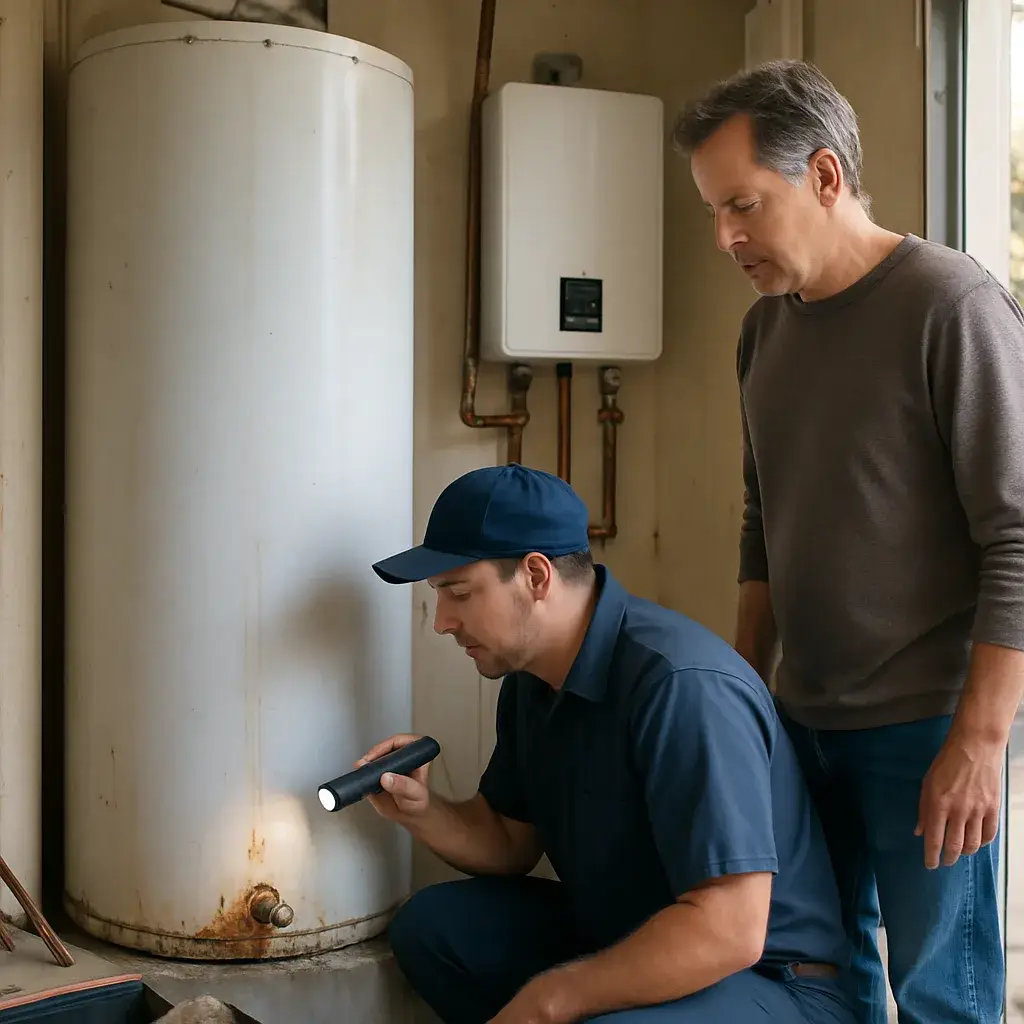
A few signs tell us clearly that repair isn’t the better move. If your tank is leaking from the tank itself (not a fitting), that tank is done. Water heater tanks don’t get patched. Once the steel shell fails, replacement is the only real option. That’s usually when homeowners start asking about tankless instead of buying another tank.
- The tank itself is leaking, rusted through, or visibly corroded at the base.
- You’re running out of hot water regularly with more than two or three people in the house.
- The unit has needed more than one repair in the past year or two.
- You’re renovating a bathroom or kitchen and want to free up the closet or garage space a tank takes up.
- Your gas or electric bills for water heating have crept up as the tank ages and loses efficiency.
- The house is on well or hard water, and sediment has built up heavy enough to shorten the tank’s life.
Age matters too. But it’s not the only factor. A ten or twelve-year-old tank that’s still working fine and just needs a thermostat or element doesn’t need to go anywhere. We’ll say that straight, because it’s your money. The math shifts toward replacement when the tank is old and something expensive breaks. Like the heat exchanger on a gas unit. Or when you’re already planning to remodel, and the closet space matters.
Switching to tankless is its own decision, not automatic just because the old tank failed. A standard tankless installation, using existing gas, water, and electrical connections, runs in the $3,700 to $5,100 range for most homes. The wider range across all jobs lands around $3,000 to $6,500. What moves that number? The unit’s size and efficiency, the brand, how easy the location is to work in, and whether the gas line or venting needs upgrading. Gas tankless units need dedicated venting. If your current setup doesn’t have it, that’s real work, not a footnote.
That price covers the equipment, the installation, connecting to your existing lines, startup and testing, and hauling away the old tank. It doesn’t cover rerouting gas lines, electrical panel work, or permit fees if your job needs them. We’ll spell those out separately once we’ve looked at the setup. If a bigger gas line or vent run is needed, we’ll tell you before we start, not after.
Why Tankless Conversion Is a Different Job Than a Tank Swap
Swapping an old tank for a new one is mostly a like-for-like job. Same water lines, same gas or electric hookup, same spot in the garage or closet. Tankless conversion touches more of your house. That’s because the unit itself works differently. The connections it needs usually aren’t already there.
Gas tankless units need dedicated venting. This venting is rated for their higher exhaust temperature. It has to run to the outside on its own path. A tank heater’s old vent usually can’t be reused as-is. That’s one reason our pricing driver list calls out gas tankless installation as including venting work, not just the unit and a connection.
The gas line matters too. Tankless units pull more gas volume for short bursts to heat water on demand. The existing gas line is often too small. We check the line size and the meter capacity before we ever quote the job. Upsizing a gas line is real work, not a footnote.
- Venting: a dedicated exhaust path, sized and rated for the new unit, run to the exterior.
- Gas line sizing: many homes need a larger supply line to keep up with tankless demand.
- Electrical: most tankless units need a standard outlet nearby, which older tank setups didn’t require.
- Condensate handling: high-efficiency units produce condensate that needs a proper drain.
- Code and permits: any of the above can trigger a code correction or a permit (a straight tank swap usually doesn’t).
Our common job for tankless installation runs $3,700 to $5,100. This uses existing connections with no major modifications. That’s the number for a house where the gas line, venting path, and electrical are already close to what the new unit needs. Add work on ducts, wiring, or plumbing lines, or a code correction, and the price moves outside that range. We’re doing work a tank swap never touches.
This is where we’d tell a homeowner straight up if their setup looks like it’ll need the bigger version of the job. We’d rather size it correctly on the visit than guess low and surprise you later. Every job we do is performed to code by licensed technicians. Permits are pulled when the work requires them (whether that’s a gas line change or new venting through an exterior wall).
Frequently Asked Questions
Common questions about Tankless water heater installation
What’s the biggest mistake homeowners make when choosing between repair and replacement?
The biggest mistake is judging the decision by age alone. A five-year-old unit with a cracked heat exchanger may need replacing, while an older unit with one failed sensor might just need a repair. We look at what part failed and what condition the rest of the unit is in, not just the number on the install date. That’s why our technician checks the whole system before recommending either option.
When would you tell me to replace instead of taking my repair money?
We’d tell you to replace if the heat exchanger itself has cracked or corroded through. That’s a core component failure, not a part swap, and a repair won’t fix it. When we find that during a diagnostic visit, we walk you through what we found and lay out your options in plain terms before you approve anything. You get a written quote either way, so the choice stays yours.
Is there a specific age when I should stop repairing and just replace the unit?
There’s no single age cutoff we can give you. It depends on the specific unit, how it’s been maintained, and what our technician finds during the visit. Hard North Texas water can wear down internal components faster in some units than others. Two water heaters installed the same year can be in very different condition. That’s why the call is made unit by unit, not by a fixed rule.
How does the repair-versus-replace math work out in dollars?
Every visit starts with a $26 to $99 service-call fee, and that amount gets credited toward the job whether you repair or replace. A standard tankless installation runs $3,700 to $5,100 in most homes, with the full range between $3,000 and $6,500 depending on the job. If a repair only buys you a year before bigger problems show up, that math often points toward replacement instead.
Can I use financing if I decide to replace instead of repair?
Yes, financing is available on qualifying installations if spreading out the cost makes more sense than paying upfront. This applies when you move forward with a full tankless installation, not the diagnostic visit itself. We can go over financing options once you’ve seen the written, flat-rate quote for the job, so you know the numbers before deciding how to pay for it.
Ready to Get Started?
Call 972-288-2263 Today, Get Service Today.