


Amperage, measured in amps (short for amperes), tells you how much electrical current is flowing through a wire at any given moment. For homeowners, that single number controls how many devices you can run at once on a circuit before the breaker trips, and it determines whether your wiring stays safely cool or starts to overheat. The National Fire Protection Association’s National Electrical Code sets the rules that govern how circuits must be sized to match those amp limits, and understanding the basics puts you in a much stronger position to spot problems before they become dangerous.
Table of Contents
- What is an amp, and why does it matter to you?
- How do amps, volts, and watts connect?
- What circuit and service amperages will you see in your home?
- How do you find or measure the amperage of a device or circuit?
- What does amperage look like for real appliances and a 2,000 sq ft home?
- Why do amperage limits exist, and what are the warning signs?
- When should you call an electrician about your home’s amperage?
- Key Takeaways
- The amperage mistake most homeowners make
- Xtreme Air Services electrical inspections and panel upgrades
- Useful sources for homeowners
- FAQ
What is an amp, and why does it matter to you?
An amp is the unit that measures how much electrical current flows through a conductor. Think of your home’s wiring like a garden hose: voltage is the water pressure pushing the flow, and amperage is the volume of water actually moving through the hose per second. More amps means more current moving through the wire, which means more heat generated if the wire isn’t sized to handle it.
The unit is named after André-Marie Ampère, the French physicist who laid the groundwork for electromagnetism. Technically, one amp equals one coulomb of charge passing a point per second. You don’t need to memorize that, but the underlying idea matters: amps measure rate of flow, not pressure.
Here’s why that’s relevant to your home:
- Higher amperage = more current capacity, which lets you run more powerful appliances.
- Undersized wiring for a given amp load generates heat, degrades insulation over time, and raises fire risk.
- Breakers are rated in amps and trip when current exceeds their rating, protecting the wiring behind them.
- Every appliance has an amp draw, either labeled directly or calculable from its wattage and voltage.
How do amps, volts, and watts connect?
The formula every homeowner should know is simple:
Amps = Watts ÷ Volts
Voltage is the electrical pressure your utility delivers. In U.S. homes, standard outlets run at 120 volts; large appliances like dryers and ranges use 240 volts. Wattage is the total power an appliance consumes. Put those two together and you can always figure out how many amps a device draws.
According to HowStuffWorks, the relationship works in both directions: Watts = Volts × Amps, so if you know any two values, you can solve for the third.
Two quick worked examples:
- A 1,200-watt microwave on a 120-volt circuit: 1,200 ÷ 120 = 10 amps. That’s well within a standard 20-amp kitchen circuit, but add a toaster and a coffee maker running at the same time and you’re pushing the limit fast.
- A 3,000-watt electric water heater on a 240-volt circuit: 3,000 ÷ 240 = 12.5 amps, as confirmed by NFPA standards guidance. That’s why water heaters typically get their own dedicated 30-amp circuit, with plenty of headroom built in.
U.S. homes use a split single-phase supply: one 120-volt leg for everyday outlets and two legs combined for 240-volt appliances. That’s why your panel has both 120V single-pole breakers and 240V double-pole breakers side by side.
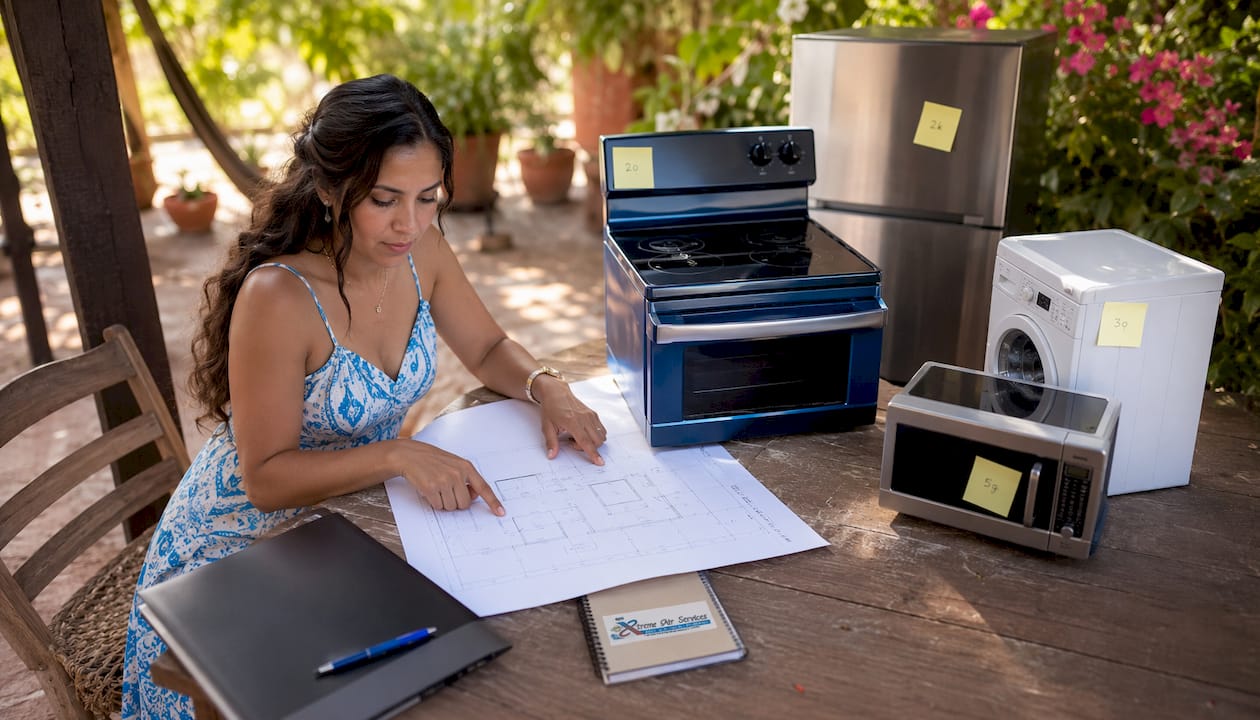
Pro Tip: Write the wattage from each major appliance’s nameplate on a sticky note and do the math before you plug in something new on a circuit. It takes 30 seconds and can save a tripped breaker or worse.
What circuit and service amperages will you see in your home?
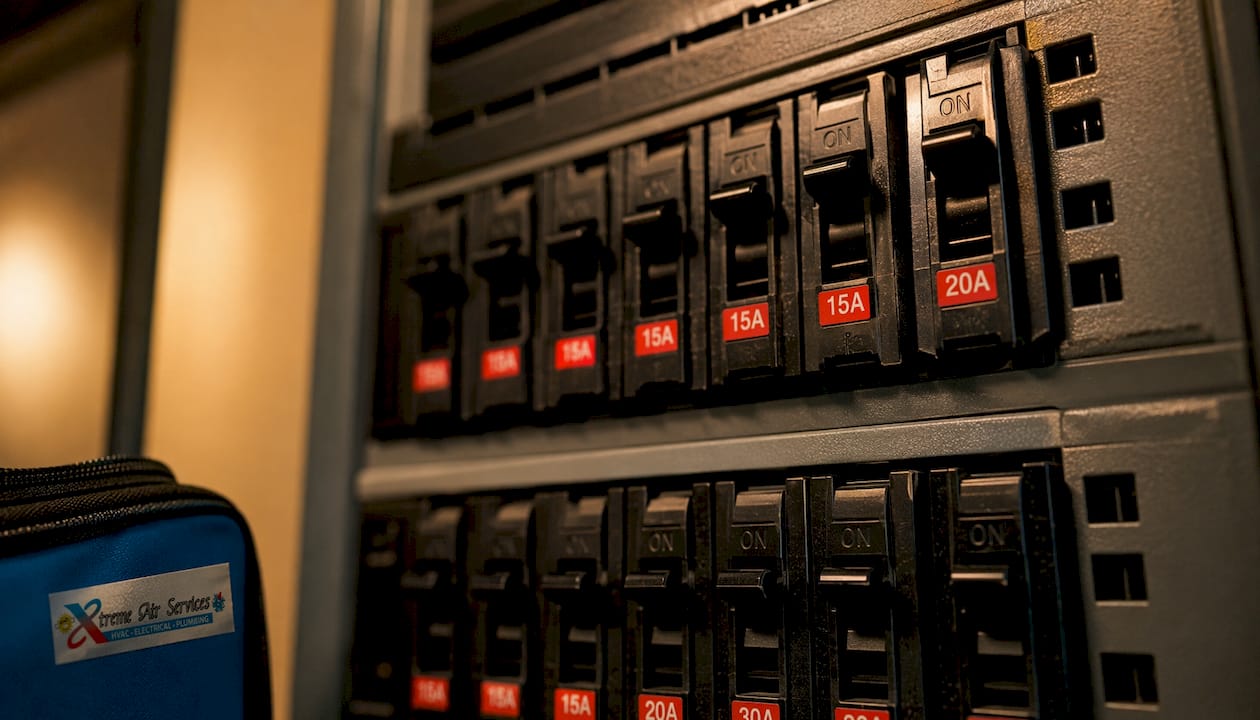
Understanding amperage in household circuits means separating two different numbers: the branch-circuit rating (the individual breaker protecting one circuit) and the service rating (the main breaker protecting your whole home).
Branch-circuit breaker sizes
Family Handyman lays out the common sizes clearly:
| Breaker size | Typical use |
|---|---|
| 15 amps | Bedroom outlets, lighting circuits |
| 20 amps | Kitchen countertop outlets, bathrooms, garage |
| 30 amps | Electric dryers, some water heaters |
| 40–50 amps | Electric ranges, large HVAC equipment |
Whole-home service ratings
The Spruce and InspectAPedia both document the range of service sizes found in U.S. homes:
| Service size | What it typically supports |
|---|---|
| 30–60 amps | Very old or small homes; often inadequate today |
| 100 amps | Small homes with gas appliances; minimum modern standard |
| 125–150 amps | Mid-size homes with modest electric loads |
| 200 amps | Current standard for new construction; handles most modern loads |
| 300+ amps | Large homes, electric heating, EV chargers, home workshops |
The service rating is the ceiling for your entire home. Every circuit inside draws from that total pool. A 200-amp panel doesn’t mean you can run 200 amps continuously on every circuit at once; it means your total simultaneous demand can’t exceed that figure without tripping the main breaker.
How do you find or measure the amperage of a device or circuit?
Most homeowners never need to touch a meter. The information you need is usually already printed somewhere. Here’s a safe, step-by-step approach:
- Read the appliance nameplate. Every appliance has a label (usually on the back or bottom) listing wattage, voltage, and often the amp draw directly. That number is your starting point.
- Check the breaker label. Open your panel door. Each breaker has an amp rating stamped on its handle (15, 20, 30, etc.) and should have a handwritten or printed label identifying the circuit. If yours aren’t labeled, that’s a project worth tackling.
- Calculate using the formula. If the nameplate shows only watts and volts, divide: Amps = Watts ÷ Volts. No guessing required.
- Photograph your panel. Take a clear photo of the full panel with all breakers visible. Store it in your phone’s photos. When an electrician visits, that image saves time and money.
- Use a clamp meter for live readings. If you want to measure actual current flowing through a wire, a clamp meter is the right tool. It clamps around a single conductor and reads the magnetic field, giving you an accurate amp reading without touching any live parts. Fluke specifically recommends clamp meters for this reason: they measure current non-invasively, with no need to break the circuit.
Avoid measuring amps with a standard multimeter in household circuits. PowerToolsToday explains that doing so requires inserting the meter in series with the circuit, which means breaking the circuit and exposing yourself to live connections. Connecting the amp port across a voltage source creates a near-short condition that can blow the meter’s fuse or damage the meter entirely.
Safety hard stops: Never touch the main bus bars inside your panel. If you’re uncomfortable opening the panel door, don’t. Call a licensed electrician for any live-panel work.
Pro Tip: Label every circuit in your panel with a piece of painter’s tape and a marker before you photograph it. Future you, and any electrician you hire, will be grateful.
What does amperage look like for real appliances and a 2,000 sq ft home?
Here’s how the formula plays out for common household appliances:
- Microwave (1,200W, 120V): 10 amps
- Window air conditioner (1,440W, 120V): 12 amps
- Electric range burner (3,000W, 240V): 12.5 amps
- Central AC compressor (approx. 3,500W, 240V): roughly 14.6 amps at the compressor alone
A 2,000 sq ft home with central HVAC, a standard electric range, a washer/dryer, water heater, and typical lighting and outlet loads will generally need at least a moderate service capacity, and most electricians recommend a larger service panel for comfortable simultaneous use. Adding an EV charger or electric heating significantly increases the required service amperage. The variables that shift the number most are how you heat the home, whether you have an EV, and how many large appliances run simultaneously.
These are illustrative estimates. A formal load calculation, which accounts for simultaneous demand and continuous loads, is the electrician’s job, not a back-of-napkin exercise. NFPA guidance is clear that overloading a circuit causes long-term wear even when the breaker doesn’t trip immediately, which is exactly why professional load calculations exist.
For outdoor lighting circuits, landscape lighting safety follows the same amperage principles: total wattage divided by voltage tells you the circuit load, and staying well below the breaker’s rated limit protects both the wiring and the fixtures.
Why do amperage limits exist, and what are the warning signs?
Breakers trip because heat is the enemy of wiring. When current exceeds a wire’s rated capacity, the conductor heats up. Sustained overheating degrades insulation, which can eventually cause arcing or fire. The breaker is the last line of defense, not the first.
Watch for these red flags in your home:
- Frequent breaker trips on the same circuit, especially under normal loads
- Warm or hot outlet covers or switch plates
- Burning smell near outlets, the panel, or appliances
- Flickering or dimming lights when a large appliance kicks on
- Discolored or scorched outlets, even slightly
- Buzzing or crackling sounds from the panel or receptacles
If you notice any of these, the immediate steps are: unplug non-essential devices from that circuit, stop using the affected outlet, and document what was running and when. Photos and notes help your electrician diagnose the problem faster. For a deeper look at common electrical problems in residential settings, those symptoms often point to overloaded branch circuits or aging wiring.
One rule worth knowing: the NEC requires that continuous loads (anything running three hours or more) be sized at 125% of the device’s amp draw. An EV charger drawing 32 amps continuously, for example, needs a circuit rated for at least 40 amps. That buffer isn’t optional; it’s code.
Never replace a breaker with a higher-rated one to stop nuisance trips. That removes the protection the wiring depends on.
When should you call an electrician about your home’s amperage?
Some situations are clearly DIY-safe (reading a nameplate, photographing your panel). Others require a licensed electrician. Call one when:
- Breakers trip repeatedly on the same circuit under normal use
- You’re adding central air conditioning or upgrading HVAC equipment
- You’re installing an EV charger
- You’re renovating a kitchen or bathroom and adding outlets or appliances
- Your panel is warm to the touch, makes noise, or shows signs of corrosion
- Your home still has 60-amp service and you’re adding modern loads
- You want to add a dedicated circuit for any high-draw appliance
A licensed electrician will perform a formal load calculation, determine whether your current service amperage is adequate, and recommend either adding dedicated circuits or upgrading the main panel. Panel upgrades require permits and inspections in virtually every U.S. jurisdiction. That’s not red tape; it’s what ensures the work is done to code and your home’s insurance remains valid.
Pro Tip: Ask your electrician for a copy of the load calculation after the job. It’s a useful document if you sell the home or add loads later.
For signs your electrical system needs an upgrade, many of the same indicators that apply to commercial buildings show up in residential panels first.
Key Takeaways
Amperage is the single most practical number in your home’s electrical system: it sets the hard limit on how much power you can draw safely, circuit by circuit and house-wide.
| Point | Details |
|---|---|
| Amperage = current flow | Amps measure how much electrical current moves through a wire; more amps means more power capacity and more heat if wiring is undersized. |
| Use the formula | Amps = Watts ÷ Volts; a 1,200W microwave on 120V draws 10 amps, a 3,000W appliance on 240V draws 12.5 amps. |
| Know your breaker sizes | Most circuits are 15 or 20 amps; large appliances need 30 amp dedicated circuits; whole-home service is typically 100–200 amps. |
| Clamp meter is safest | For live current readings, a clamp meter measures non-invasively; avoid in-line multimeter measurements on household circuits. |
| Xtreme Air Services can help | For panel inspections, load calculations, or circuit upgrades, Xtreme Air Services provides licensed electrical services for Dallas-area homeowners. |
The amperage mistake most homeowners make
Most homeowners assume their panel is fine as long as the breakers aren’t tripping. That’s the wrong signal to watch. A breaker that trips is doing its job. The real concern is a circuit that’s running at 90% of its rated capacity for hours every day, quietly degrading the insulation on the wiring behind the wall. By the time a breaker trips from that kind of wear, the damage is already done.
The other mistake is counting outlets instead of calculating loads. Adding a new appliance to a circuit that “has room” on the outlet strip tells you nothing about whether the circuit can handle the combined wattage. The formula exists for a reason. Thirty seconds with a nameplate and a calculator is a better safety check than any visual inspection.
Labeling your panel is the single highest-return task a homeowner can do in an afternoon. It costs nothing, takes an hour, and means that every future electrician, inspector, or emergency responder can work faster and safer in your home. Photograph it when you’re done. That’s the kind of maintenance that actually prevents problems rather than reacting to them.
Xtreme Air Services electrical inspections and panel upgrades
If the amperage math in your home isn’t adding up, or you’re planning to add an EV charger, a new HVAC system, or a kitchen remodel, a professional electrical inspection is the right first step before any work begins.

Xtreme Air Services provides licensed electrical services for homeowners in the Dallas area, including full panel inspections, load calculations, dedicated circuit additions, and panel upgrades. Every job is handled by licensed electricians, pulled with the proper permits, and inspected to local code. You’ll get a clear quote before any work starts, and a copy of the load calculation when it’s done.
For electrical services in Dallas, request an inspection or call to discuss a panel upgrade. If you’re also due for an HVAC check, ask about bundling it with an HVAC maintenance plan to cover both systems in one visit.
This article is general information for homeowners, not a substitute for professional electrical advice. Always consult a licensed electrician for code interpretation and work specific to your home.
Useful sources for homeowners
These U.S.-based references are reliable starting points for further reading. For code interpretation and permit requirements in your area, a licensed electrician is the authoritative source.
- NFPA National Electrical Code (NEC) overview — the governing standard for residential electrical installations in the U.S.
- U.S. Department of Energy — Energy.gov — home energy use, appliance efficiency, and load guidance
- U.S. Consumer Product Safety Commission (CPSC) — electrical safety recalls and home fire statistics
- Family Handyman — Electrical terms explained — plain-language breakdown of watts, volts, amps, and ohms
- The Spruce — How to determine your home’s electrical service amps — practical guide to reading service size
- Fluke — How to measure current with a clamp meter — tool guidance for safe current measurement
- Xtreme Air Services residential electrician services — licensed electrical help for Dallas-area homeowners
FAQ
How many amps does a 2,000 sq ft house need?
Most 2,000 sq ft homes with central HVAC and standard appliances need at least 100 amps of service, and 200 amps is the practical standard for comfortable simultaneous use. Add an EV charger or electric heating and the requirement often climbs toward 200–300 amps.
How do I tell if my house is 15 or 20 amp?
Check the breaker in your panel: a 15-amp breaker is stamped “15” on the handle, and a 20-amp breaker is stamped “20.” You can also look at the outlet itself: a 20-amp outlet has a small T-shaped slot on one side, while a standard 15-amp outlet has two straight vertical slots.
What is a good amperage for a house?
200-amp service is the current standard for new U.S. homes and handles most modern loads comfortably. Older homes with 60-amp or 100-amp service may need an upgrade if you’re adding large appliances, an EV charger, or significant HVAC equipment.
Is 25 amps enough for a whole house?
No. A service below modern residential requirements is insufficient. Even a small home with basic loads needs at least 100 amps of service by today’s standards, and most electricians recommend 200 amps for any home with central air conditioning and standard kitchen appliances.
Can I measure my home’s amperage myself?
You can check nameplate ratings and read breaker labels safely without any tools. For live current readings, a clamp meter is the safe choice: it reads current non-invasively without breaking the circuit. Avoid using a standard multimeter for household current measurement, as it requires inserting the meter in series with the circuit and carries a real risk of damage or injury.