

The National Electrical Code (NEC), published as NFPA 70 by the National Fire Protection Association, sets the minimum safety standards for electrical wiring and equipment installations across the United States. In commercial contexts, it is the governing document that determines how every circuit, panel, conduit, and grounding system in your building must be installed. While the NEC is not federal law, most states and local jurisdictions have adopted it by statute, making compliance legally required in the vast majority of U.S. commercial projects.
Here is what the NEC covers at a glance:
- What it is: NFPA 70, a nationally standardized safety code for electrical installations
- Who publishes it: The National Fire Protection Association (NFPA), with revisions every three years
- Legal status: Not federal law, but widely mandated by state and local governments
- Scope: Applies to commercial buildings, offices, retail spaces, industrial facilities, and more
- Latest edition: The latest NEC edition is the 2023 version, which is being adopted by multiple states including Minnesota starting in mid-2023
- Commercial relevance: Commercial electrical systems face stricter and more complex NEC requirements than residential ones
How the NEC applies to commercial buildings specifically
Commercial buildings operate under a different electrical reality than homes. Three-phase power, higher service voltages, larger load demands, and more complex distribution systems all push commercial installations into NEC territory that most residential electricians rarely touch.
The NEC defines commercial occupancies broadly, covering offices, retail stores, restaurants, warehouses, and any non-residential structure where people work or gather. Key NEC articles that govern these spaces include:
- Article 220: Mandatory load calculations for commercial services, accounting for demand factors and continuous load adjustments to prevent undersized panels
- Article 250: Grounding and bonding requirements, which are significantly more complex in commercial buildings than in homes
- Article 300: Wiring methods and materials, specifying conduit types, conductor sizing, and installation practices
- Article 408: Switchboards, switchgear, and panelboards, covering the distribution equipment that routes power through a commercial facility
- Article 700/701/702: Emergency and legally required standby systems, which many commercial buildings must have
Commercial installations also typically require ground fault circuit interrupter (GFCI) protection in kitchens, bathrooms, and outdoor areas, plus arc fault circuit interrupter (AFCI) protection in specific occupancy types. The NEC’s scope does not cover utility-side equipment or every electrical rule imaginable, but it is the primary standard for everything inside the building’s premises wiring.
Pro Tip: Before any commercial electrical project begins, pull the specific NEC edition your jurisdiction has adopted. Some states still enforce the 2020 edition while others have moved to 2023. Using the wrong edition can mean failed inspections and costly rework.
Legal adoption and enforcement: who actually makes NEC compliance mandatory?
The NEC itself carries no legal weight until a government body adopts it. That is where state legislatures, city councils, and county authorities come in. Oklahoma, for example, formally adopted the NEC 2023 edition as the statewide minimum code for commercial electrical construction. Minnesota did the same, effective July 1, 2023. Most other states follow a similar pattern, though the edition they adopt and any local amendments vary.
Once adopted, enforcement falls to the Authority Having Jurisdiction, or AHJ. In practice, the AHJ is typically your local electrical inspector or building department. They review permit applications, conduct on-site inspections, and issue certificates of occupancy when work passes. A few important points about how this works:
- AHJ authority: The AHJ enforces the adopted code and can approve alternative methods, but cannot create rules beyond what the adopted edition allows
- Local amendments: Jurisdictions may add requirements on top of the NEC baseline but cannot strip out mandated safety provisions
- Permitting: Most commercial electrical work requires a permit before work starts and an inspection before walls close or power energizes
- Non-compliance consequences: Failed inspections, stop-work orders, fines, and potential liability if a code violation causes injury or fire
Verifying which NEC edition and local amendments apply to your specific project address is not optional. A contractor working from the 2020 NEC in a jurisdiction that adopted 2023 is working from the wrong playbook.
What the NEC is actually designed to protect against
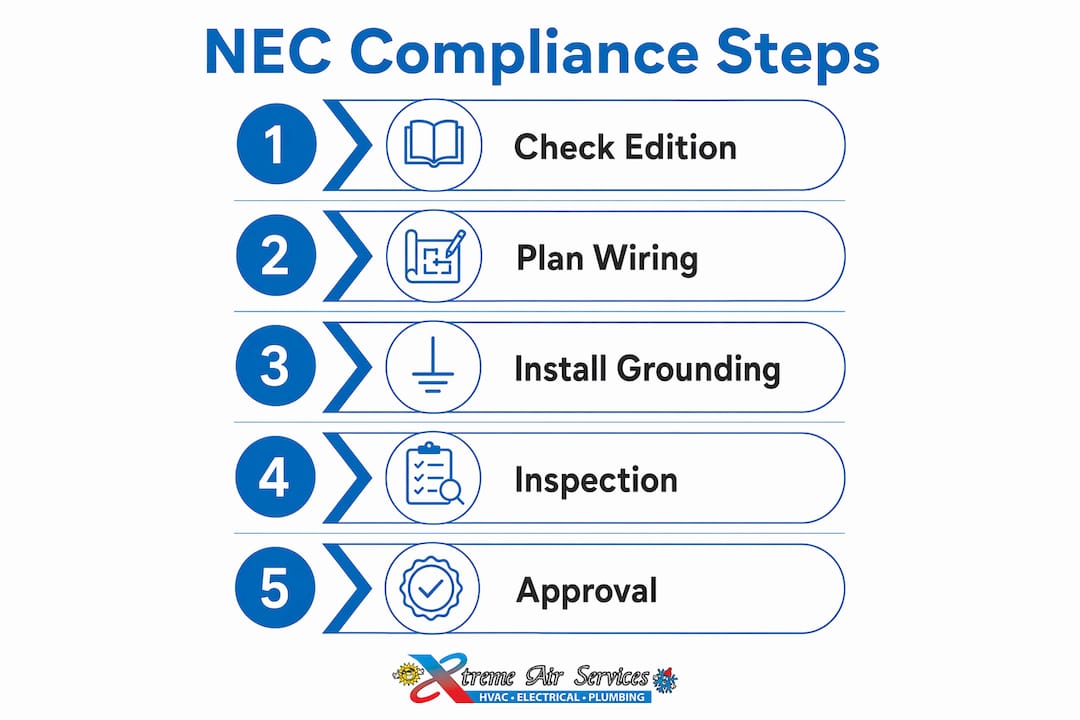
The NEC’s core objective is straightforward: protect people and property from electrical hazards. It is a safety document, not a design manual or an efficiency guide. That distinction matters more than most building owners realize.
Meeting NEC minimums means your electrical system is safe enough to occupy. It does not mean the system is optimally designed for your business’s operational needs. Many commercial operations require electrical systems that exceed NEC minimums to function reliably. The code is the floor, not the ceiling.
Key safety protections the NEC delivers in commercial settings:
- Grounding and bonding (Article 250): Prevents dangerous voltage differences between metal parts, reducing shock and fire risk
- Overcurrent protection: Requires properly sized breakers and fuses to stop conductors from overheating under fault conditions
- Wiring methods: Mandates conduit, conductor sizing, and installation practices that contain faults and prevent ignition
- Equipment ratings: Requires that panels, disconnects, and devices are rated for the voltage and current they will carry
- GFCI and AFCI protection: Catches ground faults and arc faults before they cause electrocution or fire
Commercial electrical rooms are among the most common sites for NEC violations, particularly around grounding and bonding. An unbonded grounding system does not just create a code violation; it creates real power quality problems and genuine shock hazards for anyone working near the equipment.
Common NEC compliance challenges in commercial electrical work
Commercial NEC compliance is harder than residential compliance, and not just because the code is more complex. The scale of commercial projects, the involvement of multiple trades, and the pressure to meet construction schedules all create conditions where violations happen.
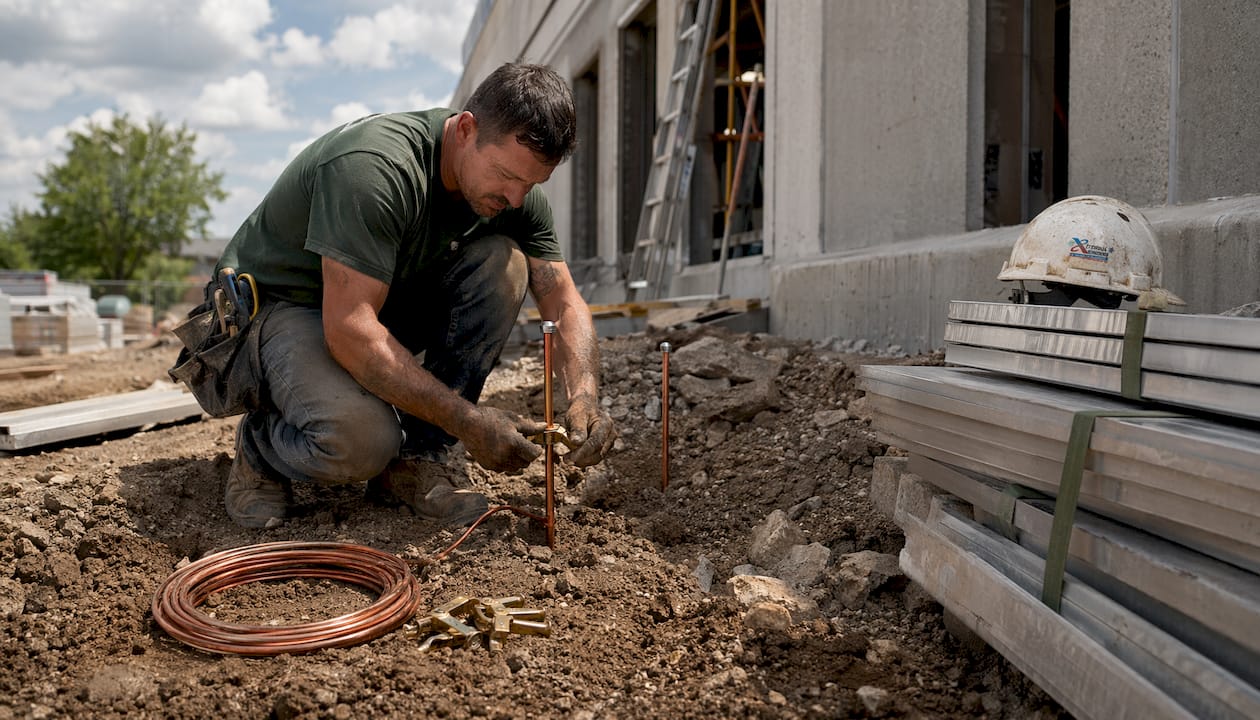
Grounding electrode systems are a frequent sticking point. Commercial buildings require multiple electrode types, including concrete-encased electrodes, ground rings, and structural steel bonding, all tied together per Article 250. Getting this right requires planning from the foundation pour, not an afterthought during rough-in.
Undersized services are another recurring problem. When load calculations per Article 220 are skipped or done carelessly, the service entrance ends up too small for the building’s actual demand. Correcting an undersized service after construction is expensive and disruptive.
Construction document conflicts create a specific trap. Architectural and engineering drawings sometimes specify equipment or layouts that do not comply with the NEC. An experienced contractor who installs what the drawings show, without flagging the conflict, owns the violation. The right move is to request a drawing revision before work begins, not after the inspector flags it.

Jurisdictional variation adds another layer of complexity. Local amendments mean that what passes inspection in one city may fail in the next county over. Contractors working across multiple jurisdictions need to track each location’s adopted edition and amendments separately.
Best practices that professional elektriciens use to stay ahead of these challenges:
- Confirm the adopted NEC edition and local amendments at project kickoff
- Complete Article 220 load calculations before sizing any service or feeder
- Plan grounding electrode systems during foundation design, not during rough-in
- Flag construction document conflicts in writing and request revisions before installation
- Schedule pre-inspection walkthroughs with the AHJ on complex commercial projects
Xtreme Air Services brings this level of code knowledge to every commercial electrical project it handles, from initial load calculations through final inspection. If your commercial building’s electrical system needs evaluation or upgrade, knowing whether it meets current NEC standards is the right starting point. You can also review signs your system needs an upgrade to get a clearer picture before calling for an inspection.
For NEC-compliant commercial electrical work in the Dallas area, Xtreme Air Services’ electrical team handles everything from service upgrades to full commercial buildouts, with inspections passed the first time.
Key Takeaways
The NEC (NFPA 70) is the mandatory safety standard governing commercial electrical installations across the U.S., enforced locally by the Authority Having Jurisdiction through permits and inspections.
| Point | Details |
|---|---|
| NEC is NFPA 70 | Published by the National Fire Protection Association and updated every three years. |
| Legal adoption varies | States and local jurisdictions adopt specific NEC editions; verify which applies before starting any project. |
| AHJ enforces compliance | Local inspectors verify installations meet the adopted code and can approve alternatives within its limits. |
| Safety, not design | The NEC sets minimum safety standards; it does not guarantee system performance or operational efficiency. |
| Commercial complexity | Grounding electrode systems, load calculations, and three-phase power make commercial NEC compliance significantly more demanding than residential. |
FAQ
What does NEC code stand for?
NEC stands for National Electrical Code, officially designated NFPA 70 and published by the National Fire Protection Association.
Is the NEC a legal requirement for commercial buildings?
The NEC is not federal law, but it is legally required in most U.S. commercial projects because state and local governments have adopted it by statute. Where it is adopted, anything less is illegal.
What does the NEC cover in a commercial building?
The NEC covers premises wiring, circuits, grounding, bonding, overcurrent protection, emergency systems, and equipment installation standards for commercial occupancies including offices, retail spaces, and warehouses.
Who enforces NEC compliance on commercial projects?
The Authority Having Jurisdiction (AHJ), typically the local electrical inspector or building department, enforces NEC compliance through the permitting and inspection process.
How often is the NEC updated?
The NFPA revises the NEC every three years. The 2023 edition is currently the active standard in many jurisdictions, though adoption timelines differ by state and locality.