


Whole-Home Standby Generator Installation: What Buyers Commonly Ask Before They Commit
What buyers ask before committing: how we size the unit, whether your gas line can feed it, where it can sit, and what the weekly test sounds like.
What’s Covered on This Page
- How We Determine the Right Generator Size for Your Home
- Where the Transfer Switch Goes and What It Does
- Whether an Existing Gas Line Can Support a Standby Generator
- Where the Generator Can Sit on Your Property
- What the Weekly Self-Test and Running Noise Are Like
- How do you decide what size generator my home needs?
- Can my existing gas line support a standby generator?
- Where can the generator actually sit on my property?
- How loud is the weekly self-test, and can I change when it runs?
- Do I need a transfer switch with a whole-home standby generator?
How We Determine the Right Generator Size for Your Home
This is the question we hear most. It is the right one to ask before you spend a dime. Size it wrong and you buy too much generator, or too little when the storm knocks the power out. Neither one helps your house. We size every Sunnyvale job off the panel, not a rule of thumb.
We start with what you want to keep running. Lights, the refrigerator, and a few outlets call for one setup. Your whole HVAC system, an electric range, and a well pump call for another. North Texas summers make that second version common, because losing power for two days in August without air conditioning can be rough on anyone in the house who is older or has health conditions. We walk your electrical panel with you and add up the actual loads, not just guess from square footage. (That part matters more than people think.) Sunnyvale summers are what push most of these units larger.
Home size gets you in the neighborhood, but it does not decide the answer. A 1,800 square foot house with two AC condensers and an electric water heater can need more generator than a 3,000 square foot home with gas appliances and one smaller system. That is why we do a backup power assessment on-site instead of quoting a size over the phone. We look at your existing electrical service, what is on each circuit, and whether you want everything covered or just the essentials. We run that assessment at your Sunnyvale address.
The transfer switch matters just as much as the generator itself. A whole-home setup uses an automatic transfer switch that senses an outage and switches your house over, often before your fridge even has a chance to warm up. The switch has to be rated for the load you are asking the generator to carry. This is not the place to undersize and hope for the best. Sunnyvale outages will find that shortcut fast.
Gas supply is the piece people forget about. The generator needs enough gas pressure and line size to run at full output, and that depends on your home’s existing gas service and how far the line has to run from your meter to the generator pad. We check this during the consultation, because a generator that is sized right on paper still will not perform if the gas line feeding it is too small. By the way, this comes up a lot. On the deeper Sunnyvale lots the meter can sit a long way from the pad.
Bigger is not automatically better. A generator sized well past what your home needs costs more to buy, more to maintain, and does not run any more reliably than one sized correctly. We would rather size it to what your panel and your priorities call for than sell you the biggest unit on the truck. Right-sizing saves Sunnyvale homeowners real money up front and later.
Where the Transfer Switch Goes and What It Does
The automatic transfer switch sits between your electrical panel and your utility connection, usually mounted right next to your existing panel in the garage or on an outside wall close to the meter. It is the part of your generator setup most homeowners never see, and it is the part doing most of the work. When the power goes out, the transfer switch senses it in seconds, disconnects your home from the dead utility line, and switches your home over to the generator. When the power comes back, it flips you back to the utility and signals the generator to shut down and cool off. You never touch a breaker or run an extension cord through a window. The full install is walked through on our Whole-Home Standby Generator Installation in Sunnyvale page.
We size the transfer switch to match the generator and your home’s electrical load. Whole-home switches typically run 200 amps to match a standard residential panel. Some homeowners choose a smaller switch tied to specific circuits, called a managed load setup, if they would rather run a smaller generator and let it carry only the essentials: refrigerator, well pump, a few lighting circuits, maybe one AC unit. That decision gets made during sizing, before we ever touch the panel, because the switch and the generator have to agree on how much power is available.
People often ask whether the switch can fail and leave them stranded. It is mechanical and electronic, so like any component it can wear out over time. That is part of why we test it during startup and why annual service exists as a maintenance item. The switch is the least likely part of the system to give trouble day to day, but it is also the one part you do not want acting up during a week-long outage, so we do not cut corners on the model or the installation. Sunnyvale storm season is exactly when a weak switch shows itself.
Placement matters more than people expect. The switch needs a clear path to both your main panel and your generator’s wiring, and it needs to be somewhere a technician can service it without pulling apart your garage storage every time. On older homes with panels that have been added onto over the years, sometimes we find the panel itself needs attention before a transfer switch can go in cleanly. We will tell you if that is the case before we quote the job, not after we have started. Older Sunnyvale panels are where this comes up most.
A transfer switch install is electrical work, done to code, with permits and inspections where they are required. We are not going to tap into your panel in a way that skips an inspection just to save a day on the schedule. If you are comparing installers and one is quoting a number that seems to skip this step, ask directly what switch model they are using and where it is rated to be installed. You can get more detail on how this fits into the full installation on our Whole-Home Standby Generator Installation page, including how transfer switch sizing connects to the generator size itself.
Whether an Existing Gas Line Can Support a Standby Generator
Most homes were not piped for a generator. That is the short answer, and it surprises a lot of people during their first call with us. A standby generator can pull anywhere from 150,000 to over 400,000 BTUs depending on its size, and that is on top of whatever your furnace, water heater, and range are already drawing from the same gas line. If the existing line and meter were sized just for the appliances you have now, there is often not enough capacity left over. Plenty of Sunnyvale homes are in exactly that spot.
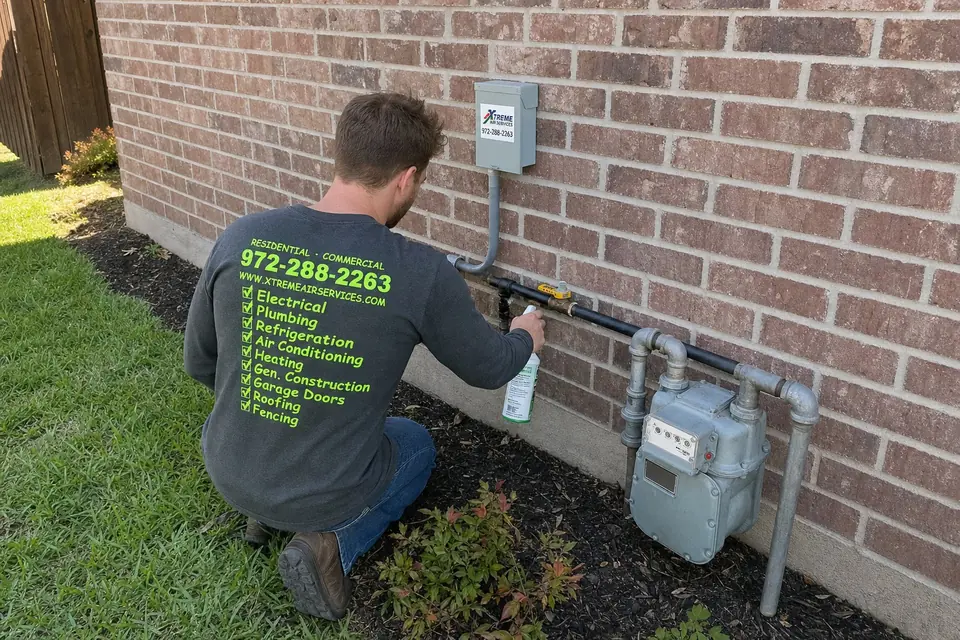
What we look at first is your meter. Gas utility meters are rated for a maximum flow, and a lot of DFW homes have a meter sized for a standard household load, not an added generator. If the math does not work, the utility has to upsize the meter before we can move forward, and that is a request we submit on your behalf, not something you have to chase down yourself. We handle the Sunnyvale utility request on your behalf.
Pipe size and distance matter just as much as the meter. A generator set up 40 feet from the house needs a bigger pipe diameter than one sitting right next to the gas service entrance, because pressure drops the farther gas has to travel. We have walked properties in older Dallas neighborhoods where the original black iron gas line was fine for a furnace and a stove, but running a new branch out to a generator pad meant adding a dedicated line instead of tying into the old one. On newer builds in places like Frisco or Forney, the existing line sometimes has room to spare, but we still test it rather than assume. Sunnyvale has both older and newer builds, so we never assume.
This is why sizing and gas line evaluation happen together, not as separate steps. During generator sizing and consultation, we calculate your home’s total connected gas load, check the meter rating, and measure the run from the meter to the proposed generator pad location. If the current line cannot support the additional load, that becomes part of your written quote, not a surprise change order after the pad is already poured. Every Sunnyvale quote includes that gas evaluation.
If a property needs a full gas line upgrade or a meter swap from the utility, that adds time and cost to the project, and we will say so up front rather than downplay it to get the job started. Some homes need nothing more than a new branch line off the existing meter. Others need the utility to run a larger service line to the house before a generator install can even happen. Both situations are common enough that we do not quote a generator install without checking gas capacity first. That rule holds on every Sunnyvale property.
If you are mid-research and just trying to figure out what your home might need, our Generator Fuel Line Connection service covers this evaluation as part of the process. It is worth asking about early, before you have picked a specific generator model, since the sizing on paper does not always match what the meter and piping can deliver. We measure that run at your Sunnyvale home.
Watch Our Video
See How We Handle Whole-Home Standby Generator Installation in Sunnyvale
Xtreme Air Services — Serving Sunnyvale and surrounding areas
Need help with Whole-Home Standby Generator Installation?
Call Today, Get Service Today. Xtreme Air Services is ready to help.
Where the Generator Can Sit on Your Property
Placement is one of the first questions we get, and it is not as simple as picking a spot near the house. A standby generator needs clearance from windows, doors, and vents, distance from your gas meter and electrical panel, and a level pad it can sit on for the life of the unit. Get any of those wrong and you either fail an inspection or end up with a generator running louder than it needs to right outside your bedroom window. Sunnyvale setbacks and manufacturer clearances both apply.
Most homes in the DFW area end up with the unit somewhere along a side yard or the back of the house, close enough to the electrical panel and gas line that we are not running long, expensive connections across the property. Distance to the panel matters because every extra foot of wire and conduit adds labor and material. Distance to the gas line matters for similar reasons, plus the size of the generator determines how much gas it needs to pull, which can affect whether your existing gas service can handle it or needs an upgrade. That is part of why sizing the unit correctly up front, based on your home’s actual power needs, changes what placement options even make sense. Sunnyvale lots are deeper than most Metroplex suburbs, which usually helps here.
Setback requirements vary by what is required for that property, not just what looks convenient. Manufacturers set minimum clearances from windows and doors for exhaust reasons, and local code adds its own requirements on top of that for things like property line distance and fire separation. We check both before we ever mark a spot on your yard. Corner lots and homes with narrow side yards are usually the trickiest, since there is less room to satisfy every clearance at once. Older Sunnyvale properties with tight side yards are the hardest.
The pad itself needs to be level and stable enough to hold a few hundred pounds of equipment for years without shifting. Site prep is part of the install, whether that means a simple gravel or composite pad on solid ground or more grading work if the yard slopes or drains poorly toward the house. Homes on older lots with mature landscaping sometimes need a tree root or drainage issue worked around, which is something we look at during the walkthrough rather than guessing from a photo. The clay soil around Sunnyvale will shift a pad that is not set properly.
Not every spot a homeowner wants is a spot we can use. If the only flat ground on your property sits too close to a bedroom window or crosses a required setback, we will tell you that up front and work through the next-best option together, rather than installing it somewhere that fails inspection or annoys you every time it kicks on. It is a better conversation to have before the pad gets poured than after. We would rather have that talk standing in your Sunnyvale yard.
We walk every property as part of our generator sizing and placement consultation, so you know exactly where the unit will sit, how far the gas and electrical runs will be, and what site prep is involved before you commit to anything. If you want a sense of how placement and site conditions affect overall cost, our Whole-Home Standby Generator Cost page breaks down what drives the number up or down.
What the Weekly Self-Test and Running Noise Are Like
Every standby generator we install runs a self-test on its own, usually once a week, for about 12 to 20 minutes depending on the manufacturer settings. This is not a malfunction. It is the unit checking its own oil pressure, battery, and charging system, then exercising the engine so it is ready when a storm knocks your power out. If you have never lived with a standby unit before, that first Saturday morning test can catch you off guard. Homeowners tell us it sounds like a lawnmower started itself in the side yard. Sunnyvale neighbors notice the first one too.
The noise level itself depends on the generator’s size and where we place the pad. A whole-home unit sized for a bigger DFW house runs louder than a smaller unit sized for a condo or a business. Placement matters too. We look at distance to bedroom windows, distance to the neighbor’s fence, and local setback rules when we plan the pad location during the install. A unit set eight feet from a window sounds different than one set thirty feet away with a fence line between. Lot depth in Sunnyvale usually works in your favor on noise.
What people ask us most is whether the test cycle can be moved to a different day or time. On most units, yes. The self-test schedule is programmable, so if Wednesday at 2pm works better for your household than the factory-default Saturday morning setting, we can typically set it during startup and testing or adjust it after. Some owners like to sync the test with a day they are already outside doing yard work, so the noise does not feel like an interruption. We set that schedule during startup at your Sunnyvale home.
A standby generator will also run for real during a grid outage, not just the weekly test, pulling from a natural gas or propane line rather than a fuel tank you have to refill. That is part of why the gas line run and connection point matter so much during install planning. A generator that is sized right and fed by a properly connected gas line starts within seconds of sensing an outage and keeps running as long as fuel supply holds, which for a natural gas hookup is effectively indefinite. That matters through a long Sunnyvale outage.
Some owners want to know if the test cycle uses meaningful fuel. It does not, in practice. A 12 to 20 minute weekly run at idle-to-moderate load burns a small amount of gas, nothing like what running your whole house during an actual outage will use. We walk through this kind of detail during the acceptance walkthrough once your unit is installed, along with how the transfer switch behaves when it senses outage and restoration, so you are not guessing at what a normal week with the generator looks like versus what an actual power event looks like. If generator noise or placement is a concern before you commit, that is a conversation worth having with us during the sizing and site consultation, before the pad gets poured.
See our full whole-home standby generator installation in Sunnyvale for what the complete job involves.
Frequently Asked Questions
Common questions about Whole-Home Standby Generator Installation in Sunnyvale
How do you decide what size generator my home needs?
We start with what you want to keep running, then walk your electrical panel and add up the actual loads. Square footage gets us in the neighborhood but does not decide it. An 1,800 square foot house with two AC condensers and an electric water heater can need more generator than a 3,000 square foot home on gas appliances. That is why we do the assessment on site instead of quoting a size over the phone, and why bigger is not automatically better.
Can my existing gas line support a standby generator?
Often not without a change, and it surprises most homeowners. A standby generator pulls anywhere from 150,000 to over 400,000 BTUs on top of your furnace, water heater, and range. We check the meter rating first, then pipe size and the distance from the meter to the proposed pad, since pressure drops the farther gas has to travel. Some homes need only a new branch line. Others need the utility to upsize the meter, which we request on your behalf.
Where can the generator actually sit on my property?
It needs clearance from windows, doors, and vents, a level pad, and a workable distance to your gas meter and electrical panel. Manufacturers set minimum clearances for exhaust, and local code adds property line and fire separation rules on top. Most homes end up along a side yard or the back of the house. Corner lots and narrow side yards are the trickiest. If the only flat spot sits too close to a bedroom window, we will tell you before the pad gets poured, not after.
How loud is the weekly self-test, and can I change when it runs?
The self-test runs about 12 to 20 minutes once a week, and homeowners often describe it as sounding like a lawnmower started itself in the side yard. Volume depends on unit size and how far the pad sits from bedroom windows and the neighbor’s fence. On most units the schedule is programmable, so if a Wednesday afternoon suits you better than the factory Saturday morning setting, we can change it during startup or afterward.
Do I need a transfer switch with a whole-home standby generator?
Yes. The transfer switch is what senses the outage and moves your home from utility power to the generator, then back again when the grid returns. Some owners choose a smaller managed-load switch tied to specific circuits so a smaller generator can carry the essentials. That decision gets made during sizing, because the switch and the generator have to agree on how much power is available.
Ready to Get Started?
Call 972-288-2263 Today, Get Service Today.