


Whole-Home Standby Generator Installation: Should You Repair or Replace?
How we weigh repair cost against a new install, what kind of failure changes the answer, and when replacing is the honest call.
What’s Covered on This Page
- The Short Answer: Cost Ratio and Failure Type Decide It
- The Factors That Decide Repair Versus Replace
- When We’d Recommend a Repair
- When We’d Recommend Replacement
- How We Walk You Through the Decision
- How do I know whether to repair or replace my generator?
- What do homeowners get wrong most often when deciding?
- When would you tell me to replace instead of taking my repair money?
- Does the service call fee count toward anything if I decide to replace?
- Is financing available if I decide to replace instead of repair?
The Short Answer: Cost Ratio and Failure Type Decide It
If a repair estimate gets close to half of what a new whole-home standby generator install would cost, we’d tell you to replace it. A full install runs $8,000 to $18,000 for most North Texas homes, with the common job a properly sized standby unit, automatic transfer switch, gas hookup, and pad, all commissioned and tested, landing between $10,000 and $14,000. Once a repair bill starts creeping toward $5,000 or $6,000 on an older unit, you’re paying a big chunk of a new system’s price for equipment that’s already logged years of run time. Sunnyvale standby units work hard through storm season, so run hours add up faster here than people expect.
Failure type matters as much as the number on the invoice. Some failures are cheap and routine: a dead battery, a fouled spark plug, a control board sensor acting up. Those get fixed and the generator runs another several years without a second thought. Other failures point at the engine itself: a cracked block, worn-out internal components, or a manufacturer that’s stopped supporting parts for that model. When the failure is inside the engine or the parts pipeline has dried up, repair isn’t really a repair. It’s a stopgap you’ll be paying for again soon.
Age plays into it too, though we don’t use age alone to make the call. A generator on year 6 or 7 with a control board issue is a different conversation than a similar unit on year 15 or 16. Standby generators run hard during North Texas storm season and summer heat waves, and that duty cycle wears on components faster than a generator that only sees light use. We look at the specific part that failed, what it costs to source, and whether the rest of the unit is in shape to justify the investment before we recommend a direction. We make that call standing in your Sunnyvale yard, not over the phone.
The Factors That Decide Repair Versus Replace
If your existing generator is under 8 to 10 years old and the transfer switch still matches your panel, a repair usually makes sense. If the unit is older, undersized for your home, or the transfer switch needs replacing anyway, a full whole-home standby generator installation is usually the better move. The decision comes down to a handful of real factors, and the full scope is laid out on our Whole-Home Standby Generator Installation in Sunnyvale page.
Generator size matters more than most homeowners expect. A lot of older standby units in North Texas were sized for a smaller load, maybe just the fridge and a few circuits. If you’ve added a pool, a second AC unit, or an EV charger since that generator went in, repairing it just gets you back to a system that still can’t cover your home. That’s a replace situation, not a repair one.
Transfer switch type is another big factor. Manual switches and older automatic switches sometimes can’t be reused with a new or larger generator. If your switch needs to change anyway, it often makes more sense to handle the generator and switch together as one job rather than pay to fix an old unit paired with equipment you’re going to replace in a year or two. Pairing the two saves a second trip out to Sunnyvale.
Gas line run and pressure play into this too. If your existing gas line was sized for a smaller unit, moving up in kW can mean a new line or a pressure adjustment. We factor that into the installation cost up front, not as a surprise add-on later. On the deeper Sunnyvale lots that gas run is often the biggest line item.
Distance from the generator pad to your electrical panel, site prep, and any code upgrades required for your specific property all move the number as well. A straightforward job with a short gas run and no code corrections needed lands toward the lower end. A property needing a longer line, more site work, or panel upgrades lands higher. Sunnyvale properties vary a lot on this, so we price it per lot.
On pricing, a full whole-home standby generator installation runs $8,000 to $18,000 depending on those factors, with most jobs we do falling between $10,000 and $14,000. That figure includes the generator, transfer switch, professional installation, and the gas and electrical connections, plus startup and testing. It doesn’t include extensive gas or service upgrades, landscaping, code corrections beyond the scope of the job, or permits unless we’ve stated otherwise. We walk through our Whole-Home Standby Generator Installation page with every customer so you know exactly what’s covered before you approve anything.
If you’re on the fence, a service call runs $26 to $99, and that fee gets credited toward the job if you move forward with us. We also offer financing on qualifying installations. Repairing an aging unit can buy you a few more years for less money up front, but if it’s already undersized or paired with an outdated switch, you may end up paying for a repair and a replacement within a short window. We’ll tell you which situation you’re in before you spend a dollar. That is how every Sunnyvale visit starts.
When We’d Recommend a Repair
We’d point you toward a repair when the standby generator itself is sound and the problem is isolated to one part. A bad transfer switch, a fuel line issue, a battery that won’t hold a charge, or a control board that’s acting up don’t usually mean the whole unit is done. If the engine and generator head are in good shape and we can pin down a single cause, repair is almost always the cheaper path and the faster one. Most of these fixes get handled in a single visit once we’ve found the actual problem. Most Sunnyvale repair calls end on that first visit.
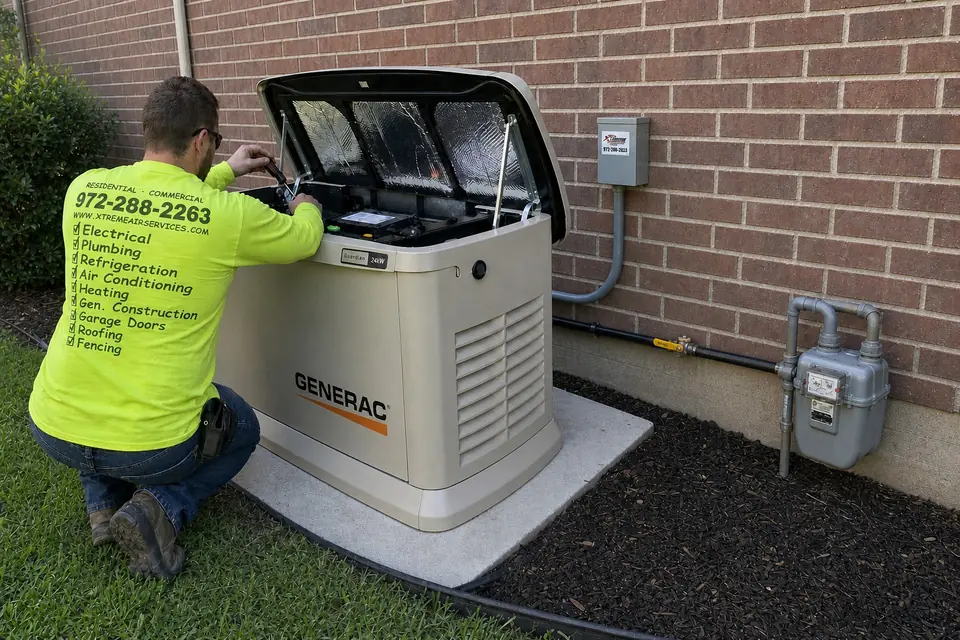
A technician runs a diagnostic visit, checks the transfer switch, tests the battery and charging system, and looks at fuel supply and pressure. We also run a load test where it applies, because a generator can start up fine and still fail to carry your home’s actual electrical load. That test tells us a lot more than just listening to the engine turn over. If everything checks out except one component, we’ll say so plainly and quote the repair. You get that number before we leave your Sunnyvale property.
We charge a $26 to $99 service-call fee for that visit, and it gets credited toward the repair if you move forward with us. So you’re not paying twice just to get an answer. Sunnyvale homeowners get that credit the same as anyone.
Age and history matter here too. A generator that’s had regular maintenance and load testing over the years tends to have fewer surprises waiting under the hood. One that’s been sitting unused, skipped its annual service, or already had a couple of unrelated failures is a different conversation. We stand behind the labor we do, so we’ll tell you plainly if we think a repair today just leads to a different failure next year. We would rather say that in a Sunnyvale driveway than bill you twice.
Fuel type plays into this too. Natural gas units tied into your home’s gas line tend to have simpler failure points than propane setups with their own tank and regulator concerns. Either way, the transfer switch is usually the first thing we look at, since it’s the component doing the actual work of switching your home from utility power to generator power during an outage, and it takes real wear over years of storms and power blips across North Texas. Sunnyvale sees its share of those every storm season.
Watch Our Video
See How We Handle Whole-Home Standby Generator Installation in Sunnyvale
Xtreme Air Services — Serving Sunnyvale and surrounding areas
Need help with Whole-Home Standby Generator Installation?
Call Today, Get Service Today. Xtreme Air Services is ready to help.
When We’d Recommend Replacement
If your standby generator is more than 15 to 20 years old, or if it’s a portable unit you drag out and wire in manually during outages, replacement usually makes more sense than another repair. Older standby units start needing parts that are hard to source, and once a control board or transfer switch on an aging system fails, tracking down the right replacement part can take weeks. A new install with a current transfer switch skips that problem entirely. Parts for older units are the hardest thing to source on a Sunnyvale service call.
We’d also point you toward replacement if your home’s power needs have outgrown what your current generator can handle. A unit sized for a house with a window AC and a few lights isn’t going to carry a home that’s since added a second HVAC system, an EV charger, or a home office that can’t afford to go dark. During a backup power assessment and generator sizing consultation, we look at your actual electrical load, not just the size of the unit already sitting in your yard. If the math doesn’t work, patching the old system just delays the real decision. We run that assessment at your Sunnyvale address before quoting anything.
Frequent nuisance shutdowns or repeated failed load tests are another sign. A generator that won’t start reliably during its scheduled self-test, or that trips off under real load, has usually got more going on than one bad part. At that point we’d rather give you a straight number on installing a new turnkey system than keep billing you for repairs on a unit that’s not going to carry you through the next ice storm. Sunnyvale has had enough hard freezes to make that a fair worry.
On cost, a full whole-home standby install typically runs $8,000 to $18,000, with most jobs landing between $10,000 and $14,000. That covers the generator itself, the automatic transfer switch, the gas hookup, the pad, and startup and testing once it’s in the ground. What moves the number around is the generator’s size in kW, the type of transfer switch, how far the gas line has to run and at what pressure, site prep for the pad, distance from the unit to your electrical panel, and any code upgrades or permits your project needs. It doesn’t include extensive gas or service upgrades, landscaping work, or code corrections outside the original scope, and permits are separate unless we’ve stated otherwise upfront. Sunnyvale permits are filed through Dallas County and quoted separately.
How We Walk You Through the Decision
We don’t hand you a single number and walk off. Whole-home standby generator installation usually lands somewhere between $8,000 to $10,000 on the low end and $14,000 to $18,000 on the higher end, and what lands you in that range depends on your house, not on us picking a number out of the air. Every Sunnyvale quote is built from that walkthrough.
The first thing we look at is generator size, measured in kW. A smaller unit that covers your fridge, a few lights, and your gas furnace costs less than a system sized to run your whole house, AC included, during a summer outage. We size it based on what you want to keep running, not what sounds impressive. A lot of Sunnyvale homes need less generator than the owner assumed.
Next is the transfer switch. This is the part that automatically shifts your home from the grid to the generator when the power drops. Some homes need a simple switch, others need one built for a bigger electrical load. That difference shows up on the price, and we tell you which one your panel calls for before we quote anything. We check that on site at your Sunnyvale panel.
Then there’s the gas line. If your meter and pressure can feed the generator without much extra piping, that keeps costs down. If we need a longer run or a pressure upgrade to get enough fuel to the unit, that adds real cost, and we’d rather tell you that during the visit than after we’ve already started digging. On a big Sunnyvale lot the meter can sit a long way from the pad.
Pad and site prep matters too. Where the generator sits, how far it is from your electrical panel, and whether the ground needs leveling all factor in. A generator installed 15 feet from the panel is a different job than one going in on the far side of the yard. That comes up often on the deeper Sunnyvale lots.
Sometimes a home’s electrical panel needs a code upgrade before a generator can tie in safely. We won’t skip that step to save you money up front, since it’s not a corner we’re willing to cut, and it’s not one your local inspector will let us cut either. Sunnyvale inspectors hold the same line.
Here’s what’s included once we give you a number: the generator itself, the transfer switch, the professional install, gas and electrical connections, and startup and testing so you know it works before we leave. What’s not included: major gas or service upgrades beyond the scope we quoted, landscaping repair, code corrections outside the original plan, and permits unless we’ve stated them upfront. Same terms on every Sunnyvale install.
If your home needs a bigger gas service or a panel upgrade to make this work, we’ll say so plainly, even though it adds cost. We’d rather you know that going in than get a surprise invoice halfway through. Financing is available on qualifying installs if the full number doesn’t fit your budget in one shot. Every install we do is backed by our workmanship guarantee, which means we install equipment we can stand behind. You can see the full breakdown on our Generator Installation Service in Sunnyvale page.
See our full whole-home standby generator installation in Sunnyvale for what the complete job involves.
Frequently Asked Questions
Common questions about Whole-Home Standby Generator Installation in Sunnyvale
How do I know whether to repair or replace my generator?
We look at two things together: the cost of the repair compared to a new install, and what failed. A cheap fix like a battery or sensor almost always points to repair. A failure inside the engine, or a unit that’s undersized for your home, points to replacement. We walk through both factors with you before you spend anything, so the choice is based on your specific unit and not a guess.
What do homeowners get wrong most often when deciding?
Most people assume age alone should decide it, but we don’t make the call that way. A newer generator can have a failure that isn’t worth fixing, and an older one can have a simple, cheap problem. We look at the part that failed, what it costs to source, and whether the rest of the unit still has life in it before we point you toward a direction.
When would you tell me to replace instead of taking my repair money?
We’d tell you to replace it if your generator is undersized for your current home, if the transfer switch needs replacing anyway, or if the repair estimate is getting close to half the cost of a new install. In those situations, a repair often just delays a replacement you’ll end up paying for soon after. We’d rather tell you that upfront than take a repair job that doesn’t hold up.
Does the service call fee count toward anything if I decide to replace?
Yes. The service-call fee runs $26 to $99, and it gets credited toward the job if you move forward with us, whether that’s a repair or a full installation. You’re not paying that fee twice just to get an answer about which direction makes sense for your unit.
Is financing available if I decide to replace instead of repair?
Yes, we offer financing on qualifying installations and larger jobs, subject to approved credit. This is worth asking about upfront if the repair-versus-replace math is landing closer to a full installation than a small fix. We can go over what qualifies as part of your quote.
Ready to Get Started?
Call 972-288-2263 Today, Get Service Today.