

If your smoke detector keeps beeping, it’s almost certainly a maintenance chirp, not a fire alarm. The most likely cause is a low or improperly installed battery. Replace it, run a reset, and the chirping usually stops within minutes. If you hear a continuous pattern of three loud beeps repeating, that’s a fire alarm: get out immediately and call 911. Don’t troubleshoot that one.
Here’s how to act right now:
- Continuous beeping (three-beep pattern, repeating): Evacuate everyone, leave the door open behind you, and call 911 from outside. Do not stop to investigate.
- Single chirp every 30–60 seconds: This is a maintenance signal. Per NFPA’s sound guidance, a single chirp at that interval means low battery. Replace it.
- Chirp after a fresh battery: You may have a residual charge issue, a seating problem, or an end-of-life unit. Full reset steps are below.
- Chirp every 5 seconds on a hardwired unit: This cadence on models like the First Alert SC5 points to an interconnect wire fault, not the battery.
Don’t ignore any chirp. A detector that’s been chirping for days has likely already drained its backup power. The USFA/FEMA and CPSC both document that missing or drained batteries are among the most common reasons alarms fail to sound during an actual fire. Xtreme Air Services technicians see this regularly in Dallas-area homes: the alarm chirped for a week, the homeowner silenced it, and the battery was dead by the time it mattered.
Key Takeaways
A smoke detector that keeps beeping is almost always signaling a low battery, a reset issue, or end-of-life status, but a continuous three-beep pattern always means evacuate first and troubleshoot never.
| Point | Details |
|---|---|
| Chirp vs. alarm | A single chirp every 30–60 seconds means low battery; three repeating beeps mean fire, evacuate immediately. |
| Battery and reset | Replace the battery, then hold the Test button 15–30 seconds with the battery removed to drain residual charge. |
| End-of-life rule | NFPA recommends replacing smoke alarms after 10 years; persistent chirping after a fresh battery often signals this. |
| Wiring faults | Hardwired units chirping every 5 seconds (e.g., First Alert SC5) indicate an interconnect wire fault, not a battery issue. |
| Xtreme Air Services | For hardwired alarm diagnostics and wiring repairs in the Dallas area, Xtreme Air Services provides licensed electrical service and full alarm replacement. |
Table of Contents
- Is that sound a real alarm or just a maintenance chirp?
- Why your smoke detector keeps beeping: causes and fixes
- How to find which detector is chirping
- How to reset your smoke detector and stop the beeping
- When does a smoke detector need replacing?
- When should you call a professional?
- Why ignoring a chirp is a real safety risk
- Common wiring issues specific to different alarm models
- What we see in the field: a perspective on alarm maintenance
- Xtreme Air Services handles hardwired alarm diagnostics in the Dallas area
- Sources
- FAQ
Is that sound a real alarm or just a maintenance chirp?
The distinction is simple once you know the patterns, and getting it right is the difference between evacuating and swapping a battery.
The fire alarm pattern is a continued set of three loud beeps, repeating: beep-beep-beep, beep-beep-beep. NFPA defines this pattern as the signal for smoke or fire. When you hear it, the action is always the same: evacuate, stay out, call 911.
Emergency rule: Three loud repeating beeps = get out now. Never re-enter a building to investigate or silence an alarm that’s sounding continuously.
The maintenance chirp pattern is a single, short beep at a regular interval, typically once every 30–60 seconds. It’s quieter than the alarm and doesn’t repeat in groups of three. This is what most people mean when they say their smoke detector keeps beeping at 3 AM. It’s annoying, but it’s the detector doing its job: telling you something needs attention.
Other patterns you may encounter:
- Chirp every 5 seconds: On hardwired or interconnected models (like the First Alert SC5), this cadence often signals an interconnect wire fault rather than a battery issue.
- Rapid chirping or multiple short beeps: Some models use this to signal a sensor fault, end-of-life status, or a self-test sequence. Check your model’s manual.
- Chirp after you press Test: Normal. The unit is confirming it received the signal.
Quick confirmation checklist before you troubleshoot:
- Is the sound coming in groups of three, repeating? Treat it as a fire alarm.
- Is it one short beep every 30–60 seconds? Start with the battery.
- Is it a hardwired unit chirping every 5 seconds? Check the interconnect wiring.
- Can you smell smoke or see haze? Evacuate regardless of the pattern.
Why your smoke detector keeps beeping: causes and fixes
Most chirping problems fall into six categories. Work through them in order.
Low or dead battery
The NFPA sound guide defines a single chirp every 30 or 60 seconds as the low-battery warning. Kidde notes this chirp can continue for at least seven days on some models before the battery fully dies.
Replace the battery with a fresh one of the correct type (most detectors use a 9V or AA battery; check the back of the unit or the manual). After replacement, press the Test button to confirm the alarm sounds correctly.
Battery not seated properly
A smoke alarm beeping after a battery change is often a seating issue, not a bad battery. First Alert’s support documentation lists three common installation mistakes: battery drawer not fully closed, battery installed in the wrong orientation, and the unit not properly locked onto its mounting bracket. Check all three before assuming the battery is defective.
Residual charge after battery swap
Even with a new battery in place, some units hold a small electrical charge that keeps the chirp going. First Alert recommends removing the unit from the bracket, taking out the battery, and holding the Test button for 15–30 seconds to drain that charge. Reinstall the battery, remount the unit, and test. This clears the chirp in most cases.
End-of-life signal
If the chirp continues after a fresh battery and a proper reset, the unit may be signaling that it has reached the end of its service life. NFPA’s guidance ties persistent chirping after a new battery to end-of-life status and recommends replacing smoke alarms after 10 years. Check the manufacture date on the back of the unit. If it’s more than 10 years old, replace it regardless of how it looks.
Environmental triggers
Kidde’s troubleshooting documentation lists humidity, steam, dust, and insects as common causes of intermittent chirping and false alarms. A detector near a bathroom, kitchen, or HVAC vent is especially prone to this. Steam from a shower can trigger a brief alarm or chirp; dust buildup in the sensing chamber can cause persistent false signals.
To clean the sensing chamber: remove the unit from its bracket, use a soft brush attachment on a vacuum to clear the vents, and blow out any remaining dust with a can of compressed air. Don’t spray cleaners or water inside the unit.
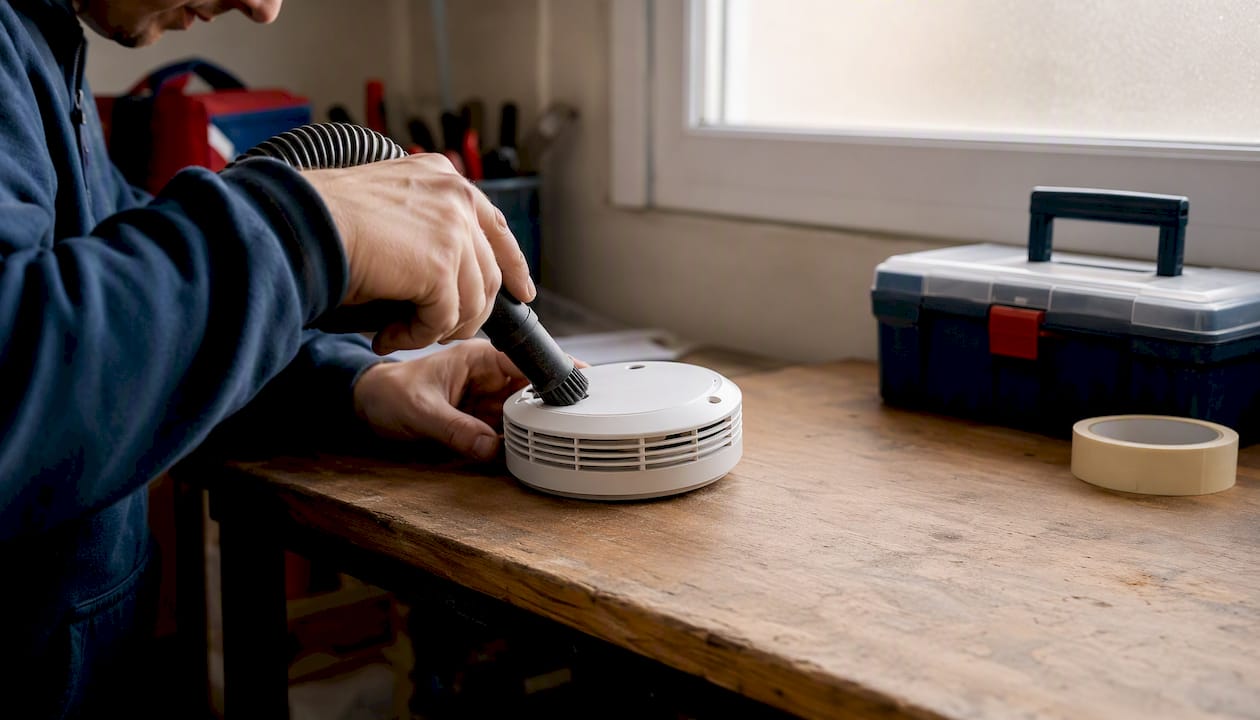
High humidity and poor airflow can also cause nuisance chirps. If your home has persistent indoor air quality issues, improving ventilation often reduces false alarm frequency.
Hardwired and interconnected alarm issues
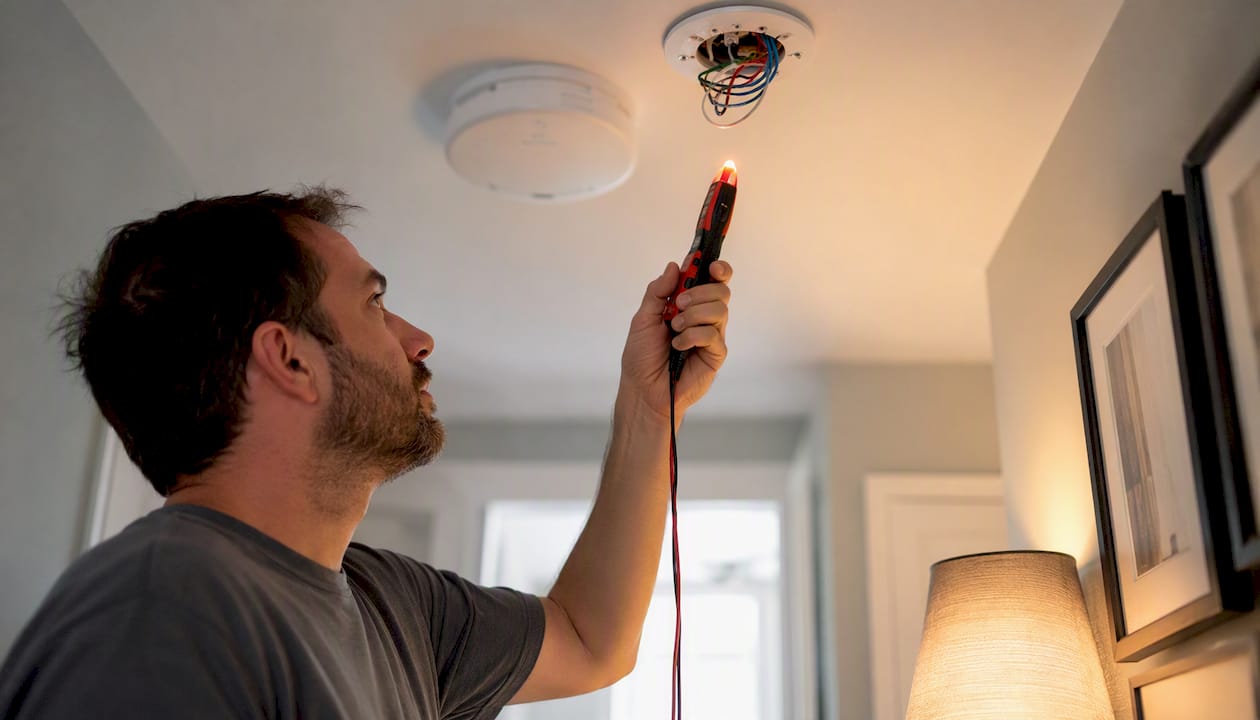
A hardwired smoke alarm chirping after a power outage or circuit interruption is usually reporting a loss of AC power. The unit runs on backup battery during the outage, and once power is restored, it may chirp briefly while it resets. If the chirp continues after power is restored, check the circuit breaker for the alarm circuit.
Interconnected systems add another layer: a fault in one unit can trigger chirping across the entire network. On the First Alert SC5, a chirp every 5 seconds specifically points to an orange interconnect wire fault. Swapping batteries on every unit won’t fix a wiring problem.
Before touching any hardwired unit: turn off the circuit breaker for that alarm circuit. Never work on a hardwired alarm with the power on.
Pro Tip: If you have a hardwired system and the chirp moves from unit to unit or affects multiple detectors simultaneously, the problem is almost certainly in the wiring or the interconnect signal, not the batteries. Call a licensed electrician rather than replacing units one by one.
How to find which detector is chirping
In a home with multiple alarms, pinpointing the chirping unit takes a few minutes but saves a lot of frustration.
- Quiet the house. Turn off the TV, music, and any loud appliances. Chirps are short and easy to miss in background noise.
- Time the interval. Most low-battery chirps occur every 30–60 seconds. Use your phone’s stopwatch to time the gap between chirps.
- Move room to room. Stand still in each room and wait for the next chirp. The sound gets noticeably louder as you approach the source unit.
- Silence known units temporarily. If you can’t isolate the source by listening, press the Test/Hush button on each unit one at a time. When the chirping stops after you press a specific unit’s button, that’s your unit.
- For hardwired systems: turn off individual breakers to isolate circuits. When the chirp stops after you cut a specific breaker, the unit on that circuit is the source. Restore power once you’ve identified it.
- If you still can’t locate it: check carbon monoxide detectors and combination smoke/CO units. A CO detector with a low battery uses the same chirp cadence as a smoke alarm. A low-level CO monitor that’s chirping is worth taking seriously.
One important note: if at any point during your search you hear a continuous three-beep pattern or smell smoke, stop searching and evacuate. Locating a chirping unit is a non-emergency task. Responding to a fire alarm is not.
How to reset your smoke detector and stop the beeping
A proper reset clears residual charge and forces the unit to re-initialize. This is the step most people skip, and it’s often what stops a smoke alarm from beeping after a battery change.
Generic reset procedure (battery-powered units)
- Twist or slide the unit off its mounting bracket.
- Remove the battery.
- Press and hold the Test button for 15–30 seconds. You may hear a brief chirp or alarm tone as the charge drains. That’s normal.
- Reinstall the battery, making sure the orientation matches the diagram inside the compartment.
- Close the battery drawer completely until it clicks.
- Remount the unit on the bracket.
- Press Test. The alarm should sound for 1–3 seconds and then go silent.
Hardwired unit reset
- Turn off the circuit breaker for the alarm circuit.
- Remove the unit from the bracket and disconnect the wiring harness.
- Remove the backup battery.
- Hold the Test button for 15–30 seconds.
- Reconnect the wiring harness and reinstall the battery.
- Remount the unit and restore power at the breaker.
- Press Test to confirm operation.
First Alert specifics
For First Alert units that chirp after a battery replacement, the manufacturer’s recommended sequence is exactly the generic reset above: remove unit, remove battery, hold Test for 15–30 seconds, reinstall battery, test. This drains the residual charge that causes post-swap chirping.
Kidde specifics
Kidde’s troubleshooting guidance adds a cleaning step to the reset process. If the unit has been in place for more than a year, vacuum the sensing chamber vents before reinstalling. Dust buildup can cause the unit to chirp again within days of a reset if it isn’t cleared.
Pro Tip: After a reset, if the unit chirps again within 24 hours, swap it with a known-good unit from another room. If the chirping follows the unit, the unit is faulty. If it stays in the original location, the problem is environmental or wiring-related.
When does a smoke detector need replacing?
A reset and fresh battery fix most chirping problems. When they don’t, replacement is usually the right call.
The 10-year rule
NFPA recommends replacing smoke alarms after 10 years from the manufacture date. The sensing elements degrade over time, and a unit that’s past its service life may chirp persistently even with a brand-new battery. That chirp is the unit telling you it can no longer guarantee reliable detection.
How to find the manufacture date
Flip the unit over. The manufacture date is printed or stamped on the back, usually near the model number. It may appear as a full date (“MFG: 03/2014”) or as a date code. If the label is worn or missing, the unit is old enough to replace.
Sealed-lithium units
Some newer alarms, including certain Kidde and First Alert models, use a sealed 10-year lithium battery. These units are designed to last the full service life of the alarm without a battery swap. When they chirp persistently, it typically means the unit has reached end-of-life and the entire alarm needs replacement, not just the battery. CPSC guidance covers sealed-lithium models and their disposal requirements.
Choosing a replacement
- Sensor type: Ionization sensors respond faster to fast-flaming fires; photoelectric sensors respond faster to slow, smoldering fires. Combination units cover both.
- Interconnected vs. standalone: Interconnected alarms (wired or wireless) sound throughout the house when one triggers. NFPA 72 recommends interconnection for new construction; it’s worth considering for retrofits too.
- Smart alarms: Models with Wi-Fi or Z-Wave connectivity send alerts to your phone and can identify which unit triggered. Useful in larger homes.
- Price range: Basic battery-powered units typically run $10–$30. Combination smoke/CO units run $25–$60. Smart interconnected units range from $50–$100 or more per unit.
Disposal
Don’t throw old alarms in the trash if they contain radioactive ionization sensors (most do). Check the manufacturer’s website for a mail-back program. Kidde and First Alert both offer disposal options. CPSC guidance also addresses proper disposal.
When should you call a professional?
Some chirping problems are genuinely beyond safe DIY. Here’s a clear decision flow.
- Replace the battery. If the chirp stops, you’re done.
- Run the full reset. If the chirp stops, you’re done.
- Check the manufacture date. If the unit is 10+ years old, replace it.
- If the chirp continues after a new battery, a full reset, and a unit that’s under 10 years old: call a licensed electrician.
Signs you need a professional now
- Chirp persists after a fresh battery and a complete reset on a unit under 10 years old.
- Multiple hardwired units chirping simultaneously or in sequence.
- Chirp cadence matches a wiring-fault pattern (e.g., every 5 seconds on a First Alert SC5).
- You can see or smell burning near the alarm or its wiring.
- The alarm circuit breaker trips repeatedly.
- You’re not comfortable working near electrical wiring.
Hardwired alarm systems involve line voltage and interconnect wiring. A loose neutral wire or a damaged interconnect can cause persistent chirping across an entire system and is a fire risk in itself. A licensed electrician can diagnose the wiring, repair or replace the harness, and confirm the system meets current NFPA 72 standards.
For a typical service call, a professional can diagnose a hardwired alarm issue in under an hour. Wiring repairs vary depending on accessibility and the extent of the fault. Full alarm replacement on a hardwired system, including new units and wiring inspection, generally takes a few hours for a standard home.
Why ignoring a chirp is a real safety risk
The chirp sounds minor. It isn’t.
USFA/FEMA’s home fire prevention guidance stresses that working smoke alarms provide the critical early warning that gives occupants time to escape. An alarm that’s been chirping for days has a battery that’s nearly dead or a unit that’s failing. Either way, it may not sound when it needs to.
CPSC documentation identifies missing, drained, or disconnected batteries as among the most common reasons smoke alarms fail to operate during a fire. The chirp is the alarm’s last-resort warning before it goes silent permanently.
NFPA’s sound definitions are worth keeping posted somewhere in the house:
- Single chirp every 30–60 seconds: Low battery. Replace it.
- Continued three-beep pattern: Smoke or fire. Evacuate and call 911.
- Chirp after battery replacement: Residual charge or end-of-life. Reset or replace.
The NFPA Learn the Sounds guide is a one-page reference worth printing and keeping near your electrical panel.
Maintenance matters beyond the battery. Test every alarm monthly by pressing the Test button. Replace batteries annually if your units use replaceable batteries. Vacuum the sensing chambers once a year. And replace any unit that’s reached its 10-year mark, regardless of whether it’s currently chirping.
Common wiring issues specific to different alarm models
Hardwired alarms share a basic wiring structure: a black hot wire, a white neutral wire, and a yellow or orange interconnect wire. But how each manufacturer implements that structure varies, and the failure modes differ accordingly.
First Alert models use an orange interconnect wire. When that wire loses continuity or makes a poor connection, the unit reports a fault through a specific chirp cadence. On the SC5 Smart Smoke and CO Alarm, a chirp every 5 seconds signals an interconnect wire fault. The fix is inspecting the interconnect connection at the wiring harness, not replacing the battery. If the orange wire is loose, corroded, or improperly terminated, the entire interconnected network can report trouble simultaneously.
Kidde models use a similar three-wire configuration but vary the interconnect wire color by product line. Kidde’s documentation notes that electrical conditions, including power interruptions and wiring faults, are a recognized cause of chirping. A unit that chirps only after power outages typically has a loose neutral connection that causes the unit to drop off AC power intermittently.
Combination smoke/CO units add complexity because they have two sensing elements and may use different chirp patterns to distinguish between a smoke fault, a CO fault, and a battery issue. Misreading a CO warning as a nuisance chirp is a serious mistake. If you have a combination unit and can’t identify the chirp pattern from the manual, treat it as a CO warning until confirmed otherwise.
A few wiring issues that come up repeatedly in hardwired systems:
- Loose wire nuts at the junction box: vibration over time can loosen connections, causing intermittent power loss and chirping.
- Incorrect interconnect termination: connecting the interconnect wire to the neutral instead of the dedicated interconnect terminal causes false alarms across the network.
- Mixed-brand interconnect: First Alert and Kidde interconnect systems are generally not cross-compatible. Mixing brands in an interconnected network can cause persistent false signals.
- Aging wiring insulation: in homes built before the 1980s, wiring insulation can crack or become brittle, causing intermittent shorts that trigger chirping.
Any of these issues warrants a call to a licensed electrician in Dallas rather than a DIY fix.
What we see in the field: a perspective on alarm maintenance
The most common scenario Xtreme Air Services technicians encounter isn’t a broken alarm. It’s a neglected one. A homeowner silenced a chirping detector months ago by pulling the battery, forgot about it, and now has a dead unit mounted on the ceiling that looks fine from the floor. The second most common scenario is a hardwired system where one unit has been replaced with a different brand, breaking the interconnect chain.
Here’s what the field experience consistently shows: most nuisance chirps are preventable with one annual check. Test every unit, vacuum the sensing chambers, verify the manufacture dates, and replace any unit over 10 years old. That 20-minute walk-through eliminates the majority of 3 AM chirps. Pair it with a broader home maintenance schedule that includes HVAC and electrical checks, and you’re catching problems before they become emergencies.
The homeowners who call us with the hardest problems are usually the ones who assumed a chirp was just a nuisance. Sometimes it is. But a chirp that persists after a battery swap and a reset is the unit telling you something is wrong with the hardware or the wiring. At that point, the cost of ignoring it is much higher than the cost of a service call.
One thing worth saying plainly: dust and poor indoor air quality cause more nuisance alarms than most people realize. Homes with older HVAC systems or inadequate filtration push particulates through the air that settle in sensing chambers and trigger false signals. Addressing the air quality at the source reduces false alarm frequency and extends the useful life of your detectors.
Xtreme Air Services handles hardwired alarm diagnostics in the Dallas area
When a battery swap and reset don’t stop the chirping, the problem is usually in the wiring or the unit itself, and that’s where Xtreme Air Services comes in. The team handles hardwired smoke alarm diagnostics, interconnect wiring repairs, full alarm replacements, and electrical safety inspections for homes and businesses across the Dallas, TX area.

A typical service visit starts with identifying the chirp pattern and the unit involved, then inspecting the wiring harness, interconnect connections, and circuit. From there, the technician provides a clear diagnosis and repair or replacement options before any work begins. No guesswork, no replacing parts that don’t need replacing.
If your alarm system is more than 10 years old or you’ve never had the wiring inspected, a residential maintenance plan that includes electrical safety checks is the most cost-effective way to stay ahead of failures. Call or book online to schedule a diagnostic visit.
Sources
These are the primary references used throughout this article. Each covers a specific aspect of smoke alarm troubleshooting and safety.
- NFPA — Learn the Sounds (Fire Prevention Week 2024)
- First Alert — What do the Chirps Mean?
- Kidde — What Is Causing My Smoke Alarm to Sound, Beep, or Chirp?
- CPSC — Smoke Alarms: Why, Where and Which (Pub. 559, revised July 2016)
- USFA / FEMA — Smoke alarms (Home fire prevention)
FAQ
How do I get my smoke detector to stop beeping?
Replace the battery first, then remove the unit, hold the Test button for 15–30 seconds to drain residual charge, reinstall the battery, and test. If the chirp continues after that, check the manufacture date: a unit over 10 years old needs replacement, not another reset.
Why is my hardwired smoke alarm beeping every 30 seconds?
A single chirp every 30 seconds on a hardwired unit usually means the backup battery is low. Replace the backup battery, run the reset procedure, and restore power. If the chirp continues after that, the unit may have a wiring fault or be at end-of-life.
Why does my smoke detector keep beeping even after I changed the battery?
The most common reason is residual electrical charge in the unit. Per First Alert’s guidance, removing the unit, removing the battery, and holding the Test button for 15–30 seconds clears that charge. A chirp that persists after a proper reset on a unit under 10 years old points to a wiring issue or a faulty unit.
Why is my smoke detector beeping at 3 AM?
Batteries lose voltage as temperatures drop overnight, which can push a marginal battery below the threshold that triggers the low-battery chirp. The fix is the same: replace the battery. If it happens again after a fresh battery, run the full reset and check the manufacture date.