Most flickering lights trace back to something minor: a loose bulb, an old dimmer that doesn’t play well with LEDs, or a brief voltage dip when a big appliance kicks on. Those cases are annoying, not dangerous. But if the flicker hits your whole house randomly, or you notice a burning smell, warm outlets, or buzzing at the panel, stop using that circuit and call a licensed electrician immediately. The rest of this guide walks through both the harmless causes and the ones that need urgent attention.
TL;DR:
- Whole-house flickering or symptoms like burning smells and buzzing indicate urgent electrical issues that require immediate professional inspection.
- Loose neutral connections at the panel or service faults are common causes of widespread flickering and can pose fire risks if not addressed promptly.
- Flickering caused by appliance startups, such as air conditioners, is normal and results from voltage dips of 2 to 4 percent that last only a few cycles.
- LED and fluorescent lights Flicker differently from incandescents because of their electronic drivers or ballasts, with cheaper drivers causing more noticeable flicker.
- DIY fixes are limited to bulb and fixture replacements, while internal wiring or panel work must be handled by licensed electricians to ensure safety.
Table of Contents
- What Causes Flickering Lights? The Full Breakdown
- How Do You Diagnose What’s Causing the Flicker?
- When Is Flickering an Electrical Emergency?
- Why LEDs, Fluorescents, and Incandescents Flicker Differently
- Safe DIY Fixes vs. When to Call a Pro
- Preventing Flicker Before It Starts
- Can Flickering Lights Affect Your Health or Comfort?
- How Do Voltage Sags and Surges Affect Your Lighting?
- Can Storms or Temperature Swings Cause Flickering Lights?
- Xtreme’s Field Perspective: What We Actually Find On-Site
- Call Xtreme When Flicker Won’t Quit
- Sources
- FAQ
What Causes Flickering Lights? The Full Breakdown
Flickering lights almost always fall into one of four categories: the bulb itself, the switch or dimmer, the circuit, or the electrical service coming into your house. Figuring out which one you’re dealing with starts with noticing the pattern.
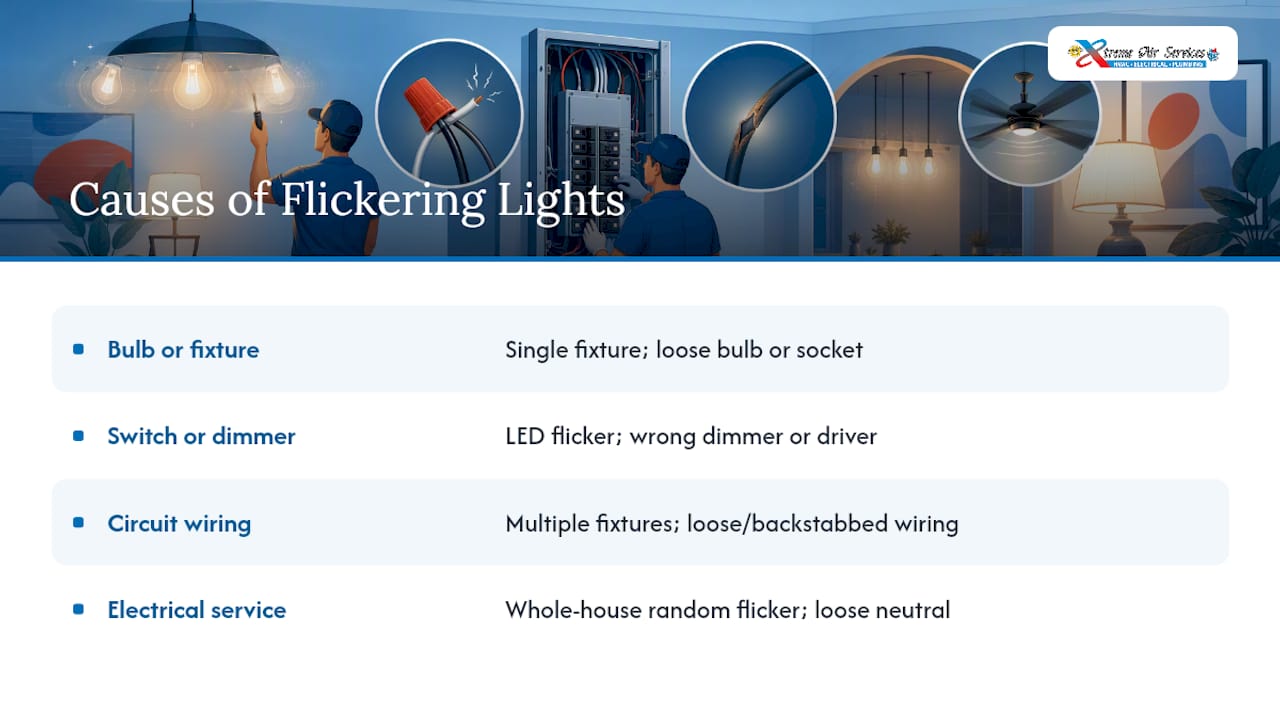
Single-bulb or single-fixture problems are the easiest to fix and the most common. A bulb that’s screwed in slightly loose loses contact with the socket’s electrical tab, and that intermittent connection shows up as flicker. Corroded sockets cause the same symptom, especially in bathrooms, kitchens, or outdoor fixtures where moisture gets in over the years. Sometimes the fixture itself is just failing, not the bulb.
Switch and dimmer issues show up almost exclusively with LED bulbs. Older dimmers were built for incandescent bulbs, which draw current differently than LEDs. Put a non-dimmable LED on a dimmer switch, or pair an LED with a dimmer that isn’t rated for low-wattage electronic loads, and you’ll get anything from a subtle flicker to a visible strobe. The Department of Energy notes that LEDs depend on drivers rather than a heated filament, so a cheap or mismatched driver can produce pronounced flicker that never showed up with the old incandescent bulb in the same socket.
Circuit-level causes point to the wiring itself. Loose connections at a junction box, backstabbed wiring (the push-in connections some electricians use instead of screw terminals), or an overloaded circuit running too many devices can all cause flicker that affects more than one fixture on that same circuit. Older homes are especially prone to backstabbed connections loosening over time.
Service-level issues are the ones that should get your attention fastest. A loose neutral connection at the panel or a failing utility drop can cause flicker across your entire house, often randomly and without any obvious trigger. This is different from a normal appliance-related dip.
Voltage dips from appliance startup are usually harmless. Large motors, like your AC compressor or a well pump, draw a surge of current the instant they switch on. The EPRI technical documentation on flicker shows this can cause a 2 to 4% drop in RMS voltage for a few cycles, which is more than enough for sensitive lighting to visibly dim for a split second. That’s why lights flicker when AC turns on or lights dim when AC turns on in so many homes; it’s a normal side effect of how compressor motors start, not a fault by itself.
Driver and ballast failures matter too. LEDs fail differently than fluorescents, which flicker distinctly depending on whether they use an older magnetic ballast or a newer electronic one.
How Do You Diagnose What’s Causing the Flicker?
Work through these steps in order. Each one rules out a cause before you move to something more involved, and it builds a case history that makes any eventual electrician visit faster and cheaper.
- Tighten and swap the bulb. Turn off the fixture, tighten the bulb firmly, and turn it back on. If it still flickers, swap in a known-good bulb of the exact same type. This single test resolves a surprising share of complaints, since a loose bulb is the most common and fastest cause to isolate.
- Isolate the circuit. Flip the breaker for that circuit off and back on, then watch whether the flicker returns immediately or only under load. Unplug major appliances on that circuit one at a time to see if a specific device triggers it.
- Test the dimmer. If a dimmer switch is involved, bypass it temporarily with a standard on/off switch, or test the same bulb in a non-dimmed fixture. If the flicker disappears, you’ve found an incompatible dimmer, not a wiring fault.
- Check for heat and noise. Feel switch plates and outlet covers near the affected circuit. Warmth, discoloration, or a buzzing sound at a switch, outlet, or the panel itself is not normal and means you should stop testing and call a professional.
- Log the pattern before you call anyone. Note the time of day, which specific appliance was running, how long the flicker lasted, and whether it hit one room or the whole house.
Pro Tip: Keep a simple note on your phone: date, time, what was running (AC, dryer, well pump), which lights flickered, and for how many seconds. That fifteen-second habit can cut an electrician’s diagnostic time in half, because a loose neutral looks completely different on paper than a one-time appliance dip.
If your flicker consistently tracks one appliance, run that appliance again while watching the lights. It’s the fastest way to confirm a load-related voltage dip rather than a wiring problem.
When Is Flickering an Electrical Emergency?
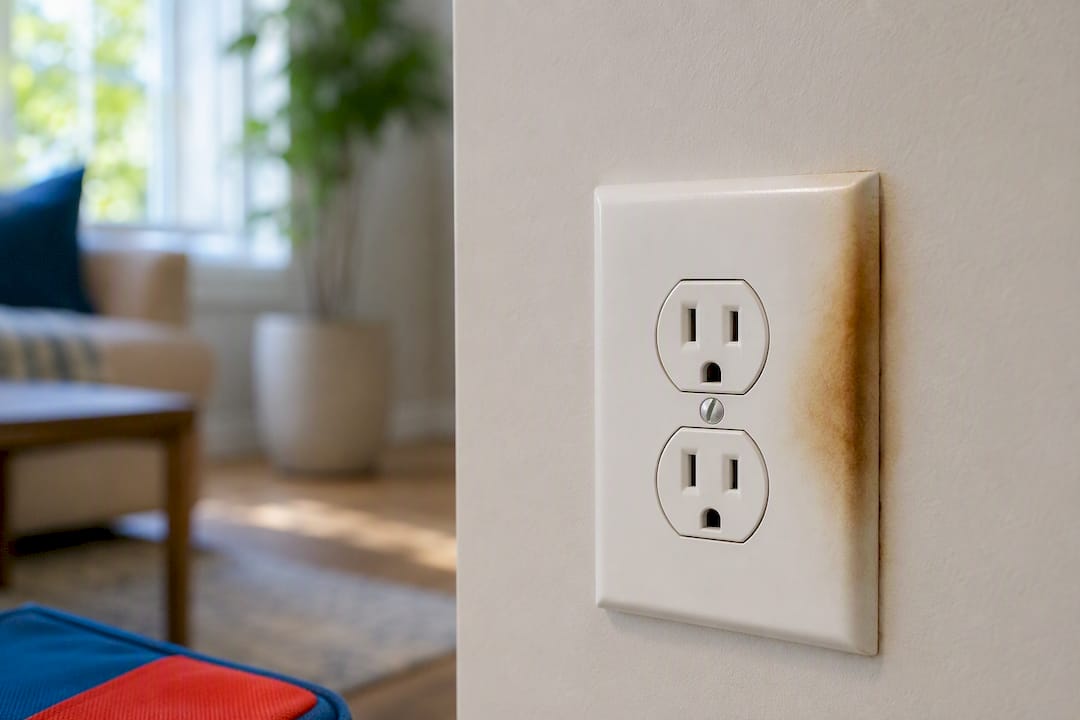
Some flicker patterns are a warning sign, not an inconvenience. Watch for these red flags: a burning or hot-plastic smell near any switch or outlet, a warm or discolored outlet cover, visible sparking, or a humming or buzzing sound coming from your electrical panel. Any one of these means stop using that circuit now.
A loose neutral connection deserves special attention. In a multi-wire branch circuit, a loose neutral can cause voltage to become unbalanced between circuits, so some lights run dim while others run unusually bright, sometimes bright enough to burn out bulbs early. That imbalance is a sign of a genuine connection failure at the panel or service point, not a bulb or dimmer issue, and it’s not something to troubleshoot yourself.
Electrical failures are a well-documented cause of home structure fires, and federal fire safety guidance is direct about it: treat burning smells, visible smoke, or arcing as emergencies that require immediate action, including shutting off power at the breaker if it’s safe to reach and calling an electrician or your utility right away. If the panel itself is smoking or making unusual noise, don’t touch it. Get everyone clear and call for help.
Why LEDs, Fluorescents, and Incandescents Flicker Differently
Incandescent bulbs almost never show fast flicker because the filament stays hot between electrical cycles, so brief voltage dips barely register visually. That thermal buffer is gone with modern lighting, which is part of why flicker complaints have grown alongside LED adoption.
LEDs run on electronic drivers instead of a heated filament, and a driver responds to voltage changes in real time. Pair a cheap driver with an incompatible dimmer and you get a visible, sometimes rapid flicker that an incandescent bulb would have smoothed right over. Fluorescent lamps split into two camps: older fixtures with magnetic ballasts flicker at the power line frequency, while newer electronic ballasts run at a much higher frequency that’s usually invisible to the eye.
None of this requires a large voltage swing to show up. EPRI’s research on flicker sensitivity finds that in certain conditions, an RMS voltage change of just a quarter of one percent can be visible in sensitive lighting. That’s why a fluctuation too small to affect your appliances can still make a light bulb across the room visibly dip.
Safe DIY Fixes vs. When to Call a Pro
You can safely handle bulb swaps, dimmer replacements, and basic fixture cleaning yourself. Anything involving the panel, the meter, or removing wiring at a junction box belongs to a licensed electrician.
Safe to try yourself:
- Tighten a loose bulb or replace it with the same wattage and type.
- Swap an incompatible dimmer for one rated for LED loads (check the bulb packaging for compatible dimmer models).
- Test the bulb in a different socket to rule out a bad fixture.
- Wipe down and inspect a socket for visible corrosion before replacing the fixture.
Leave to a licensed electrician:
- Any work inside the panel, including tightening breaker connections or the neutral bus.
- Anything involving the meter base or utility-side connections.
- Replacing backstabbed wiring connections behind switches or outlets, since this often means opening walls or boxes you’re not equipped to safely close back up.
- Diagnosing whole-house or randomly-timed flicker, which usually points to service-level problems.
A simple switch or outlet swap is routine. But if that swap doesn’t fix the flicker, or if you find scorched wiring, melted insulation, or loose strands behind the cover plate, that’s a sign of a deeper problem, not a bad part. Before calling for service, gather your notes on timing and affected circuits, snap a photo of any discoloration, and know which breaker feeds the affected area. That prep alone often shortens a service call by half.
Preventing Flicker Before It Starts
A few upgrades cut down on flicker long term instead of just treating symptoms as they show up. Choose dimmable LED bulbs with documented low-flicker driver specs, and match them to a dimmer the manufacturer lists as compatible rather than whatever was already installed. Homes running an EV charger, a large workshop tool, or a well pump benefit from a dedicated circuit for that load, since it keeps startup current from tugging on the same circuit as your lighting. Old backstabbed connections are worth replacing proactively in homes over 20 years old, and a panel evaluation is worth scheduling if your service feels marginal for your current appliance load. A yearly visual check of outlets and switch plates for warmth or discoloration catches most problems before they become hazards.
Can Flickering Lights Affect Your Health or Comfort?
Flicker isn’t just visually annoying; it can have a real physical effect, even when you can’t consciously see it. A 2024 study on temporal light modulation in modern light sources found that flicker performance varies widely between LED models, and that even flicker occurring at frequencies too fast to perceive can trigger headaches or other symptoms in people who are sensitive to it. That matters because two LED bulbs that look identical on the shelf can behave completely differently once they’re powered.
People report eye strain, headaches, and a general sense of unease in spaces with flickering light, even at low levels most people wouldn’t consciously notice. Photosensitive individuals, including some people with migraines or certain neurological conditions, can react more strongly to flicker in the visible range, which is one reason low-flicker driver specifications have become a bigger deal in lighting design over the past several years.
If a specific room in your house consistently gives you a headache or makes you feel like something’s “off” with the lighting, it’s worth checking whether the bulbs there are lower quality or paired with an incompatible dimmer. Swapping to a bulb with better driver specs sometimes resolves a health complaint that looked, on the surface, like nothing more than a lighting preference.
How Do Voltage Sags and Surges Affect Your Lighting?
A voltage sag is a brief drop in supply voltage, usually caused by a large load starting up somewhere on your circuit or even on your utility’s grid. A surge is the opposite: a brief spike above normal voltage. Both show up as flicker, but they come from different sources and carry different risks.
Sags are the more common culprit inside a home, and they’re usually harmless in isolation. Your AC compressor, a garage door opener, or a neighbor’s large appliance drawing on a shared transformer can all cause a momentary dip that dims your lights for less than a second. It becomes a bigger concern when sags happen frequently or last longer than a fraction of a second, since that pattern often means your service is close to its capacity limit or a connection somewhere is loose enough to add resistance under load.
Surges are less common but more damaging over time, since repeated small surges degrade sensitive electronics, including LED drivers, faster than a stable supply would. A whole-house surge protector installed at the panel is the most reliable way to guard against this, especially in areas prone to storms or grid instability.
If your utility has had recent outages or brownouts in your area, and your flicker started around the same time, the cause may sit outside your home entirely. That’s worth mentioning to an electrician, since it changes whether the fix is inside your panel or a call to your utility provider.
Can Storms or Temperature Swings Cause Flickering Lights?
Weather is one of the more overlooked triggers for flicker, and it hits in two different ways: storms and temperature extremes.
During storms, wind and lightning can loosen utility connections, cause tree branches to brush against power lines, or trigger brief voltage sags across the grid as utilities respond to fluctuating demand. This often produces the kind of random, whole-house flicker that has nothing to do with your home’s internal wiring at all. If your lights flicker mainly during or right after storms, the fix may sit at the utility drop or transformer, not inside your panel.
Temperature swings cause a slower, less dramatic effect. Extreme heat pushes AC systems to run longer and cycle more often, which means more frequent compressor startups and more frequent brief voltage dips throughout the day. Extreme cold does something similar with heating systems and well pumps. Neither of these are faults by themselves, but they do make existing weak points, like a marginal connection or an aging panel, more likely to show symptoms during peak season.
If flicker gets noticeably worse in July and August or during a hard freeze, that’s a clue your electrical system is running closer to its limit than you’d like, even if nothing is technically broken yet.
Xtreme’s Field Perspective: What We Actually Find On-Site
When our electricians get called for flicker complaints, loose connections and service-side issues turn up more often than homeowners expect. A visit typically includes thermal imaging to spot connections running hot under load, torque checks on panel terminals, and startup testing on major appliances to confirm whether a dip is normal or a symptom of something failing. Most calls start with the electrical troubleshooting steps we walk homeowners through before ever reaching for a tool.
— Xtreme
Call Xtreme When Flicker Won’t Quit
A bulb swap or a new dimmer takes care of most flicker complaints. What Xtreme Air Services handles is everything past that point, the loose connections, overloaded circuits, and panel issues that a DIY fix can’t reach and shouldn’t attempt.

A service call gets you a full inspection of the affected circuits, a clear diagnosis of what’s actually causing the flicker, safety fixes for anything hazardous, and a written estimate before any repair work starts. If you’ve already tightened the bulb and tested the dimmer and the flicker is still there, or if you noticed any warmth, buzzing, or discoloration during your own checks, that’s the line where DIY should stop. Our residential electrician team in the Dallas area handles everything from a single flickering fixture to full panel and wiring upgrades when a home’s service is due for one. Schedule a diagnostic visit and get a straight answer on what’s actually happening behind your walls.
Sources
For deeper technical detail: EPRI’s flicker chapter covers voltage sensitivity, the DOE’s flicker basics page explains LED-specific causes, a 2024 peer-reviewed study covers health effects, USFA fire safety guidance covers electrical fire risk, and Better Homes & Gardens offers a practical homeowner rundown.
- Flicker basics | Department of Energy
- Research on the Flicker Effect in Modern Light Sources Powered by an Electrical Network
- Why is My Light Flickering? Causes and Solutions — Better Homes & Gardens
- USFA: Appliance and electrical fire prevention
FAQ
Do Flickering Lights Indicate an Electrical Problem?
Sometimes. A single flickering bulb is usually a loose connection or dimmer mismatch, but whole-house or randomly timed flicker often points to a real wiring or service-side problem that needs an electrician.
How Do I Stop My Lights From Flickering?
Start by tightening or swapping the bulb, then test whether a dimmer is compatible with your bulb type. If neither fixes it, the cause is likely in the circuit or service, which calls for a licensed electrician.
Can Flickering Lights Be a Fire Hazard?
Yes, in certain cases. Flicker paired with a burning smell, warm outlets, buzzing, or visible sparking is a sign of an electrical fault that can lead to a home fire, and that circuit should be shut off and inspected immediately.
What Does It Mean When Lights Flicker Everywhere You Go?
Flicker across multiple rooms or the whole house usually points to a service-level issue, such as a loose neutral connection or a utility-side fault, rather than a single bad bulb or fixture.
Why Do My Lights Flicker When My AC Turns On?
This is typically a normal, brief voltage dip caused by the AC compressor’s motor drawing a surge of current at startup, which the EPRI research on flicker shows can briefly lower voltage by a few percent.