


What to Expect With Electrical Troubleshooting: The Problems We’re Called About Most
Breaker trips, dead outlets that trace back to a GFCI, flickering lights, and the intermittent faults that never show up while we are standing there.
What’s Covered on This Page
- Repeated Breaker Trips Usually Point to One of a Few Causes
- A Dead Outlet or Switch Often Traces Back to a Nearby GFCI
- Flickering or Dimming Lights Can Start Local or Come From the Circuit
- Intermittent Faults Don’t Always Show Up During the Visit
- Homes With Older Aluminum Wiring Can Show These Issues More Often
- Related Links
Repeated Breaker Trips Usually Point to One of a Few Causes
When a breaker keeps tripping, most homeowners assume the breaker itself is bad. Sometimes that’s true. More often, the breaker is doing its job. It’s shutting off power because something downstream is pulling too much current or leaking current where it shouldn’t.
Overload is the most common problem we see in older Dallas County homes. A window unit, a space heater, and a hair dryer on the same circuit can push past what a 15 or 20 amp breaker is rated for. The fix isn’t always a bigger breaker. Sometimes it’s a dedicated circuit for the appliance pulling the most load (this is the part people overthink).
A short circuit happens when a hot wire touches a neutral or ground wire. It usually trips the breaker immediately. And hard, not after a few hours of use. This shows up more in homes built before the 1990s. Wiring insulation has had decades to age in a hot Texas attic.
A ground fault is different. Current is escaping to a path it shouldn’t. This often happens through a wet location, a damaged cord, or a failing appliance. If the tripping happens near a bathroom, kitchen, or garage outlet, we often test for this first.
- Breaker trips only when a specific appliance runs: this usually points to overload or a failing appliance, not the panel.
- Breaker trips immediately on reset with nothing plugged in: this usually points to a wiring short.
- Breaker trips near water sources or outdoors: this usually points to a ground fault.
- Breaker won’t reset at all: the breaker itself may have failed from age or heat.
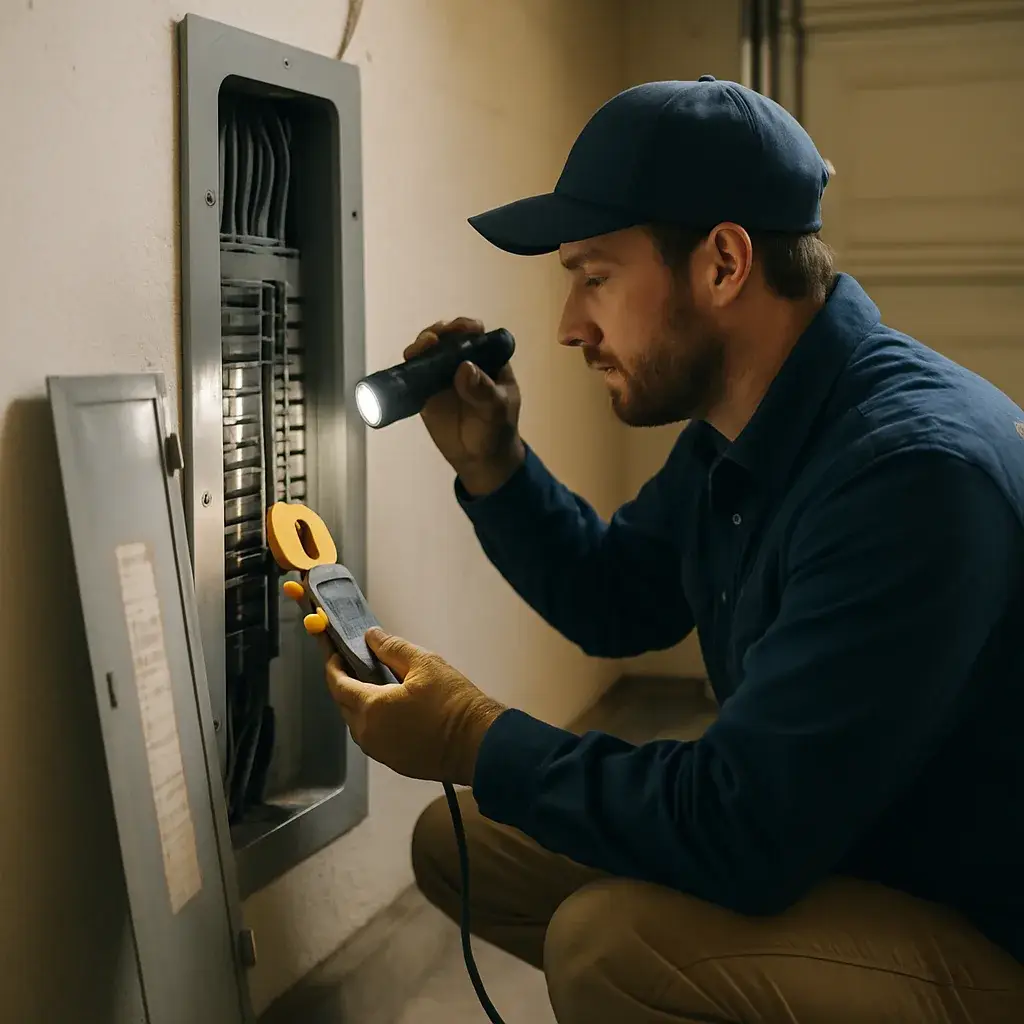
We trace it circuit by circuit with test equipment. We don’t just swap the breaker first and hope it fixes itself. A new breaker on a circuit with a real wiring problem will just trip again. Then you’ve spent money without solving anything. Our electrical troubleshooting visit ends with a plain write-up of what we found and what it would take to correct it. You’re deciding with actual information instead of a guess.
Not every repeat trip needs a full rewiring job. Sometimes it’s one loose connection or one overloaded outlet. We won’t recommend more work than the finding supports. If the fix turns out to be a bigger job, like aluminum wiring replacement or a subpanel addition, we’ll walk you through why before quoting it. What this typically costs to diagnose is on our pricing page, and any diagnostic fee is generally credited toward the repair if you move forward with it.
A Dead Outlet or Switch Often Traces Back to a Nearby GFCI
When your bathroom outlet, kitchen plug, and garage receptacle all quit at once, it’s rarely three separate issues. Many homes built in Sunnyvale and across the DFW area between the 1950s and 1990s use one GFCI outlet to protect several others. It’s on the same circuit, often downstream. If that single GFCI trips, everything after it loses power. Even if those outlets are in another room entirely.
You’ll often notice this when a few outlets just stop working, with no clear reason. Say a hair dryer trips the GFCI in the bathroom. Suddenly, the garage fridge outlet and a bedroom lamp plug are dead too. Nothing looks connected. That’s because the GFCI doing the protecting isn’t always in the same room where the problem shows up.
GFCI protection covers a chain of outlets, not just the one you can see. Older homes in North Texas often had GFCIs added later – during a remodel or a code update. These don’t always get labeled. We’ve seen downstream outlets lead back to a GFCI hiding in a garage, an exterior wall, or even an attic junction box. Sometimes with no marking at all. It takes some real time to find the right reset point in a house that’s been around a while.
During a diagnostic visit, a technician traces the circuit. We don’t just guess at each outlet. That’s how we find the actual GFCI that’s protecting the whole group, not just a dead plug. Once we find it, we test it. We confirm which outlets it feeds. Then we explain what we found in plain language, before any repair work starts.
- Bathroom, kitchen, garage, and exterior outlets are common spots for a GFCI on this type of chain.
- A tripped GFCI can cut power to outlets in a different room. You won’t always see a connection.
- Older homes with updated wiring might have an unlabeled or hard-to-find GFCI.
If you want a closer look at how a visit like this works, our electrical troubleshooting service walks through what to expect. We do this before we ever step onto your property.
Not every dead outlet points back to a GFCI, by the way. Sometimes it’s a loose connection, a failed breaker, or aging wiring that needs a closer look. That’s part of why tracing the circuit matters more than guessing.
Flickering or Dimming Lights Can Start Local or Come From the Circuit
Flickering or dimming lights are common calls for us. The cause can be small, like a loose bulb. It might be as involved as a bad connection in your electrical panel. You notice one light flickering, or the whole house dims. What’s happening behind that flicker gives us the real answers.
A single fixture that flickers is often a local problem. Maybe a loose bulb. It could be a worn socket. Or a dimmer switch not right for the bulb type. (We see this a lot with LED bulbs on old incandescent dimmers.)
But whole-house dimming when a big appliance starts points somewhere else. That usually means a connection issue on a shared circuit. It could be a loose neutral, or a loading problem at the panel. Many homes in Sunnyvale and other towns east of Dallas, especially those built from the 1950s to the 1990s, have connections that have loosened over time. The Texas heat cycling through attics and walls plays a role.
We’ve also found flickering tied to aluminum wiring in some older homes. It expands and contracts differently than copper. This can loosen connections. That’s a specific thing we check for on older properties.
A licensed technician will inspect the fixture, the switch, and its circuit. We trace the issue back to its source. We don’t just swap a bulb and leave. If the pattern points that way, we test connections at the panel. Then we explain what we found, in plain language. That happens before any repair work starts.
Flickering in one lamp might be something you can check yourself. Try tightening a bulb. Or use a different dimmer. But if flickering is tied to your whole electrical panel, or if you smell burning or feel a warm outlet cover, that’s serious. Don’t wait. Our diagnostic visit gives you a plain write-up of what we found. It includes what it would take to fix it. Cost details are always upfront.
This work is part of our general electrical troubleshooting service. The same licensed, insured, background-checked technicians who do all our other electrical work handle it.
Not sure what your Electrical troubleshooting project needs? Ask us.
Call Today, Get Service Today. Xtreme Air Services is ready to help.
Intermittent Faults Don’t Always Show Up During the Visit
A flickering light or a breaker that trips once a week can be a challenge. The fault often goes quiet when a technician arrives. You flip the switch, everything works fine, and that outlet that shocked you Tuesday acts normal on Thursday. This is common for loose connections, heat-related faults, or wiring that only fails under specific loads.
Many electrical faults are connection problems, not part failures. A wire nut that’s backed off a bit. A breaker terminal that’s loosened from years of heating and cooling. Or a splice in a hot attic that only causes trouble when temperatures get high enough. None of these show symptoms until the exact conditions return. We see this a lot in older homes around Sunnyvale and Dallas County. Those from the 1950s through the 1990s often have decades of connections cycling hot and cold.
When a fault doesn’t show up during a visit, a licensed technician still has ways to find it. This means checking connection points for heat damage or looseness. We can also test under load, where it’s safe to recreate the condition. We review which circuits and appliances were involved when the problem happened. We explain what we find in plain English, without jargon. And you get a written summary of what was checked, even if the fault stayed quiet that day.
An intermittent fault sometimes needs more than one visit to catch it. Especially if it only appears under a rare mix of load and temperature. We’d rather tell you that upfront than promise a diagnosis we can’t deliver on a system that’s behaving itself.
Our electrical troubleshooting service covers the diagnosis and the written findings. If you want a sense of what that visit typically involves and costs before you call, our pricing guide breaks that down.
Homes With Older Aluminum Wiring Can Show These Issues More Often
Many homes in Sunnyvale, Mesquite, and other older DFW neighborhoods (built in the 1960s and 1970s) have aluminum wiring instead of copper. This isn’t a flaw on its own. But aluminum acts differently at connection points over time. That’s usually where we find problems start.
Aluminum expands and contracts more than copper when it heats up and cools down. After years of this movement, a connection at an outlet, switch, or breaker can come loose. A loose connection creates resistance, and resistance makes heat. We trace that chain when we come out to these homes.
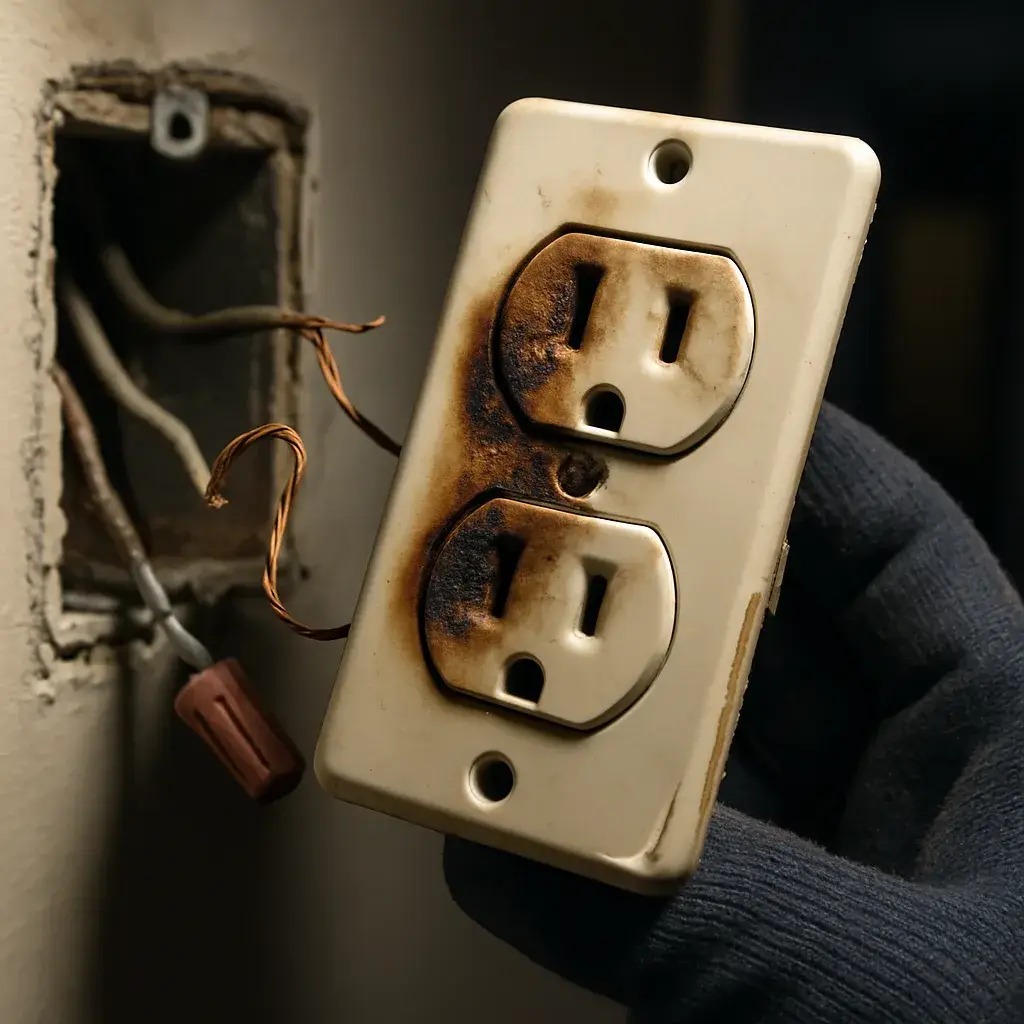
You’ll often notice small things first. A warm cover plate on a switch or outlet. A light that flickers, even when nothing else is on. You might see a discolored or slightly melted-looking plate around a receptacle. Sometimes a breaker trips for no clear reason, or an outlet stops working without a blown fuse. (It’s worth having someone check it out.)
None of that means your whole house needs rewiring automatically. We won’t tell you it does. Electrical troubleshooting means finding the exact connection or circuit causing the issue. We don’t treat every aluminum-wired home the same way. Our technicians use test equipment to find the actual source of the problem. We explain what we find in plain words before any work begins.
Sometimes, the fix is at the connection itself. Other times, replacing the wiring run is a better long-term solution. Aluminum wiring replacement is a service we offer when it’s the right choice for your home. We decide that after the diagnostic, not before.
If you want to know more about how a diagnostic visit works for things like a tripping breaker or a dead outlet, our electrical troubleshooting page walks you through the process step by step.
You can expect us to be direct about what we find. If a warm outlet is just a loose screw at the receptacle, that’s what we’ll tell you. We won’t try to make a small job into a bigger one.
Ready to Get Started?
Call 972-288-2263 Today, Get Service Today.