


Electrical Troubleshooting: When We Repair vs. When We Replace
How we decide between repairing a fault and replacing the circuit – what the diagnostic tells us, and what each route costs.
What’s Covered on This Page
- What Factors Decide Repair vs. Replace
- What the Diagnostic Visit Costs and What’s Included
- When We’d Recommend a Repair
- When We’d Recommend a Replacement
- How We Help You Decide Between Repair and Replace
- Related Links
- The house is from the 70s and the branch wiring is aluminum. Does that mean a rewire?
- Does the $100 to $350 include fixing the problem, or is that just to find it?
- The garage GFCI trips every time it rains. New GFCI, or something bigger?
- I’ve got a rental in Seagoville and the tenant is the one seeing the problem. Can they let you in?
- There’s a burning smell near an outlet. Should I wait for you or shut something off?
- I have three things wrong – a dead outlet, flickering lights and a bathroom fan that hums. Is that three separate diagnostics?
What Factors Decide Repair vs. Replace
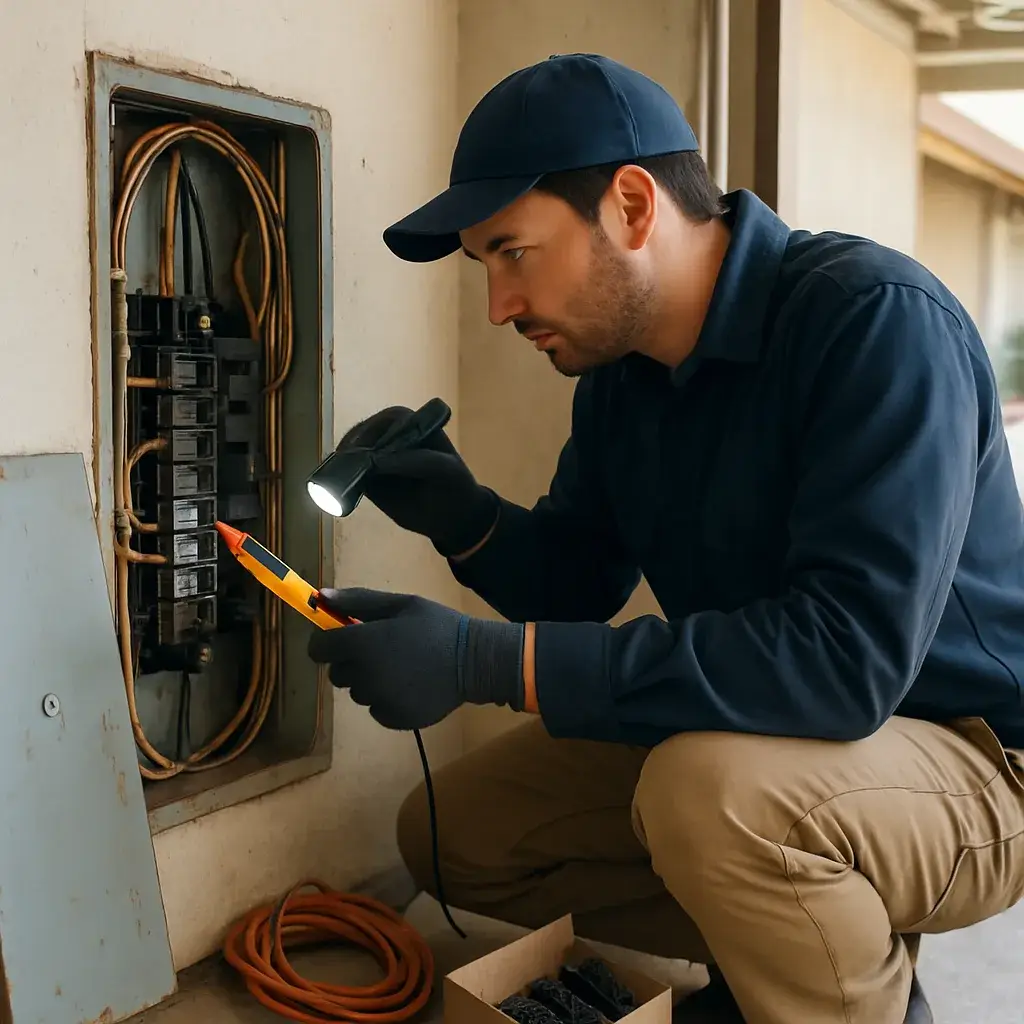
Electrical troubleshooting starts with a $100 to $200 diagnostic. That fee often gets applied to the repair cost if you move forward. We trace a dead outlet, tripping breaker, or intermittent fault back to its source. What happens after that depends on what we find. A loose connection, a worn outlet, or a bad switch is a repair. This typically runs in the $100 to $350 range. The price depends on how many circuits are involved and how much access the job takes.
- Wiring age and type: Aluminum wiring or old knob-and-tube runs fail differently than copper. We’ll tell you plainly when replacement is the safer call, instead of patching around it.
- Whether it’s one spot or a pattern: A single outlet that quit is a repair. But a breaker that keeps tripping across the house often means the panel or a circuit is undersized for what’s plugged into it.
- Panel condition: A panel that’s outdated or maxed out gets a panel repair or a panel replacement/upgrade. Not another patch.
- How many circuits are affected: Fixing one dedicated circuit is different work than tracing a fault that’s touching several rooms.
- Access and home size: Attic runs and slab-era wiring in older DFW homes can take longer to trace than a newer subdivision build. This affects the labor side of the job.
We don’t push replacement when a repair holds up fine. If a breaker trips once from an overloaded circuit and the wiring behind it checks out, we fix that connection and move on. But if we’re looking at aluminum wiring or a panel that’s been patched too many times already, we’ll say so at the diagnostic. Putting a new outlet on old wiring doesn’t fix the actual risk. That’s the call we make in person, not over the phone. It depends on what the technician sees in your walls and panel.
We go into more depth on what’s included in that diagnostic visit on our electrical troubleshooting page. You can get the full breakdown before booking.
What the Diagnostic Visit Costs and What’s Included
A standard electrical troubleshooting visit runs $100 to $350. Most jobs land between $100 and $200. This covers a dead outlet, a breaker that keeps tripping, or an intermittent fault somewhere in the house. The call-out fee itself is $26 to $99. It goes toward the repair cost if you decide to move forward with us that same visit.
What moves the number around isn’t a mystery. A single dead outlet in an easy-to-reach spot is a quick trace. A fault jumping between circuits in an older home takes longer. So does one buried behind finished walls with no attic or crawlspace access. Sometimes specialized test equipment is needed to pin it down. Home size and circuit count matter too. A 1960s slab home in Sunnyvale with decades of add-on wiring is a different job than a newer subdivision build with a modern panel.
- Included: a licensed technician on site, a full trace of the fault to its actual source, and a written summary of what we found and what it will take to fix it
- Excluded: the repair itself. Corrective work like replacing a bad outlet, rewiring a section, or fixing a panel issue is priced and approved separately before we touch anything
- Financing isn’t typically part of a diagnostic-only visit. We do offer it on bigger repairs and replacements once you know what you’re dealing with
We won’t pad a diagnostic call with guesswork. If the fault turns out to be something simple, we’ll say so. The bill reflects that. If it’s more involved, you’ll have a real number in writing before we do anything else. That quote is covered by our 100% satisfaction guarantee, like every job we perform.
If you want the full breakdown of what we handle beyond a single diagnostic visit, our electrical troubleshooting service page lays out the rest of the scope.
When We’d Recommend a Repair
Most of the time, a repair is the right call. If a breaker keeps tripping, an outlet has gone dead, or a light flickers on one circuit, our technician traces the fault to its source. We fix that specific problem. A loose connection gets tightened and secured. A worn outlet or switch gets swapped out. A damaged wire segment gets repaired to code. That work usually falls in our typical $100 to $350 range for electrical troubleshooting. It gets your circuit back to normal without touching anything else in your home.
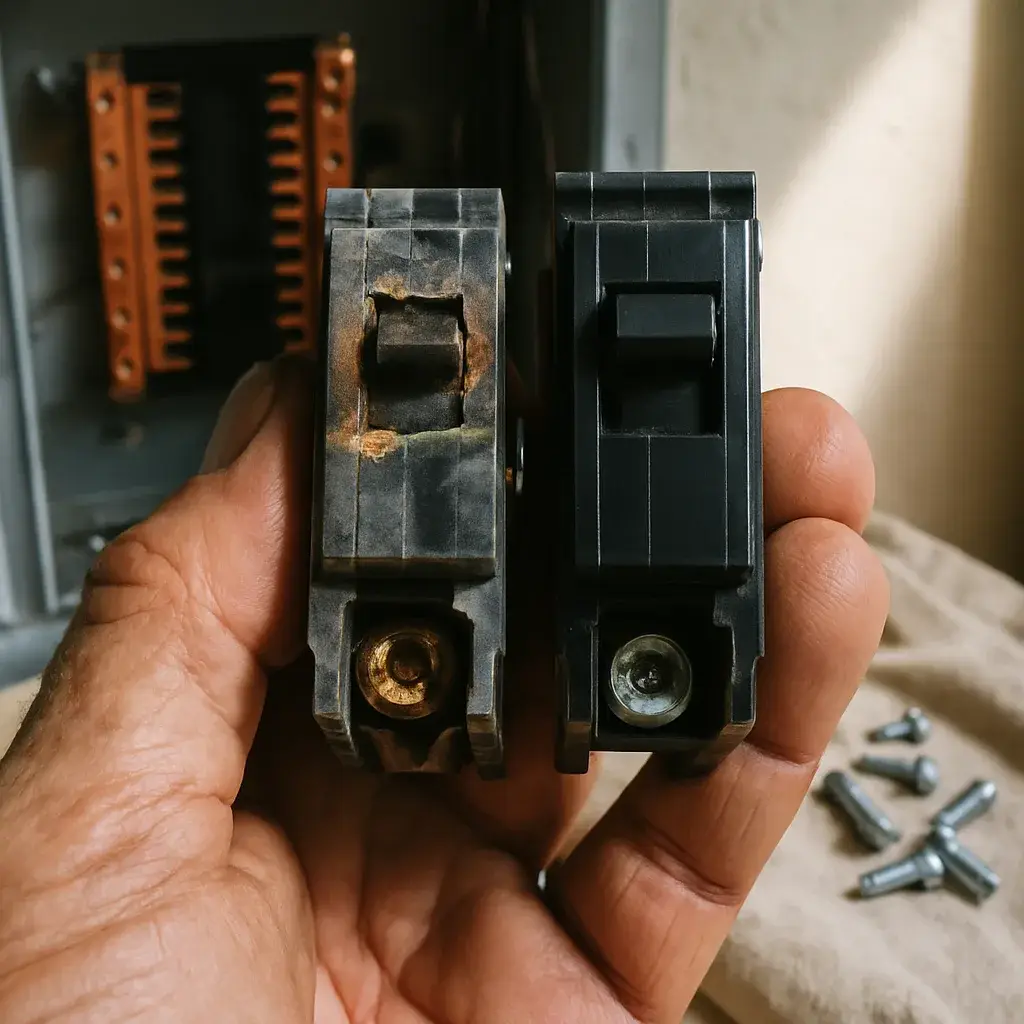
We lean toward repair when the fault is isolated. This means one outlet, one switch, or one circuit acting up. The rest of your electrical system checks out fine on inspection. Repair also makes sense when the wiring itself is sound. The issue is usually a component, a connection, or a device that failed on its own.
- A single dead outlet or switch with good wiring behind it
- One breaker that trips under a specific load, like a space heater or window unit
- A loose or corroded connection found during the diagnostic visit
- A failed device, like a GFCI outlet that’s stopped resetting
Replacement enters the conversation when the diagnostic points to something bigger than one part. If we find aluminum wiring, old knob-and-tube wiring, or a panel that’s undersized, overheated, or recalled, patching one symptom won’t fix the underlying condition. In older Dallas County and Kaufman County homes, especially ones built before the 1990s, we sometimes find wiring or panels that were fine for the electrical loads of that era. But they aren’t built for today’s window units, kitchens, and home offices. That’s a bigger conversation, and we walk you through it plainly before recommending it.
A repair is cheaper and faster. But it only solves the specific fault we found that day. If the same type of fault shows up again somewhere else on an aging system, that’s usually a sign the underlying wiring or panel is the real issue, not the individual outlet or breaker. We won’t push a replacement on you if the fault is isolated and the rest of the system checks out fine. And we won’t quietly patch a symptom if the panel or wiring behind it is the actual problem.
Every visit starts with a $26 to $99 service call fee. This gets applied toward the repair if you move forward with our electrical troubleshooting work. You’ll get the diagnosis and a plain-English rundown of your options (repair or replace) before we touch anything else.
Not sure what your Electrical troubleshooting project needs? Ask us.
Call Today, Get Service Today. Xtreme Air Services is ready to help.
When We’d Recommend a Replacement
Most of the time, troubleshooting a dead outlet or a tripping breaker ends with a repair, not a replacement. But the diagnostic sometimes turns up a part that’s past fixing. When that happens, we’ll tell you plainly. We’ll put it in the written findings summary before any work starts.
- An outlet or switch with heat damage, melted plastic, or a burnt smell, which we handle through outlet & switch installation rather than repair
- A breaker that keeps tripping after a clean reset, which usually points to panel age or capacity and may call for an electrical panel replacement or upgrade
- Aluminum wiring feeding the circuit, which we address through aluminum wiring replacement rather than patching around it
- Wiring insulation that’s cracked, brittle, or chewed, where a section of home rewiring makes more sense than a spot repair
- A circuit that’s overloaded for what it’s running, where a dedicated circuit installation solves the root cause
The answer depends on what we find. Two homes with the same symptom (a breaker that trips every few days) can have two different answers. One might need a fifteen-minute fix. The other might trace back to a panel that’s been overloaded for years. We won’t know which one you’ve got until a technician traces the fault to its source. That’s the whole point of the visit.
The diagnostic itself runs $100 to $200 for a typical dead-outlet, tripping-breaker, or intermittent-fault call. That covers the on-site inspection plus a written summary of what we found and what it would take to fix it. The service-call fee, $26 to $99 depending on the visit, goes toward the repair cost if you move forward with us. If the findings point to something bigger than a simple part swap, you’ll see that in writing before you approve any next step. For the full picture on how the diagnostic works and what it covers, our electrical troubleshooting page walks through the process.
How We Help You Decide Between Repair and Replace
Most of the time, the answer comes down to what’s causing the fault. Not how it feels from your side of the wall. A tripping breaker or dead outlet can come from something as small as a loose wire nut or as involved as failing insulation on an old circuit. Once we trace the fault to its source during our electrical troubleshooting visit, we tell you plainly whether it’s a repair or something that needs to be replaced, and why.
A single loose connection, a worn outlet, or a tripped breaker with a clear cause usually gets repaired on the spot. It’s a contained fix. The part is easy to source. There’s no reason to touch anything else on that circuit.
Replacement comes into play when the fault points to something bigger than the part in front of us. If we find aluminum wiring, old knob-and-tube, or a panel that’s undersized or damaged, patching the one spot you called about doesn’t fix the actual problem. In those cases, we’d tell you the repair is a short-term patch, not a fix. Aluminum wiring replacement, knob-and-tube replacement, or an electrical panel replacement or upgrade is the more realistic path. (Even though it costs more than the original service call.)
- Age and condition of the wiring or component feeding the fault
- Whether the issue is isolated to one outlet or breaker, or tied to shared wiring
- Code compliance, since some older setups don’t meet current standards and need code correction
- How often the fault repeats once addressed, based on what we find during the visit
- Whether the fix is a straightforward outlet & switch repair or points toward a larger job like electrical panel repair
A diagnosis alone runs $100 to $200 for a typical dead outlet, tripping breaker, or intermittent fault. The $26 to $99 call-out fee is applied toward the repair if you move forward with us. If the fault turns out to be small, you’re not paying for a bigger job you don’t need. If it points to something structural in the wiring, you’ll know that before any repair work starts, not after.
We won’t recommend replacing a panel or rewiring a circuit because it’s the bigger ticket. We recommend it when the fault we traced lives there. That distinction is the whole point of tracing the problem first instead of guessing at a fix.
Frequently Asked Questions
Common questions about electrical troubleshooting
The house is from the 70s and the branch wiring is aluminum. Does that mean a rewire?
Not automatically. Aluminum branch wiring fails at the connections, not down the middle of the run, so the usual repair is re-terminating every device on that circuit with connectors rated for aluminum-to-copper: outlets, switches, the splices in the boxes, and the breaker terminations. That’s a repair, and the troubleshooting visit is what tells us how much of it you need. Replacement comes in when the conductor itself is damaged – overheated insulation, a burned neutral, or a run someone has already spliced with plain wire nuts. We start with the boxes on the circuit that’s giving you trouble, then tell you whether the rest looks the same.
Does the $100 to $350 include fixing the problem, or is that just to find it?
That’s the troubleshooting itself – locating the fault and telling you exactly what the repair takes. Most jobs land between $100 and $200. The call-out fee is separate, $26 to $99, and it gets credited toward the work if you go ahead. Repair pricing is quoted to you before anything gets replaced, so you approve two things: the diagnostic when you book, and the fix once we know what it is. Financing is available if the repair turns out larger than expected.
The garage GFCI trips every time it rains. New GFCI, or something bigger?
Swapping the GFCI is the cheap guess and it usually fails. Water is getting into something on that circuit – an exterior box without a gasket, an in-use cover that isn’t closing, a fixture on the same run, or a buried cable that’s been nicked by a shovel. We open the outdoor devices on that circuit and read leakage with the sections isolated, which tells us whether one device is wet or the underground run is. A wet device is a repair. A damaged buried cable means replacing that section of run, and that’s the one worth knowing about before it takes the circuit out for good.
I’ve got a rental in Seagoville and the tenant is the one seeing the problem. Can they let you in?
Yes. Seagoville is in our service area. Give us the tenant’s name and number when you book, and tell them to leave the panel and the affected rooms accessible. They can show us what’s happening, but they can’t authorize the repair – we call you with the findings and the price before we do anything past the diagnostic. You can approve and pay by phone.
There’s a burning smell near an outlet. Should I wait for you or shut something off?
Kill that breaker now and leave it off, and keep the outlet out of service until we’ve had the cover plate off. Heat at a device is almost always a loose termination or a receptacle that’s lost its grip on the plug, and both of those are repairs: new device, conductors re-terminated on the screws. What turns it into a replacement is damage behind the box – insulation charred back into the cable, or a neutral that’s been cooking long enough to discolor several inches of wire. Then that section of the run gets replaced. Call 972-288-2263; the phone is answered 24 hours a day.
I have three things wrong – a dead outlet, flickering lights and a bathroom fan that hums. Is that three separate diagnostics?
Usually one visit. Symptoms that trace back to the same circuit or the same loose neutral get sorted together, and that visit typically lands $100 to $200. If they’re on separate circuits at opposite ends of the house, the troubleshooting time grows and the visit moves toward the $350 end. List all three when you book so we schedule enough time rather than squeezing you into a short slot. You’ll get a price for each fix before any repair starts, and you can do them in any order.
Ready to Get Started?
Call 972-288-2263 Today, Get Service Today.