A GFCI trips because it senses a current imbalance, usually of around 5 milliamps, and cuts power to prevent shock. The most common culprits are moisture, a faulty appliance, a ground fault, or wiring problems. Start by unplugging everything on that circuit and pressing RESET. If it still won’t hold, work through the checks below before calling a licensed electrician.
TL;DR:
- Moisture is the primary cause of GFCI trips in damp environments like bathrooms, kitchens, and outdoor areas, especially during humid weather or condensation buildup.
- Downstream appliance faults, especially from devices like refrigerators, sump pumps, or microwaves with internal leaks, often cause GFCIs to trip unexpectedly.
- Regularly testing GFCIs monthly and replacing worn or faulty units can prevent nuisance trips and ensure safety compliance.
- Wiring issues such as damaged insulation, loose neutral connections, or reversed line and load wiring are common causes of persistent trips that require professional diagnosis.
- Persistent or immediate trips with nothing plugged in indicate wiring faults or a defective GFCI, often necessitating expert inspection and repair.
Table of Contents
- Common Causes Behind a GFCI Outlet That Keeps Tripping
- Step-by-Step Troubleshooting: Isolate the Fault and Verify the GFCI
- When the GFCI Won’t Reset or Trips With Nothing Plugged In
- Keep Nuisance Trips Down With Regular Testing and Smart Setup
- Diagnosing Intermittent Trips Tied to Humidity and Temperature
- Appliances and Tools That Commonly Trip a GFCI
- Where GFCI Placement Matters for Safety and Code
- What a Tripping GFCI Means for Your Home’s Electrical System
- A Homeowner’s Reality Check on GFCI Troubleshooting
- Get a Licensed Electrician on the Problem, Not Just a Reset Button
- Sources
- FAQ
Common Causes Behind a GFCI Outlet That Keeps Tripping
A GFCI outlet is built to notice something most people never think about: the tiny difference between the current flowing out on the hot wire and the current returning on the neutral. When that gap crosses roughly 5 milliamps, the Siemens diagnostic guide confirms the device trips within milliseconds. That threshold is what makes GFCIs so good at preventing shock, and also why they trip over things that seem harmless.
Moisture and condensation are the number one cause in bathrooms, kitchens, garages, and anywhere near an exterior door. Water in an outlet box, a damp extension cord, or condensation inside a wall cavity creates a leakage path the GFCI reads as a fault. It doesn’t take a flood. A humid summer night can be enough.
Downstream appliance faults trip the outlet even though the problem lives somewhere else. GFCIs commonly protect several outlets on one circuit, so a failing coffee maker or a cracked extension cord three outlets away can knock out power at the GFCI itself.
Cumulative leakage builds up when you have too many modern electronics sharing one GFCI-protected branch. Phone chargers, LED drivers, and surge-protected power strips all leak a small amount of current through their internal filters. Individually it’s nothing. Stacked together on one circuit, it adds up to a nuisance trip that has nothing to do with a real hazard, according to Fluke’s field guide on ghost trips.
Wiring problems cause some of the most stubborn trips. Damaged insulation, a loose neutral connection, or a shared neutral across a multi-wire branch circuit all confuse the GFCI’s internal balance. If the outlet was recently installed or replaced, line and load reversal is a frequent culprit, and Eaton’s technical support documentation flags this as one of the most common installer mistakes.
Aging or defective GFCI mechanisms show up as a mushy reset button, no audible click, or a device that trips seemingly at random with nothing plugged in anywhere near it. GFCIs have moving parts and electronic sensing circuits that wear out. Past a certain age, the fix isn’t troubleshooting. It’s replacement.
A quick reference for matching symptoms to likely causes:
- Trips only in wet weather or humid rooms → moisture
- Trips when you turn on a specific appliance → downstream fault
- Trips randomly with several devices plugged in → cumulative leakage
- Won’t reset at all, or trips immediately → wiring issue or dead GFCI
- Old outlet, mushy button, inconsistent behavior → aging device
Step-by-Step Troubleshooting: Isolate the Fault and Verify the GFCI
Work through this in order. Skipping steps is how people either miss the real cause or get hurt.
- Confirm the breaker is safe to work near. If you plan to open any outlet box, shut off the breaker for that circuit first and confirm the power is dead with a non-contact voltage tester. Never work inside a live box.
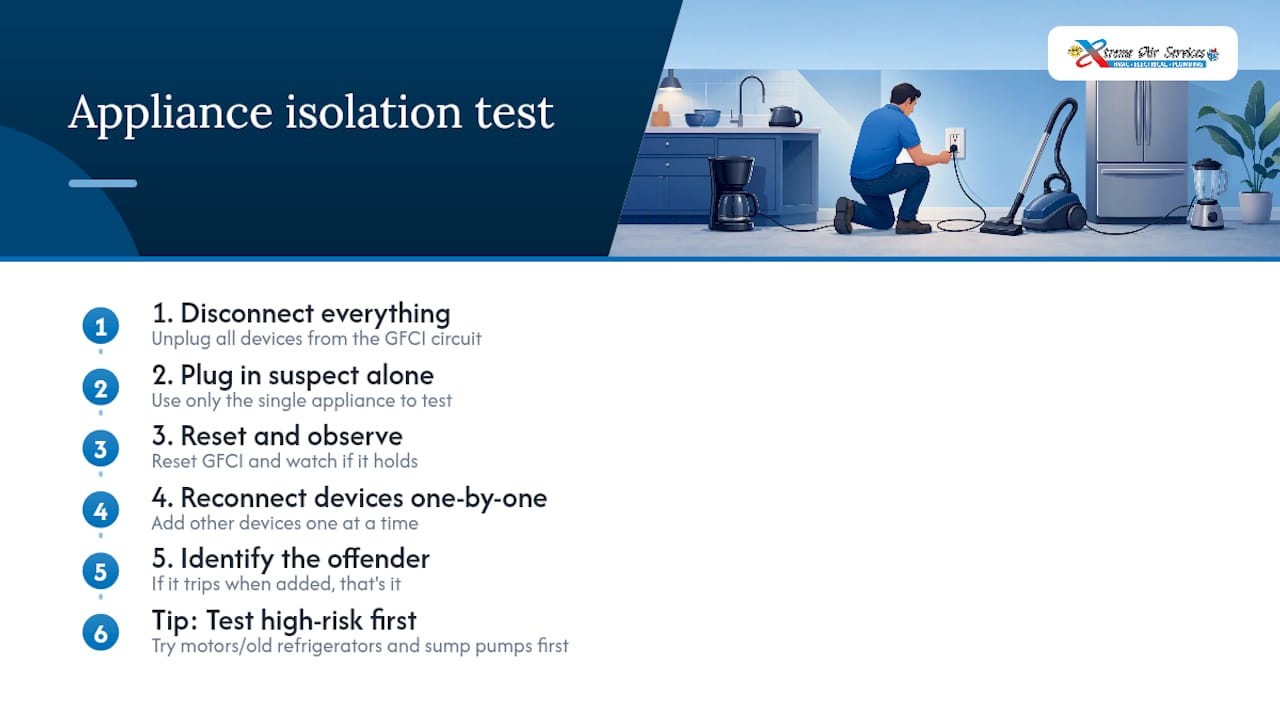
- Unplug everything on the circuit. Every downstream outlet the GFCI protects, plus anything plugged directly into the GFCI itself. This is the single most useful diagnostic move you have, because it separates “the outlet is bad” from “something plugged into it is bad.”
- Press TEST, then RESET. TEST should produce an audible click and cut power. RESET should produce its own click and the button should stay in, flush with the faceplate. If TEST does nothing, or RESET pops right back out with zero load connected, the receptacle itself is likely failing.
- Reset with all loads removed. If it holds now, the fault is downstream on one of the devices or outlets you unplugged, not the GFCI itself. This single test, drawn from the Siemens circuit breaker diagnostic sequence, immediately narrows the search.
- Use a plug-in GFCI tester for a cleaner read. These small testers simulate a genuine 5 mA fault and confirm the outlet trips at the right sensitivity and speed, which is more reliable than eyeballing a click, according to EngineerSkill’s testing walkthrough.
- Reconnect devices one at a time. Plug in one item, wait, then reset if it trips again. Repeat down the line. Whichever device causes the trip is your fault.
- Stop if it trips immediately with nothing connected. That points to wiring inside the wall or a hardwired load like a sump pump, and it’s outside safe DIY territory.
Pro Tip: If you own or can borrow a leakage clamp meter, clamp it around the hot and neutral together at the panel or outlet. A steady reading above a few milliamps with everything “off” usually means insulation damage somewhere in the run, not a bad appliance.
When the GFCI Won’t Reset or Trips With Nothing Plugged In
A GFCI that refuses to reset even with every load disconnected is telling you something specific. Many modern units include a reset lockout that prevents the device from energizing at all if the wiring is wrong, most often line and load reversed during installation. The Leviton lockout guide walks through checking for this before assuming the outlet is defective.
A few signs point clearly to one path or another:
- Trips instantly, every time, with nothing plugged in anywhere → wiring fault or panel-side problem, call an electrician.
- Resets fine with everything unplugged, trips again once you plug something back in → downstream device, keep isolating.
- No click on TEST or RESET, LED behaving oddly, button feels loose → the receptacle has failed internally and needs replacement.
- Shared neutral wiring, a wired-in sump pump, or a hardwired smoke detector on the circuit → this is a job for a licensed electrician, since these hidden loads are easy to miss and dangerous to guess at.
Keep Nuisance Trips Down With Regular Testing and Smart Setup
Test every GFCI outlet monthly using the built-in TEST button. Press it, confirm the click and loss of power, then press RESET and confirm the second click. The CPSC backs monthly testing as standard safety practice, since a GFCI that isn’t working is a hazard hiding in plain sight.
- Use weather-resistant (WR) GFCIs outdoors along with in-use, weatherproof covers, and keep exterior junction boxes sealed and dry.
- Spread out modern electronics. Avoid loading one GFCI-protected branch with every phone charger, gaming console, and surge-protected strip in the room.
- Give high-draw appliances their own circuit when possible, rather than sharing a GFCI branch with several other devices.
- Replace at signs of wear, not just failure. Manufacturer guidance indicates that GFCI receptacles have a limited service life, and any device showing signs of wear such as a mushy button, no click, or repeated unexplained trips should be replaced.
Pro Tip: Write the test date on a small sticker inside the panel door. It sounds unnecessary until you’re trying to remember whether you tested the garage GFCI in March or just think you did.
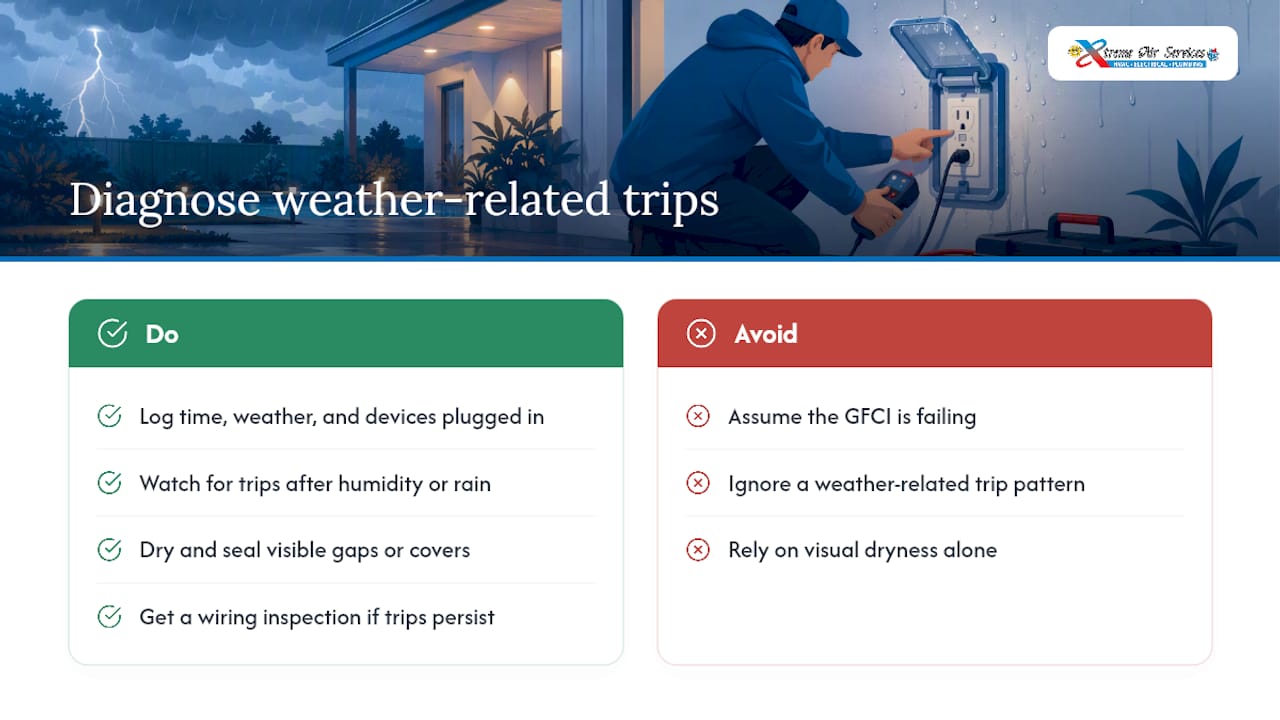
Diagnosing Intermittent Trips Tied to Humidity and Temperature
Trips that come and go with the weather are almost always moisture related, even when the outlet looks bone dry when you check it. Humidity swings change how much leakage current an outlet box or a marginal appliance produces. A bathroom GFCI that trips only on shower days, or a garage outlet that acts up during a Texas summer afternoon, is showing you a pattern worth tracking.
Keep a simple log for a week or two: time of day, weather, what was plugged in. Intermittent trips that cluster around high humidity or after rain point to moisture intrusion in the box, a cracked outdoor cover, or condensation forming inside a wall cavity near an exterior wall. Temperature swings matter too. Extreme heat can degrade old wire insulation just enough to create a small leakage path that only shows up once the attic or wall cavity gets hot enough.
If the trips happen only during specific weather and the outlet resets cleanly otherwise, moisture is the leading suspect and you likely don’t have a failing GFCI at all. If the pattern holds even after you’ve dried everything out and sealed visible gaps, the leakage is probably coming from inside the wall, and that’s a wiring inspection, not a weatherproofing fix.
Appliances and Tools That Commonly Trip a GFCI
Certain devices show up over and over as the source of trips, largely because of how they’re built rather than anything wrong with your electrical system. Refrigerators and freezers with electronic control boards, window air conditioners, and microwaves all use internal filters or capacitors that leak small amounts of current by design, and that leakage can be enough to push a shared circuit over the edge.
Sump pumps and garage freezers deserve special attention. Trades forums and homeowner discussions consistently point to garage-circuit combinations of a freezer and a sump pump as one of the most frequent real-world causes of repeated GFCI trips, since both devices draw steadily and often sit on the same protected branch.
To test a suspect appliance, plug it into the GFCI outlet by itself with everything else disconnected. If the outlet holds, plug in your other devices one at a time and watch for the trip to return. If it trips the moment the appliance in question goes in, you’ve found your answer. Devices with heavy motor loads or older refrigeration compressors are worth testing first, since they’re the most common offenders.
Where GFCI Placement Matters for Safety and Code
The National Electrical Code requires GFCI protection anywhere water and electricity are likely to meet: bathrooms, kitchens within a set distance of the sink, garages, unfinished basements, outdoor outlets, and areas near laundry sinks. That’s not arbitrary. Every one of those locations represents a spot where a person’s skin is more likely to be wet, and wet skin dramatically lowers the body’s resistance to electric shock.
Installing a GFCI in the wrong spot, or skipping one where code requires it, isn’t just a compliance issue. It’s a safety gap that a home inspection or insurance claim can expose later, often at the worst possible time. If you’re adding an outlet near a wet bar, a utility sink, or an exterior wall, treat GFCI protection as non-negotiable rather than optional.
Code compliance also affects resale and insurance. An outlet installed without required GFCI protection can complicate a home sale or a claim after water damage, since it signals the wiring wasn’t done to current standards. When in doubt about whether a location requires protection, the safer assumption is yes.
What a Tripping GFCI Means for Your Home’s Electrical System
A GFCI that keeps tripping is doing its job, but repeated trips carry real consequences beyond the inconvenience. Every trip cuts power abruptly, which can affect anything running on that circuit: a sump pump mid-cycle, a freezer holding food, a security camera, or a medical device. A pattern of frequent trips on a circuit protecting critical equipment is a problem you can’t just reset your way past.
Frequent trips also shorten the life of the GFCI mechanism itself. These are electromechanical devices with a finite number of trip cycles built into their design, and a unit that’s tripping weekly is wearing toward failure faster than one that trips once a year. Once a GFCI starts failing internally, it stops offering reliable shock protection even when it appears to be working, which defeats the entire purpose of having one installed.
There’s a bigger-picture read here too. A GFCI that trips constantly is often a symptom, not the disease. Underlying wiring damage, an overloaded circuit, or a failing appliance rarely fixes itself. Left alone, the same conditions that cause nuisance trips can eventually cause a fire risk or a genuine shock hazard once the protective device finally does fail.
A Homeowner’s Reality Check on GFCI Troubleshooting
Most advice on this topic treats every trip like a five-minute fix: unplug things, hit reset, done. That works often enough that people assume it always will, and that’s the gap we’d push back on. A GFCI that trips once during a thunderstorm and never again is a different animal from one that trips three times a week. The first is the device doing exactly what it’s supposed to do. The second is a system telling you something is wearing out, whether that’s the receptacle, the wiring behind it, or an appliance quietly leaking current.
The DIY ceiling is lower than most guides admit. Isolating a downstream appliance is safe and genuinely useful work. Opening a wall to chase a shared neutral or a damaged conductor is a different category of risk entirely. We’d rather see a homeowner run the load isolation test, get a clear answer, and then make an honest call about whether the next step belongs to them or to a licensed electrician. Guessing past that point is where people get hurt, not from the shock itself, but from working inside a box they shouldn’t have opened.
— Xtreme
Get a Licensed Electrician on the Problem, Not Just a Reset Button
If you’ve unplugged everything, tested the mechanics, and the outlet still won’t cooperate, you’re past the point where guessing helps. Licensed electricians bring leakage clamp meters and panel-level testing that most homeowners don’t own, so a fault that would take you an afternoon of trial and error gets isolated in one visit.

That matters most for the cases DIY troubleshooting can’t safely finish: shared neutral circuits, hidden hardwired loads like sump pumps, or a receptacle that needs full replacement rather than another reset attempt. A licensed electrician will diagnose the fault, correct line and load wiring where that’s the issue, swap out a failing GFCI receptacle, and add a dedicated circuit if your setup genuinely needs one. For readers in the Dallas, TX area dealing with a GFCI that won’t stay reset, scheduling an electrical diagnostic is the direct next step, and it beats another round of unplugging everything in the garage to see what sticks.
Sources
- AFCI-GFCI Circuit Breaker Diagnostic Guide (Siemens)
- GFCI amber light on (Eaton Knowledge Hub)
- Chasing ‘ghost’ trips in GFCI-protected circuits (Fluke)
- How to reset a GFCI outlet after lockout: a step-by-step guide (Leviton)
- Consumer Product Safety Commission guidance (CPSC)
FAQ
How many times can a GFCI trip before it goes bad?
There’s no fixed number. What matters more is the pattern: a GFCI that trips occasionally under real fault conditions is working correctly, but one tripping repeatedly over days or weeks is showing signs of wear and should be tested with a plug-in tester or replaced.
Why does my GFCI outlet keep tripping even though I still have power?
You likely still have power to other outlets or circuits because the GFCI only cuts power to the outlets it protects downstream, not your whole panel. The trip itself still points to moisture, a faulty appliance, or leakage current on that specific branch.
Is it okay to leave a GFCI tripped?
Leaving it tripped is safe in the sense that no power flows to the protected outlets, but it means you’ve lost that protection and any devices relying on those outlets. Treat a tripped GFCI as something to diagnose promptly, not something to ignore indefinitely.
Why do GFCI breakers randomly trip?
Random trips usually trace back to cumulative leakage from multiple electronics sharing a circuit, moisture intrusion, or an aging mechanism that’s grown overly sensitive. Isolating loads one at a time, as covered above, is the fastest way to find which of these is happening in your home.