If your panel feels warm to the touch, trips breakers repeatedly, still uses fuses, or you smell anything burning near it, stop guessing and call a licensed electrician now. Those are the most common red flags that point to a real safety risk, not just an inconvenience. Everything short of those urgent signs still deserves a professional load calculation before you assume you’re fine.
TL;DR:
- Most electrical panels should feel cool; warmth, burning smells, or scorch marks indicate serious safety risks requiring immediate professional attention.
- Frequent breaker trips, fuse panels, or panels with no spare slots often signal overloads or outdated systems that need an upgrade or load calculation.
- Older panels with under 100 amps or known recalls, such as certain Schneider Electric or Siemens models, are unsafe and should be replaced regardless of appearance.
- Full service upgrades, including utility involvement, typically cost between $5,000 and $25,000, while simpler replacements usually range from $2,000 to $4,000.
- A licensed electrician should perform a load calculation and inspection within weeks for non-emergency signs to determine if repairs or full replacement are necessary.
Table of Contents
- Top Signs You Need an Electrical Panel Upgrade
- What Do These Warning Signs Actually Mean?
- When Should You Call a Licensed Electrician?
- What Does an Electrical Panel Upgrade Cost?
- How Xtreme Evaluates Your Panel
- What Field Technicians Wish Homeowners Knew
- Ready for a professional electrical panel assessment?
- Sources
- FAQ
Top Signs You Need an Electrical Panel Upgrade
Most panel problems announce themselves before anything catastrophic happens. You just have to know where to look and what counts as normal wear versus a genuine hazard.
Here’s the shortlist worth checking today:
- A warm panel or warm breakers. Panels should feel cool to room temperature. Warmth at the panel face or on individual breakers signals loose connections or overloaded circuits.
- A burning smell or scorch marks. Any smoky odor near the panel, or visible discoloration around breakers, means insulation or wiring has already started to fail.
- Frequent or new breaker trips. A breaker that trips once in a while is doing its job. One that trips weekly is warning you the circuit is overloaded or the breaker itself is failing.
- Fuses instead of breakers, or service under 100 amps. Fuse boxes and 60-amp service were standard decades ago, but they can’t handle modern appliance loads safely.
- Physical damage, rust, or moisture inside the panel. Corrosion weakens connections and creates paths for arcing.
- No spare breaker slots, or a row of tandem breakers crammed in. A full panel with double-stacked breakers is often a sign someone added circuits without upgrading capacity.
- New big loads on the way. An EV charger, heat pump, or electric range often demands more amperage than an older panel was ever built to deliver.
- A manufacturer recall on your exact model. Some panels look fine on the outside and still carry a known defect.
That last point matters more than most homeowners realize. Schneider Electric recalled about 1.4 million Square D QO load centers for thermal burn and fire hazards, and Siemens issued a similar recall on SolarReady meter combos manufactured between August 2021 and August 2022. Neither defect was something you’d notice just by glancing at the panel door.
What Do These Warning Signs Actually Mean?
Not every sign carries the same urgency, and knowing which ones can wait separates a smart homeowner from a panicked one.
Treat these as emergencies:
- Overheating, a burning smell, or scorch marks. Shut off the affected circuit if you can do so safely, check your smoke alarms, and call an electrician the same day.
- Any visible arcing or sparking. Leave the panel alone and call immediately.
Treat these as urgent, but not five-alarm:
- Frequent trips without an obvious cause. Write down when they happen and what’s running on that circuit. Resist the urge to just keep flipping the breaker back.
- Old fuse panels or panels made by a now-obsolete manufacturer. These often can’t source replacement parts, which is a safety and a practicality problem.
Treat these as planning issues:
- A full panel with no open slots. Your options usually come down to a full panel replacement, adding a subpanel, or consolidating circuits. A licensed electrician determines which one fits with a proper load calculation.
- Adding an EV charger, heat pump, or electric range. Sometimes this only requires a new panel. Other times it requires a full service upgrade, which brings your utility company into the picture.
Pro Tip: Before your electrician arrives, open the panel door (without touching anything inside) and photograph the label with the model and date code. If your panel is ever the subject of a recall or CPSC investigation, that photo is the fastest way to confirm whether your exact unit is affected.
When Should You Call a Licensed Electrician?
Call the same day for any burning smell, unusual heat, repeated tripping, or visible damage. For everything else on the checklist, schedule an inspection within the next few weeks rather than letting it sit for months.
Here’s what a competent visit typically includes:
- Visual inspection of the panel interior, breakers, and connections for corrosion, loose wiring, or heat damage.
- Label documentation, confirming the panel’s model, amperage, and date code against known recalls.
- A load calculation, which is the only reliable way to know whether your current service can handle your existing appliances plus anything you’re planning to add.
- A recommendation, backed by a written estimate, on repair versus full replacement.
Before the electrician shows up, pull together your utility bill, a rough list of major appliances, and any new equipment you’re planning, like an EV charger or a heat pump. Then ask directly: Will you run a load calculation? Is a full service upgrade likely, or just a panel swap? Will the utility company need to get involved? Can I get a written estimate with a timeline? A circuit map speeds up the whole diagnosis, so if you’ve ever labeled your breakers, bring that list along too.
What Does an Electrical Panel Upgrade Cost?
A straightforward panel replacement typically runs $2,000 to $4,000, while a full service upgrade, one that involves the utility’s transformer or meter base, can range from $5,000 to $25,000 depending on the scope, according to Rewiring America’s electrification guidance.
What pushes a job to the higher end:
- Whether the utility needs to upgrade the service conductors or transformer feeding your home, not just the panel itself.
- Permitting timelines, which vary by city and can add days or weeks before work even starts.
- How much rewiring or code correction the existing setup needs beyond the panel swap.
Rewiring America’s own data is worth noting here: homes with 100 to 150 amp service can often electrify major appliances with careful planning, meaning a full service upgrade is required less often than most homeowners assume. Subpanels and staged upgrades are legitimate middle paths when a full service upgrade isn’t yet necessary.
How Xtreme Evaluates Your Panel
Every visit starts the same way: a visual inspection of the panel and breakers, photo documentation of the label and interior condition, and a conversation about what you’re planning to add in the next year or two, whether that’s an EV charger, a new HVAC system, or a kitchen remodel.
From there, our technicians run the numbers, not guesses:
- A proper load calculation determines whether your current amperage can handle your actual usage.
- If the panel is structurally sound, has open capacity, and shows no corrosion or recall matches, we’ll often recommend a targeted repair instead of a full replacement.
- If it’s an obsolete fuse box, shows heat damage, or is undersized for what you’re planning, replacement is the safer and more cost-effective call.
- We walk you through repair versus replace tradeoffs and give you a written estimate before any work starts.
Technicians are licensed, insured, and background checked, and same-day and emergency scheduling are often available without extra charge for after-hours calls.
— Xtreme
What Field Technicians Wish Homeowners Knew
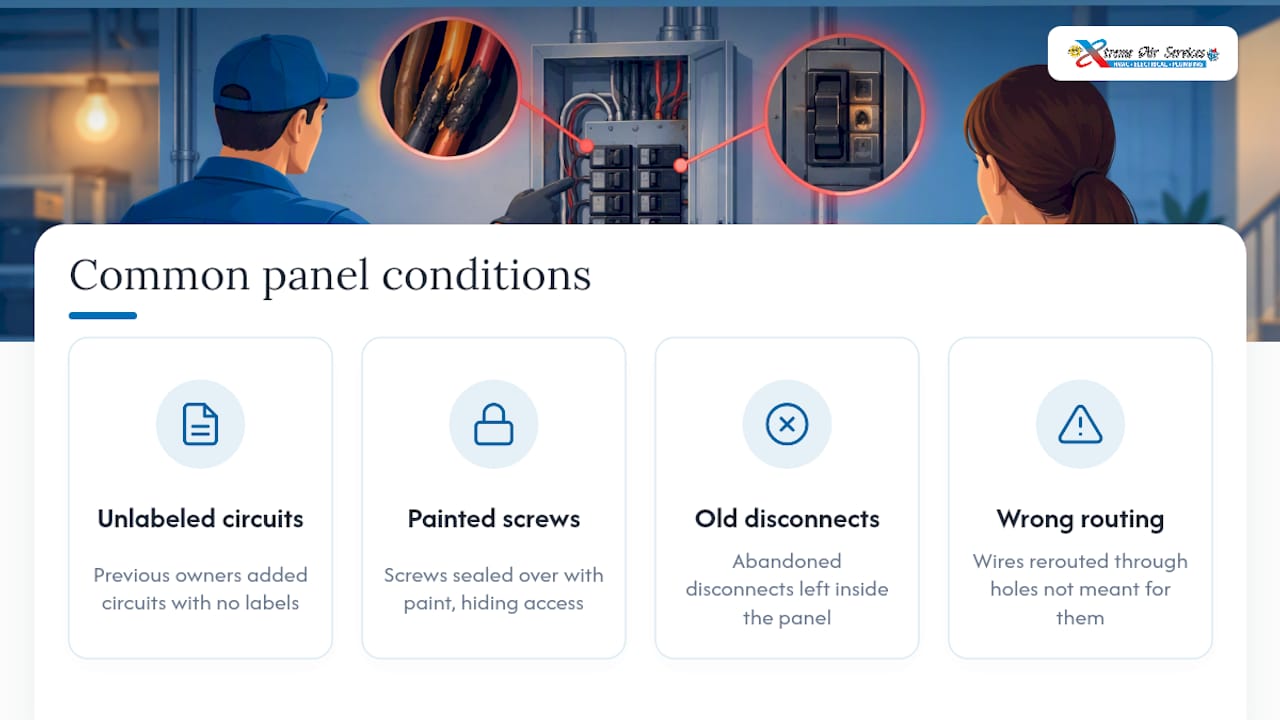
I once opened a panel where three previous owners had each added circuits without labeling anything. Paint-sealed screws, abandoned disconnects, wires rerouted through holes they were never meant to use. Mapping that mess safely took longer than the actual panel swap.
That’s the real argument against DIY work here: even with the main breaker off, the main lugs and service conductors stay energized. One practical thing to do before we arrive: find your breaker labels, even messy handwritten ones. It saves real time.
Ready for a professional electrical panel assessment?
This service offers a straightforward alternative to guessing whether your panel is safe or just old, with flat rate pricing upfront, no hidden charges for after-hours calls, and a satisfaction guarantee on the work.
Booking an inspection gets you a visual check, a real load calculation, and a written estimate before anyone touches a breaker, not a vague “you probably need an upgrade” guess. If the panel’s fine, we’ll tell you that too. If it’s not, you’ll know exactly what it costs and why. Schedule your residential electrical panel evaluation and get a straight answer instead of a guessing game.
Sources
Panel recall lookups: CPSC Schneider Electric recall; electrification guidance from Rewiring America; inspection checklists from ESFI; fire statistics from NFPA.
- Cpsc
- Pros and cons of a panel upgrade | Rewiring America Electrification Planner
- Electrical Safety Foundation International — Indoor electrical safety check booklet
FAQ
How Do I Know if My Electrical Panel Needs Upgrading?
Watch for a warm panel, burning smells, frequent breaker trips, a fuse box, or a panel with no open breaker slots. Any of these warrants a professional inspection and load calculation rather than a guess.
Is a Warm Electrical Panel Dangerous?
Yes, a warm panel usually means loose connections or an overloaded circuit, both of which can lead to arcing or fire. Electrical failure or malfunction contributes to roughly 77% of home electrical fires, so it’s not something to wait out.
How Much Does an Electrical Panel Upgrade Cost?
A standard panel replacement typically runs $2,000 to $4,000, while a full service upgrade involving the utility can range from $5,000 to $25,000. A written estimate is typically provided after an on-site inspection, since exact pricing depends on panel condition and amperage needs.
Do I Need a Panel Upgrade for an EV Charger or Heat Pump?
Not always. Homes with 100 to 150 amp service can often handle these additions with proper load planning, though older panels under 100 amps are more likely to need a full upgrade.
Can I Check if My Panel Has Been Recalled?
Yes, open the panel door and photograph the label showing the model and date code, then compare it against listings like the Schneider Electric recall or the Siemens SolarReady recall. If your model matches, contact the manufacturer or a licensed electrician for a free inspection.