


Central Air Conditioning Repair in Plano: What It Takes to Fix It Right the First Time
Central AC problems diagnosed and fixed right the first time, with clear pricing on what drives the cost.
What’s Covered on This Page
- Signs Your System Needs a Repair Call
- What Happens During a Repair Visit
- What’s Included in the Price and What Isn’t
- What Drives the Cost of a Repair Up or Down
- When You Don’t Need to Call for Repair
- How fast can someone get to my house in Plano when my AC quits?
- Is it worth fixing an older central AC, or should I think about something else?
- Do I need to be home during the repair visit?
- What should I do if my AC keeps shutting off on its own?
Signs Your System Needs a Repair Call
Most of the time, your system tells you something’s wrong well before it shuts down. The trick is knowing what each sign means. Here’s what to watch for, and what part is usually behind it.
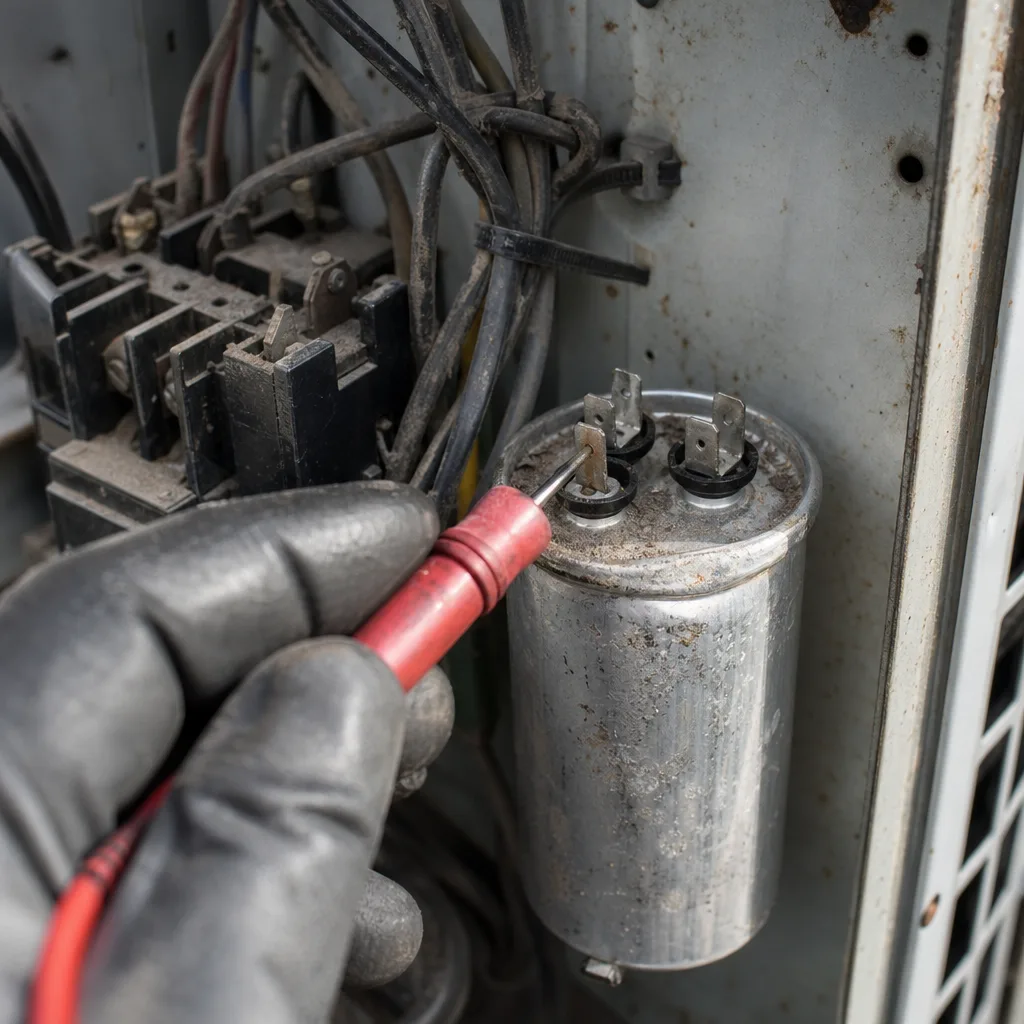
- Warm or barely cool air from the vents. The fan is running, but the air isn’t cold. This often points to low refrigerant from a leak, a dirty condenser coil, or a weak capacitor that’s keeping the compressor from starting.
- The outdoor unit hums, but the fan doesn’t spin. That’s a common sign of a failed capacitor or a worn-out fan motor. The capacitor is a small part that gives the motors the kick they need to start.
- Weak airflow in some or all rooms. A failing blower motor, a frozen evaporator coil, or leaky ductwork can all leave you with a trickle of air instead of a steady flow.
- Ice on the copper line or the indoor coil. A frozen coil usually means the system is low on refrigerant or isn’t moving enough air across the coil.
- Water near the indoor unit or a stain on the ceiling below it. A clogged drain line backs up water from the cooling process. With so many North Texas systems up in the attic, that water can show up on your ceiling first.
- Grinding, squealing, banging, or rapid clicking. Grinding and squealing often mean motor trouble. Clicking without the system starting can point to an electrical part or a control board.
- The system turns on and off every few minutes. This is called short cycling. It can come from a bad sensor, a thermostat problem, an electrical fault, or a system that’s low on refrigerant.
- It won’t turn on at all. The cause could be as simple as a thermostat issue or a tripped safety switch, or as involved as a failed circuit board.
- Your electric bill jumps with no change in how you use the AC. A system that’s struggling has to run longer to do the same job, and you pay for every extra hour.
Plano summers make these signs worth taking seriously. When your system runs for hours on end in the Texas heat, a part that’s starting to fail gets pushed harder every day. A weak capacitor that barely gets the compressor going in May can leave you with no cooling at all by July.
Here’s the good news. Most of the signs above trace back to one failed part, not a whole system that needs replacing. Our most common central air conditioning repair call is just that: find the part that failed, repair or replace it, and make sure the system runs right before we leave. Most of those calls are a single common failure fixed on the first visit.
Before you call, jot down what you noticed and when it started. Is the air warm, or is there just less of it? Is the outdoor unit running? Did you hear a noise or spot water? Those details help our licensed and insured technicians get to the right part faster, so your home cools down sooner.
What Happens During a Repair Visit
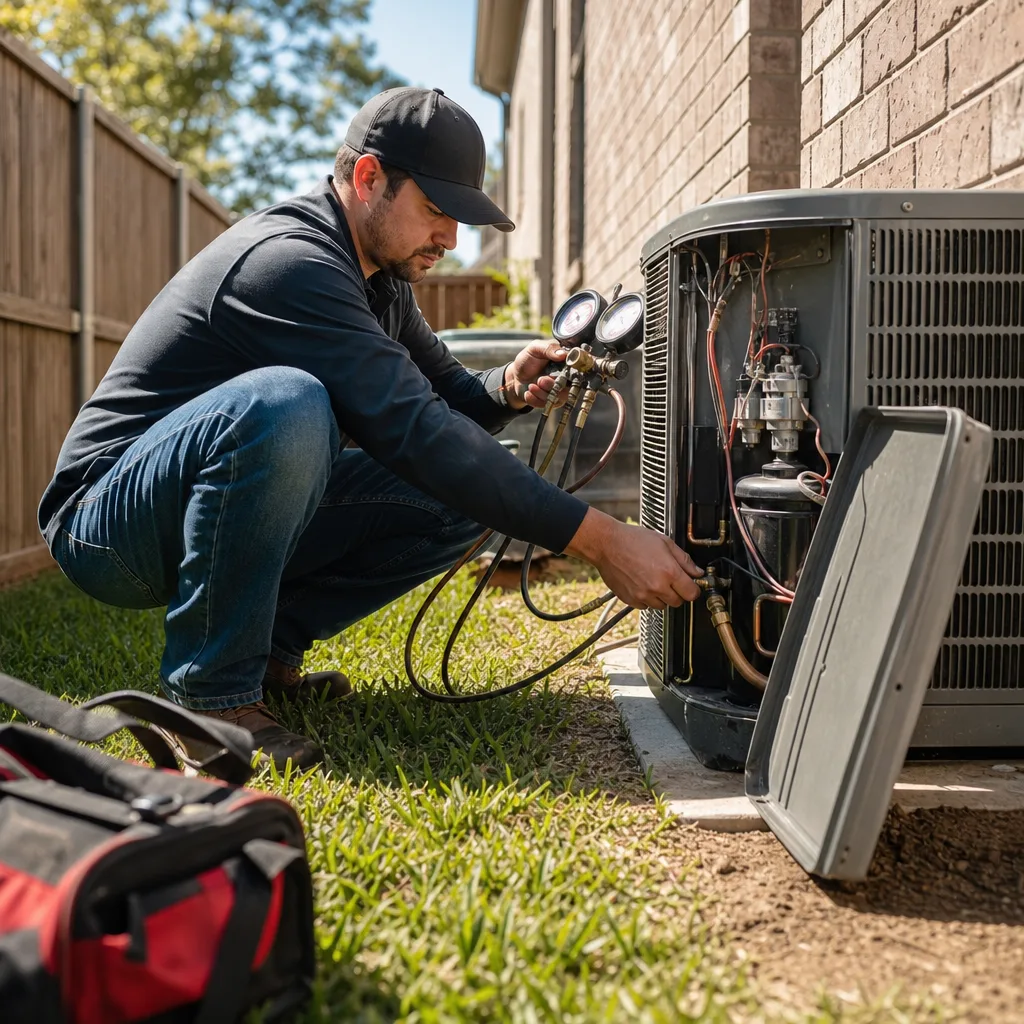
A repair visit has one goal. We find the part that failed, fix it, and prove your system is cooling again before we leave. You stay in charge of every decision along the way, and you’ll know the price before any work begins.
Here’s how it goes, step by step.
- We find the problem. Your technician starts with what you noticed, like warm air, a humming outdoor unit, or water near the indoor unit. Then they trace it to the part that’s failing. On a central system, that can be anything from a capacitor or fan motor outside to a clogged drain line or iced-up coil inside.
- You get the price up front. Once we know what’s wrong, you get a flat-rate price for the fix. It’s not an hourly meter that keeps running while someone works. Nothing gets done until you say yes.
- We make the repair. The technician repairs or replaces the failed part. Your price covers diagnosis, labor, and the standard replacement part.
- We test it. The fix isn’t done when the new part goes in. We run the system and check that it’s cooling right, not just turning on.
- We clean up. Cleanup is part of the job, so you’re not left sweeping up after us.
What if the technician finds more than one problem? Sometimes a part fails because something else wore it out, or a second part is close to failing too. If that happens, you’ll hear about it plainly. Additional failed parts, major components, code upgrades, and permits aren’t part of a standard repair price. They’re quoted separately, so you can decide what to fix now and what can wait. You won’t find them added to your bill after the fact.
There’s a $26-$99 service-call fee to send a technician to your home. If you go ahead with the repair, that fee is credited toward it. And if your AC quits on a Saturday night, you won’t pay more for that. There’s no extra charge for nights or weekends.
Who’s coming to your door matters too. Our technicians are licensed and insured, background-checked, and drug-tested. You’re letting someone into your home on a stressful day, and you should feel good about who walks in.
For most homeowners, this is a single visit. One worn-out part gets found, replaced, and tested, and the house starts cooling down again. If the problem turns out bigger, like a failed compressor or a system near the end of its life, you’ll get the facts and a separate quote. Financing is available on larger repairs and replacements, so you can make the call that’s right for your family without being rushed.
What’s Included in the Price and What Isn’t
Here’s the straight answer. Most central AC repairs we do run $150-$700. Our most common job, finding one failed part, fixing or replacing it, and making sure the system runs right, runs $150-$400. You’ll know your exact number after diagnosis and before any work starts.
So why a range and not one price? Two homes on the same Plano street can have the same symptom and very different repairs. These are the things that move your price up or down:
- How much failed. A worn capacitor is a small part. A burned-out fan motor is a bigger job. The extent of the failure is the biggest factor.
- Part cost and availability. Some parts are common and easy to get. Others cost more or take longer to track down.
- Your equipment’s age and brand. Older systems and certain brands can need parts that cost more than the standard ones.
- More than one problem. If two parts have failed, you’re paying for two repairs, not one.
- Timing. This one won’t change your price with us. A Sunday night call costs the same as a Tuesday morning call.
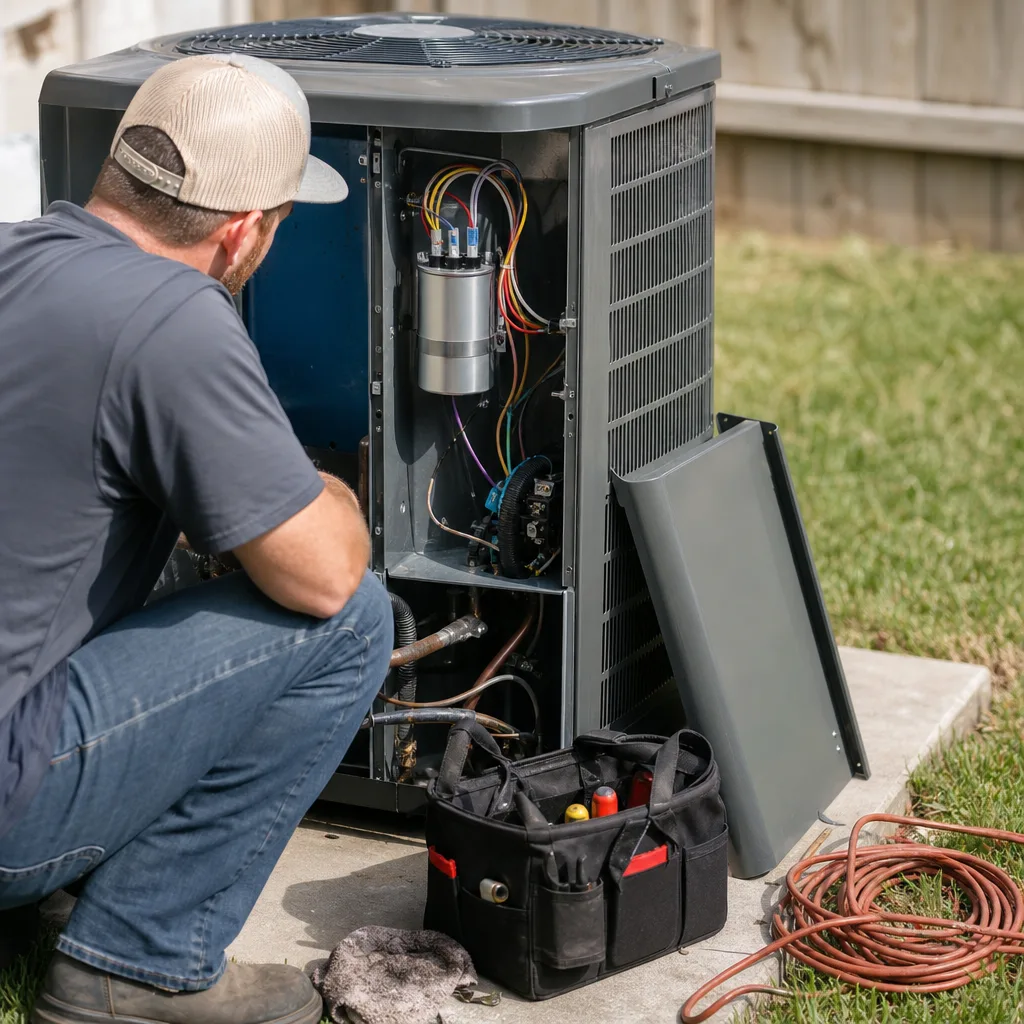
Picture a July evening. Your outdoor unit is humming, the fan isn’t spinning, and the house is getting warmer by the hour. That’s the kind of single-part problem the $150-$400 range is built around. Your quote covers the fix itself, the testing, and the cleanup we walked through above.
Where does the standard price stop? It stops at the big stuff. A compressor or a condenser coil is a major component, so it gets its own quote. The same goes for permits or code upgrades an older system might need. If your technician finds one of these, you’ll see a separate number and decide for yourself. Nothing gets folded into your bill quietly. Add in the service-call fee, which comes off your total when you go ahead with the repair, and you have the full picture.
A quick word on financing. For a smaller repair like this, we don’t typically offer it, because most single-part fixes don’t need it. If your repair turns into something larger, or you decide to replace the system, financing is available.
Whoever you call, these questions will tell you a lot about how a company prices its work:
- Is the price a flat rate, or are you charging by the hour?
- Will I approve the price before any work begins?
- Does the quote include the part, or just the labor?
- Is the trip or service-call fee credited if I go ahead with the repair?
- Do nights or weekends cost extra?
- If you find a second problem, will you stop and ask me first?
You should get a clear, simple answer to every one of these. If a company dodges them, that tells you something. With us, the answers are short. It’s upfront flat-rate pricing, you approve it first, the standard part is included, the fee gets credited, and there’s no extra charge for nights or weekends.
Have questions? We’re happy to help.
Call Today, Get Service Today. Xtreme Air Services — West Plano is ready to help.
What Drives the Cost of a Repair Up or Down
The biggest thing that moves your repair bill is timing. We don’t mean the clock, since nights and weekends cost the same with us. We mean how long a problem runs before someone fixes it. A lot of big repairs start out as small ones.
Take the capacitor. It’s a small part that doesn’t cost much. When it gets weak, your compressor and fan motor have to strain to start every time the system kicks on. Give that a few weeks of nonstop Plano heat, and a one-part fix can turn into two failed parts. Sometimes it turns into a separate quote for a major part like the compressor. The first repair was the low-cost one.
Airflow works the same way. A clogged filter starves the indoor coil of air. The coil can freeze, the system runs longer, and the blower motor works harder than it should. A new filter costs a few dollars. Fixing what a clogged filter caused costs a lot more.
Age changes the math in a different way. On a newer system in one of Plano’s newer subdivisions, parts are usually easy to find. On an older home still running its original system, a part may cost more, take longer to get, or no longer be made at all. Some older systems also use a refrigerant that’s harder to find and costs more to add. When your technician tells you that, it isn’t a sales pitch. It’s what you need to know to decide if one more repair makes sense.
So how do you know if a repair is worth it? Ask two questions. How old is the system? Is this its first big repair, or one of several? A single-part fix on a system that’s otherwise in good shape is usually worth doing. A major repair on a tired system deserves a second thought. Either way, you’ll get the facts and a separate quote. The choice is yours, with no one rushing you.
Here’s what tends to keep a repair small, and what tends to make it bigger:
- Small repairs: you call when you first notice warm air, a humming outdoor unit, or water near the indoor unit, before the system stops cooling altogether.
- Small repairs: you check and change your air filter often, especially in summer when the system runs the most.
- Small repairs: you keep the outdoor unit clear of grass clippings, leaves, and overgrown plants so it can move air freely.
- Bigger repairs: a weak part gets pushed for weeks until it takes another part down with it.
- Bigger repairs: an older system needs a hard-to-find part or a refrigerant that costs more.
- Bigger repairs: the failure reaches a major component, which gets its own quote.
None of this means you should worry about every little noise. It means a quick call about a small sign is often the least expensive call you’ll make. A Tuesday-afternoon capacitor swap beats a compressor quote in the middle of a July heat wave.
Watch Our Video
See How We Handle Central air conditioning repair in Plano
Xtreme Air Services — West Plano
When You Don’t Need to Call for Repair
Not every warm house needs a technician. Some problems take five minutes and cost you nothing. Try these checks before you pay a service-call fee. If one of them fixes it, great. You just saved yourself a visit.
- Check the thermostat. Make sure it’s set to Cool, not Heat or Off. Set it a few degrees below the room temperature. If the screen is blank, put in fresh batteries. A dead thermostat looks a lot like a dead AC.
- Check the breaker. Look in your electrical panel for a tripped AC or furnace breaker. Reset it one time. If it trips again, stop there. A breaker that keeps tripping means something is pulling too much power, and that’s a job for a pro.
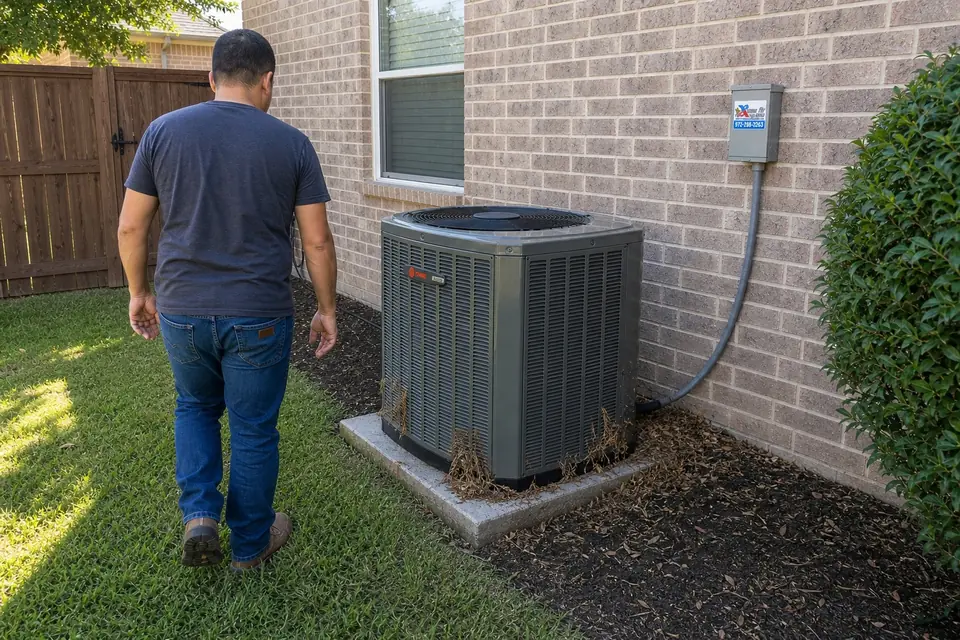
- Check the outdoor switch. Most outdoor units have a shutoff box on the wall nearby. Make sure it hasn’t been bumped off by a lawn crew or a curious kid.
- Give it a few minutes after a power blink. Many systems wait a few minutes before they restart after the power drops. That pause protects the compressor. Give it about five minutes before you decide it’s broken.
- Open the vents. Closed or blocked vents in a few rooms can make the whole house feel like the AC is weak. Move rugs and furniture off the floor vents too.
- Clear the outdoor unit. Pull away grass clippings, leaves, and plants pressing against the sides. The unit needs room to breathe.
If you spot ice on the indoor coil or the copper line, turn the system to Off and leave the fan on Auto. Then check your filter. A badly clogged filter can freeze a coil all by itself. Swap in a clean one and let the ice melt for a few hours before you turn cooling back on. If it cools fine after that and doesn’t ice up again, you’re done. If the ice comes back, the cause is something else, like low refrigerant or a weak blower, and you’ll want it checked.
Here’s one more that surprises people. On a 105-degree Plano afternoon, a healthy system may run all day and still struggle to get your house down to 72. That doesn’t always mean it’s broken. Every AC has limits, and the hottest days push right up against them. If the air coming out of your vents is cold and the house cools off once the sun goes down, your system is likely just working hard. Closing the blinds on west-facing windows helps more than you’d think.
So when can you wait? If the system cools well, the noise was a one-time thing, and nothing is leaking or icing, you can keep an eye on it. Make a note of what you saw and when. If it happens again, you’ll have good details to share. If it doesn’t, you didn’t need us. That’s a fine outcome too.
Frequently Asked Questions
Common questions about Central air conditioning repair
How fast can someone get to my house in Plano when my AC quits?
We offer same-day service, 6 days a week, so you’re not stuck waiting through a hot Plano afternoon. When you call, let us know what you’ve noticed, like warm air or water near the indoor unit, so your technician comes ready for the likely cause.
Is it worth fixing an older central AC, or should I think about something else?
It depends on the repair and the age of your system. A single-part fix, like a capacitor or fan motor, is usually worth doing even on an older system. A major repair, like a compressor, deserves a second thought, and we’ll always give you the facts and a separate quote so you can decide.
Do I need to be home during the repair visit?
You don’t have to watch the whole repair, but it helps to be reachable in case the technician finds a second problem. Since you approve every price before work starts, we’ll call or come find you if anything beyond the original issue turns up.
What should I do if my AC keeps shutting off on its own?
This is called short cycling, and it’s worth a call rather than waiting it out. It can come from a bad sensor, a thermostat problem, an electrical fault, or low refrigerant, and in Plano’s long summer heat, a system that keeps restarting puts extra strain on parts that are already struggling.
Ready to Get Started?
Call (469) 217-9095 Today, Get Service Today.