


Commercial HVAC Repair & Maintenance in Allen
Commercial and rooftop systems repaired before one failing part takes the rest down – plus preventive maintenance.
What’s Covered on This Page
- What Commercial HVAC Repair & Maintenance Covers
- Signs Your Rooftop Unit or Commercial System Needs a Repair Call
- Checks to Make Before Calling for Commercial Repair
- Verify Your Contractor Is Licensed for Commercial Mechanical Work
- What a Commercial Repair Costs and What’s Included
- Who is responsible for HVAC repairs in a leased commercial space, me or my landlord?
- How fast can a technician reach my rooftop unit if it’s down during business hours?
- Can one technician fix both the HVAC and an electrical problem if that’s what’s really wrong?
- Does a commercial maintenance visit include checking the electrical connections, not just cleaning the coils?
What Commercial HVAC Repair & Maintenance Covers
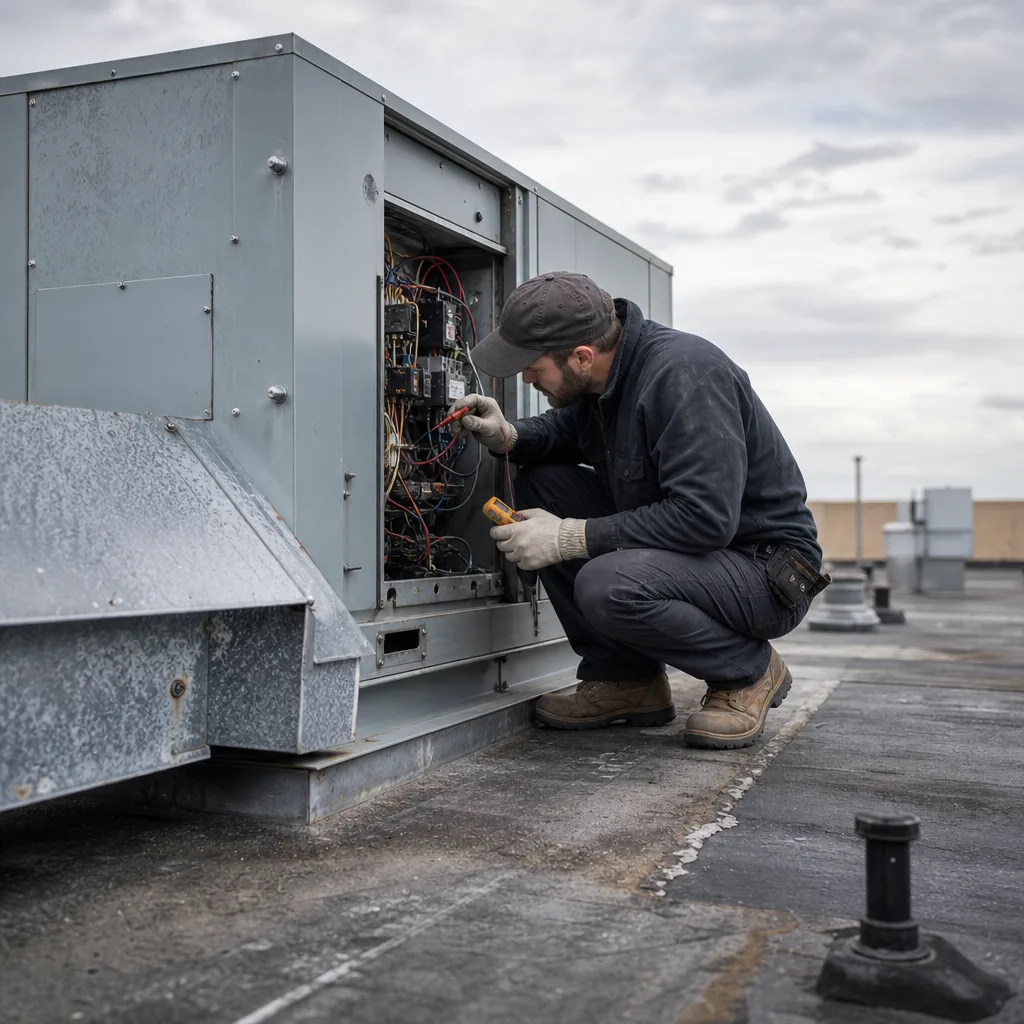
Commercial HVAC repair and maintenance is the work that keeps your building’s heating and cooling running, so your doors stay open and your customers, staff, and tenants stay comfortable. When something quits, the job is simple to describe. We find the failed part, repair or replace it, and make sure the system runs right before we leave. Most calls come down to one common failure that gets fixed on the first visit.
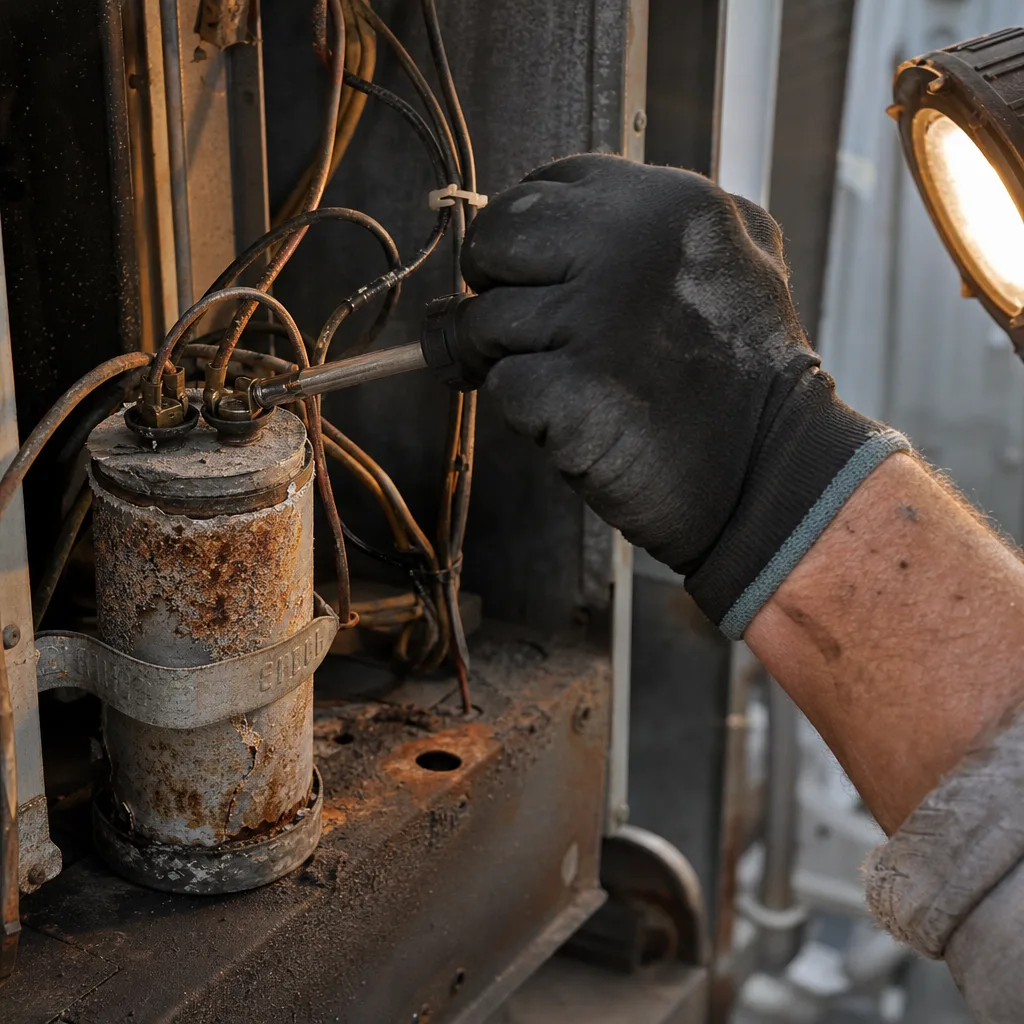
In Allen, that usually means equipment that works hard through long Texas summers. Here’s what the service reaches:
- Rooftop units (RTUs), the all-in-one systems that cool most strip centers, offices, and retail spaces
- Compressors, capacitors, and fan and blower motors, the parts that most often stop a system cold
- Refrigerant leaks and recharges when your unit is running but not cooling
- Condenser and evaporator coil cleaning, which helps your system move heat the way it should
- Drain lines that clog and back up into ceilings or work areas
- Thermostats, controls, and building automation that tell the whole system when to run
- Commercial ductwork and system balancing when some rooms are freezing and others are hot
Because we’re one team for HVAC, plumbing, electrical, and refrigeration, you don’t need a second company if the problem turns out to be a bad circuit or a walk-in cooler that’s also struggling. We also handle commercial refrigeration, kitchen ventilation, and make-up air systems, and each of those has its own page.
Maintenance is the other half of the job. A commercial tune-up usually means cleaning coils, changing filters, checking belts and electrical connections, clearing drain lines, and testing how the system starts and runs. The goal is to catch a weak part on a slow Tuesday instead of losing it on a packed Saturday in August. If you want that on a regular schedule, we offer commercial preventive maintenance.
Here’s what you’re paying for on a typical repair. The price includes diagnosis, labor, and the standard replacement part, plus testing and cleanup. It doesn’t include additional failed parts, major components, code upgrades, or permits unless they’re quoted separately. That way, if your technician finds a second problem, you’ll hear about it and approve it before anything changes.
Most commercial repairs fall between $300 and $2,400. The full range for this work runs $300 to $5,000, depending on how bad the failure is, what the part costs and how fast it can be found, your equipment’s age and brand, and whether more than one part has failed. Timing won’t push your price up, though. There’s no extra charge for nights or weekends. The service-call fee is $26 to $99, and it’s credited toward your repair if you go ahead with Xtreme Air Services. Flexible financing is available on qualifying installations and larger jobs, on approved credit.
Signs Your Rooftop Unit or Commercial System Needs a Repair Call
Your rooftop unit sits up where you can’t see it, so trouble usually shows up downstairs first. You notice it in the room temperature, the noise, a water stain, or the power bill. Here’s what each sign tends to point to, so you can tell a small hiccup from a real repair call.
- Warm air, or a space that won’t cool down. If the thermostat says 72 and the sales floor feels like 80 by mid-afternoon, the system isn’t keeping up. That can mean a failed capacitor or fan motor, low refrigerant from a leak, or a dirty coil that can’t shed heat.
- The unit runs nonstop, or it keeps clicking on and off. A system that never shuts off on a mild day is working too hard. One that starts and stops every few minutes, called short cycling, often has an electrical or control problem. Both wear parts out faster.
- New noises from the roof or the vents. A squeal often points to a worn belt or bearing. Grinding can mean a motor is failing. Buzzing or repeated clicking with no cooling can mean the compressor is trying to start and can’t.
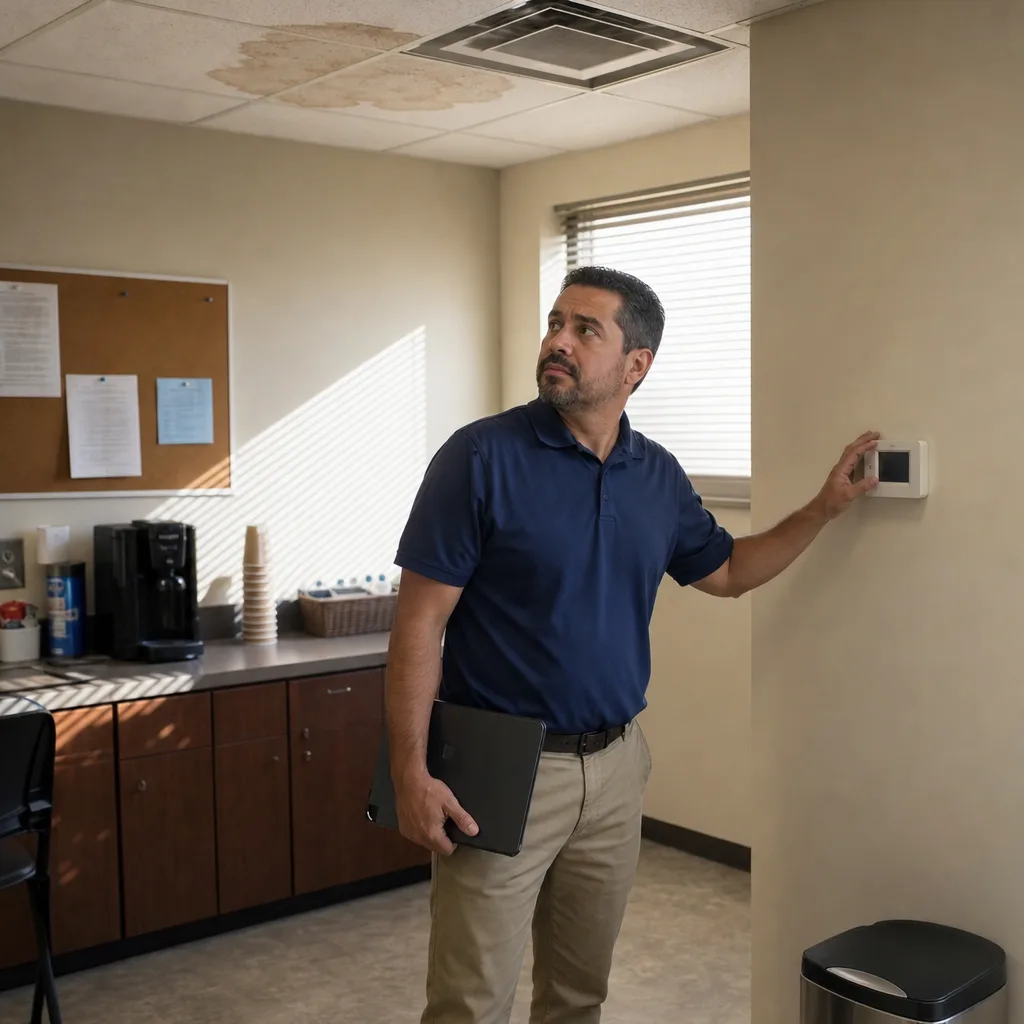
- Water where it doesn’t belong. Ceiling tile stains under the unit, drips near a supply vent, or a soggy spot on the roof usually mean a clogged drain line or a cracked drain pan. Left alone, that water finds your inventory, your ceiling, or your tenant’s office.
- Ice on the lines or coil. Frost on the copper refrigerant line is a sign of low refrigerant, a dirty filter, or weak airflow. Ice blocks air and keeps your space from cooling.
- Some rooms freeze while others bake. Uneven temperatures can come from a failing damper, a control issue, or ductwork that’s out of balance.
- A power bill that jumps for no clear reason. If your hours and occupancy didn’t change but your bill did, the system is probably running longer to do the same job.
- A burning or electrical smell from the vents. This points to an electrical part overheating and shouldn’t wait.
Texas summers make these signs show up fast. A unit that limps through May can quit outright the first week it’s over 100 degrees, because that’s when every part is pushed hardest. Spring and summer storms matter too. After hail, it’s worth having someone look at the condenser coil, since bent fins and damaged coil tubes can cut cooling even if the unit still turns on.
If it’s still not right, jot down what you noticed and when. Which rooms are affected, what the thermostat reads versus how it feels, any sounds, and whether it started after a storm or a power blip. That helps your technician narrow it down faster once they’re on the roof, which means less downtime for your business.
Checks to Make Before Calling for Commercial Repair
You’ve already checked the thermostat, the breaker, and the filter. A commercial building has a few more places where your system can be told to stop. Some of them take two minutes to rule out. These checks can save you a service call, or at least make the one you do book a lot shorter.
- Your building controls or schedule. If your space runs on a control system or a programmable schedule, look for a holiday mode, an unoccupied setting, or an override someone forgot to clear. A unit that thinks the building is closed will sit idle during business hours and look broken.
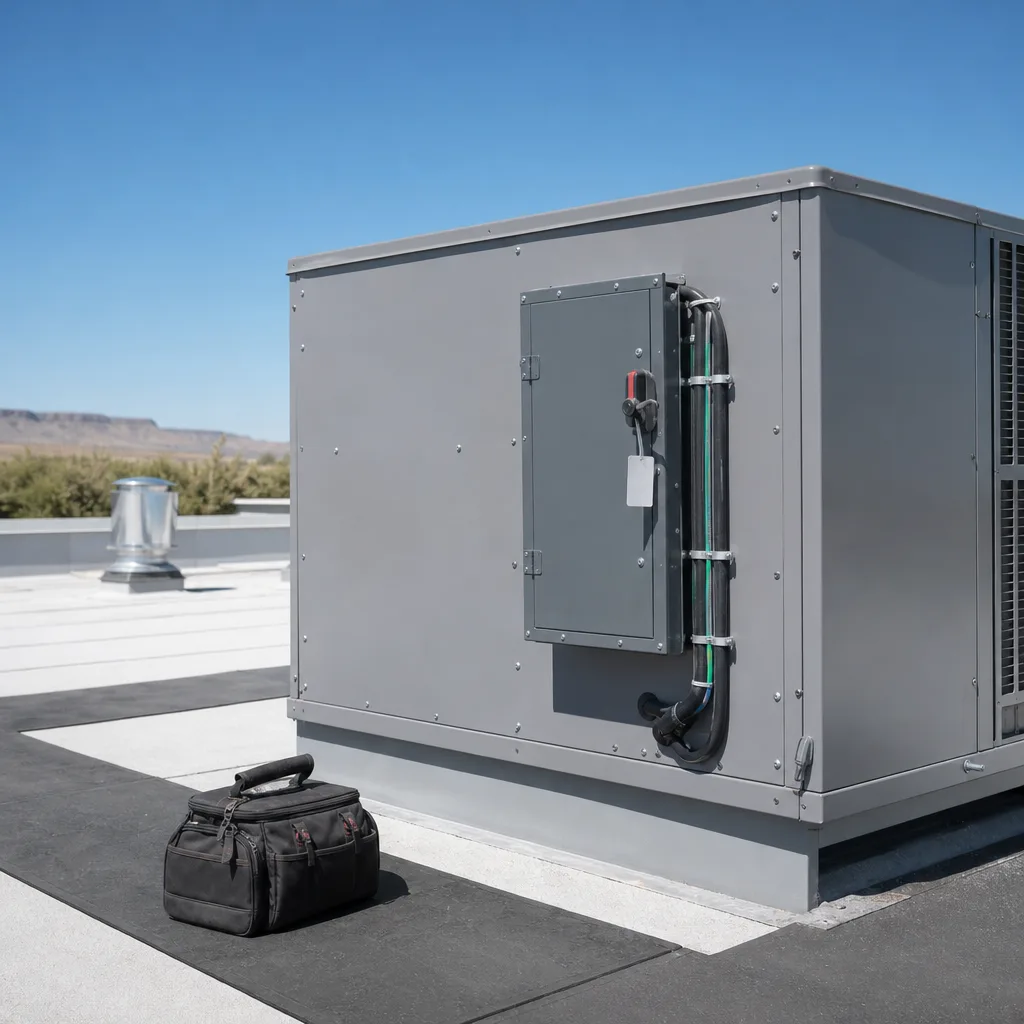
- The disconnect switch at the unit. Every rooftop unit has a shutoff box right next to it. Roofers, sign crews, and other trades sometimes flip it off and forget to turn it back on. If someone on your team can reach the roof through a proper hatch, it’s worth a look. If not, leave it for your technician.
- One unit or all of them? Many offices and strip centers in Allen have several rooftop units. If every one quit at the same time, think about the building’s power first, not the HVAC. If only one quit, the problem likely lives in that unit.
- A full drain pan. Many units have a float switch that shuts the system off when the drain pan fills up. A system that went dead after a humid stretch, with no other clues, may be protecting your ceiling. Flipping it back on won’t help until the clog is cleared, so that one does need a repair visit.
- Blocked returns and vents inside. Boxes, stock, or furniture stacked against a return grille can choke your system’s airflow. Clear anything sitting in front of returns and supply vents, then give it time to catch up.
Next, check your lease. In some commercial leases, the tenant pays for HVAC repairs and upkeep. In others, the landlord or property manager handles it and has a contractor they call first. Knowing who’s responsible before you pick up the phone keeps you from paying for a repair someone else owes. It also saves a day of back-and-forth while your space heats up.
If none of that does it, have these things ready so your technician can get right to work:
- The model and serial number from the unit’s nameplate, or a clear photo of it
- How to get on the roof, such as the hatch location, a ladder, a key, or the building manager’s number
- Any recent work on the roof, the unit, or the electrical panel, even if it seems unrelated
- Your last service date or maintenance records, if you have them
- Your hours, and whether you’d rather have the work done before opening or after closing
That last one matters more than people think. Since nights and weekends cost the same, you can pick a time that keeps your doors open and your customers comfortable.
If one of these checks gets the cool air running again, you’re done. You don’t need a visit. If the unit comes back on but quits again within a day, the first shutdown wasn’t a fluke. Get it looked at before the next hot afternoon turns a small fix into a lost day of business.
Not sure what your Commercial HVAC repair & maintenance project needs? Ask us.
Call Today, Get Service Today. Xtreme Air Services — Allen is ready to help.
Verify Your Contractor Is Licensed for Commercial Mechanical Work
Anyone can put a ladder against your building. Not just anyone can legally repair your HVAC system in Texas. The Texas Department of Licensing and Regulation, or TDLR, licenses air conditioning and refrigeration contractors. Before someone works on your rooftop unit, take two minutes to make sure they hold a current license. That small step protects your building, your lease, and your budget.
Checking matters more for a business than for a house. Commercial equipment is bigger, it runs on higher-voltage power, and it often sits on a roof your landlord owns. If an unlicensed worker damages the unit or the roof, your insurance may not cover it, and your landlord may hold you responsible. Texas licenses also come in different classes, and some classes limit the size of equipment a contractor can work on. Ask whether the license covers equipment the size of yours.
Ask for these things before work starts:
- The contractor’s TDLR license number. A real contractor will give it to you right away. You can look it up on TDLR’s website and check that the name and status match the company at your door.
- Who’s doing the work. Technicians in the field often work under a licensed contractor. Ask whether the person on your roof is registered or licensed and covered by that contractor’s license.
- Proof of insurance. Ask for a certificate of insurance. Many commercial leases and property managers require one before anyone goes on the roof, so it’s smart to have it on file.
- Refrigerant certification. Technicians who handle refrigerant need federal certification. If your unit has a leak or needs a recharge, ask about it.
- A written price you approve first. You should see what’s included and what isn’t, such as permits or extra parts, before anyone picks up a tool.
Watch for red flags too. A cash-only price with no paperwork is one. So is a truck with no company name, or someone who gets vague when you ask for a license number. After a big North Texas hail storm, out-of-town crews sometimes go door to door at strip centers and office parks. Not all of them are bad, but check the license before you sign anything.
Here’s ours, so you don’t have to ask. Xtreme Air Services holds Texas HVAC License #TACLA29023C. We’re licensed and insured, and our background-checked and drug-tested team members handle HVAC, plumbing, and electrical. If your repair turns up a second problem in another trade, you won’t need to vet a second company. Our Allen location is at 1333 W McDermott Dr, Suite 200.
Call now
Watch Our Video
See How We Handle Commercial HVAC repair & maintenance in Allen
Xtreme Air Services — Allen
What a Commercial Repair Costs and What’s Included
You already know the ranges from earlier on this page. What matters now is how your number gets set, so you can tell a fair quote from a padded one. With upfront flat-rate pricing, you see the price for the job and approve it before work starts. It doesn’t change because the repair took longer than expected, and there’s no meter running while your technician works on the roof.
Here’s how each cost factor shows up on a real job:
- How bad the failure is. A unit that won’t start because of one burned-out part costs less to fix than one where that part failed and took something else down with it.
- Part cost and availability. Common parts are often easy to find. Parts for some equipment can take longer to track down, and that affects both the price and how soon you’re cooling again.
- Equipment age and brand. Older rooftop units can need parts that are harder to source. Some brands also use parts that cost more than others.
- More than one failure. If a capacitor quit because a fan motor was struggling, replacing only the capacitor sets you up for a repeat call. Your technician should tell you about both parts.
- When you call. This one won’t raise your bill. There’s no extra charge for nights or weekends, so a Saturday breakdown costs the same as a Tuesday one.
The bigger numbers usually come from what’s excluded from a standard repair. Major components, extra failed parts, code upgrades, and permits are quoted separately. Say your technician replaces a bad part and then finds the compressor is failing too. You’ll hear about it, see a separate price, and decide. Nothing gets added to your bill without your yes.
That approval step also gives you room to think. If a major component on an older unit has failed, you might want to weigh the repair against a replacement, check with your landlord, or plan the work for a slower week. Flexible financing is available on qualifying installations and larger jobs, on approved credit, so a bigger repair doesn’t have to come out of one month’s budget.
Before you approve any commercial repair, ask these questions. A good contractor will answer them without fuss:
- What failed, and what caused it to fail?
- Is this price for the whole job, including labor, the part, testing, and cleanup?
- Did you see any other parts that are close to failing?
- Will this job need a permit or any code work?
- Is the service-call fee credited toward the repair if I go ahead?
With us, that last answer is yes. The service-call fee is credited toward your repair when you move forward with Xtreme Air Services. Since most calls come down to one common failure fixed on the first visit, the price you approve is often the only price you’ll see.
Call 469-299-8996
Frequently Asked Questions
Common questions about Commercial HVAC repair & maintenance
Who is responsible for HVAC repairs in a leased commercial space, me or my landlord?
It depends on what your lease says. Some commercial leases make the tenant responsible for HVAC repairs and upkeep, while others put that duty on the landlord or property manager. Check your lease before you call anyone, so you don’t end up paying for a repair someone else owes. This also saves you a day of back-and-forth while your space sits uncomfortable.
How fast can a technician reach my rooftop unit if it’s down during business hours?
Same-day service is available 6 days a week, so a down unit doesn’t have to cost you more than one business day. Since there’s no extra charge for nights or weekends, you can schedule the repair before opening or after closing instead of shutting your doors during busy hours. Have your roof access and unit nameplate info ready so the visit goes faster once the technician arrives.
Can one technician fix both the HVAC and an electrical problem if that’s what’s really wrong?
Yes, one team handles HVAC, plumbing, and electrical work, so a bad circuit behind your rooftop unit doesn’t mean calling a second company. This matters because electrical problems often show up as HVAC symptoms, like a unit that won’t start or keeps tripping a breaker. If your repair turns up a wiring issue, it gets diagnosed and fixed in the same visit.
Does a commercial maintenance visit include checking the electrical connections, not just cleaning the coils?
Yes, a commercial tune-up includes checking belts and electrical connections along with cleaning coils, changing filters, clearing drain lines, and testing how the system starts and runs. The goal is catching a weak part before it fails on a busy day. This matters most in North Texas, where summer heat pushes every connection and component harder.
Ready to Get Started?
Call (469) 299-8996 Today, Get Service Today.