


Chiller Installation in Plano for Commercial Buildings
Commercial chiller replacement sized for your building, with what's included and excluded explained before work starts.
What’s Covered on This Page
- Chiller Installation Is Commercial Mechanical Work, Not Residential AC
- Standard Scope Covers Equipment, Installation, Startup, and Testing
- What Drives Chiller Installation Cost Up or Down
- One Licensed Team Handles Electrical and Plumbing Factors That Expand Scope
- Plan Ahead Before an Aging Chiller Fails During Peak Season
- What is the $5,000 rule people mention for HVAC systems?
- Does my chiller installation need a permit in Plano?
- Is a rooftop or ground-level chiller a bigger job to install?
Chiller Installation Is Commercial Mechanical Work, Not Residential AC
Chiller installation is a different kind of job from swapping out the AC on your house. A home system cools air directly with refrigerant. A chiller cools water instead. That chilled water travels through a loop of pipes to air handlers and coils spread across your building. Fans then blow air across those coils to cool each space.
Because the chiller sits at the center of everything, a lot of other equipment depends on it being set up right:
- Pumps that keep chilled water moving through the building
- Piping that has to be sized, insulated, and connected without leaks
- A cooling tower, if you have a water-cooled chiller, to get rid of the heat the chiller pulls out
- Electrical service big enough to start and run a large compressor
- Controls that tell the chiller, pumps, and air handlers how to work together
Get any one of those wrong and the whole building feels it. In a North Texas summer, that can mean warm offices, unhappy tenants, or a process line that has to shut down. That’s why this work is about keeping your business running, not just about comfort.
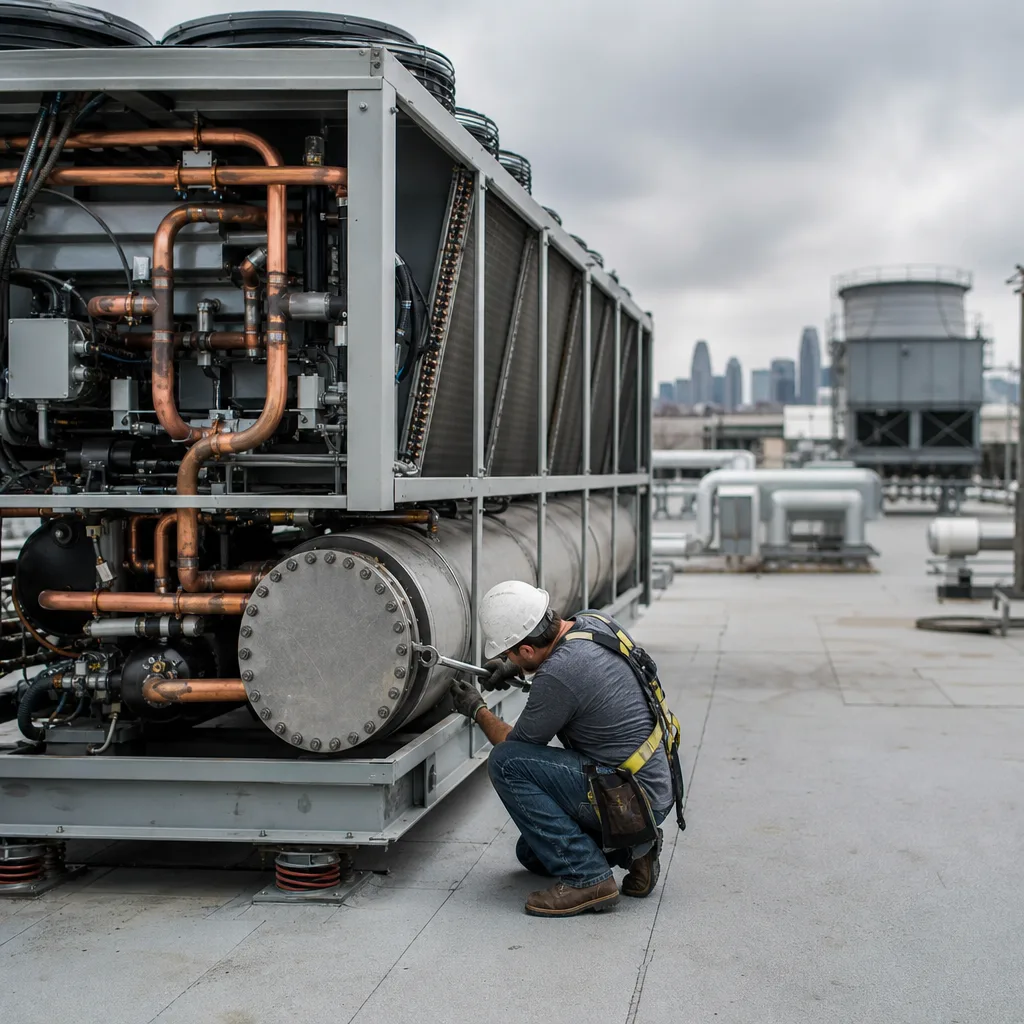
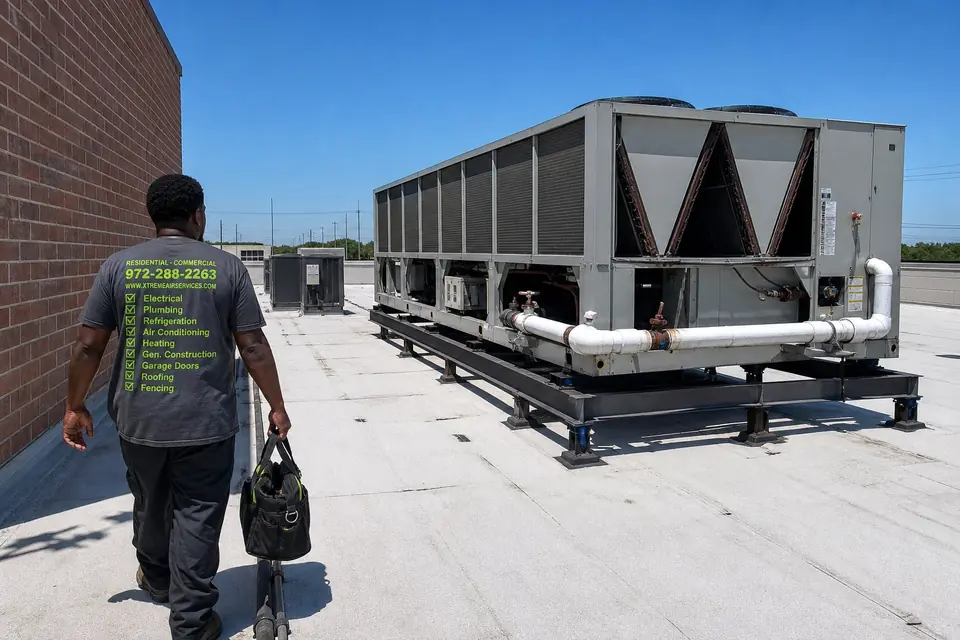
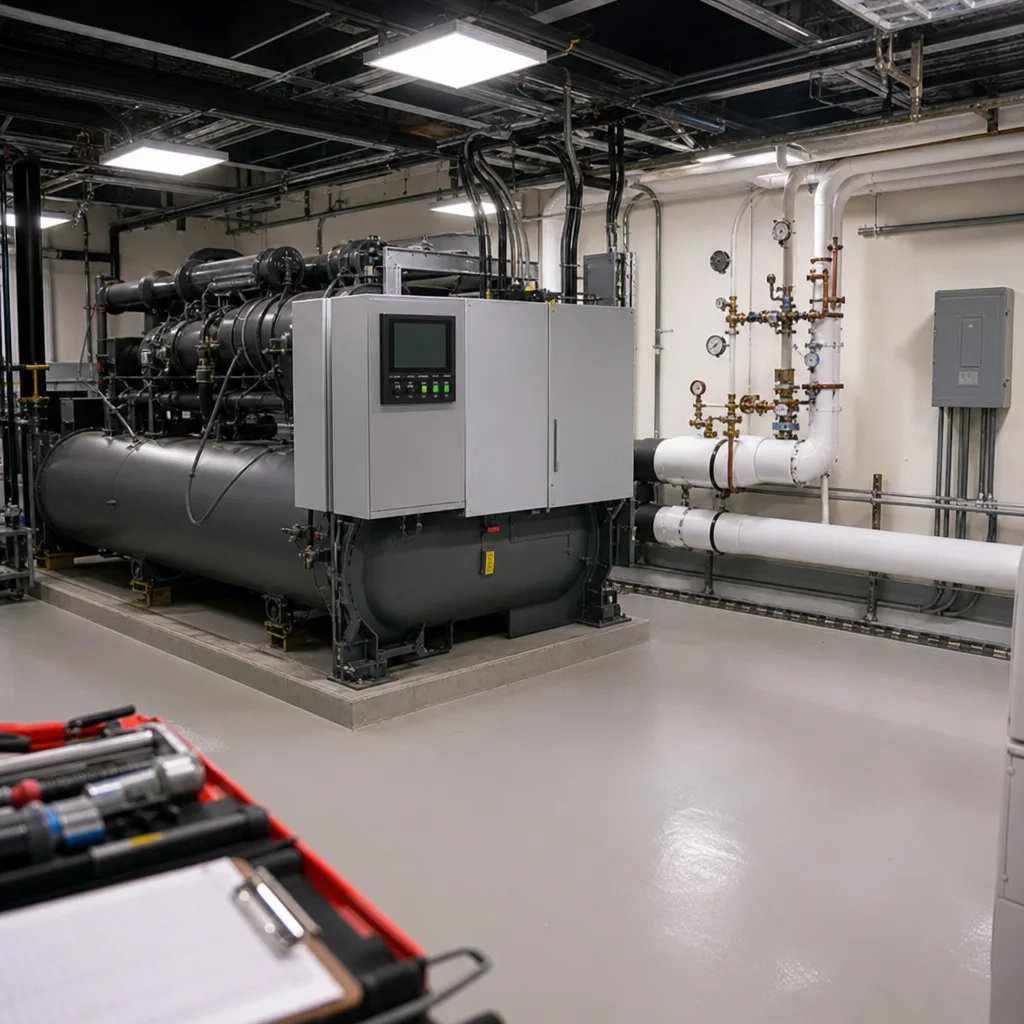
Chillers come in two main types. Air-cooled chillers sit outside, often on a roof or a pad, and use fans to shed heat. Water-cooled chillers usually sit in a mechanical room and send their heat to a cooling tower. Which one fits your building depends on its size, how much space you have, and how hard the system has to work.
Here’s the honest part. If you own a home in Plano and your AC is struggling, a chiller isn’t the answer. Even large homes are cooled with central air conditioning, heat pumps, or ductless mini-splits. Those cost far less and are much simpler to keep running. Our central air conditioning installation, heat pump installation, and cooling load calculation services are the right place to start. You’ll save yourself a lot of money and hassle.
Chillers make sense for buildings that need a lot of cooling in one central plant. Think office buildings, schools, medical facilities, larger retail spaces, and manufacturing or process cooling. If your building already has a chiller and it’s reaching the end of its life, replacing it is usually the cleanest path. Switching to a whole new type of system is a much bigger project.
This is also why the contractor you pick matters so much. A chiller job touches HVAC, plumbing, and electrical all at once. Xtreme Air Services is a licensed and insured contractor (HVAC License #TACLA29023C) and a Trane Comfort Specialist. We handle HVAC, plumbing, and electrical under one roof. Our mechanical work also covers cooling tower installation, piping installation, pump installation and repair, and building automation. That means one accountable team owns the full chiller plant, instead of several crews pointing at each other when something doesn’t line up.
Standard Scope Covers Equipment, Installation, Startup, and Testing
When you’re budgeting for a chiller, the first thing you want to know is what the price buys. Our most common chiller installation is a standard like-for-like job. That means a new chiller goes in where the old one was, using the existing connections with no major changes to the building. That job runs $42,000-$96,000. It covers the equipment and materials plus professional installation, startup, and testing.
Across all chiller jobs, our typical price range is $15,000-$150,000. The spread is wide because chillers vary a lot. A small air-cooled unit for one building is a very different job from a large water-cooled plant tied to a cooling tower.
Here’s what’s included in a standard installation:
- The chiller and the materials needed to set it
- Professional installation
- Standard connections to your existing piping, power, and controls
- Startup and testing
- Haul-away of the old unit
Startup and testing matter more than most people think. Startup is the first time the new chiller runs with real water moving through your building’s loop. Testing confirms it’s cooling the way it should, so you aren’t finding out on the first 100-degree afternoon that something’s off. In a North Texas summer, that check is what keeps your tenants, staff, or process line running.
Here’s what’s not included unless your quote says otherwise:
- Duct, electrical, or plumbing modifications
- Code corrections
- Permits
Those items depend on the building, not on the chiller. Two owners can buy the same unit and still get very different bills. If one building needs a bigger electrical feed or new piping and the other doesn’t, the costs won’t match.
These are the things that push the price up or down:
- Equipment size, capacity, and efficiency. Tonnage is how much cooling the chiller can deliver. More tonnage and higher efficiency usually cost more up front.
- Brand and model
- Ease of access. A rooftop unit that needs a crane, or a mechanical room with a tight doorway, takes more work than a ground-level pad.
- Condition of the existing wiring, piping, and ductwork
- Code upgrades and permits
- Any custom fabrication needed to make the new unit fit
When you compare quotes, line them up against these two lists. Ask each contractor whether startup and testing are included. Ask whether haul-away is covered, and which modifications they expect your building to need. A low number that leaves out startup or permits isn’t really a lower price. It just moves the cost to later.
A couple of practical notes. There’s a $26-$99 service-call fee for the visit, and it’s credited toward the work if you go ahead with Xtreme Air Services. A chiller is a big investment, so flexible financing is available on qualifying installations and larger jobs, on approved credit. That can help you replace a failing unit now instead of waiting through another summer.
What Drives Chiller Installation Cost Up or Down
The lists above tell you what moves the price. Here’s how those factors show up in a real building, and which ones you get a say in. Some are set by your building. Others are choices you make, and those choices can save you real money or cost you for years.
Size is the first choice, and bigger isn’t better. An oversized chiller costs more up front. It also turns on and off too often, which wears it out faster and doesn’t control humidity well. The right size comes from a cooling load calculation, not from copying the tonnage on the old nameplate. Your building may have changed since that chiller went in. You might have added a server room, more people, or a tenant with heavy equipment. Or a floor might sit half empty now. Any of those changes the size you really need.
Efficiency is the next choice. A more efficient chiller costs more to buy. In Plano, though, the cooling season runs long, and a commercial chiller can work hard for many months of the year. The harder your chiller runs, the faster a higher-efficiency unit earns back its extra cost on your power bill. Ask any contractor you talk to for an estimate of what the chiller will cost to run, not just to install.
Access is set by your building, and it can swing the price a lot. A rooftop unit may need a crane lift. That lift often has to be planned for early morning or a weekend so it doesn’t block your parking lot or your customers. Ground-level units need a solid pad. North Texas has expansive clay soil that swells when it’s wet and shrinks when it dries. An old pad that has shifted or cracked may need to be leveled or rebuilt before a new chiller can sit on it. Rooftop air-cooled units also take the brunt of spring hail, so it’s worth asking how the coils will be protected.
Your building’s condition is where surprise costs hide, even on a like-for-like swap. Here’s what can turn a simple job into a bigger one in an older building:
- Chilled water piping that’s corroded, leaking, or missing insulation
- An electrical feed that can’t safely start a newer compressor
- Old controls that can’t talk to the new chiller, pumps, and air handlers
- Pumps near the end of their life that would fail soon after the new chiller goes in
None of these are reasons to panic. They’re reasons to have the whole plant looked at before you get a final number, so the quote matches your building and the cost doesn’t show up halfway through the job.
Timing is the factor you control the most. If your chiller fails in July, you have fewer choices. You take the equipment that’s available, and you’re working against the clock while your building heats up. If your chiller is aging, noisy, or needing repairs more often, planning the replacement for spring or fall gives you room to choose the right size and efficiency. It also lets you schedule the changeover when your building can go without full cooling for a short while. Planning ahead also gives you time to look at financing instead of making a rushed decision.
Ready when you are – get in touch today.
Call Today, Get Service Today. Xtreme Air Services — North Plano is ready to help.
One Licensed Team Handles Electrical and Plumbing Factors That Expand Scope
The electrical and plumbing changes left out of a standard quote are where most chiller jobs grow. When those changes come up, it matters who does them just as much as what they cost.
Start with power. A new chiller doesn’t always draw power the same way the old one did. Its nameplate may call for a different breaker, disconnect, or wire size. Many newer chillers use a variable-speed drive. That drive eases the compressor on gently instead of slamming it on, but the circuit has to be set up to protect it. If your building’s electrical service is already near its limit, a bigger feed may mean working with Oncor, the utility that delivers power in Plano. That takes lead time, so it’s better to find out early.
Electrical items that can come up on a chiller job include:
- A new disconnect or breaker sized for the new chiller
- Heavier wiring, or a dedicated circuit for pumps and controls
- A panel or service upgrade when the building can’t carry the load
- Code corrections that an inspection turns up once the old unit comes out
Plumbing has its own list. A water-cooled chiller depends on a cooling tower that loses water as it works, so the tower needs a steady makeup water line. That line needs a backflow preventer so tower water can’t flow back into city water. The chilled water loop also has to be drained, flushed, and refilled when the new chiller goes in, and the valves and pump connections have to line up with the new unit. North Texas water is hard. It leaves scale inside towers and heat exchangers, so plan for water treatment from day one.
Here’s how jobs go sideways. You take the lowest quote, and it only covers setting the chiller. Then you find out the electrical work needs a different contractor and the makeup water line needs a third. Now three schedules have to line up. If the chiller won’t start, each crew can point at the others while your building sits warm.
Xtreme Air Services is a licensed and insured HVAC contractor (HVAC License #TACLA29023C) with plumbing and electrical under one roof. Our work includes commercial electrical, code correction, piping installation, pump installation and repair, and backflow testing. That means one company answers for whether the whole plant works, not just the box on the pad.
Because those changes are left out unless your quote says otherwise, ask to see them as separate line items. With upfront flat-rate pricing, you approve the price before work starts, so you know what the power and plumbing changes will cost before anyone picks up a tool.
Call 469-527-5131
Watch Our Video
See How We Handle Chiller installation in Plano
Xtreme Air Services — North Plano
Plan Ahead Before an Aging Chiller Fails During Peak Season
You already know a July failure leaves you with fewer choices. The good news is that most chillers give you some warning first. Here’s what to watch for, and what to do once you see it.

These signs mean your chiller may be getting close to the end:
- Repair calls are coming more often, and each one costs more than the last.
- Your power bills keep climbing even though your building is being used the same way.
- The building holds temperature in the morning but drifts warm on hot afternoons.
- The chiller needs refrigerant added again and again, which points to a leak.
- You hear new noise or feel new vibration, or you see oil around the compressor.
- Your service tech has trouble finding parts, or your unit runs on an older refrigerant that’s no longer made and gets more expensive to top off every year.
Age alone isn’t a reason to replace a chiller. If yours has been well maintained, holds temperature, and only needs an occasional repair, fixing it is often the smarter use of your money for now. The time to start planning a replacement is when repairs keep stacking up, or when one big repair would cost a large share of what a new unit costs. A straight look at your repair history usually makes the answer clear.
If you’re leaning toward replacing it, use the cooler months to get ready. A few steps make the job go smoother:
- Write down the information on your chiller’s nameplate, and pull together your service records and a year of power bills.
- List the spaces that can’t go without cooling, like server rooms, medical areas, or a process line.
- Ask for a full look at your pumps, piping, electrical feed, and controls, so your quote reflects your real building.
- Get the permit and any power upgrade with Oncor started early, since those can take time.
- Pick a changeover window when your building is lightly used, and decide whether critical spaces need temporary cooling during the swap.
- Check your financing options before you need them, not after the old unit quits.
Picture two building owners with the same aging chiller. One plans in the fall, gets the right size, and swaps it on a mild weekend while tenants barely notice. The other waits, and the compressor fails on a 100-degree afternoon in August. Now that owner is renting temporary cooling, paying to rush the job, and fielding calls from unhappy tenants. Both end up with a new chiller. Only the first one gets to choose how it happens.
With a Plano cooling season that runs long, the best time to plan is while your chiller still runs. You keep control of the size, the efficiency, the schedule, and the budget. Your building keeps running the whole time.
Call 469-527-5131
Frequently Asked Questions
Common questions about Chiller installation
What is the $5,000 rule people mention for HVAC systems?
It’s a rule of thumb some contractors use to decide repair versus replace, not a code requirement. You multiply the repair cost by the age of the equipment, and if that number tops $5,000, replacement usually makes more financial sense than another repair. For a chiller, this matters most once repair calls start stacking up and each one costs more than the last. A straight look at your repair history, compared against a replacement estimate, usually makes the decision clear.
Does my chiller installation need a permit in Plano?
Most commercial chiller installations need a permit, since the work touches mechanical, electrical, and sometimes plumbing systems. Permit and inspection requirements can also depend on code upgrades the job triggers, like an electrical service increase. Getting the permit process started early matters most when your building needs a bigger power feed, since utility coordination can add lead time before the installation can begin.
Is a rooftop or ground-level chiller a bigger job to install?
A rooftop chiller is usually the bigger job because it often needs a crane lift to set the unit in place. That lift has to be scheduled carefully, often early morning or a weekend, so it doesn’t block your parking lot or customers. Ground-level units need a solid pad instead, and older pads sometimes need releveling or rebuilding before a new chiller can sit on them safely.
Ready to Get Started?
Call (469) 527-5131 Today, Get Service Today.