


Commercial HVAC Installation in Plano: Is Your Contractor Qualified?
New commercial systems scoped and sized for your building, with what's included and what costs extra laid out first.
What’s Covered on This Page
- Commercial HVAC Installation Covers More Than Home AC Replacement
- Texas Licensing Rules Decide Who Can Legally Do This Work
- Plano’s Mechanical Permit Process for Commercial Installations
- How the Installation Process Works From Consultation to Startup
- Keeping Your Business Running During Installation
- What factors drive the cost of a commercial AC installation up or down?
- What is the $5,000 rule people mention for HVAC systems?
- How big of a unit do I need for a 5-ton-sized commercial space?
Commercial HVAC Installation Covers More Than Home AC Replacement
Commercial HVAC installation in Plano is a different job from putting a new AC in a house. At home, one system cools one family. In your building, the equipment has to keep up with customers coming and going, a full staff, computers, lights, and sometimes kitchen equipment, all through long days in a North Texas summer. If the system is wrong for the space, the trouble doesn’t stay with you. Your tenants, customers, and employees feel it, and so does your bottom line.

Here’s what makes a commercial install its own kind of work:
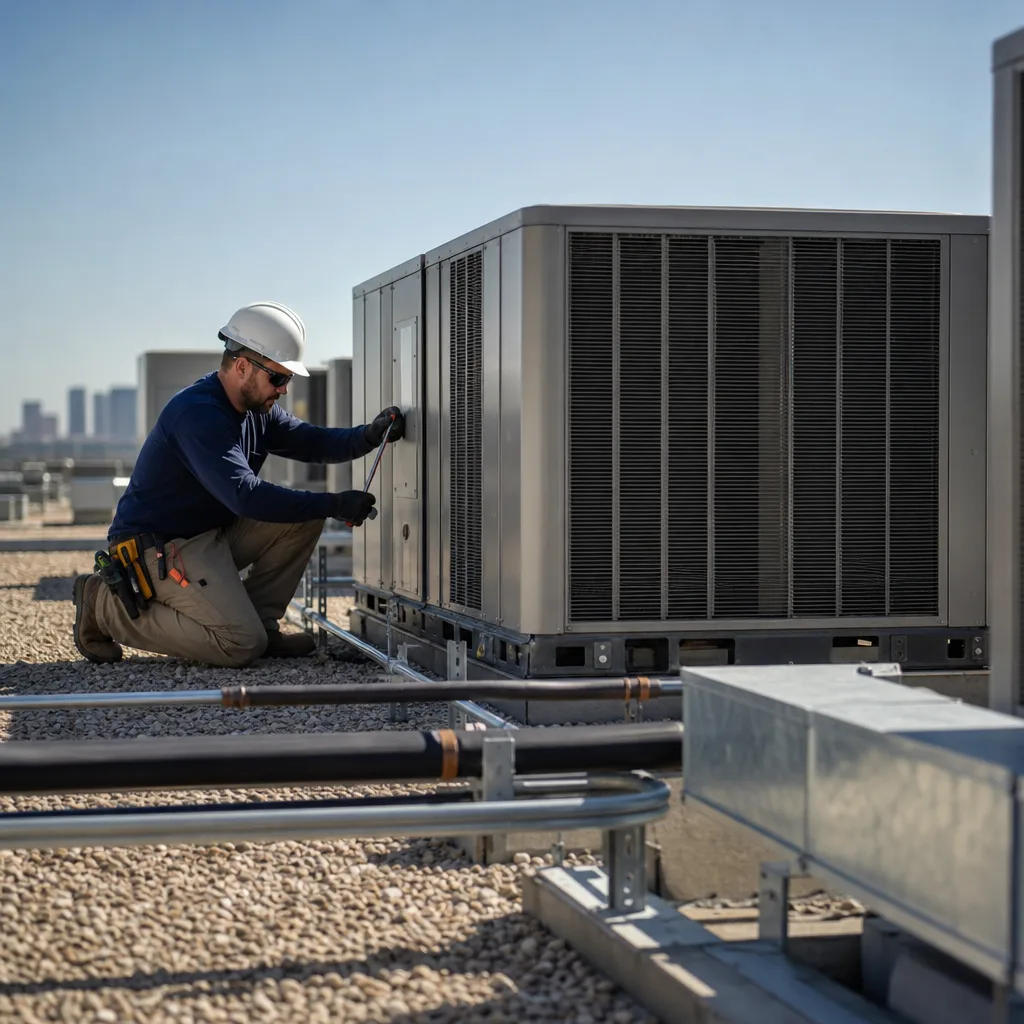
- Size and weight. Many businesses run on rooftop units, often called RTUs. They’re much heavier than a home condenser. Setting one can take a crane, a curb that fits the unit, and a plan that protects your roof.
- Load, not square footage. A cooling load calculation looks at how many people are inside, how much glass faces the sun, and how much heat your lights and equipment give off. A restaurant and an office of the same size can need very different systems.
- More system types. Depending on your building, the right fit might be packaged rooftop units, split systems, VRF (one outdoor system feeding many indoor units that each set their own temperature), or VAV (a system that changes how much air goes to each area as needs change). Commercial kitchens also need make-up air to replace the air the exhaust hood pulls out.
- Bigger power. Commercial equipment often runs on three-phase power and heavier circuits. The electrical side has to be ready before the new unit starts up.
- Controls. Building automation and programmable controls let you schedule the system around your hours, so you aren’t cooling an empty building at midnight.
- Permits and inspections. Commercial work generally goes through the city’s permit and inspection process, and that timeline has to fit into your schedule.
The install is where your system’s next 15 years get decided. A unit that’s oversized cycles on and off, leaves the air damp, and wears out early. One that’s undersized runs nonstop on a 100-degree afternoon and still can’t keep up. Ductwork that doesn’t match the new equipment leaves some offices freezing and others stuffy. Balancing the airflow and checking every part of the system after startup is how you find out the job was done right the first time. You shouldn’t have to wait for a hot week to learn the hard way.
Commercial installs often reach past the HVAC equipment. You might need electrical work for a new unit, a condensate line, or a gas connection. Xtreme Air Services handles HVAC, plumbing, and electrical under one roof. We’re licensed and insured, holding HVAC License #TACLA29023C, and we’re a Trane Comfort Specialist. That gives you one accountable local team to call about every part of the project, not three contractors trying to work around each other.
Texas Licensing Rules Decide Who Can Legally Do This Work
In Texas, you can’t just hire anyone with a truck and a ladder to put in a commercial system. The state licenses this work, and a single install can touch three different trades. Each one has its own license. If the person doing that part of the job doesn’t hold the right one, it can hold up your permit, stall your inspection, and leave you exposed if something goes wrong.
Here’s what a typical commercial install can involve:
- The HVAC equipment itself. Air conditioning and refrigeration contractors are licensed by the Texas Department of Licensing and Regulation, or TDLR. That license covers designing, setting, and connecting your units.
- The electrical side. New circuits, disconnects, and three-phase power for a rooftop unit are electrical work. In Texas, that calls for a licensed electrician, also through TDLR.
- Gas and condensate lines. If your new unit burns natural gas, the gas piping is plumbing work in Texas. It needs a licensed plumber, and the plumbing license comes from the state plumbing board, not TDLR.
- Refrigerant. Anyone who opens a refrigerant line has to hold federal EPA certification to handle it safely and legally.
Why should you care whose name is on the license? When a city inspector looks at the job, they’re checking that licensed people did licensed work. A permit application asks for the contractor’s license. If a crew cuts corners on the electrical or gas side, you’re the one waiting on a re-inspection while your space sits hot. And if there’s ever a fire or a gas problem, unlicensed work can turn an insurance claim into a fight.
Some contractors handle this by bringing in subcontractors for the electrical and gas pieces. That can work, but it adds hand-offs. It’s also fair to ask who’s licensed for each part and who answers for it if the startup doesn’t go right.
Xtreme Air Services is a licensed and insured HVAC, plumbing, and electrical contractor. Our HVAC license is the one listed above, and our plumbing work is done under Master Plumber Larry Breedlove’s license. When your install needs a new circuit or a gas connection, those pieces stay with our team.
You can look up any HVAC or electrical license yourself on the TDLR website in a couple of minutes. Search the license number or the company name, and check that it’s active and matches the business on your contract. It’s a quick step, and it tells you a lot about who you’re letting onto your roof.
Plano’s Mechanical Permit Process for Commercial Installations
Before new commercial equipment goes on your roof or into your mechanical room in Plano, the work generally needs a permit from the city. After it’s installed, it needs to pass inspection. The permit itself isn’t the hard part. The timing is. If you plan for it from day one, it fits around your business. If it’s an afterthought, it can leave your new unit sitting unused while your space heats up.
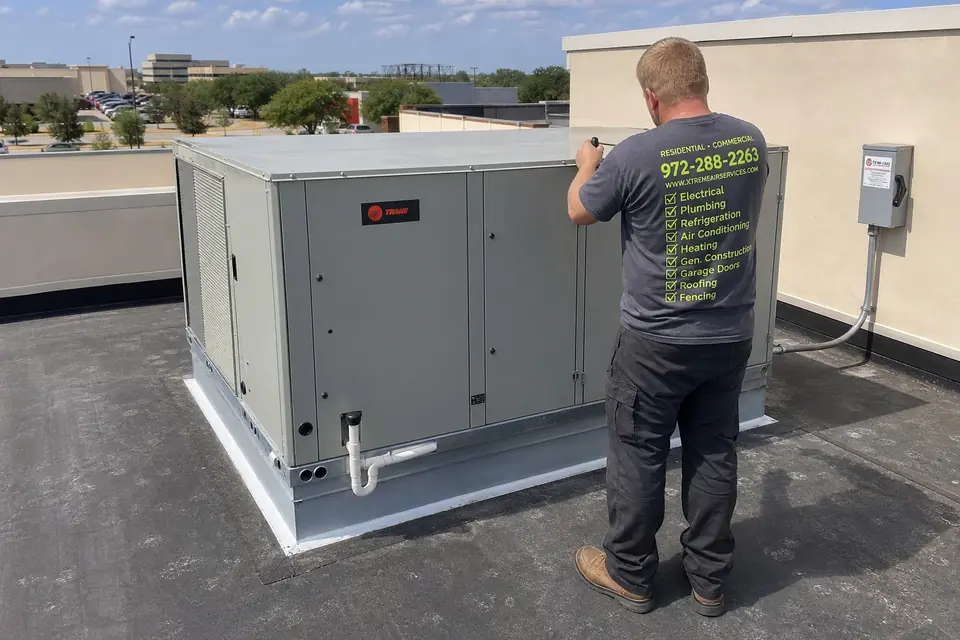
Most commercial HVAC projects need a permit, even when you’re swapping a unit for one the same size. A permit is usually needed when the job involves any of these:
- Replacing or adding a rooftop unit, split system, or air handler
- New or rerouted ductwork
- New circuits, disconnects, or a bigger electrical feed for the equipment
- Gas piping for a gas-fired unit
- Exhaust or make-up air work in a commercial kitchen
The application often asks for more than a form. Expect equipment specs, the contractor’s license information, and, for bigger or more complex jobs, drawings that show where the equipment goes and how the air moves. If a new rooftop unit is heavier than the one it replaces, someone may need to confirm the roof can carry the weight. If the electrical or gas side changes, those trades may need their own permits on top of the mechanical one. Each one has its own sign-off.
Inspections usually come in stages. A rough-in inspection checks ductwork, piping, and wiring before ceilings close up or the work gets covered. The final inspection happens after the system is running. On larger air handlers, inspectors may also check that safety devices are in place, like smoke detectors in the ductwork that shut the system down if they sense smoke. If something doesn’t pass, it gets fixed and rescheduled. That’s why a clean install the first time matters to your schedule, not just your comfort.
If you lease your space, there’s one more step outside City Hall. Many commercial leases require the landlord or property manager to approve HVAC work, roof access, and crane days ahead of time. Get that approval moving at the same time as the permit, not after. Otherwise you can end up with a city permit in hand and a locked roof hatch.
Here are a few ways to keep the permit side from slowing you down:
- Plan the install for spring or fall when you can, before a Texas summer makes every day without cooling more costly
- Have the swap and the inspections scheduled around your slow hours, so customers and staff aren’t standing in a warm building
- Ask your contractor for a realistic timeline that includes permit review and inspections, not just install days
- Read your bid closely to see whether permit fees are included
On that last point, we’ll be upfront. Our standard installation price covers the equipment, materials, professional installation, standard connections, startup and testing, and haul-away of your old unit. Permits aren’t included unless your quote says so. Any code corrections the city requires are also extra. We’d rather you know that now than find it on a final bill. We’ll point out anything we expect the inspection to flag before work starts, so the price you approve is the price you plan around.
Need help with Commercial HVAC installation?
Call Today, Get Service Today. Xtreme Air Services — North Plano is ready to help.
How the Installation Process Works From Consultation to Startup
A commercial install doesn’t start the day a crane shows up. Most of the work that keeps your business running smoothly happens in the weeks before. Here’s how a typical project moves from the first conversation to a system that’s cooling your space.
1. The site visit. A good contractor walks your building before quoting anything. They’ll look at your current units, the roof curbs they sit on, your electrical panel, the condition of your ductwork, and how equipment will get on and off the roof. They should also ask about your business hours, your busiest days, and any rooms that never feel right. That’s the raw information for the load calculation we covered earlier. If someone quotes you over the phone without seeing the building, that’s a guess.
2. The written proposal. You should get the equipment, the scope of work, and the price in writing. Read what’s included and what isn’t, especially duct changes, electrical upgrades, and permits. With us, you get upfront flat-rate pricing that you approve before work starts, so no meter is running. For larger jobs, flexible financing is available on qualifying installations, on approved credit.
3. Scheduling and prep. Once you say yes, a few things run at the same time. The equipment gets ordered, and larger or specialty units can take a while to arrive. Permits and landlord approvals get moving, as we covered above. The install day gets set around your slow hours, and a crane is booked if the unit’s going on the roof. Ask when the equipment is expected and what happens if it’s late.
4. Install day. The old unit gets shut down, disconnected, and removed. The new one is set in place, and the crew connects power, gas if your unit uses it, the condensate drain, and the duct connections. Then they wire the thermostat or building controls. A simple like-for-like rooftop swap can often be done quickly. Jobs with new ductwork, electrical upgrades, or several units take longer, and the crew may work in phases so part of your building stays cool.
5. Startup and testing. This is the step you shouldn’t let anyone rush. The system gets turned on and checked while it runs. That means testing the refrigerant charge, the airflow, the air temperature coming out of the vents, the electrical draw, and the safety controls. Startup and testing are part of our standard installation. Before the crew leaves, someone should show you how to set your schedule, where the filters are, and who to call if something seems off.
You can make the whole process faster with a few simple steps:
- Pick one person on your team to be the contact for questions and access.
- Make sure roof hatches, mechanical rooms, and electrical panels can be reached on install day.
- Let staff and tenants know ahead of time when the cooling will be off.
- Keep a list of hot or cold rooms so they get checked during startup.
Watch Our Video
See How We Handle Commercial HVAC installation in Plano
Xtreme Air Services — North Plano
Keeping Your Business Running During Installation
Your biggest worry probably isn’t the new unit. It’s the day your old one comes off the roof. Will customers walk out? Will your server closet overheat? Will the lunch rush happen in a hot dining room? A good install plan answers those questions before anyone climbs a ladder.
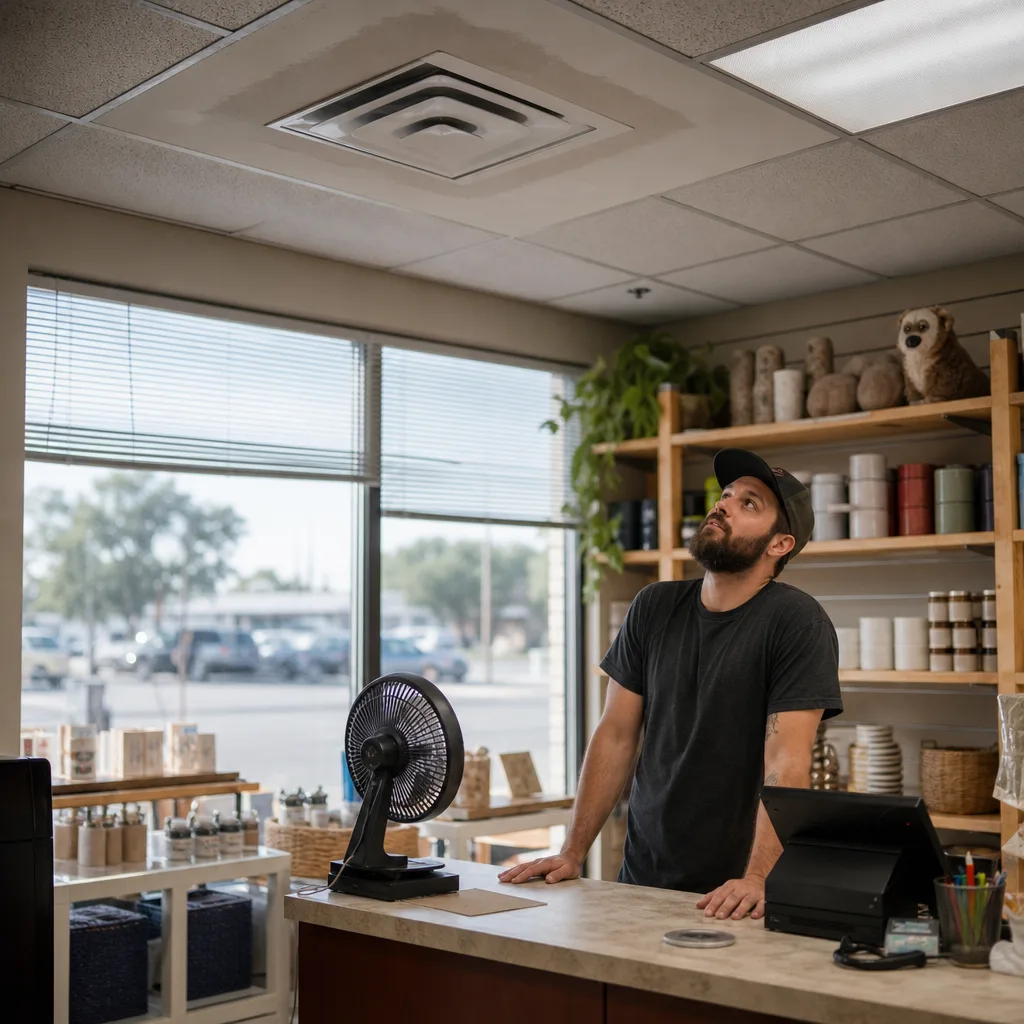
Start by naming the rooms that can’t go without cooling, even for a few hours. These are different for every business:
- An IT or server closet, where heat can shut down equipment
- A kitchen line, where cooks are already working next to hot equipment
- Exam rooms, pharmacies, or storage for supplies that have to stay within a temperature range
- Stockrooms holding products that don’t handle heat well, like candles, cosmetics, or electronics
Once you know those spots, you can protect them. Temporary portable cooling can keep a critical room steady while its main unit is down, and portable AC services are something our team offers. On a multi-unit building, the order of the swap matters. Do the units that serve offices and storage first, and save the ones over your sales floor or dining room for your slowest day.
A simple trick helps too. Run your system colder than usual the morning of the swap. A building that starts the day cool holds that cool for a while after the unit shuts off, which buys you comfort during the work.
Crane day takes some planning in its own right. A crane needs space, and that usually means blocking off part of your parking lot or a drive lane for a few hours. If you’re in a shopping center, give the businesses next door a heads-up. Keep customers away from the lift zone, and know which entrance they’ll use while it’s going on.
Then there are the details that catch people off guard:
- Power shutoffs. Electrical work for a new unit can mean briefly cutting a circuit. Ask which circuits will go down and when, so your registers, computers, and refrigeration aren’t caught off guard.
- Fire alarm tie-ins. Duct smoke detectors are often wired to your building’s fire alarm. Call your alarm monitoring company before the work starts, so a test or a disconnected wire doesn’t send a fire truck to your door.
- Dust and ceiling tiles. If crews work above your ceiling, cover shelves, displays, and desks below. It takes minutes and saves a long cleanup.
- Refrigeration. If walk-in coolers or display cases share power with the work area, confirm they’ll stay running.
One more rule protects you from the worst case. Your old unit shouldn’t come off the roof until the new one has arrived and been checked over. Equipment can show up late or damaged. If your working system is already gone when that happens, you’re stuck waiting in the heat. Keeping the old unit running until the new one is ready means a delay costs you time on the calendar, not a day of business.
Frequently Asked Questions
Common questions about Commercial HVAC installation
What factors drive the cost of a commercial AC installation up or down?
The biggest cost drivers are the size of the unit, the complexity of the ductwork, and any electrical or gas work the job needs. A straightforward rooftop swap costs less than a job that also needs new ductwork, a bigger electrical feed, or a roof structural check. Crane access, permit fees, and code corrections the city requires can also add to the total. That’s why a site visit and written proposal matter more than a phone quote.
What is the $5,000 rule people mention for HVAC systems?
The $5,000 rule is a rough guide some contractors use to decide between repairing or replacing a unit, not a code requirement. You multiply the age of the unit by the repair cost, and if that number passes $5,000, replacement often makes more financial sense than another repair. On commercial equipment, this matters less than on a home system, since a failed component on an aging rooftop unit can also mean your ductwork, controls, or electrical setup are due for an upgrade too. A contractor should walk you through both options with real numbers before you decide.
How big of a unit do I need for a 5-ton-sized commercial space?
There’s no single size that fits every building, because the right unit depends on a proper cooling load calculation, not square footage alone. A 5-ton unit might suit a small office, but a restaurant or retail space the same size, with more people, equipment, and glass facing the sun, can need something larger. That’s why we walk the building, check your current equipment and ductwork, and calculate the load before quoting a size, instead of guessing from square footage.
Ready to Get Started?
Call (469) 527-5131 Today, Get Service Today.