


Cooling Tower Installation in Plano: Full Replacement or Repair?
Cooling tower installs for commercial chilled-water plants, with the permit and mechanical code requirements explained.
What’s Covered on This Page
- Full Installation vs. Component Repair: How to Tell Which One You Need
- Why Plano’s Commercial Buildings Need This Service
- Who Should Be Doing This Work
- What Happens During a Cooling Tower Installation Project
- What Drives Cooling Tower Installation Cost
- Why do some buildings have cooling towers and others don’t?
- How long does a building go without cooling during a tower changeover?
- What’s the difference between fixing a cooling tower and replacing it?
Full Installation vs. Component Repair: How to Tell Which One You Need
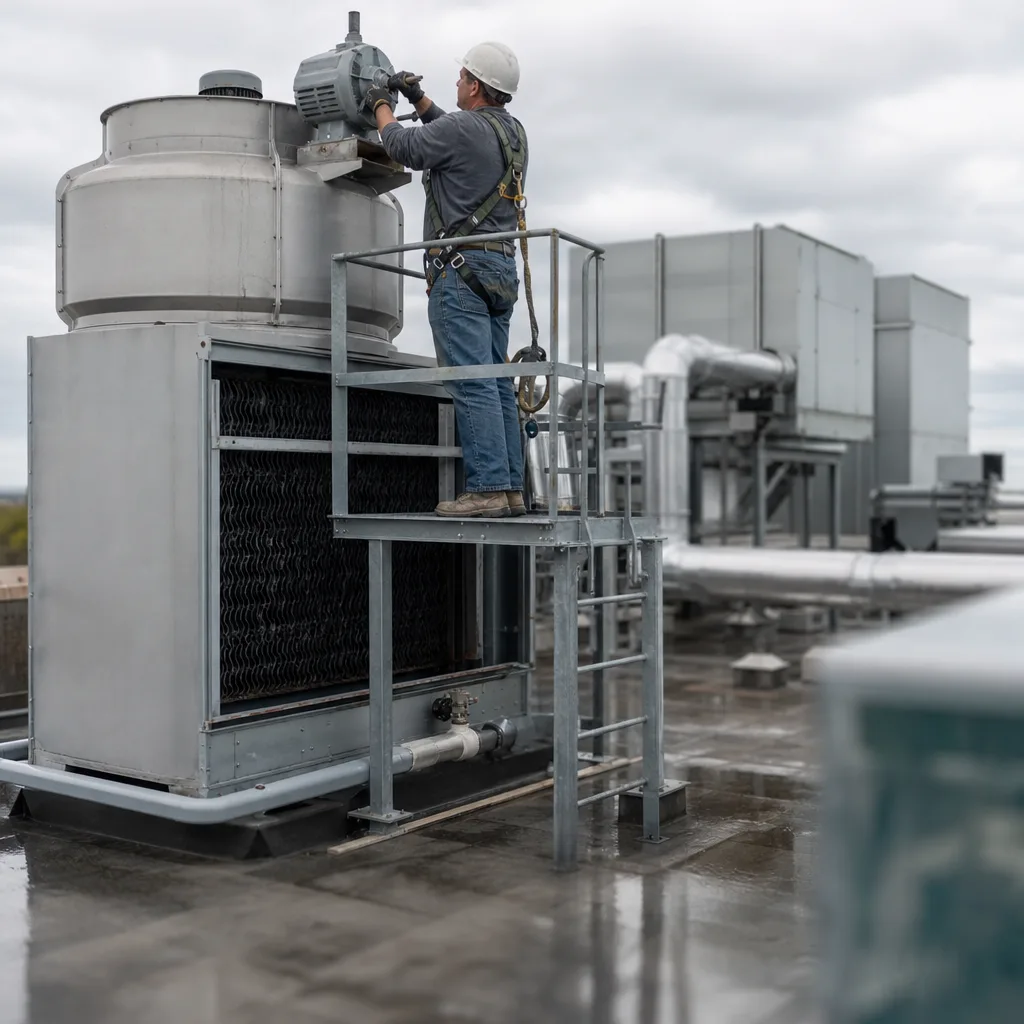
A cooling tower is really two things. There’s the structure, which means the casing, cold water basin, and frame. Then there are the working parts that sit inside it. Most parts can be swapped out. The structure can’t be patched forever. That one idea sorts out most repair-or-replace decisions.
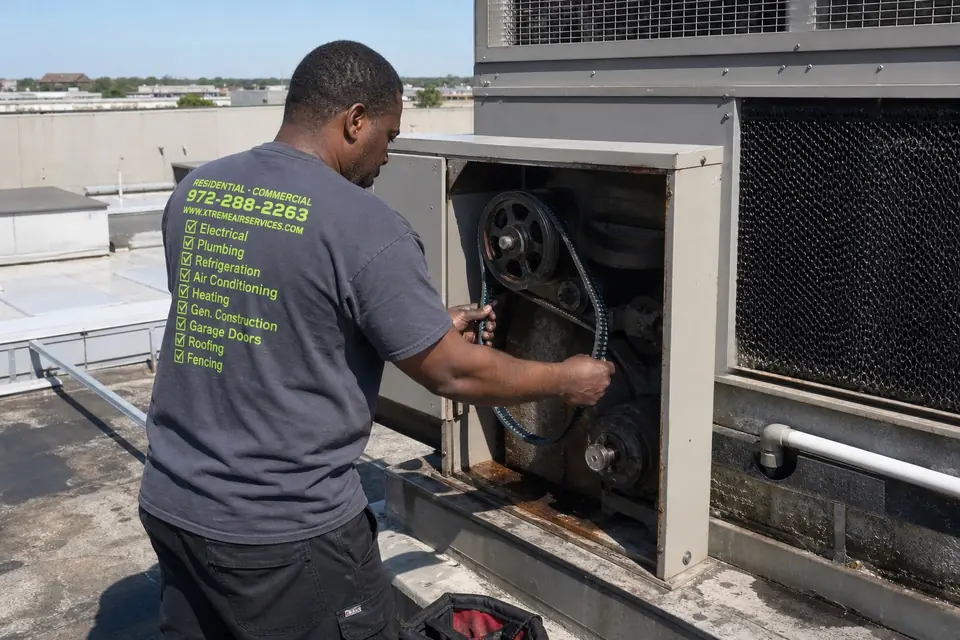
A repair is usually the right call when the problem is one of these:
- A fan motor, belt, bearing, or gearbox that’s noisy, shaking, or has quit
- Fill media clogged with scale or slime, so water doesn’t spread out and cool well
- Spray nozzles or distribution basins that are plugged and leave dry spots on the fill
- A sticking float valve or makeup water problem that leaves the basin too low or overflowing
- Worn drift eliminators letting too much water mist blow off the top
- A circulation pump that’s lost pressure or started leaking at the seal
None of those mean your tower is done. If the pump is the issue, that’s pump installation and repair work, not a new tower. If you’re not sure what’s wrong, mechanical system troubleshooting can pin it down before anyone talks about replacement.
A full installation starts to make more sense when you see these signs:
- Rust you can poke through, flaking metal, or holes in the casing or basin
- Leaks that come back at new seams every time one gets sealed
- A sagging or twisted frame, or fan supports that won’t stay lined up
- Fill, fan, and structure all wearing out at about the same time
- Your building added space, equipment, or tenants, and the tower can’t hold the water temperature on hot afternoons
- Repair bills showing up every season with no end in sight
North Texas is hard on towers in two ways. Our water is hard, and a cooling tower works by evaporating water. When water leaves as vapor, the minerals stay behind and build up as scale on fill, nozzles, and metal. Over years, scale and the chemistry used to control it wear down the structure itself. Plano summers stack heat on top of that. Your tower runs hardest from June through September, and that’s exactly when a weak tower shows it can’t keep up.
Here’s a common picture. You’ve replaced the fan motor, then the fill, then sealed a basin leak, and now there’s rust running down the casing. Each fix made sense on its own. Put together, they’re telling you the structure is near the end. Another repair just buys a little time before the next shutdown, often in the middle of a hot week when your building can least afford it.
If your tower is solid and one part failed, fix the part. If the structure is going, putting money into new parts inside it rarely pays off. An honest look at the shell and basin should come before anyone hands you a replacement quote.
Why Plano’s Commercial Buildings Need This Service
If your building is big enough to have a cooling tower, that tower is quietly holding up your whole cooling system. Most larger offices, medical buildings, schools, and multi-tenant properties don’t cool with rooftop units alone. They use a water-cooled chiller, and the chiller has to dump the heat it pulls out of your building somewhere. The cooling tower is where that heat goes. When the tower can’t shed heat, the chiller can’t keep up, and every floor feels it.
Plano has a lot of buildings that work this way. That includes office campuses along the Legacy Drive corridor, where our own Plano office sits, and the medical, retail, and mixed-use buildings around them. In these buildings, cooling is a business service you deliver every day, not a comfort extra. Your tenants expect it in their lease. Your employees need it to work. Server rooms, labs, and kitchens may need it just to stay running.
That’s why a tower problem is a business problem. Here’s what’s really on the line when one starts to fail:
- Tenants calling about warm suites, and in a leased building, those calls can turn into lease complaints
- Equipment rooms running hot, which puts servers and electronics at risk
- Lost workdays if a floor or a whole building gets too warm to use
- Emergency repair costs on top of a replacement you were going to need anyway
- Rushed decisions made in the middle of a crisis instead of with time to compare options
Timing matters more than most owners expect. As we covered above, a worn tower usually shows its weakness when your building’s cooling demand peaks. That’s the worst possible moment to start a replacement. A planned install lets you choose when the tower comes offline. That might be a cooler stretch of the year, a weekend, or a slow season for your tenants, so the switchover happens on your schedule and not the tower’s.
Picture two building managers with the same aging tower. One has seen the rust and the repeat leaks, gets the structure looked at in the off-season, and plans the swap. The other waits until the tower can’t hold water temperature on a hot afternoon. Both end up with a new tower. Only one also ends up with angry tenants, rush charges, and a building that ran warm for days.
A cooling tower install also isn’t a one-trade job. It ties into condenser water piping, circulation pumps, and electrical feeds to the fan motors. Our team handles commercial HVAC, piping, pump work, and commercial electrical, so you deal with one accountable local company instead of lining up separate crews and hoping their schedules match. For a building where every day offline costs money, that coordination is a big part of getting the job done right the first time.
The point isn’t to replace your tower before it’s time. It’s to know where your tower stands, so a replacement happens when it makes sense for your building and not when the tower forces it.
Who Should Be Doing This Work
A cooling tower install isn’t a job for a residential AC crew that’s added commercial work to its website. You want a licensed commercial mechanical contractor who has worked on water-cooled systems before and can show you how the new tower will tie into your chiller, pumps, and piping. The tower itself is only part of the job. The connections around it decide whether it works well for years or fights your system every summer.
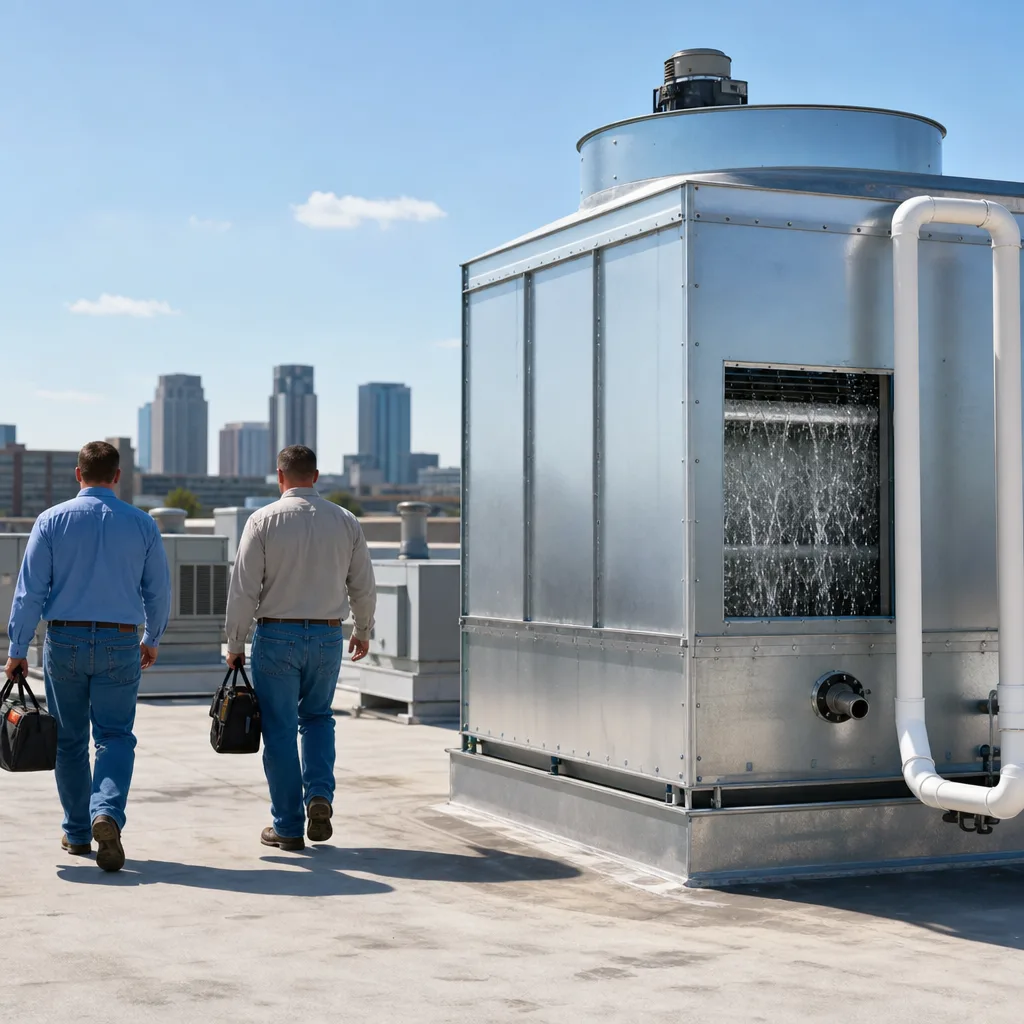
Here’s what a qualified installer should be ready to handle or plan for:
- Sizing the tower to your building’s real cooling load, not just matching the old nameplate
- Checking that the roof or pad can carry the weight of a tower full of water
- Planning the lift, which often means a crane and a street or lot closure for a few hours
- Connecting condenser water piping, makeup water, and drains so water flows evenly across the fill
- Wiring the fan motors and controls safely to your building’s power
- Starting up and testing the system before your team takes it back
Some of this may need other experts, and a good contractor will say so up front. If there’s any doubt about your roof’s strength, a structural engineer should sign off before a new tower goes up there. Water treatment is also its own specialty. Because North Texas water leaves so much scale behind, you’ll want a water treatment program in place from day one, and many buildings use a dedicated water treatment vendor for that. A contractor who brushes off either point isn’t looking out for you.
Before you sign with anyone, ask these questions:
- What’s your Texas HVAC license number, and can I check it with TDLR?
- Are you insured for commercial rooftop and crane work?
- Have you installed water-cooled systems on buildings like mine?
- What’s included in your quote, and what’s excluded, like permits, code corrections, or piping changes?
- How will you keep my building cooling during the changeover?
- Who handles startup and testing, and what will you show me when it’s done?
Clear answers tell you a lot. Vague ones tell you more.
Here’s how we answer those questions at Xtreme Air Services. We’re licensed and insured, and you can look up our HVAC License #TACLA29023C with the Texas Department of Licensing and Regulation. Our technicians are background-checked. You’ll get upfront pricing approved before work starts, so you know what’s included and what isn’t before anyone touches your tower. Flexible financing is available on qualifying installations and larger jobs, on approved credit. And our 4.8-star reputation across more than 2,900 reviews on Google, Angi, and HomeAdvisor comes from North Texas customers who trusted us with their buildings and homes.
We also work out of our Plano office on Legacy Drive, so your building isn’t a long drive away when it’s time to look at the tower, plan the lift, or come back after startup.
Call 469-527-5131
Have questions? We’re happy to help.
Call Today, Get Service Today. Xtreme Air Services — North Plano is ready to help.
What Happens During a Cooling Tower Installation Project
Most of a cooling tower installation happens before anyone climbs onto your roof. The day the old tower comes down is usually the shortest and loudest part. The planning before it and the testing after it decide whether your building runs cool all summer.
Here’s how a typical project moves from start to finish.
- Planning and permits. The new tower gets matched to your building’s load, the crane day gets mapped out, and permits get settled. Ask early who’s pulling the permits. On a standard install, permits are excluded unless the quote says otherwise, so you’ll want that in writing.
- Planning the changeover. This is the step that protects your tenants. If your tower has more than one cell, one side can sometimes keep running while the other is swapped. If it doesn’t, the shutdown gets timed for a cooler stretch, a weekend, or a slow week, so your building goes without the tower for as short a time as possible.
- Draining and taking out the old tower. The system gets drained, and the old piping, power, and controls get disconnected. Then the old tower comes apart and leaves the site. On a standard like-for-like job, haul-away of the old unit is included.
- Setting the new tower. The crane lifts the new tower onto the roof or pad, and it gets leveled and anchored. A level tower matters more than you’d think. If it sits crooked, water spreads unevenly across the fill and the basin may not drain right.
- Tying it into your system. Condenser water supply and return lines, makeup water, overflow, and drains get connected. Fan motors and controls get wired to your building’s power. Standard connections are part of the install. Any piping, electrical, or code changes beyond the existing connections are priced separately.
Next comes the first fill. A new tower should start with a water treatment plan from day one, not a few weeks later. That’s especially true with North Texas water and all the scale it leaves behind. Many new towers are made of galvanized steel. That zinc coating needs careful water chemistry at first, so it doesn’t break down early into a white, crusty buildup. If you use a water treatment vendor, bring them in before startup, not after.
Startup and testing are where you find out if the job was done right. These come included with a standard installation. A good startup checks:
- Fan rotation, belt tension, and vibration, so the fan runs smooth and quiet
- Even water flow across every section of fill, with no dry spots
- The float valve and makeup water, so the basin holds the right level
- The bleed-off line, which drains a little water on purpose to keep minerals from piling up
- Water leaving the tower at the temperature your chiller needs, under real load
Before the crew leaves, you should get a walk-through. You should know where the shutoffs are, how the controls work, and what readings the tower hit during testing. Those numbers give you a baseline. Next summer, when the tower is working its hardest on a 100-degree afternoon, you’ll have something to compare it to.
Watch Our Video
See How We Handle Cooling tower installation in Plano
Xtreme Air Services — North Plano
What Drives Cooling Tower Installation Cost
Here’s the straight answer. Our cooling tower installations typically run $10,000 to $100,000. The most common job we quote is a standard like-for-like replacement that uses your existing connections with no major changes, and that usually falls between $28,000 and $64,000. That price covers the equipment and materials, professional installation, startup, and testing.
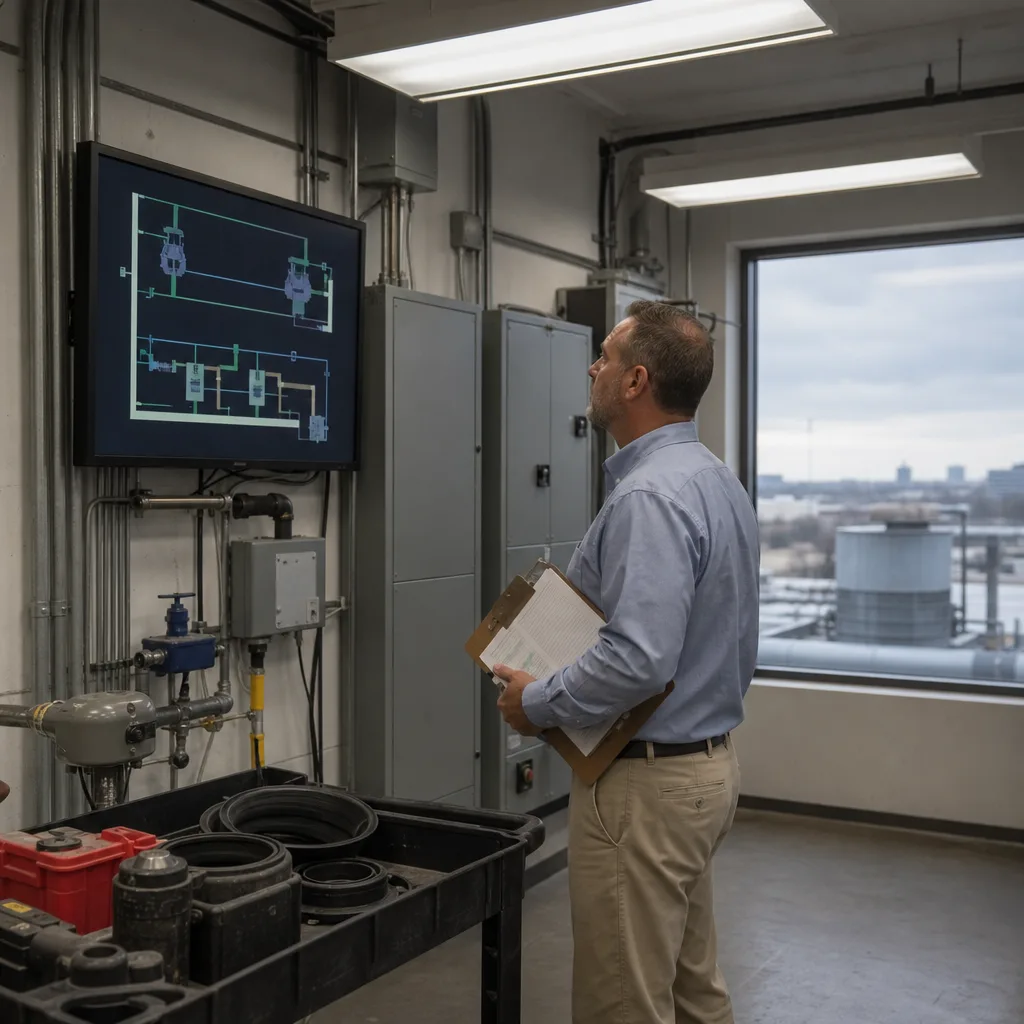
That’s a wide range, and it should be. A small tower on a ground-level pad behind a medical office is a very different job from a large tower on top of a multi-story building. These are the things that move your number:
- Size and capacity. Towers are rated in tons, which is how much heat they can shed. A bigger building load needs a bigger tower, and that costs more. Sizing to your real load matters here, because a tower that’s too small won’t hold water temperature and one that’s too big costs more than it should.
- Brand and model. Different towers come with different build materials, fan setups, and efficiency, and all of that affects price.
- Ease of access. A tower on a pad you can drive up to is simpler than one that needs a big crane, a tight lift over a busy lot, or a street closure.
- Condition of what’s already there. Old wiring and condenser water piping that’s worn out, the wrong size, or not up to today’s code may need work before the new tower can tie in.
- Code upgrades and permits. Bringing a site up to current code adds cost, and so do permits.
- Custom fabrication. If the new tower’s footprint doesn’t line up with the old supports or pipe locations, steel or piping may need to be custom built to fit.
The quoted range covers a standard install, which includes haul-away of the old unit. Piping, electrical, or plumbing changes, code corrections, and permits are excluded unless the quote says otherwise. That’s why two quotes for the “same” tower can look far apart. One may cover the extras and the other may leave them for later. When you compare, line up what each one covers, not just the bottom number.
This is where planning ahead pays off. When you know your tower’s condition before it fails, you have time to get the site checked, sort out any piping or code issues, and line up permits. Then you can pick a changeover window that works for your building. A tower that quits in August doesn’t give you that time. Flexible financing is also available on qualifying installations, on approved credit, if spreading out the cost helps you replace on your schedule.
To get a real number for your building, the first step is a look at your tower and the site around it. Our service-call fee is $26 to $99, and it’s credited toward the work if you go ahead with Xtreme Air Services. You’ll get upfront pricing approved before any work starts, so you know exactly what’s included before you commit.
Call 469-527-5131
Frequently Asked Questions
Common questions about Cooling tower installation
Why do some buildings have cooling towers and others don’t?
A building needs a cooling tower when it uses a water-cooled chiller instead of rooftop AC units. Larger offices, medical buildings, schools, and multi-tenant properties often use chillers because they handle big cooling loads more efficiently than packaged units. The tower’s job is to get rid of the heat the chiller pulls out of your building. If your property only has standard rooftop units, you likely don’t have or need a cooling tower.
How long does a building go without cooling during a tower changeover?
It depends on whether your tower has more than one cell. If it does, one side can sometimes keep running while the other gets swapped out, so your building stays cool during the work. If it doesn’t, the shutdown gets timed for a cooler stretch, a weekend, or a slow week for your tenants. Planning this ahead of time, instead of waiting for the tower to fail in summer, is what keeps downtime short.
What’s the difference between fixing a cooling tower and replacing it?
A repair fixes a failed part, like a fan motor, pump, or clogged fill, while the structure underneath stays solid. A replacement is needed when the casing, basin, or frame itself is corroding or leaking at new spots every time one gets patched. If you’ve replaced several parts in a row and now see rust running down the casing, that’s usually a sign the structure is near the end, not just the parts inside it.
Ready to Get Started?
Call (469) 527-5131 Today, Get Service Today.