


Commercial HVAC Installation in Allen: Sized, Permitted, and Installed Right
Commercial systems sized, permitted and installed right – after ruling out a repair or maintenance fix first.
What’s Covered on This Page
- Know When Your Building Needs Installation, Not Repair
- Rule Out Installation When Repair or Maintenance Will Do
- What Happens During a Commercial Installation
- Understand What Drives the Cost of Your Project
- Clear the Licensing and Permit Requirements Before You Sign
- What is the $5000 rule for HVAC?
- What’s the best type of commercial HVAC system for my building?
- How do I know if my commercial HVAC contractor is licensed?
Know When Your Building Needs Installation, Not Repair
Commercial HVAC installation is a big decision, and you shouldn’t make it just because your system had a bad week. The right answer depends on what’s wrong, how old the equipment is, and whether it still fits your building. When those three things line up, you can stop guessing and plan the job on your schedule, not in the middle of a breakdown.
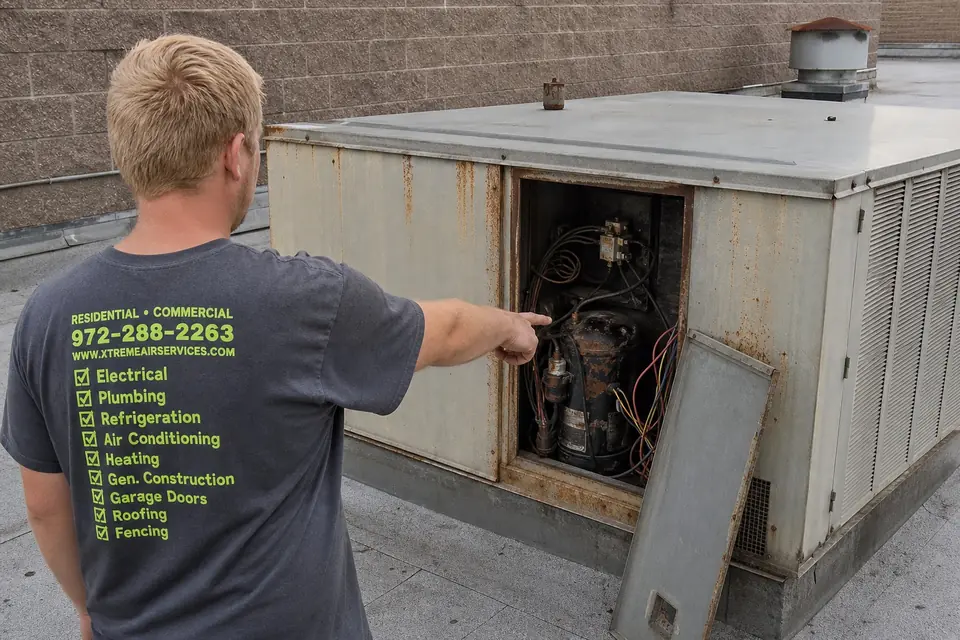
These are the signs that point toward a new installation:
- Your unit is near the end of its working life and the repair calls keep stacking up. If you’re paying for a new fix every few months, that money is going into equipment that’s on its way out.
- One big repair would cost a large share of what new equipment costs. A failed compressor on an old rooftop unit is a common example.
- Your system uses an older refrigerant that’s getting harder and more expensive to find. Every leak repair costs more than the last one.
- Some spaces never get comfortable. A front office that’s freezing while the back room runs hot often means the system wasn’t sized or zoned for how you use the building today.
- Your building’s use has changed. A retail space that becomes a restaurant, or an open floor that gets split into offices, needs a different load than it was built for.
- Your energy bills keep climbing even though your usage hasn’t changed. Long North Texas summers make an inefficient unit work harder for more months of the year.
Now the other side. You probably don’t need new equipment if your system is fairly young and one part failed, like a capacitor, a fan motor, or a clogged drain line. Those are normal wear items. Replacing a whole system over a single failed part on healthy equipment isn’t doing right by you, and we won’t recommend it. The same goes for a unit that runs fine but needs a good cleaning or a tune-up. Regular maintenance can be the thing that keeps a solid system going for years.
If you’re stuck somewhere in the middle, waiting for the next breakdown is the most expensive way to find out. When equipment fails during the hottest stretch of a Texas summer, you’re making the decision under pressure, with tenants, customers, or inventory on the line. Getting the system checked while it’s still running gives you time to compare options and plan the install around your business hours.
That first look is simple. Our team works out of our office at 1333 W McDermott Dr in Allen, and our licensed and insured technicians can tell you plainly whether you’re looking at a repair or a replacement. There’s a $26 to $99 service-call fee, and it’s credited toward the repair if you proceed with Xtreme Air Services. Either way, you get a clear answer and an upfront price before any work starts.
Rule Out Installation When Repair or Maintenance Will Do
Plenty of commercial comfort problems look like an equipment problem when they aren’t. Before you spend money on new units, rule out the issues below. Each one has a fix that costs far less than an install, and putting in new equipment wouldn’t solve any of them.
- The air isn’t getting where it needs to go. Leaky, crushed, or disconnected ductwork above a drop ceiling can leave a room starved for air while the rooftop unit works just fine. Duct sealing or HVAC system balancing fixes that. A brand-new unit pushing air into the same leaky ducts would leave you with the same warm room.
- The controls are the problem. A failing thermostat, a bad sensor, or a building automation schedule someone changed can make a healthy system look broken. If the unit runs and cools when it’s told to, the fix is in the controls, not on the roof.
- The coils are dirty or damaged. Dust, pollen, and North Texas hail can clog or flatten the thin fins on a condenser coil. The unit then can’t shed heat and struggles on hot afternoons. Coil cleaning or coil repair can bring a lot of that lost cooling back.
- A newer unit has a refrigerant leak. If the system is fairly young and uses a current refrigerant, finding and fixing the leak is usually the right call. That’s very different from an old unit on a refrigerant that’s being phased out.
- One unit out of several failed. If your building has four rooftop units and one is worn out, replacing that one may be all you need. The others don’t have to go the same day just to match.
Sometimes the honest answer is to wait. If your equipment is running and holding temperature, a replacement in the middle of July usually isn’t the best timing. Swapping a rooftop unit means some downtime, and peak summer is when your building can least afford it. Keeping a working system going with repairs and maintenance, then planning the install for spring or fall, gives you more control over cost and schedule.
Check your lease before you agree to anything. Many commercial leases spell out who pays to replace HVAC equipment and who pays for repairs and upkeep. In some cases, the rooftop unit is the landlord’s responsibility, not yours. Knowing that first can save you from paying for equipment you don’t own.
The same goes for how long you plan to stay. If you expect to move out in a year or two, new equipment stays with the building when you leave. Keeping a sound system running is often the smarter use of your money.
If any of these fit your building, a repair or a maintenance visit is the right move, and that’s the answer you should get from any contractor you call. Installation only makes sense once these smaller causes are ruled out.
What Happens During a Commercial Installation
A commercial install happens in stages. Most of the work is done before the old unit ever comes off your roof. If you know the steps, you can plan around your business, so swap day doesn’t catch your staff or customers off guard.
- Sizing the system. A cooling load calculation looks at your square footage, windows, roof, how many people are inside, and what gives off heat, like ovens, coolers, or server closets. That number sets the tonnage, which is how much heat the unit can pull out of your building each hour. Copying the old unit’s size is just a guess, especially if the way you use the space has changed.
- Choosing equipment and checking the fit. Efficiency ratings like SEER2 tell you how much cooling you get for your electric dollar. A new unit may not match the old one’s footprint, so the roof curb, the metal frame the unit sits on, may need an adapter or custom fabrication. The electrical service, gas line, and ductwork also get checked to make sure they can handle the new equipment.
- Permits and scheduling. Most commercial replacements need a city permit and an inspection. Rooftop units usually go up by crane, so the lift gets scheduled for early morning or after hours to keep your doors open. In a North Texas summer, starting early also keeps the crew off a blazing hot roof in the afternoon.
- Removing the old unit and setting the new one. Power and gas get shut off. The old refrigerant is recovered, not released into the air. Then the old unit comes off and the new one is set and leveled on the curb.
- Connecting everything. This step covers electrical, gas, the condensate drain that carries water off the roof, the duct connections, and your thermostat or building controls.
- Startup and testing. A good startup checks the refrigerant charge, airflow, voltage, and how much power the motors draw. It also checks the heat, the safety controls, and whether the thermostat schedule matches your business hours. A unit that only turns on hasn’t really been tested.
When Xtreme Air Services handles your commercial HVAC installation, the job includes the equipment and materials, professional installation, standard connections, startup and testing, and hauling away the old unit. Duct, electrical, or plumbing changes, code corrections, and permits aren’t included unless your quote says so. If your building needs any of those, ask to see them listed in writing before work starts. That way the price you approve is the price you pay.
Downtime depends on the scope. A straight like-for-like rooftop swap that uses the existing connections is often a one-day job. A new curb, duct changes, or electrical work can add days. Ask any contractor for a written schedule that shows when your space will be without air. Then you can tell your staff, tenants, or customers ahead of time instead of the morning of.
Need help with Commercial HVAC installation?
Call Today, Get Service Today. Xtreme Air Services — Allen is ready to help.
Understand What Drives the Cost of Your Project
Our commercial HVAC installations typically run $10,000 to $100,000. That’s a wide range because commercial buildings are so different. Our most common job is a standard like-for-like replacement that uses your existing connections with no major changes. That job typically costs $28,000 to $64,000. It covers the equipment and materials, plus professional installation, startup, and testing.
Where your project lands depends on tonnage and scope. These are the things that move the number:
- Size and capacity. A bigger building or a heavier heat load, like a kitchen or a full office, needs more tonnage. More tonnage costs more. This is why the load calculation matters. An oversized unit costs more up front and doesn’t run as well.
- Efficiency. A higher SEER2 rating means more cooling for each dollar you spend on power. AFUE does the same job for gas heat. Higher-efficiency equipment costs more on day one. Our summers are long, so that unit runs hard for a lot of months, and the savings add up over the years.
- Brand and model. Different product lines and features come at different prices.
- Ease of access. A unit on a low roof with clear crane access costs less to swap than one on a tall building, a tight lot, or a spot where the lift has to happen after hours.
- Condition of what’s already there. Worn ductwork, undersized wiring, or old gas piping may need work before new equipment can go in.
- Code upgrades and permits. Older buildings sometimes need updates to meet current code.
- Custom fabrication. A curb adapter or special ductwork adds cost when the new unit doesn’t match the old footprint.
The last four items are where surprise costs usually come from. Duct, electrical, and plumbing changes, code corrections, and permits aren’t in our standard price unless your quote says so. The good news is that most of these can be spotted before you sign. A careful look at your roof, panel, and ducts during the estimate turns a surprise into a line item you can plan for.
When you compare quotes from any contractor, ask a few simple questions:
- Did you do a load calculation, or did you just match the old unit’s size?
- What tonnage and efficiency rating is this quote for?
- Are permits, crane time, and old unit removal included?
- What happens to the price if you find bad ductwork or wiring once the job starts?
- How many days will my space be without air?
A low quote that leaves out permits or skips the load calculation isn’t really lower. It just moves the cost to later, often in the middle of a hot week when you can least afford it. That’s the same trap as waiting on a failing system. Paying for the right job once costs less than paying for the wrong one twice.
If the full cost is more than you want to pay at once, we offer flexible financing on qualifying installations and larger jobs, on approved credit. That can let you replace a failing unit on your schedule instead of patching it through another summer.
Call 469-299-8996
Watch Our Video
See How We Handle Commercial HVAC installation in Allen
Xtreme Air Services — Allen
Clear the Licensing and Permit Requirements Before You Sign
Before you sign a commercial HVAC contract, confirm two things: the contractor is licensed for the work, and the contractor is the one pulling the permit. Both protect you. If something goes wrong on your roof or fails inspection, you want a licensed company on the hook, not your business.
In Texas, HVAC contractors are licensed by the Texas Department of Licensing and Regulation (TDLR). You can look up any license number on the TDLR website in about a minute. Our HVAC license is #TACLA29023C. Ask every contractor to print their license number on the quote, and make sure the name on the license matches the company doing the work, not a subcontractor you’ve never met.
A commercial install also touches other trades. The new unit needs electrical hookups, and gas heat needs a gas line connection. Those trades carry their own licenses in Texas, so ask who’s doing that part of the job. Xtreme Air Services is a licensed and insured HVAC, plumbing, and electrical contractor, so those connections don’t get handed off to a stranger. Anyone handling the old refrigerant should also hold EPA certification, since that refrigerant has to be recovered properly.
Insurance matters more on a commercial job than most people think. A crane is lifting a heavy unit over your roof, your parking lot, and sometimes your neighbor’s building. Ask for a certificate of insurance that shows general liability and workers’ comp. Many landlords and property managers won’t let a contractor on the roof without one, so getting it early keeps your install date from slipping.
Now the permit. In Allen, the city handles permits and inspections for this kind of work. The licensed contractor should pull the permit in their own name. Be careful if someone asks you to pull it yourself, or tells you the job doesn’t need one. Unpermitted work can cause trouble later with an insurance claim, a building sale, or a future tenant’s build-out. Since permits aren’t in our standard price unless your quote says so, ask to see the permit listed as its own line item.
Use this short checklist on any quote before you sign:
- The contractor’s TDLR license number is on the quote, and you’ve checked it.
- You have a certificate of insurance, with your landlord listed if your lease requires it.
- The quote says who pulls the permit and whether the permit fee is included.
- You know who’s making the electrical and gas connections, and they’re licensed for it.
- You know when the city inspection happens and who will meet the inspector.
A good contractor answers all five without hesitating. If you get vague answers or a shrug on any of them, that tells you what you need to know before any money changes hands.
Call 469-299-8996
Frequently Asked Questions
Common questions about Commercial HVAC installation
What is the $5000 rule for HVAC?
It’s a rule of thumb some contractors use to decide between repair and replacement. You multiply the repair cost by the age of the unit, and if that number tops $5,000, replacement usually makes more financial sense than another repair. It’s a helpful gut check, but on a commercial system we still run a real load calculation and look at your building’s actual condition before recommending installation over repair.
What’s the best type of commercial HVAC system for my building?
The best system is the one sized and chosen for your building’s actual load, not just a copy of what’s already on the roof. Tonnage, efficiency rating, and equipment type should come from a cooling load calculation that accounts for your square footage, occupancy, and any heat sources like ovens or server rooms. A unit that matches your building’s real use performs better and costs less to run than one picked to match the old footprint.
How do I know if my commercial HVAC contractor is licensed?
Look up their license number on the Texas Department of Licensing and Regulation website, which takes about a minute. Every HVAC contractor working on a commercial system in Texas should be able to print a TDLR license number right on your quote, and the name on that license should match the company doing the work, not a subcontractor you’ve never met.
Ready to Get Started?
Call (469) 299-8996 Today, Get Service Today.