


Commercial Refrigeration in Plano: Fast, Licensed Repair
Walk-in coolers, freezers and ice machines repaired by licensed refrigeration technicians – usually one part, not a whole new system.
What’s Covered on This Page
- A Warm Walk-In Cooler Is a Business Emergency, Not a Comfort Issue
- Signs a Refrigeration Problem Can’t Wait
- Common Commercial Refrigeration Failures We Repair
- What Happens During a Repair Visit
- What Drives Commercial Refrigeration Repair Cost
- What exactly counts as commercial refrigeration?
- Can my regular HVAC company handle my walk-in cooler, or do I need a refrigeration specialist?
- How do I know if a refrigeration technician is qualified?
A Warm Walk-In Cooler Is a Business Emergency, Not a Comfort Issue
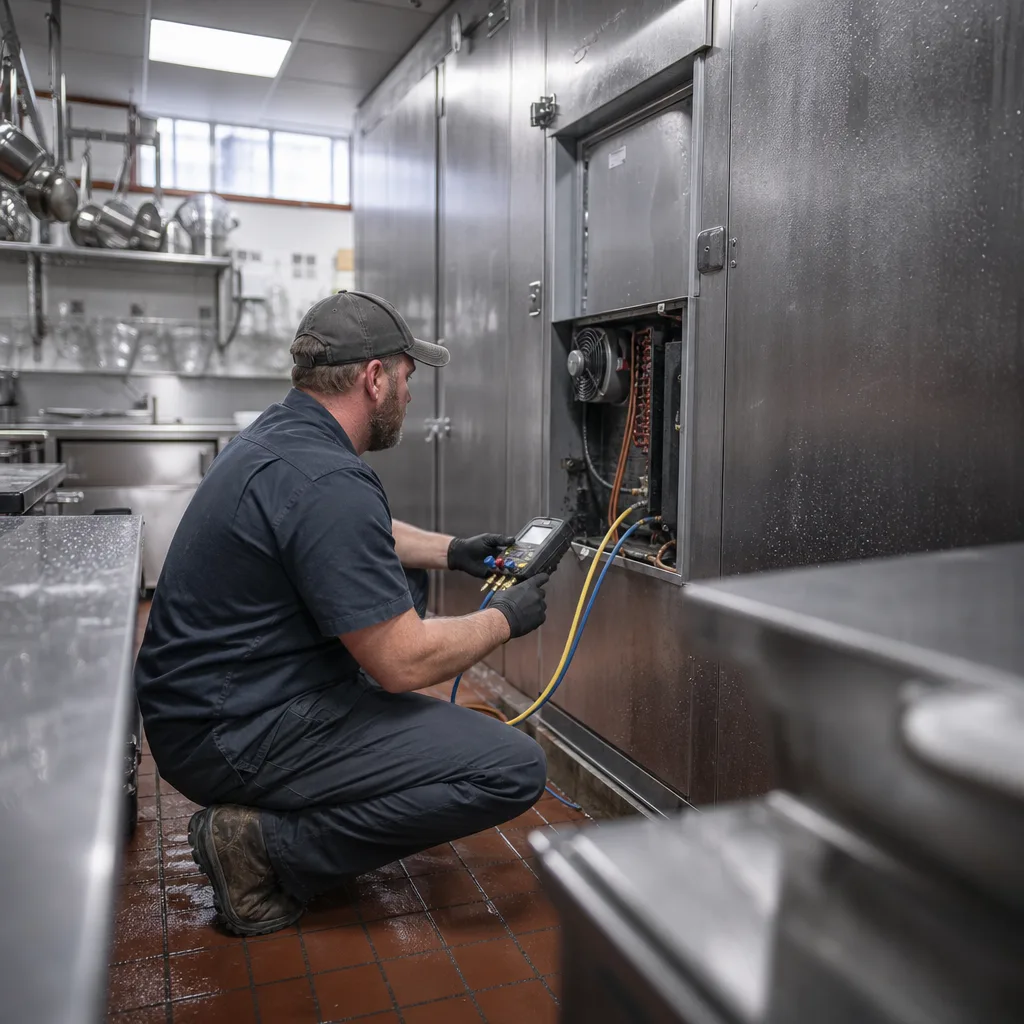
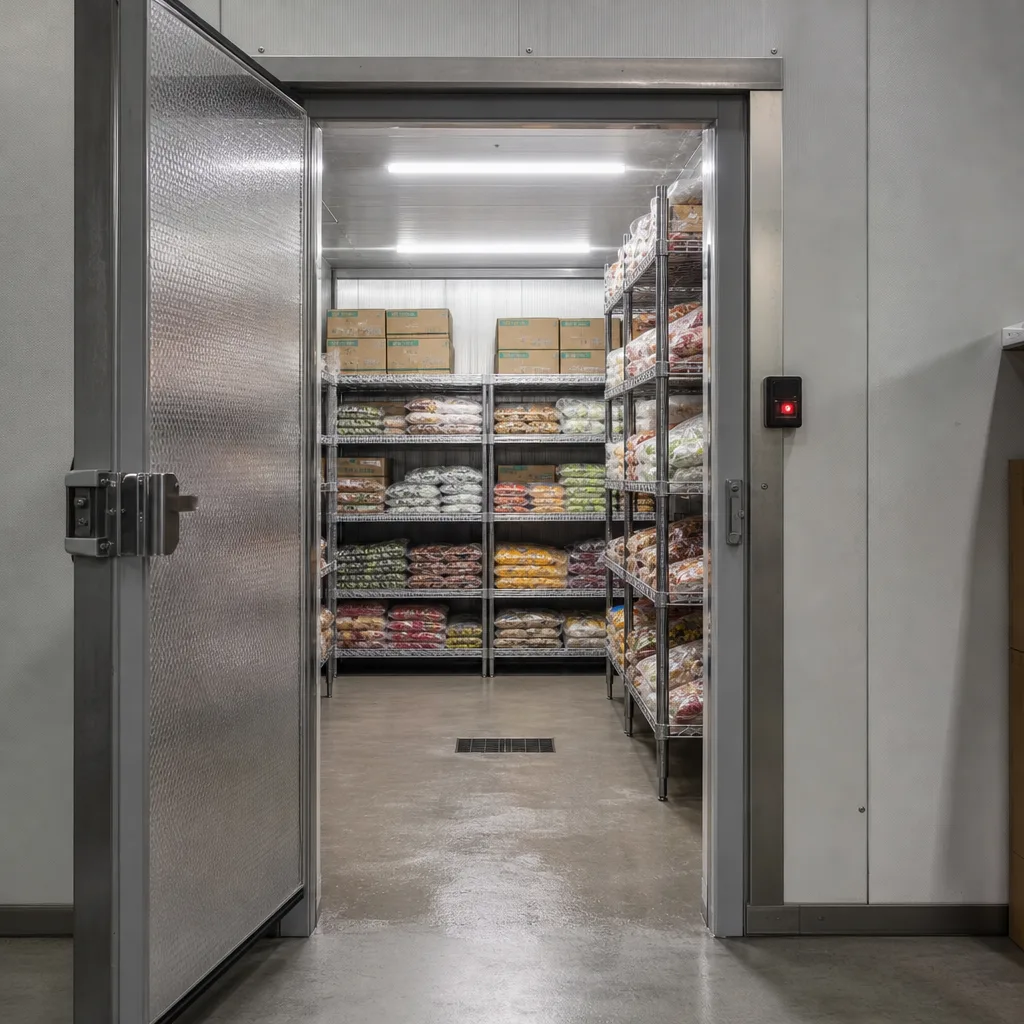
If your AC acts up at home, you sweat for a day. If your walk-in quits, you can lose a full load of meat, dairy, and produce before the next delivery truck shows up. That’s why we treat commercial refrigeration as a business problem first. The real goal isn’t just a cold box. It’s keeping your doors open and your stock safe to sell.
Most cooler failures don’t happen all at once. The system usually gives you a few hints first. If you catch them early, a small repair can stop a large loss.
- The box feels warmer than usual, or your thermometer keeps creeping up during the day.
- The compressor runs nonstop and never seems to shut off.
- Ice is building up on the evaporator coil, the fan unit inside the box.
- There’s water pooling on the floor, or frost is forming around the door.
- The door doesn’t seal tight, or the gasket is torn or flattened.
- You hear new noises, like rattling, buzzing, or clicking that wasn’t there last week.
- Your energy bill jumped and nothing else about your business changed.
Plano summers make every one of these worse. When it’s blazing hot outside, your condenser has to work much harder to get rid of heat. That’s true whether it sits on the roof or in a cramped back room behind the kitchen. A unit that barely kept up in spring can fall behind fast in July, often on your busiest weekend.
Here’s a common moment. It’s Friday night, the dinner rush is starting, and a cook says the walk-in feels “off.” You’re tempted to wait until Monday because you assume weekend service costs extra. With us, it doesn’t. Xtreme Air Services doesn’t charge extra for nights or weekends, so waiting buys you nothing except more risk to your inventory.
When you call, you’ll talk to a real person, any time of day or night. The more you can tell us, the faster our tech can track down the cause once they’re on site. These details help most:
- Whether it’s a cooler, a freezer, a reach-in unit, or an ice machine.
- The temperature you’re seeing now and when you first noticed the change.
- Any of the warning signs above, especially ice, water, or a compressor that won’t stop.
- Where the condenser is located, such as on the roof, outside, or indoors.
- The make and model if you can see it on the unit.
Our licensed, background-checked technicians come out the same day. They find the failed part and give you upfront pricing before any work starts, so you can decide with clear numbers in front of you instead of guessing while your stock warms up.
Signs a Refrigeration Problem Can’t Wait
Not every warning sign means the same thing. Some give you a few hours to check the simple stuff. Others mean your product is at risk right now. Here’s how to tell the difference so you don’t panic over a propped door or wait too long on a dying compressor.
Call right away if you notice any of these:
- The box keeps getting warmer even after the door has stayed shut for a while.
- The compressor is running, but the box isn’t getting any colder.
- The unit has gone completely quiet, and the breaker hasn’t tripped.
- Frozen product is starting to soften or drip.
- You smell burning, see smoke, or the breaker trips again right after you reset it. Shut the unit off and leave it off.
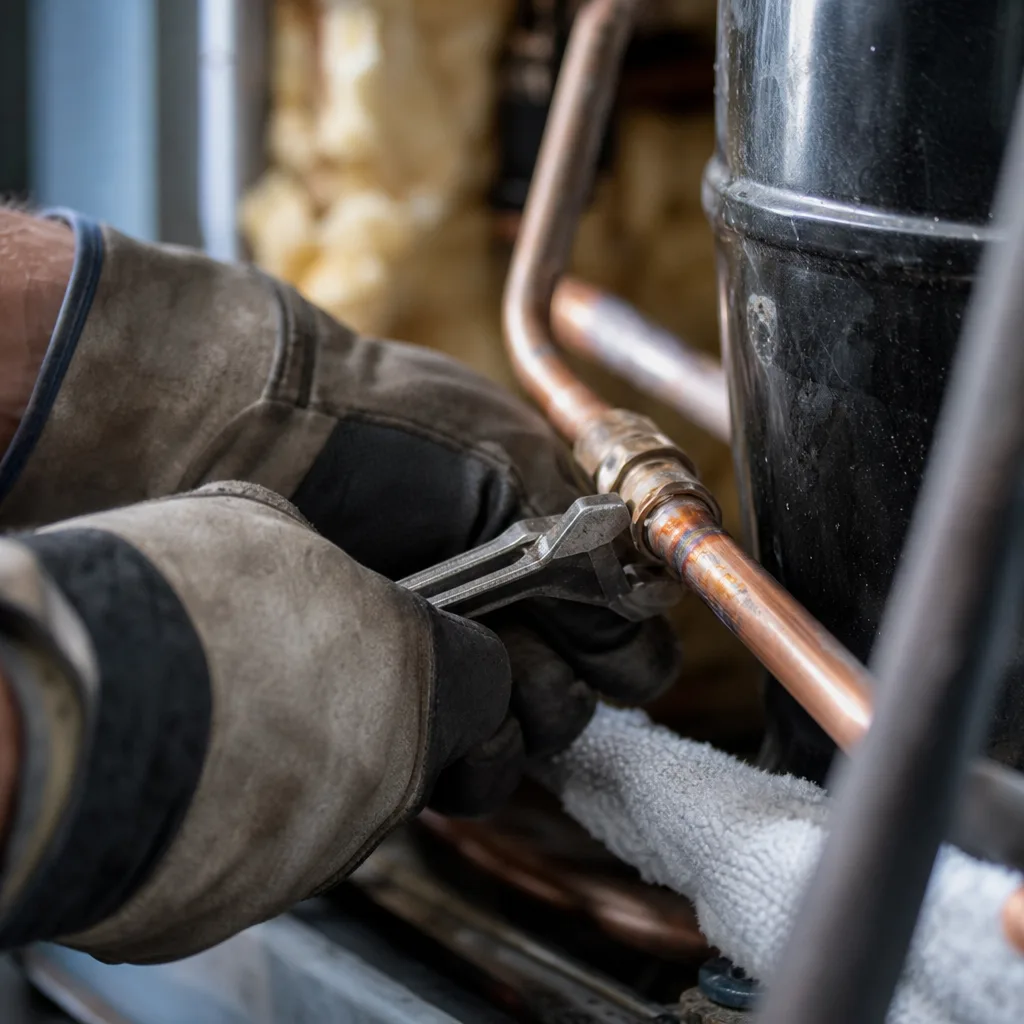
- You hear a hiss or see oily spots around the copper lines or fittings. That can point to a refrigerant leak, and refrigerant work is a job for a licensed, certified tech, not a DIY fix.
Before you call, check these. Sometimes it’s not a repair at all:
- The breaker or the disconnect switch near the unit. Reset it once. If it trips again, stop and call.
- The door. Make sure nobody propped it open during a delivery and that nothing is keeping it from closing all the way. A worn gasket, covered above, also lets warm air pour in.
- The shelves. Boxes stacked tight against the evaporator fan block the cold air from moving around the box.
- The thermostat or controller. It’s easy for someone to bump the setting while cleaning or restocking.
- The condenser coil. If it’s caked with grease or lint, which happens a lot near kitchen exhaust, it can’t get rid of heat. That calls for a routine cleaning, not an emergency repair.
If one of those fixes it and the temperature drifts back to normal over the next few hours, you probably didn’t need a tech today. That’s a good outcome. Keep an eye on it and write down what happened, in case it comes back.
If none of them helps, don’t keep resetting things and hoping. Every hour you wait gives the problem more time to spread to other parts and gives your stock more time to warm up.
While you’re waiting for help, a few simple steps buy you time:
- Keep the door closed as much as you can. Every opening lets cold air out.
- Don’t load a fresh delivery into a box that’s already struggling.
- Move your most sensitive items, like meat, seafood, and dairy, into a reach-in or another unit that’s still holding temperature.
- Write down the temperature and the time every so often. It helps our tech see how fast the box is losing ground, and it gives you a clear record for your own food safety files.
Ice machines follow the same rule. A machine that’s making less ice or slow ice can usually wait for a scheduled visit. One that’s leaking water across the floor or has stopped completely during a busy stretch shouldn’t wait, because it’s both a slip hazard and a hit to your service.
Common Commercial Refrigeration Failures We Repair
Most refrigeration breakdowns come down to one worn or failed part, not the whole system. Our job is to find that part, repair or replace it, and make sure your box runs right before we leave. Most calls are a single common failure fixed on the first visit. Here are the parts that usually cause trouble and what each one looks like from your side of the door.
- Evaporator fan motor. This is the fan inside the box that pushes cold air around. When it slows down or stops, the coil may still be cold, but your product isn’t. You’ll often notice one corner of the walk-in running warmer than the rest.
- Condenser fan motor. This fan sits with the condenser and blows heat away from it. If it quits, heat builds up fast, especially on a hot Plano afternoon. That can push the compressor past its limit.
- Start parts on the compressor. Capacitors, relays, and contactors are small electrical parts that help the compressor kick on. When one fails, you may hear clicking or humming, but the compressor never really starts. These are usually quick swaps.
- Defrost system. Freezers and many coolers melt ice off the coil on a schedule using a heater, a timer, or a control. If any of those fail, ice keeps building until air can’t pass through the coil, and the box warms up even though the unit is running.
- Thermostat or controller. A failed sensor or control can tell the system the box is cold when it isn’t, or keep it running nonstop. The fix is often a sensor or control replacement, not a major repair.
- Drain line. The water from defrost has to go somewhere. In a freezer, a drain line that freezes or clogs sends water back into the box, where it turns to ice on the floor or the coil.
- Refrigerant leaks. We track down the leak first, then repair it and recharge the system. Topping off refrigerant without finding the leak only buys you time.
- Compressor. This is the heart of the system and the biggest part to replace. Many compressor failures start with one of the smaller problems above, like a dead condenser fan or a bad start part that went unfixed.
That last point is why timing matters so much. A failed fan motor is a fairly small job by itself. Leave it alone for a few hot days and the compressor may overheat trying to make up for it. Now you’re paying for two parts instead of one, and your stock sits warm longer while you wait. Catching the first failure early is the best way to keep a repair small.
Ice machines have their own common trouble spots. North Texas has hard water, and the minerals in it leave scale on the parts that make and release ice. Over time, scale can slow ice production, cause cloudy or thin cubes, and keep the machine from dropping its harvest. Clogged water filters, stuck water valves, and failed pumps or sensors are also common causes of slow or stopped ice.
Because our team also handles commercial HVAC, electrical, and plumbing, we can follow a problem past the box itself. If your cooler keeps failing because of a bad circuit or a drain that backs up, we can track that down too instead of sending you to call someone else.
Not sure what your Commercial refrigeration project needs? Ask us.
Call Today, Get Service Today. Xtreme Air Services — North Plano is ready to help.
What Happens During a Repair Visit
A repair visit has one job. Find the part that failed, fix it, and make sure your box is running right before our tech leaves. Here’s what that looks like from your side of the door, so nothing about the visit catches you off guard.
A few minutes of prep before the tech arrives can save real time once they’re on site:
- Clear a path to the walk-in and to the condenser. If the condenser is on the roof, know who has the hatch key or ladder access.
- Keep your temperature log close by. Those notes show how fast the box has been losing ground.
- Have someone on hand who can approve the repair, so the work doesn’t stall while you track down the owner or manager.
- If you haven’t already, move boxes away from the evaporator fan so the tech can reach it.
First comes the diagnosis. Our tech tracks down the failed part. The service-call fee is $26-$99, and it’s credited toward the repair if you go ahead with Xtreme Air Services. If you decide to fix it, that fee isn’t an extra cost stacked on top. It becomes part of the repair.
Next, you get the price before any work starts. It’s upfront, flat-rate pricing, so there’s no meter running while the tech works and no number that grows as the day goes on. You see it, you approve it, and then the work begins. If the tech finds something bigger, like a compressor that’s done or more than one part that’s failed, you’ll hear about it at this point. It won’t show up on a bill later.
Here’s what the price covers. It includes the diagnosis, the labor, and the standard replacement part, plus testing and cleanup. It doesn’t include additional failed parts, major components, code upgrades, or permits unless those are quoted separately. Anything beyond the main repair gets its own quote that you approve first.
So what does a repair usually cost? Our most common job is a single failed part, found, fixed, and tested. It typically runs $300-$2,400. Across all commercial refrigeration work, our typical range is $300-$5,000. Where your repair lands depends on how much has failed, what the part costs and how easy it is to get, how old the equipment is and who made it, and whether more than one component went out. The time of day doesn’t change the price, because we don’t charge extra for nights or weekends. For qualifying installations and larger jobs, flexible financing is available on approved credit.
Then the repair itself. Most calls are a single common failure fixed on the first visit. That’s good news when you have a full walk-in and a dinner rush on the way.
Last, the tech tests the system and confirms it’s running correctly before calling the job done, then cleans up the work area. Keep logging the temperature for the rest of the day. A box that steadily pulls back down to its set point and holds there is the proof you’re looking for. It means you can go back to stocking it with confidence.
Watch Our Video
See How We Handle Commercial refrigeration in Plano
Xtreme Air Services — North Plano
What Drives Commercial Refrigeration Repair Cost
Two walk-ins can have the same symptom and very different repair bills. The ranges we covered above are wide for a reason. Here’s what moves your number up or down, so a quote makes sense when you see it.
How much has failed. This is the biggest factor by far. A bad start relay or a dead fan motor is one part and a fairly short job. A compressor that cooked itself because that fan quit last week is a much bigger repair. That’s the same damage chain we described earlier, now showing up on the bill. The sooner a failure gets caught, the more likely you’re paying for one part instead of two or three.
The part itself, and how easy it is to get. Common motors, capacitors, and sensors are easy to find. Parts for older or less common units may need to be special ordered, and that can add cost and wait time. Older systems can also run on refrigerants that are harder to find and cost more to recharge.
Age and make of the equipment. A newer unit usually takes standard parts and gives a clear answer. An older one may have worn parts hiding behind the one that failed. If your box is getting up in years and the repair keeps growing, ask whether repair still makes sense or whether it’s time to plan for replacement. You should get a straight answer either way.
Where the equipment sits. A condenser on a Plano rooftop in August, or one tucked in a cramped room behind a kitchen line, takes more effort to reach and work on than one at ground level. Grease-caked coils near exhaust hoods and scaled-up ice machines from our hard North Texas water can also turn a simple fix into a bigger cleaning job.
When it breaks. With many providers, a Saturday night call costs more than a Tuesday morning one. With us it doesn’t, because Xtreme Air Services doesn’t charge extra for nights or weekends. That means you never have to weigh your inventory against an overtime rate.
Whoever you call, these questions will tell you a lot about a quote before you approve it:
- Is this a flat price for the job, or are you billing by the hour?
- Does the service-call fee count toward the repair if I go ahead?
- What exactly does this price include, and what would cost extra?
- Is the part on the truck, or does it need to be ordered? How long would that take?
- Did the failed part cause any other damage I should know about now?
- Does the price change if the repair happens after hours or on a weekend?
A provider who answers those clearly, before touching a tool, is one you can trust with your walk-in. If the answers are vague, that’s your sign to slow down and ask more.
The cheapest repair is almost always the early one. Clean condenser coils, a door gasket that seals, and a quick call when the temperature first starts to drift will keep most problems in the one-part range. That protects your budget and your stock.
Frequently Asked Questions
Common questions about Commercial refrigeration
What exactly counts as commercial refrigeration?
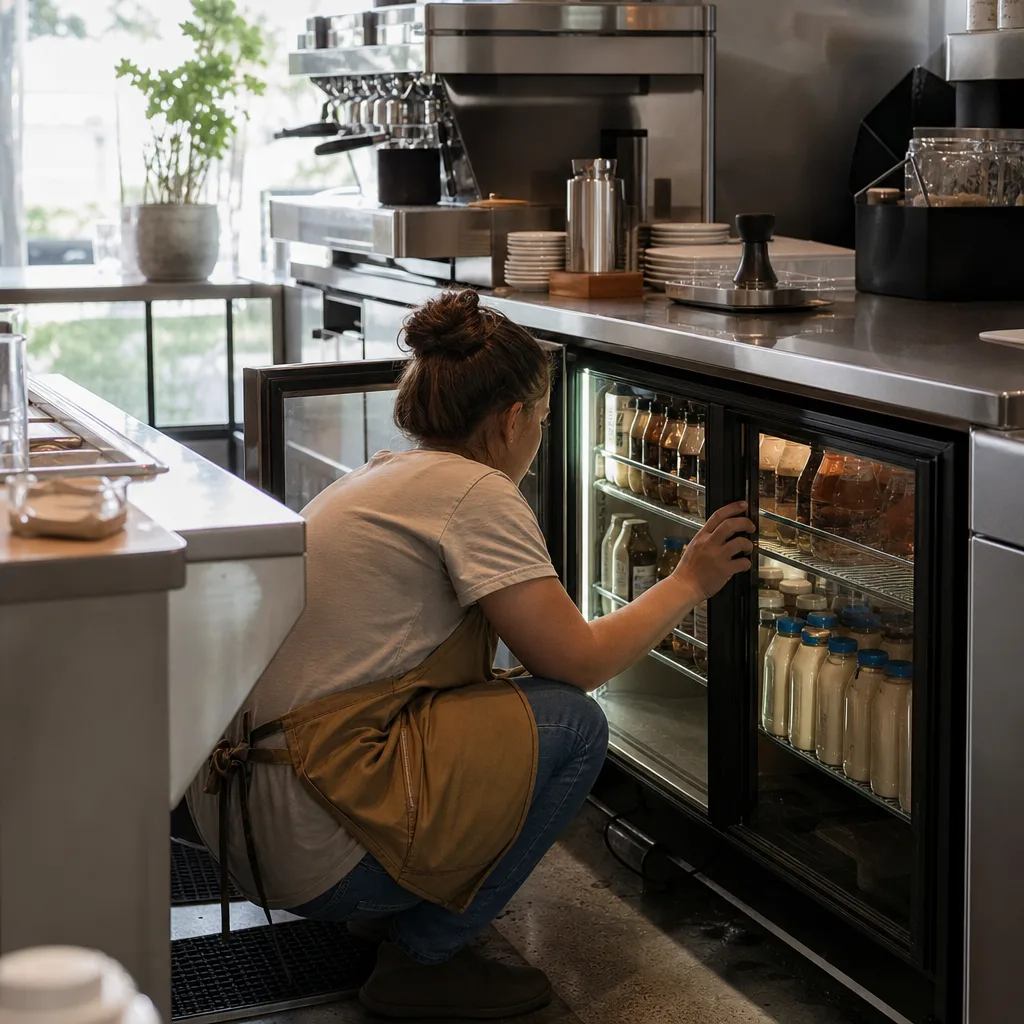
Commercial refrigeration covers any equipment that keeps food or drinks cold for a business, not a home. That includes walk-in coolers and freezers, reach-in units, prep tables, and ice machines. If it holds product you plan to sell, it falls under commercial refrigeration rather than a regular kitchen fridge.
Can my regular HVAC company handle my walk-in cooler, or do I need a refrigeration specialist?
Commercial refrigeration and commercial HVAC use related skills, but they are not identical jobs. A walk-in cooler, freezer, or ice machine has its own parts, like defrost systems and evaporator coils, that need specific training to diagnose correctly. Look for a company that lists commercial refrigeration repair as its own service, not just an add-on to HVAC work.
How do I know if a refrigeration technician is qualified?
Ask if they are licensed and background-checked, and whether they handle refrigerant work specifically, since that requires certification under EPA rules. A qualified tech should also give you upfront, flat-rate pricing before starting repairs, not a number that changes as the job goes on. If a company won’t answer clearly about licensing or pricing, keep calling around.
Ready to Get Started?
Call (469) 527-5131 Today, Get Service Today.