


Tankless Water Heater Installation in Dallas: Know the Scope Before You Book
Tankless installs by licensed plumbers, with the gas line, venting, permits and inspection covered.
What’s Covered on This Page
- What a Standard Tankless Installation Includes
- Gas Line and Venting Requirements Drive Most Cost Changes
- Dallas Permits and Licensed Plumber Requirements
- Tank-to-Tankless Conversion vs. Like-for-Like Replacement
- Sizing a Tankless Unit for Household Demand
- Can I install my own tankless water heater in Texas?
- What size tankless unit do I need for a home with four bathrooms?
- Does a tankless water heater cost more to install than a regular tank?
What a Standard Tankless Installation Includes
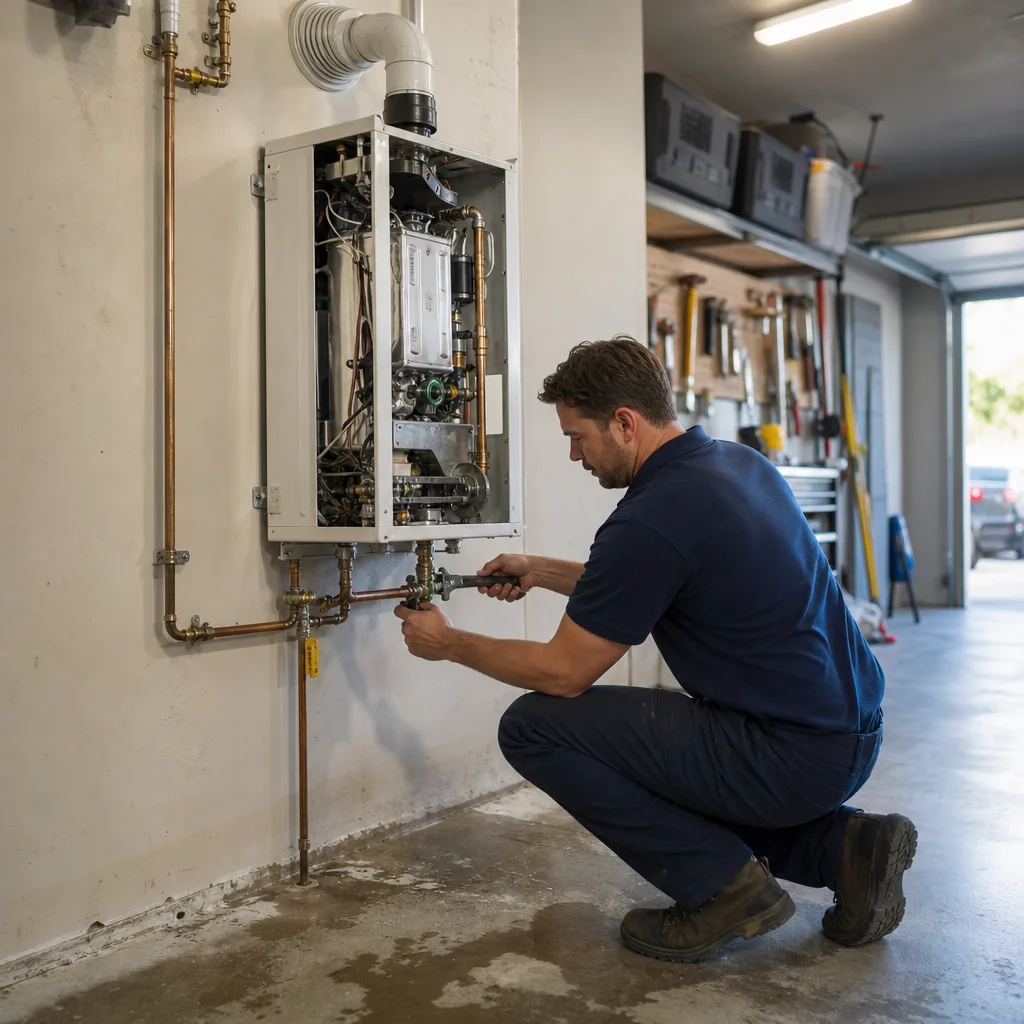
When you get a quote for a tankless water heater, you should know exactly what’s in it and what isn’t. Here’s how a standard job breaks down with our team.
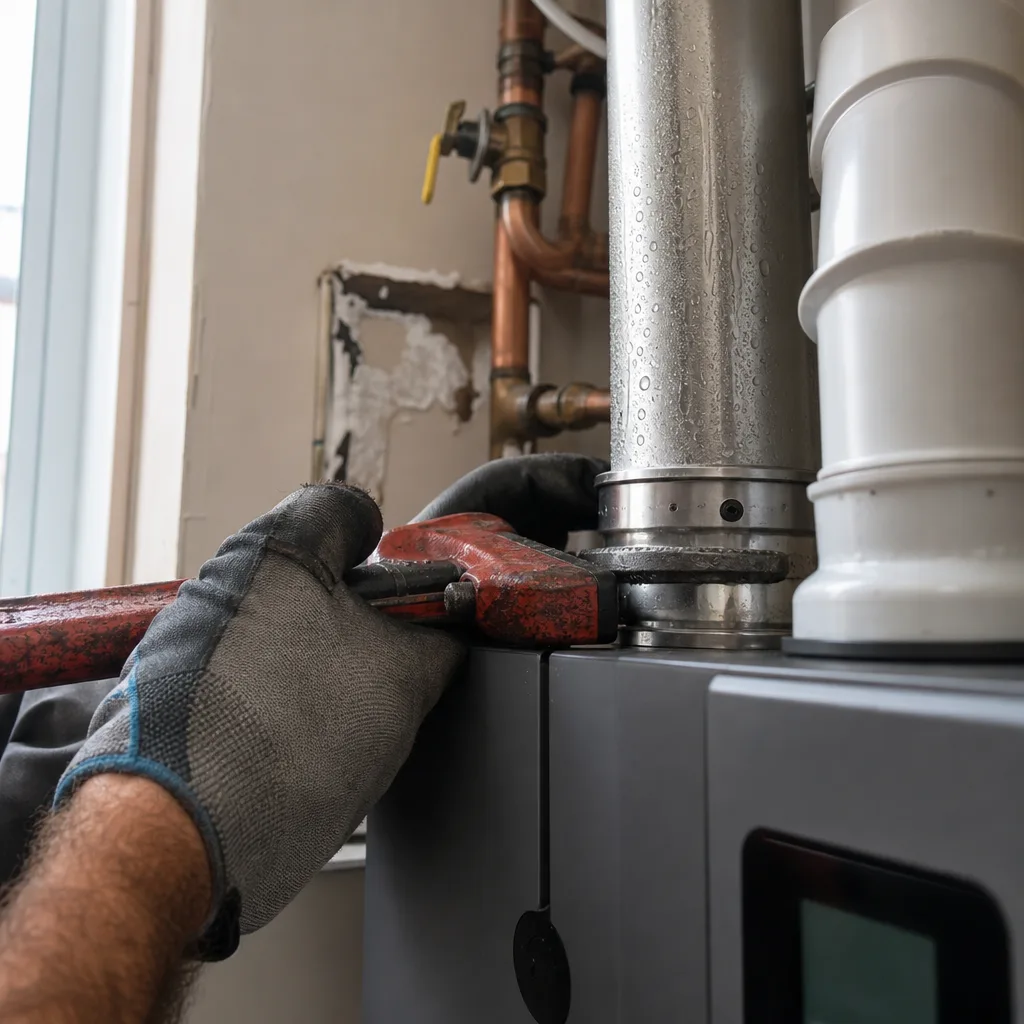
Our most common tankless job is a like-for-like installation. That means your home already has the gas, water, and electrical connections the new unit needs, and nothing major has to change. That job runs $3,700-$5,100. Across all our tankless installs, the typical range is $3,000-$6,500. Where your home lands depends on what’s behind the wall.
- The equipment and materials: the tankless unit plus the parts it takes to install it.
- Professional installation by our licensed and insured technicians.
- Standard connections to your existing water, gas, and power.
- Startup and testing, so you know you have hot water before we leave.
- Haul-away of your old unit, so it doesn’t end up sitting in your garage.
A standard job doesn’t cover duct, electrical, or plumbing modifications. It also doesn’t cover code corrections or permits unless your quote says it does. We spell this out because it’s where most surprise bills come from, and we don’t want you to get one.
If you’re switching from an old tank to tankless, plan on some of this extra work. A gas tankless unit burns a lot of fuel in a short burst when you turn on the hot water. Your existing gas line may be too small to keep up. Gas tankless units also need their own venting, and the vent on an old tank often can’t be reused. That’s why our pricing notes say gas tankless jobs include venting. An electric tankless unit can pull more power than your current panel has room for.
If your home needs any of that, it’s the same company doing it. Our gas line installation, electrical panel upgrade, and dedicated circuit installation services cover those pieces, so you don’t have to juggle three different contractors.
Several things move the price up or down: the size and capacity of the unit, its efficiency, the brand and model, how easy the install spot is to reach, the condition of your existing wiring and plumbing, code upgrades, permits, and any custom fabrication. A big family that runs two showers and the dishwasher at once needs a larger unit than a couple in a small home. The unit has to be sized to the job, so we don’t recommend a one-size-fits-all model.
If we come out to look at your setup, there’s a $26-$99 service-call fee, and it’s credited toward the job if you go ahead with Xtreme Air Services. You’ll see upfront flat-rate pricing before any work starts, so there’s no meter running.
If the full cost is more than you want to pay at once, flexible financing is available on qualifying installations and larger jobs, on approved credit.
Gas Line and Venting Requirements Drive Most Cost Changes
If your tankless quote comes in higher than the standard job, the reason is almost always behind your walls or above your ceiling. It’s usually the gas pipe feeding the unit or the path the exhaust has to take to get outside. The tankless unit itself is rarely what changes the price much. Here’s what decides how much work your home needs.
Your gas pipe works like a garden hose. A long, skinny hose can’t fill a bucket as fast as a short, wide one. A gas tankless unit needs a lot of gas all at once, several times more than a typical tank heater. Whether your current pipe can deliver that depends on a few things:
- How far the water heater sits from your gas meter. A longer run loses more pressure along the way.
- The size of the pipe that’s there now. Many older lines were sized for a tank heater and nothing more.
- What else runs on the same line. Your furnace, gas range, and dryer all pull from it, and the pipe has to keep up when they run together.
- Whether your gas meter can supply the total load of every gas appliance in your home.
If the pipe falls short, the fix can be a new section of larger pipe or a new line run straight from the meter. A short run in a garage is a much smaller job than a long run across an attic.
Venting depends on the type of unit you pick. A condensing tankless unit cools its exhaust enough to vent through plastic pipe. It also makes acidic water, called condensate, so it needs a drain line nearby. A non-condensing unit runs hotter and needs a special metal vent made for that heat. Either way, the vent has to reach outside through a wall or the roof and stay a safe distance from windows, doors, and air intakes. A straight shot through a garage wall costs less than a long run through the attic and out the roof.
Where your heater sits matters a lot in Dallas. Many of the 1950s to 1990s slab-on-grade ranch homes here have the water heater in the garage, close to an outside wall. That often makes venting simple. Homes with the heater in the attic or tucked into an inside closet usually need longer vent and gas runs. Attic jobs also have to deal with summer heat up there, tight access, and keeping a drain line clear for the condensate.
Sometimes the honest answer is that tankless doesn’t pencil out. Say your heater is in the middle of the house, far from the meter, and needs both a new gas line and a long roof vent. A new tank water heater may serve you better for the money. If you mostly want endless hot water for a busy household, tankless can still be worth it. You should just know what the full job costs before you decide.
Because gas line work and venting fall outside the standard install, you’ll see them as separate line items on your upfront quote before any work starts. Then you can weigh tankless against a tank replacement with real numbers in front of you.
Dallas Permits and Licensed Plumber Requirements
Swapping a tank for a tankless unit isn’t just a plumbing job. It touches your water lines, often your gas line, and the vent that carries exhaust out of your home. That’s why Texas requires this kind of work to be done by a state-licensed plumber. In Dallas, a water heater job like this also usually needs a permit and a city inspection.
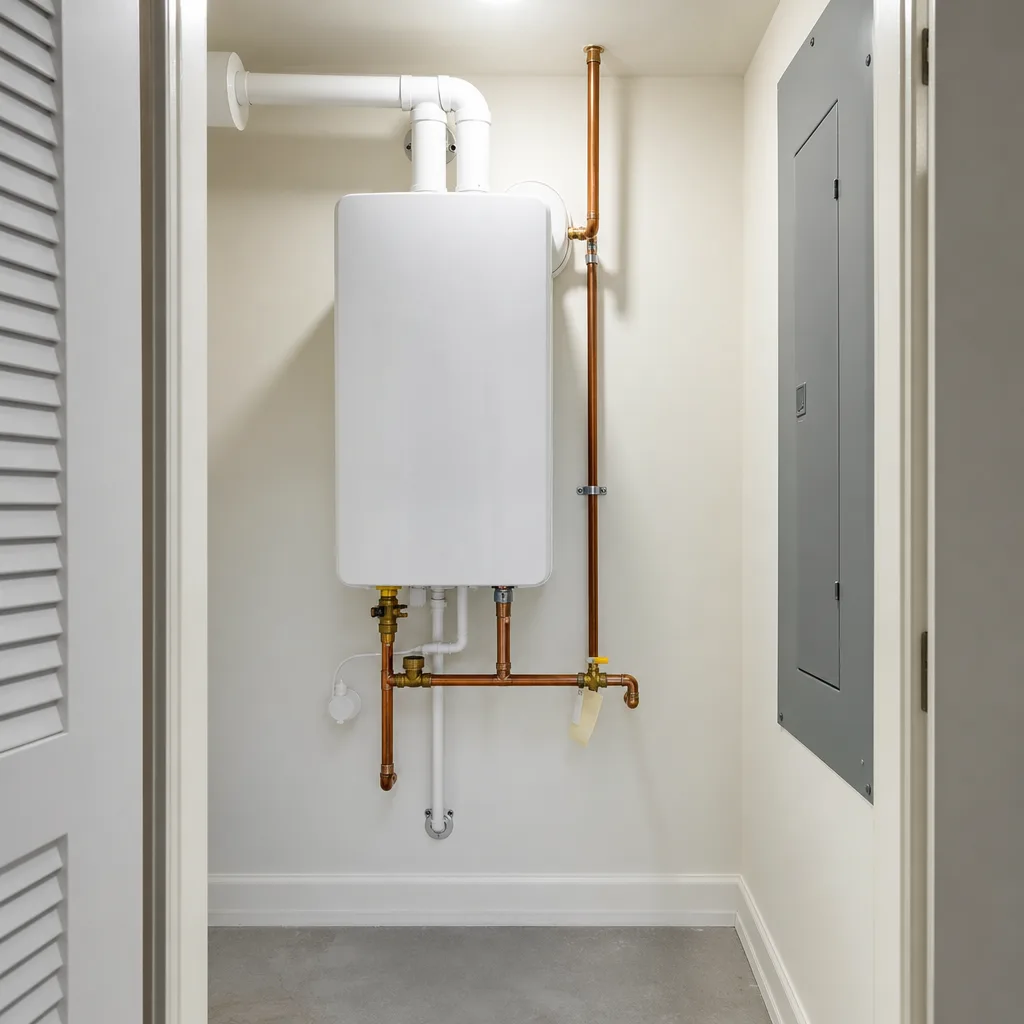
Our plumbing work is done under Master Plumber Larry Breedlove, and our technicians are licensed and insured. You’re not counting on a handyman’s best guess about gas pressure or vent clearances.
Some folks see the permit as red tape. It’s really a second set of eyes on your home at no risk to you. After the install, a city inspector looks at the parts that matter most for safety:
- Gas connections and whether the gas line is sized and tight for the new load
- The vent, including how it runs and how far it sits from windows, doors, and air intakes
- The relief valve and its discharge line, which keeps pressure from building up in the unit
- Water connections and shutoff valves
- For electric units, the wiring and the circuit feeding the unit
An inspection matters most on jobs where something changed, like a new gas line run across the attic or a fresh vent through the roof. Those are the spots where a shortcut can stay hidden for years.
Skipping the permit can come back on you later. If you sell your home, a buyer’s inspector may spot a tankless unit with no permit on record and ask questions. If something ever goes wrong, an insurance company may look at whether the work was permitted and done by a licensed pro. A permit on file is simple proof that it was.
One local wrinkle: a Dallas mailing address doesn’t always mean the City of Dallas handles your permit. Some homes with a Dallas address sit inside a neighboring city that has its own permit office and its own rules. Your installer should check which city your property is in before pulling the permit, so the right inspector signs off.
As mentioned above, permits aren’t part of the standard install price unless your quote says so. You’ll see the permit as its own line on your upfront quote, so you know the cost before you say yes.
Whoever you hire, these questions will tell you a lot in a few minutes:
- Whose plumbing license will this job run under, and can I see it?
- Will you pull the permit, or are you expecting me to?
- Is the permit included in my quote or listed as a separate line?
- Who meets the inspector, and what happens if the inspector asks for a change?
- If my gas line or vent needs work, is that done by the same licensed team?
A good contractor answers these without hesitating. If you get a shrug, or an offer to skip the permit to save a little money, take that as your answer and keep looking.
Ready when you are – get in touch today.
Call Today, Get Service Today. Xtreme Air Services — North Dallas is ready to help.
Tank-to-Tankless Conversion vs. Like-for-Like Replacement
There are really two different tankless jobs, and knowing which one you have tells you a lot about your quote. A like-for-like replacement swaps an old tankless unit for a new one. A conversion takes out a tank water heater and puts a tankless unit in its place.
A quick look at what’s in your garage or closet usually gives you the answer:
- You have a box about the size of a carry-on suitcase on the wall. That’s a tankless unit. Your gas line, vent, and water connections were set up for tankless already, so you’re likely looking at the like-for-like job in the $3,700-$5,100 range covered above.
- You have a tall round tank on the floor. That’s a conversion. Expect the gas line and vent questions from the section above to come up, and expect them as separate lines on your quote.
- You have an electric tank. Going to electric tankless can mean a bigger power draw than your panel was built for, so the panel check comes first.
A conversion changes more than pipes, so here’s what else to think about before you switch.
Where it hangs. A tankless unit mounts on a wall, which can free up floor space in your garage. The best wall isn’t always where the old tank sat. Sometimes moving it a few feet to an outside wall makes the vent run shorter and simpler.
How your hot water feels. You won’t run out of hot water in the middle of a shower anymore. But a tankless unit doesn’t store heated water, so it may take a moment longer for hot water to reach a far bathroom. Very low flows, like a trickle at the sink, may not be enough to turn the unit on. Most families get used to it fast, but it’s good to know going in.
Hard water upkeep. North Texas water leaves mineral scale behind, and a tankless unit’s heat exchanger is where that scale builds up. Plan on periodic flushing to keep it running well. If scale is already a problem in your home, our water softener installation can cut down on that buildup.
Winter freezes. If your unit sits in a garage or attic, it’s exposed when a hard freeze rolls through. Tankless units have water inside small passages, and those can freeze. Placement and freeze protection should be part of the plan, not an afterthought.
Is a conversion worth it? It can be, especially for a busy household that keeps running out of hot water. It’s not the right call for every home. If your tank is working fine and your family rarely runs short, there’s no reason to rush. Replacing a tank that’s failing with another tank is a perfectly good choice too. What matters is that you compare both with real numbers, not guesses.
Call 469-213-3107
Watch Our Video
See How We Handle Tankless water heater installation in Dallas
Xtreme Air Services — North Dallas
Sizing a Tankless Unit for Household Demand
A tankless unit isn’t sized by how many gallons it holds, because it doesn’t hold any. It’s sized by how much hot water your home uses at the same moment and how much the unit has to warm that water up. Get this wrong and you’ll hear the classic complaint: the shower goes lukewarm the minute someone starts the dishwasher.
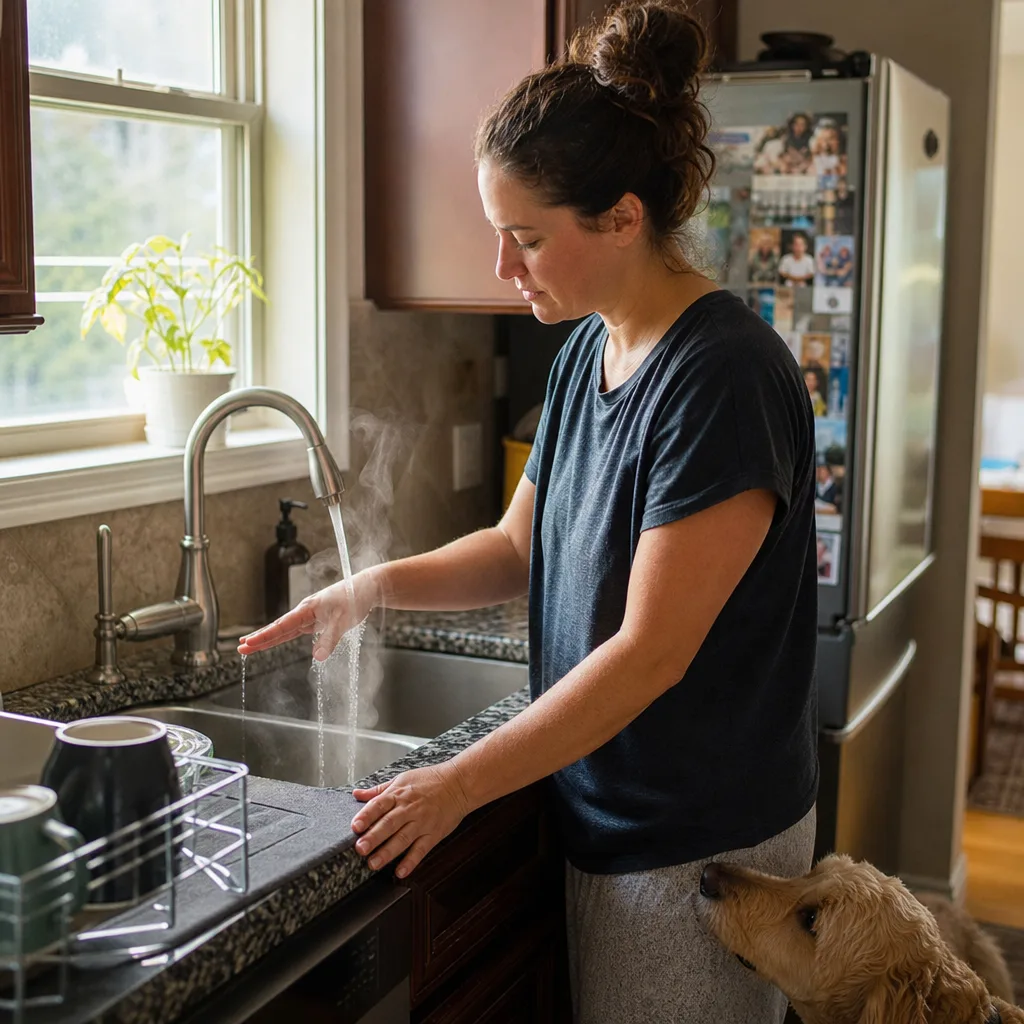
Two numbers decide the right size:
- Flow rate, measured in gallons per minute (GPM). This is the total hot water running at once. If two showers are going and each pulls about two gallons a minute, the unit has to keep up with roughly four.
- Temperature rise. This is the gap between how cold your water comes in and how hot you want it to come out. The bigger that gap, the fewer gallons a minute any unit can heat.
That second number is where Dallas homes get tricky. Your incoming water isn’t the same temperature all year. In July it comes in warm, and almost any unit keeps up. After a January cold front, it comes in much colder, and the same unit heats noticeably fewer gallons a minute. A tankless heater that feels great in summer can come up short on a cold morning. A good installer sizes for your coldest mornings, not your easiest ones.
It also helps to think about your busiest 15 minutes, not your average day. Here’s how that looks for a few common households:
- A couple in a one-bath home: one shower and maybe a sink at the same time. A smaller unit usually covers it.
- A family of four with two bathrooms: two showers running together on school mornings, sometimes with the washer going. This calls for a noticeably bigger unit.
- A large household with a soaking tub or a shower with several heads: very high flow at once. This may need the largest units made, or two units linked together.
Fuel type plays a part too. Gas tankless units can usually heat more water per minute than electric ones. A whole-house electric unit can work well in a smaller home, but in a bigger family’s home it may struggle on winter mornings, on top of the panel question covered above.
Bigger isn’t automatically better, either. A larger gas unit needs more gas, and that can turn a simple swap into the gas line upgrade described earlier. You’d be paying more up front for hot water capacity you’ll never use. The goal is a unit that handles your real peak, with a little room to spare, and nothing more.
Before you get a quote, jot down a few answers. They’ll make any estimate more accurate:
- How many people live in your home, and how many bathrooms do you have?
- Do showers overlap in the morning or at night?
- Do you have a large tub or a shower with more than one head?
- Do the dishwasher or washing machine often run while someone’s showering?
- Are you planning to add a bathroom or more people to the household soon?
With those answers, an honest installer can show you why a certain size fits your home instead of just picking the biggest model on the truck.
Frequently Asked Questions
Common questions about Tankless water heater installation
Can I install my own tankless water heater in Texas?
No, Texas law requires a state-licensed plumber to handle gas, water, and vent connections on a water heater install. This isn’t a DIY-friendly job because it involves gas line sizing, venting, and code-required inspections. A licensed plumber also knows how to size the unit correctly and pull the permit your city requires.
What size tankless unit do I need for a home with four bathrooms?
A home with four bathrooms usually needs a larger gas unit, or sometimes two units linked together, because several showers can run at once. The right size depends on your peak demand, not just bathroom count. Count how many fixtures might run hot water at the same time, especially on busy mornings, and size for your coldest winter incoming water temperature, not summer conditions.
Does a tankless water heater cost more to install than a regular tank?
Usually yes, because tankless units often need extra gas line or venting work that a tank replacement doesn’t. A straightforward swap of one tankless unit for another costs less than converting from an old tank, since a conversion often requires upgrading the gas line, adding proper venting, and sometimes electrical work. The final price depends on what’s already in place behind your walls.
Ready to Get Started?
Call (469) 213-3107 Today, Get Service Today.