


Commercial HVAC Installation in Irving: Getting the Scope Right the First Time
New commercial systems scoped and sized for your building, with what's included and what costs extra laid out first.
What’s Covered on This Page
- Know Whether You Need a Full Installation or a Repair First
- What a Standard Commercial Installation Includes
- What Drives Your Installation Price Up or Down
- Sizing Equipment for Irving’s Cooling Demand
- The Installation Process From Quote to Startup
- What’s the difference between a residential HVAC system and commercial HVAC?
- Is there a rule for deciding when to replace an aging commercial unit instead of repairing it?
- What should be in a commercial HVAC maintenance plan?
Know Whether You Need a Full Installation or a Repair First
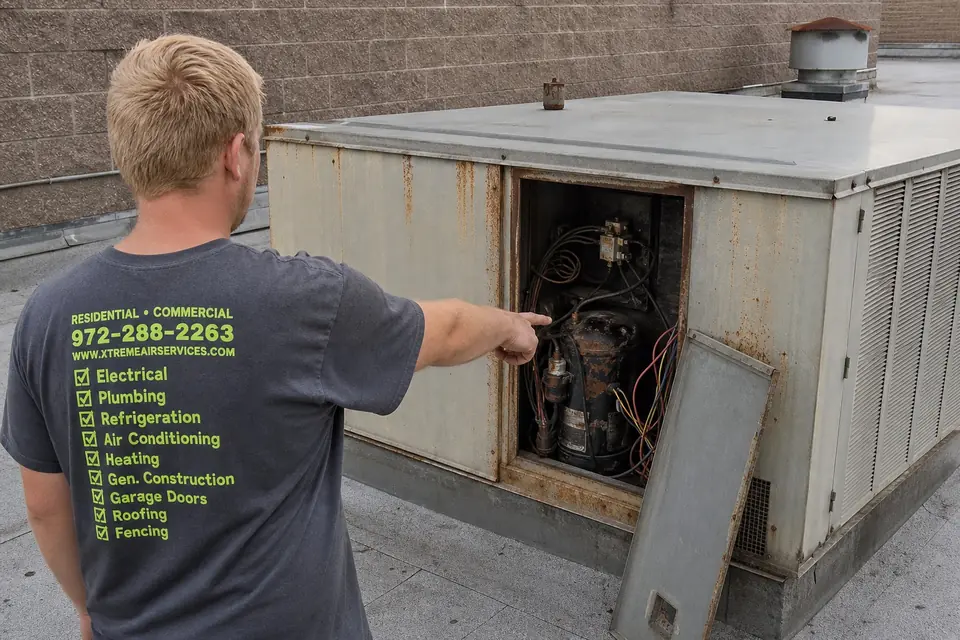
Before you budget for new equipment, find out what’s wrong. A unit that quit this morning isn’t automatically a unit that’s done. A bad capacitor, a worn-out fan motor, a clogged drain line, or a refrigerant leak can shut down your cooling just as hard as a dead compressor. Those fixes cost a small slice of what a new system does.
A repair is usually the right call when:
- The system is fairly young, and this is its first real problem.
- One part failed, and the rest of the unit checks out fine.
- Your space, headcount, and layout haven’t changed since the system went in.
- Your energy bills have stayed steady from one summer to the next.
It’s time to plan an installation when:
- You keep paying for the same kind of repair, season after season.
- A major part, like the compressor or heat exchanger, fails on an older unit.
- The system runs on an older refrigerant that makes repairs costly and parts hard to find.
- You’ve added staff, equipment, or square footage, and some areas never get comfortable.
- You’re building out or remodeling a space, and the existing system was never sized for the new layout.
- Tenants or employees still complain about hot and cold spots after the system’s been serviced.
Here’s a common picture. Your front office feels fine, but the back of the building turns warm every July afternoon. That doesn’t always mean the unit is failing. It could be an airflow problem, a duct issue, or equipment that was sized before that part of the building changed. The fix might be a repair, some duct work, or a new system. The only way to know is to have someone look at it.
Timing matters for your business, too. A planned installation happens on your schedule, when it’s least disruptive to customers and staff. An emergency replacement happens on the hottest day of the year, when your doors are open and your system’s already down. If your equipment is showing the signs on the second list, planning ahead protects your uptime. If it’s showing the signs on the first list, put that money into a repair and get more years out of what you have.
Xtreme Air Services is a licensed and insured contractor, HVAC License #TACLA29023C, and we handle commercial HVAC installation, repair, and maintenance. Our service-call fee is $26-$99, and it’s credited toward the repair if you move forward with us. That way, finding out what’s really going on doesn’t cost you extra when a repair is the right answer.
What a Standard Commercial Installation Includes
A standard commercial installation is a like-for-like swap. The new equipment goes where the old equipment was, and it ties into the connections that are already there, with no major changes to your building. For that job, our price is $28,000-$64,000. Commercial installations as a whole run $10,000-$100,000, since the final number depends on tonnage and scope. Tonnage is simply how much cooling the system can deliver.
Here’s what a standard installation covers:
- The new equipment and materials
- Professional installation by licensed and insured technicians
- Standard connections to your existing setup
- Startup and testing, so the new system is turned on and checked
- Haul-away of the old unit, so it isn’t left on your roof or behind your building
Some items aren’t included unless your quote says they are:
- Duct modifications
- Electrical modifications
- Plumbing modifications
- Code corrections
- Permits
These items are kept separate because no two buildings are the same, and you often can’t tell what’s needed until someone looks. A newer unit might need a different electrical circuit than the one it replaces. Ductwork in an older space may leak, or it may have been sized for a layout that no longer exists. A condensate drain line might need a new route. Code corrections come up when existing work doesn’t meet today’s code, and permit needs depend on the job. Building these into every price would mean overcharging the businesses that don’t need them.
This matters most when you’re comparing bids. Two quotes can look thousands of dollars apart just because one includes permits and duct work and the other leaves them out. Before you decide, ask every contractor the same questions:
- Is removal of the old unit included?
- Are permits in this price, or extra?
- What happens to the price if the ductwork or wiring needs changes?
- Is startup and testing part of the job?
Get the answers in writing. A clear scope protects your budget, and it protects your schedule, too. Surprise work found halfway through an install is how a planned one-day shutdown turns into three.
If your building needs more than a straight swap, you don’t have to bring in a separate crew. We also handle commercial ductwork, commercial electrical, and commercial plumbing, so you have one fewer company to schedule and one team responsible for the whole job.
A new system is a big expense for any business. Flexible financing is available on qualifying installations and larger jobs, on approved credit, so you can replace failing equipment without draining your operating cash.
What Drives Your Installation Price Up or Down
Your quote comes down to a handful of things. Some are your choice, like how efficient a system you want. Others come with your building, like how hard it is to reach the old unit. Once you know what they are, you can read any quote and see where the money is going.
- Size of the system. More tonnage means more equipment and more cost. The right size depends on your space and how you use it, not just the label on the old unit. A busy kitchen, a server closet, or a full staff all add heat. A unit that’s too big costs more up front and turns on and off too often, which can leave the air feeling damp. A cooling load calculation sorts this out before anyone orders equipment.
- Efficiency rating. SEER2 tells you how much cooling you get for each unit of electricity over a full season. A higher number means lower power bills. AFUE does the same job for gas heat. It shows how much of the fuel turns into warmth for your building. Higher ratings cost more up front and save money every month after. In North Texas, where cooling runs for much of the year, those savings add up.
- Brand and model. Features change the price. A variable-speed fan, for example, runs at a low, steady speed most of the time instead of blasting on and off. That gives you more even temperatures and better humidity control, and it costs more than a basic single-speed model.
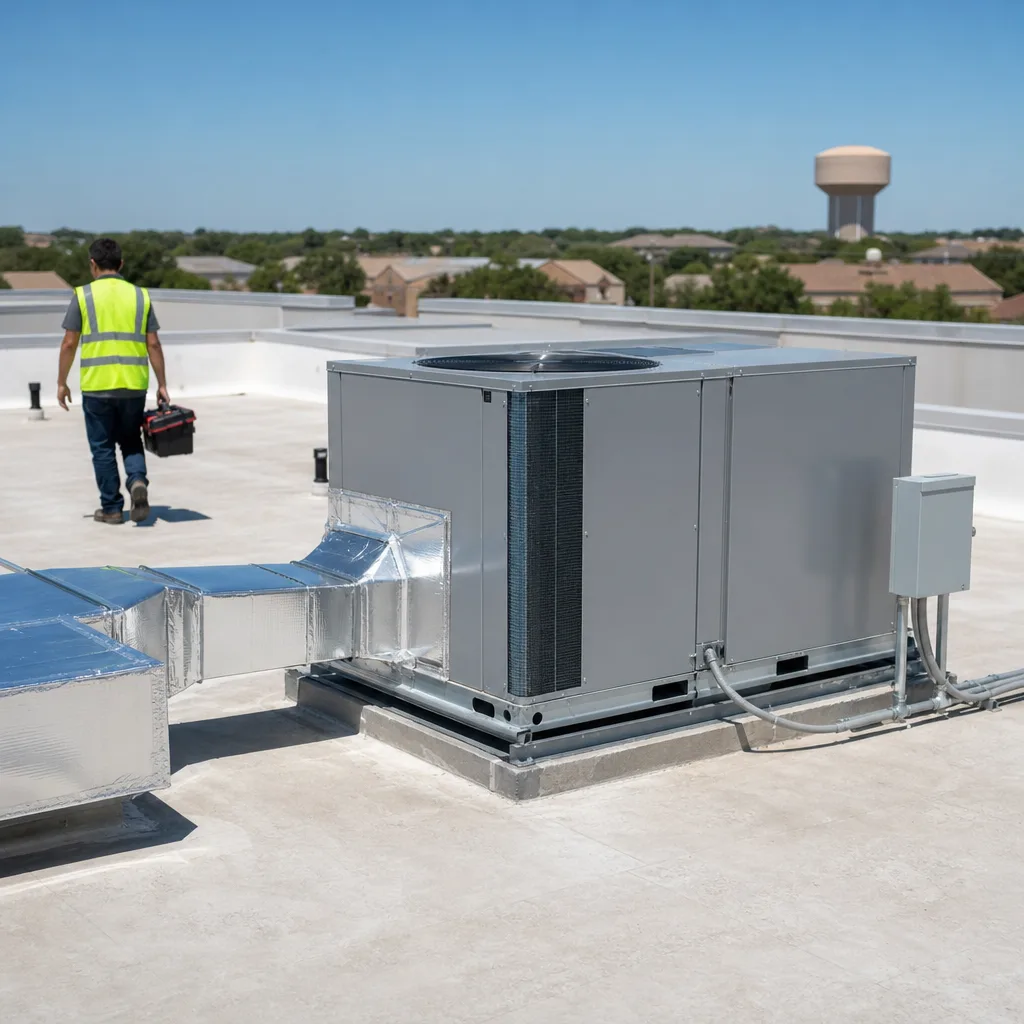
- Ease of access. A unit on the roof of a taller building may need a crane to lift it into place. A cramped mechanical room or a hard-to-reach ceiling space takes more labor. Equipment that sits at ground level with open space around it is the simplest case.
- Condition of your ductwork, wiring, and plumbing. These are the add-ons listed above. Their condition decides whether they come up at all. Sound connections keep you close to a straight swap. Worn or undersized ones push the price up.
- Code upgrades and permits. When older work doesn’t meet today’s code, it has to be brought up to it before or during the install. Permit costs depend on the job.
- Custom fabrication. A new unit doesn’t always fit the old footprint. If the base or duct openings don’t line up, our team may need to build adapters or custom transitions to connect it. We handle ductwork fabrication and sheet metal work, so that piece doesn’t have to wait on another shop.
One more tip for comparing bids. If two quotes for the same building list different tonnage or different efficiency ratings, you’re not comparing the same job. Ask each contractor how they sized the system and which rating they priced. A lower number sometimes means a smaller or less efficient unit, and that can cost you more in power bills and comfort complaints down the road.
None of these factors should be a surprise on install day. A good quote names the tonnage, the efficiency rating, and any access or fabrication work before you sign. That way, you know what you’re paying for and why.
Need help with Commercial HVAC installation?
Call Today, Get Service Today. Xtreme Air Services — Irving is ready to help.
Sizing Equipment for Irving’s Cooling Demand
The right size for your new system is the one that matches how your building gains heat today. That’s not always the number on the old unit’s label. It’s the most important call in the whole installation, since a system that’s the wrong size will cost you every month it runs, no matter how efficient it is.
In Irving, your system has to keep up through long, hot North Texas summers, often on the hottest weekday afternoons when your doors are open and your building is full. Sizing has to hold up on those days, not just on a mild morning in May.
Copying the old tonnage feels safe, but it can repeat an old mistake. The first system may have been sized wrong. Or your building may have changed since it went in. Maybe you added a break room, more computers, or a second shift, or a wall of west-facing glass that now bakes all afternoon. Each of those adds heat the old sizing never planned for.
A proper sizing looks at how your space is really used. That includes:
- How many people are in the building, and during which hours
- Heat-making equipment, like ovens, servers, printers, and lighting
- Windows, sun exposure, and which side of the building takes the afternoon sun
- Roof condition and insulation, especially on single-story buildings with a lot of roof
- How much outside air the space brings in, since that air has to be cooled and dried too
- Whether some rooms run hotter than others and may need their own zone
Oversizing has its own problems, which we covered above. An undersized system fails in a different way. It runs nonstop on peak days and still can’t hold your set temperature. Your staff feels it by mid-afternoon, and your customers notice it too. Running that hard also puts more wear on the compressor and fan motors, so the equipment can wear out sooner than it should.
Sometimes the answer isn’t one bigger unit. A building with a hot back room and a cool front office might do better with zoning, or with a separate system for the problem area. That way, one thermostat isn’t trying to please two very different spaces. Getting that answer right at install time is much easier than fixing it after the equipment is on the roof.
You can help get an accurate size by having a few things ready before the estimate:
- Your normal business hours and typical headcount
- A list of any changes to the space since the current system went in
- Where people complain about hot or cold spots, and what time of day
- Recent utility bills, if you have them handy
- Building plans or a floor plan, if one is available
Xtreme Air Services offers cooling load calculations as part of installation planning. That way, the tonnage on your quote is based on your building, not a guess. Whoever you hire, ask how they arrived at the size they’re recommending. A contractor who sized it carefully will be glad to walk you through it.
Watch Our Video
See How We Handle Commercial HVAC installation in Irving
Xtreme Air Services — Irving
The Installation Process From Quote to Startup
A commercial installation goes smoothly when the hard thinking happens before install day. Most of the steps are about planning. The swap itself is the short part. Here’s how the job moves from a quote to cool air.
1. The quote and scope. Once the system is sized and the extras are known, you get a written scope. With Xtreme Air Services, you approve upfront flat-rate pricing before any work starts, so no meter is running. Read the scope closely. It should name the equipment, the tonnage, and any duct, electrical, or plumbing work your building needs.
2. Picking the date. This decision matters most to your business. Your space will be without cooling for part of the swap, so pick your slowest day, not your busiest. In an Irving summer, a morning install is easier on your staff than one that runs into a 100-degree afternoon. If you lease, check with your landlord early. Many buildings have rules about roof access, crane lifts, and work hours.
3. Getting ready. Before install day, the equipment gets ordered, permits get pulled if your job needs them, and any crane lift gets booked. On your end, a few small steps save real time:
- Clear a path to the unit, the electrical panel, and the thermostat
- Have roof keys or access codes ready for the crew
- Tell your staff and tenants when the cooling will be off
- Move stock, files, or equipment away from the work area
- Have one person on site who can answer questions and sign off
4. Install day. Power to the old unit gets shut off. The refrigerant is recovered, not vented into the air, because federal rules require that. The old unit is disconnected and removed. The new one is set in place and tied into your power, controls, ductwork, and condensate drain. Haul-away of the old unit is part of the job, so it won’t sit on your roof or behind your building.
5. Startup and testing. This step decides whether the new system runs the way it should for years. A new unit can turn on and still be set up wrong. Startup and testing are included in our installation, so the system is turned on and checked before the crew leaves. A good startup looks at:
- Refrigerant charge, so the system cools at its rated efficiency
- Airflow across the coil and out of your vents
- Electrical readings on the compressor and fan motors
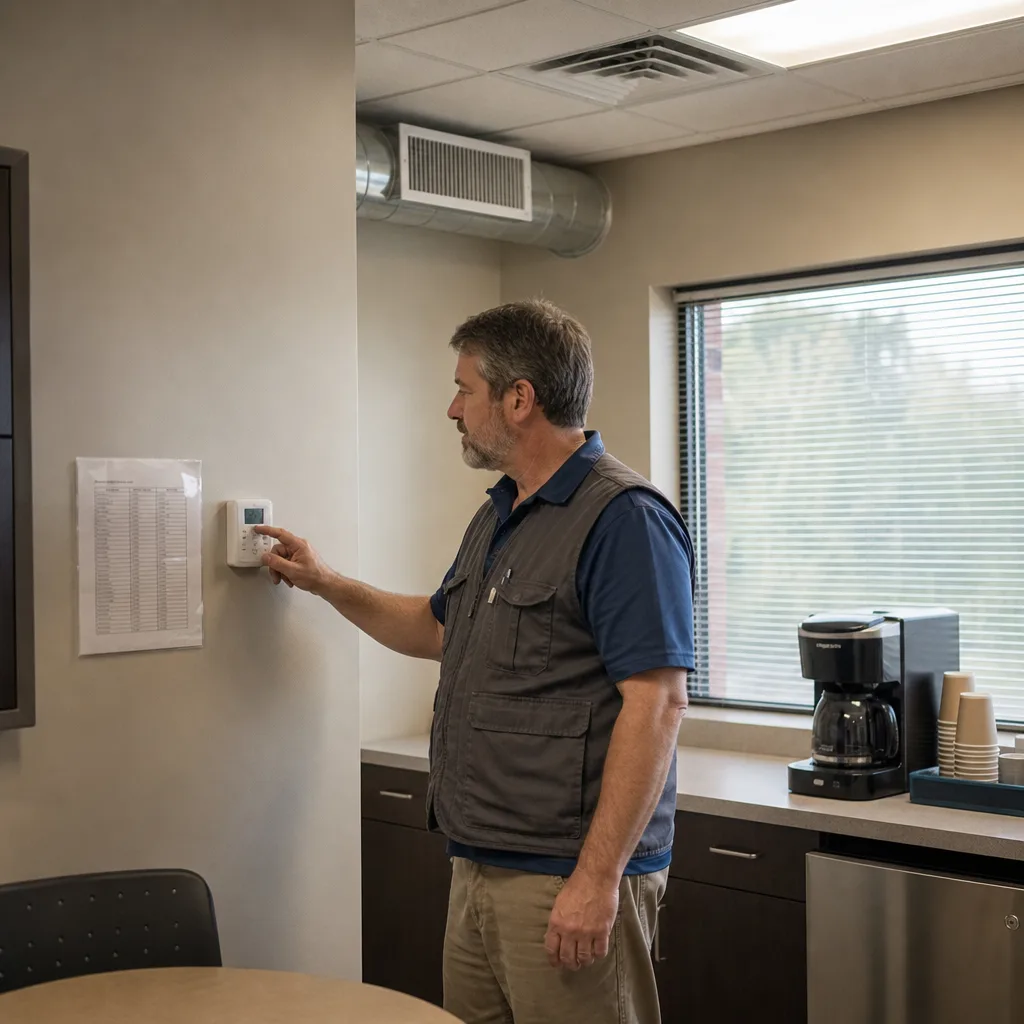
- Thermostat and control settings, including your business-hour schedules
- The condensate drain, so water goes where it should and not into your ceiling
- A full run in cooling, and in heating if your unit has it
6. The walkthrough. Before you sign off, ask a few simple questions. What filter size does the unit take? How do you change the thermostat schedule? Where are the startup readings written down? Keep those readings with your building records. If a problem shows up next summer, they give the next technician a clear starting point.
A straight swap with clear access is the simplest case. A crane lift, new ductwork, or electrical changes add steps, and a good contractor will tell you about them before install day, not on the day itself. When the plan’s set ahead of time, the only surprise should be how much quieter and cooler your space feels.
Frequently Asked Questions
Common questions about Commercial HVAC installation
What’s the difference between a residential HVAC system and commercial HVAC?
Commercial HVAC systems are built to handle bigger spaces, more people, and equipment that puts off extra heat, like ovens or servers. Many commercial buildings use rooftop units instead of the split systems common in houses, and they often need zoning to keep different rooms comfortable. Sizing a commercial system takes more into account too, like how many people use the space and when, not just square footage.
Is there a rule for deciding when to replace an aging commercial unit instead of repairing it?
Some contractors use a rule of thumb that multiplies the repair cost by the age of the unit, and if that number passes a set threshold, replacement makes more financial sense than another repair. The idea behind it is simple: older units cost more to keep fixing, and that money is better put toward new equipment. That said, the real decision should weigh how often repairs are stacking up, whether a major part like the compressor has failed, and whether your space has changed since the system was installed.
What should be in a commercial HVAC maintenance plan?
A solid maintenance plan checks refrigerant charge, airflow, electrical connections, and the condensate drain on a regular schedule, usually a couple of times a year. Regular visits catch small issues, like a weak capacitor or a clogged drain line, before they turn into a breakdown on a busy day. Ask any contractor what’s included in their plan and how often they come out, since coverage varies a lot from one agreement to the next.
Ready to Get Started?
Call (469) 200-2166 Today, Get Service Today.