

Most people assume their home breathes on its own. Open a window, run a fan, and you’re done. The reality is that understanding how home ventilation works is one of the most overlooked factors in both indoor health and monthly energy bills. Poor ventilation traps pollutants, drives up humidity, and forces your HVAC system to work harder than it should. This guide breaks down the mechanics behind home ventilation systems, explains the different types available, and gives you the practical knowledge to make smarter decisions about your home’s air.
Table of Contents
- Key takeaways
- How home ventilation works and why it matters
- Understanding ventilation types for your home
- Common mistakes that hurt ventilation performance
- Ventilating windowless rooms and tight spaces
- My take on what most homeowners get wrong
- Get a professional ventilation assessment
- FAQ
Key takeaways
| Point | Details |
|---|---|
| Ventilation is not just airflow | Controlled air exchange removes pollutants, regulates humidity, and protects your home’s structure. |
| Four main system types exist | Exhaust, supply, balanced, and energy recovery systems each serve different homes and climates. |
| ERVs and HRVs save real money | Switching to an energy recovery system can cut ventilation-related energy costs by 40 to 60 percent. |
| Vent sizing mistakes hurt performance | Measuring the faceplate instead of the duct opening restricts airflow and strains your blower motor. |
| Windows alone are not enough | Modern airtight homes need mechanical ventilation to maintain healthy, continuous air exchange. |
How home ventilation works and why it matters
Ventilation is the process of replacing stale indoor air with fresh outdoor air in a controlled, deliberate way. That word “controlled” is what separates real ventilation from simple infiltration, which is the unplanned leakage of air through cracks, gaps, and poorly sealed joints. Infiltration is unpredictable. It gives you no say in where air enters, how much comes in, or what it brings with it.
The practical measure of how well a space is ventilated is called Air Changes per Hour, or ACH. It tells you how many times the total volume of air in a room gets replaced within one hour. Recommended ACH in bedrooms sits at 5 to 6 for effective pollutant removal and humidity control. Most homes with no mechanical system fall well short of that target.
The health stakes are real. Without adequate air exchange, your home accumulates:
- Carbon dioxide from breathing, which causes fatigue and poor concentration
- Volatile organic compounds (VOCs) off-gassed from furniture, paint, and cleaning products
- Excess moisture that feeds mold growth and dust mites
- Particulate matter from cooking, candles, and outdoor pollution that seeps inside
Energy efficiency is also directly tied to how your ventilation system operates. A poorly designed system forces conditioned air out of the house and pulls in unconditioned air, making your heating and cooling system compensate constantly.
Pro Tip: If your home feels stuffy even with windows open, check whether your HVAC return vents are blocked. Furniture placed in front of return grilles is one of the most common causes of poor home air circulation that homeowners overlook.
Understanding ventilation types for your home
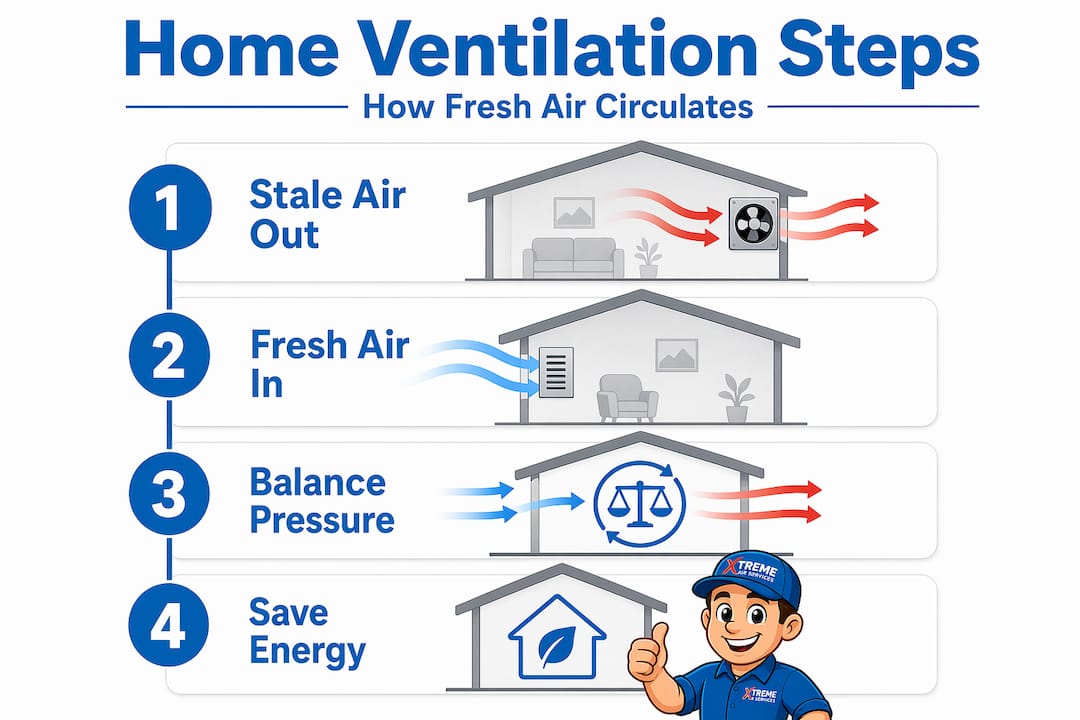
ASHRAE 62.2-2022 categorizes ventilation into four main types: exhaust, supply, balanced, and energy recovery. Each one moves air differently and suits different climates, budgets, and home constructions.
| System type | How it works | Best climate | Key limitation |
|---|---|---|---|
| Exhaust only | Pulls air out, creates negative pressure | Cold climates | Draws in unfiltered outdoor air |
| Supply only | Pushes air in, creates positive pressure | Hot/humid climates | Can push moisture into wall cavities |
| Balanced | Equal intake and exhaust, neutral pressure | Mixed climates | Higher installation cost |
| HRV | Balanced with heat recovery | Cold climates | Does not transfer moisture |
| ERV | Balanced with heat and moisture recovery | Hot/humid or mixed | More complex maintenance |
Exhaust-only systems are the simplest and cheapest. They use fans in bathrooms and kitchens to pull stale air out. The downside is that they depressurize the home, which means outdoor air gets sucked in through whatever gaps exist in the building envelope. You have no control over where that air comes from.

Supply-only systems work in reverse. They push fresh air into the home, creating slight positive pressure that forces indoor air out through leaks. This works well in hot, humid climates because it prevents outdoor humidity from being drawn through walls. The risk is that in cold climates, warm moist indoor air can get pushed into wall cavities and condense, causing structural damage over time.
Balanced systems solve the pressure problem by moving equal volumes of air in and out simultaneously. This gives you neutral pressure and predictable airflow. The premium versions of balanced systems are HRVs and ERVs.
An HRV (Heat Recovery Ventilator) captures heat from outgoing stale air and transfers it to incoming fresh air. No mixing of the two airstreams occurs. You get fresh air without losing the heat you paid for. An ERV (Energy Recovery Ventilator) goes one step further. ERVs recover 60 to 85 percent of sensible heat and also transfer moisture between airstreams, which prevents your home from becoming too dry in winter or too humid in summer.
HRV systems transfer heat only, making them the right call in very cold climates where you want to exhaust moisture. ERVs are better suited for hot, humid climates or mixed climates where humidity management in both directions matters. Choosing the wrong one for your climate can create moisture problems rather than solve them.
Moving from exhaust-only to ERV systems can reduce ventilation-related HVAC energy consumption by 40 to 60 percent. For a home spending $200 a month on heating and cooling, that is a meaningful number.
Pro Tip: If you live in a climate with cold winters and humid summers, an ERV is almost always the better choice over an HRV. The moisture transfer capability works in both seasons, protecting your home year-round.
Common mistakes that hurt ventilation performance
Knowing the system types is only half the picture. How you install, size, and operate them determines whether they actually work. This is where most homeowners and even some contractors make costly errors.
Vent sizing is the most common technical mistake. Measuring the faceplate instead of the duct opening reduces airflow and puts unnecessary strain on the blower motor. The faceplate is always larger than the actual duct. When a contractor sizes a vent based on the faceplate, the system ends up undersized, airflow drops, and you get noise from increased air velocity as the system compensates.
Closing vents in unused rooms is another widespread habit that backfires. Many homeowners close vents to “save energy” in rooms they don’t use. In reality, this increases static pressure throughout the duct system, reduces total airflow, and can cause the blower motor to overheat. Every room in a forced-air system is part of a balanced circuit.
Humidity mismanagement creates a different set of problems. Running humidifiers continuously often leads to excess moisture, mold growth, and degraded indoor air quality. Mechanical systems with moisture control, like ERVs, help maintain healthy humidity levels without the guesswork of manual humidifier operation.
Here are the daily habits that actually support good ventilation performance:
- Run bathroom exhaust fans for at least 20 minutes after showering, not just during
- Use your kitchen range hood every time you cook, even for quick meals
- Keep interior doors open when possible to support airflow pathways
- Schedule annual filter changes and duct inspections to maintain system output
- Avoid blocking return air grilles with furniture or curtains
Pro Tip: Opening windows briefly each day helps, but it cannot substitute for mechanical ventilation in airtight homes. Modern construction seals homes tightly for energy efficiency, which means you need a system designed for continuous, controlled air exchange.
Ventilating windowless rooms and tight spaces
Windowless rooms present a real challenge. Bathrooms, interior offices, closets, and finished basements often have no direct connection to outdoor air. Without a deliberate strategy, these spaces accumulate moisture, odors, and pollutants faster than any other part of the home.
Mechanical cross-ventilation relies on pressure differences created by exhaust fans and carefully designed airflow pathways. Here is how to apply it practically:
- Install a dedicated exhaust fan rated for the room’s volume. For a windowless bathroom, calculate the room’s cubic footage and match the fan’s CFM (cubic feet per minute) rating to achieve at least 5 to 6 air changes per hour.
- Create an air pathway with door undercuts. A gap of three-quarters of an inch to one inch at the bottom of a door allows replacement air to enter the room as the exhaust fan pulls air out. Without this pathway, the fan works against itself.
- Use transfer grilles in walls or doors when door undercuts are not practical. These passive grilles let air move between rooms without requiring ductwork.
- Add a standalone air purifier with a HEPA filter to capture particulates in spaces where fresh air supply is limited. This does not replace ventilation but significantly improves air quality between air changes.
- Consider a ductless mini-split or spot ERV for finished basement spaces. These units can provide both conditioning and controlled fresh air exchange without connecting to the main duct system.
Achieving 5 to 6 ACH removes pollutants and stabilizes temperature and humidity effectively, even in rooms with no windows. The key is giving air somewhere to come from, not just somewhere to go.
My take on what most homeowners get wrong
I’ve worked with enough homes at Xtreme Air Services to see the same patterns repeat. The biggest one is that people invest in a good HVAC system and assume ventilation is handled. It’s not. Heating and cooling your air is not the same as exchanging it.
What I’ve found is that moisture management is the detail that separates comfortable homes from problematic ones. I’ve seen homes with brand-new ERV systems still struggling with humidity because nobody balanced the airflow rates after installation. The equipment was right. The setup was wrong.
The other thing I’ve learned is that ventilation is a whole-house system, not a collection of individual fans. Every exhaust point, every supply register, every return grille is part of one interconnected circuit. When one part is blocked or undersized, the entire system compensates in ways that create noise, inefficiency, and comfort complaints.
My honest advice: get a professional airflow assessment before buying any equipment. Knowing your home’s actual ACH, identifying where air is leaking uncontrolled, and understanding your climate’s moisture demands will tell you exactly which system fits. Guessing costs more in the long run.
— Xtreme Air Services
Get a professional ventilation assessment
If reading this made you realize your home’s ventilation might be working against you, the next step is a professional evaluation. At Xtreme Air Services, we assess your home’s actual airflow, identify problem areas, and recommend the right system for your climate and construction. Whole-house ventilation systems range from $700 to $15,000 depending on system type, and the energy savings from upgrading to an ERV or HRV can offset that cost significantly over time.

Whether you need a new exhaust fan in a problem bathroom or a full ERV installation for a tightly sealed home, our HVAC team handles the assessment, design, and installation. Contact Xtreme Air Services to schedule your consultation and start breathing better air at home.
FAQ
What is the difference between ventilation and infiltration?
Ventilation is controlled, intentional air exchange through fans, ducts, or mechanical systems. Infiltration is unplanned air leakage through cracks and gaps in the building envelope, which you cannot regulate or filter.
How do I know if my home has enough ventilation?
The standard measure is Air Changes per Hour (ACH). Bedrooms should achieve 5 to 6 ACH for healthy air quality. If your home feels stuffy, has condensation on windows, or has persistent odors, your ventilation is likely inadequate.
Can I just open windows instead of installing a ventilation system?
Opening windows helps in mild weather, but it cannot provide the continuous, controlled air exchange that modern airtight homes require. Mechanical ventilation is necessary to maintain consistent indoor air quality year-round.
What is the best home ventilation system for a humid climate?
An ERV (Energy Recovery Ventilator) is the best choice for humid climates. It transfers both heat and moisture between airstreams, preventing excess humidity from entering the home in summer and keeping air from becoming too dry in winter.
Why does closing vents in unused rooms hurt my HVAC system?
Closing vents increases static pressure in the duct system, which reduces total airflow and forces the blower motor to work harder. This shortens equipment life, increases energy use, and creates uneven temperatures throughout the home.
Article generated by BabyLoveGrowth