

The most effective way to reduce commercial building energy costs combines targeted upgrades, smarter operations, and continuous monitoring. You do not need to overhaul everything at once. Start with the strategies that deliver the fastest payback, then layer in deeper retrofits as your budget allows.
Here are the core methods covered in this guide:
- Conduct a professional energy audit and benchmark your building with ENERGY STAR Portfolio Manager
- Replace fluorescent and incandescent fixtures with LED lighting and add occupancy sensors
- Maintain and optimize your HVAC system, including economizer controls and scheduling
- Seal air leaks and upgrade insulation across the building envelope
- Deploy an Energy Management Information System (EMIS) for real-time monitoring
- Add renewable energy sources such as rooftop solar panels
- Implement building automation to coordinate HVAC, lighting, and plug loads
- Train occupants and staff on daily energy-saving habits
How to analyze your current energy use and run a commercial energy audit
Most building owners skip straight to upgrades without knowing where their energy actually goes. That is a costly mistake. A professional energy audit maps every end use, from HVAC and lighting to plug loads and process equipment, and ranks opportunities by payback period.
Benchmarking through ENERGY STAR Portfolio Manager gives you a scored comparison against similar buildings nationwide. Buildings that benchmark regularly tend to reduce energy use over time on average. That compounds quickly across a portfolio.
Beyond the standard audit, newer inspection methods add precision. Drone-mounted thermal cameras identify envelope failures and roof leaks without scaffolding. Duct leakage testing with a blower door pinpoints pressurization losses that standard walkthroughs miss entirely.
Key figure: Energy-efficient buildings save approximately $0.53 per square foot annually on utility expenses compared to typical buildings, plus $0.60 per square foot on operations and maintenance.
1. Upgrade to LED lighting and add smart controls
LED lighting upgrades cut lighting energy consumption by up to 50%, and lighting typically accounts for up to 25% of a commercial building’s total energy use. That math alone justifies the project cost in most buildings.
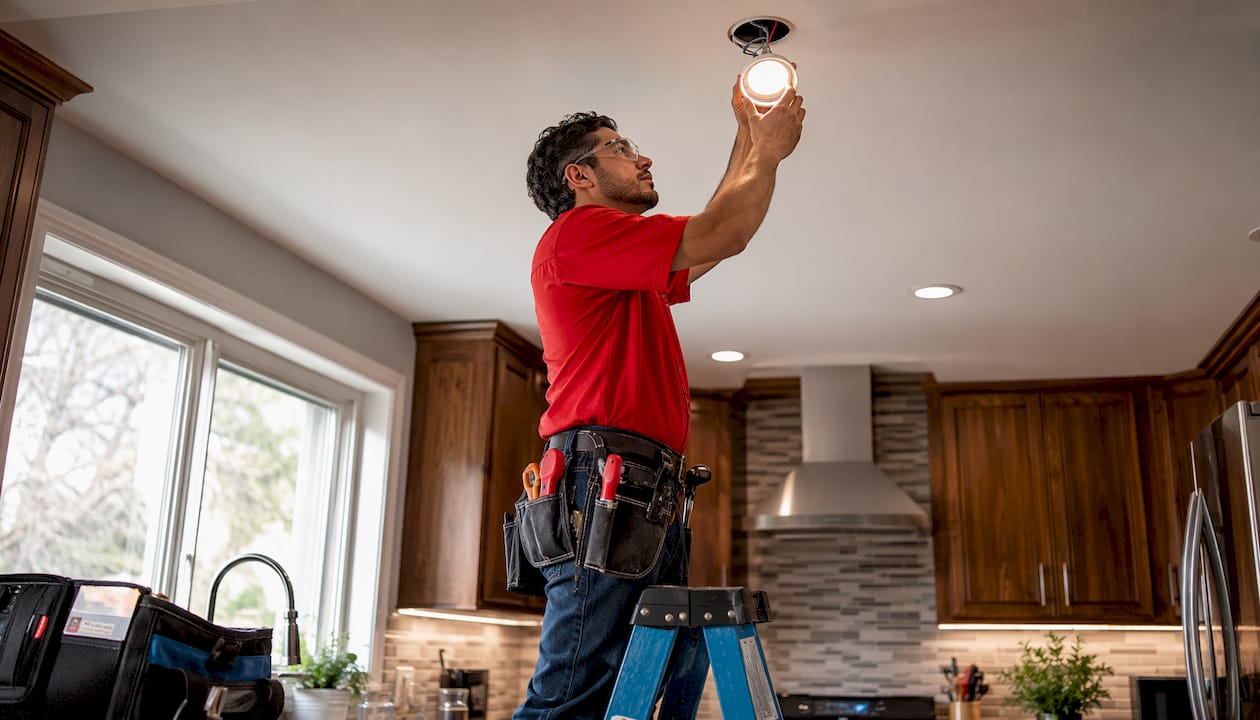
Occupancy sensors prevent lights from running in empty conference rooms, restrooms, and storage areas for hours at a time. Daylight harvesting controls dim fixtures near windows automatically when natural light is sufficient. Both technologies work best when integrated into a central building management system rather than operating as standalone devices.
Pro Tip: When selecting fixtures for open office spaces, choose tunable-white LEDs that adjust color temperature throughout the day. Cooler light in the morning supports alertness; warmer tones in the afternoon reduce eye strain. Occupants notice the difference, and you still get the full energy savings.
Lighting upgrades also reduce heat output inside the building, which lowers the cooling load on your HVAC system. The two improvements reinforce each other, which is exactly why bundling them produces deeper savings than either project alone.
2. Maintain and optimize your HVAC system
HVAC is the single largest energy consumer in most commercial buildings, and a poorly maintained system wastes energy silently. Dirty coils, clogged filters, and miscalibrated sensors all force the system to work harder than necessary.
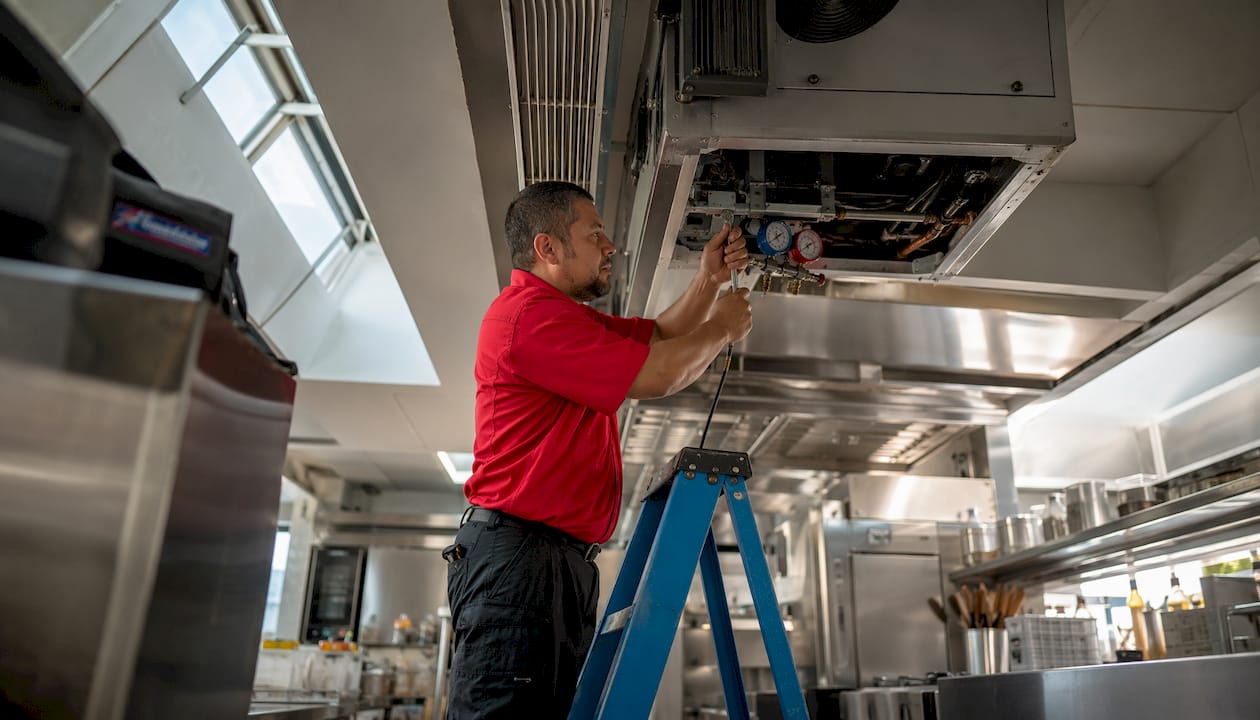
Scheduling is the fastest no-cost fix available. Reducing HVAC operating hours to match actual occupancy can save a significant portion of building energy without touching any equipment. Simulation data shows that trimming just a few hours off weekday runtime and keeping the system off on weekends saves a substantial portion of annual HVAC energy.
Economizer function deserves close attention. A properly operating economizer uses outdoor air to meet cooling needs instead of running mechanical refrigeration. When it works correctly, it can cut energy costs by 10–20% depending on climate. When it malfunctions, the system compensates silently with mechanical cooling, and the waste goes unnoticed until the utility bill arrives.
Eliminating simultaneous heating and cooling is another high-value fix. Improper control settings or valve leakage can cause a system to heat and cool the same zone at the same time, burning energy on both sides. Correcting this alone can reduce HVAC heating and cooling energy by 5–20%. For a deeper look at how commercial air balancing affects system performance, proper distribution testing is the starting point.
3. Improve building envelope insulation and air sealing
The building envelope is the boundary between conditioned and unconditioned space. Every gap, thin wall, and uninsulated roof section transfers heat directly into or out of your building, forcing the HVAC system to compensate continuously.
Envelope improvements including insulation upgrades and air sealing can reduce HVAC heating and cooling load by 20–30%. Older commercial buildings built before modern energy codes went into effect carry the most opportunity here.
Priority areas to address:
- Roof and attic: Heat gain through the roof is the largest single envelope load in most climates. Add insulation above the deck or use a cool roof coating.
- Walls: Blown-in insulation works well for existing walls without full demolition.
- Windows and doors: Weatherstripping and door sweeps are low-cost fixes. Upgrading to double-pane glazing is a larger investment with a longer payback.
- Ductwork: Ducts running through unconditioned spaces lose conditioned air before it reaches the zone. KoolDuct, a pre-insulated duct panel system, addresses both leakage and thermal loss in a single installation. It performs well in retrofit situations where adding external duct wrap is impractical.
Air sealing and insulation work best when done together. Sealing without insulating leaves thermal bridging in place; insulating without sealing leaves infiltration paths open.
4. Deploy an energy management information system
An Energy Management Information System (EMIS) collects data from meters, sensors, and building controls, then surfaces anomalies and optimization opportunities that manual review would never catch. EMIS technologies enable 10–20% site energy savings in best-practice implementations.
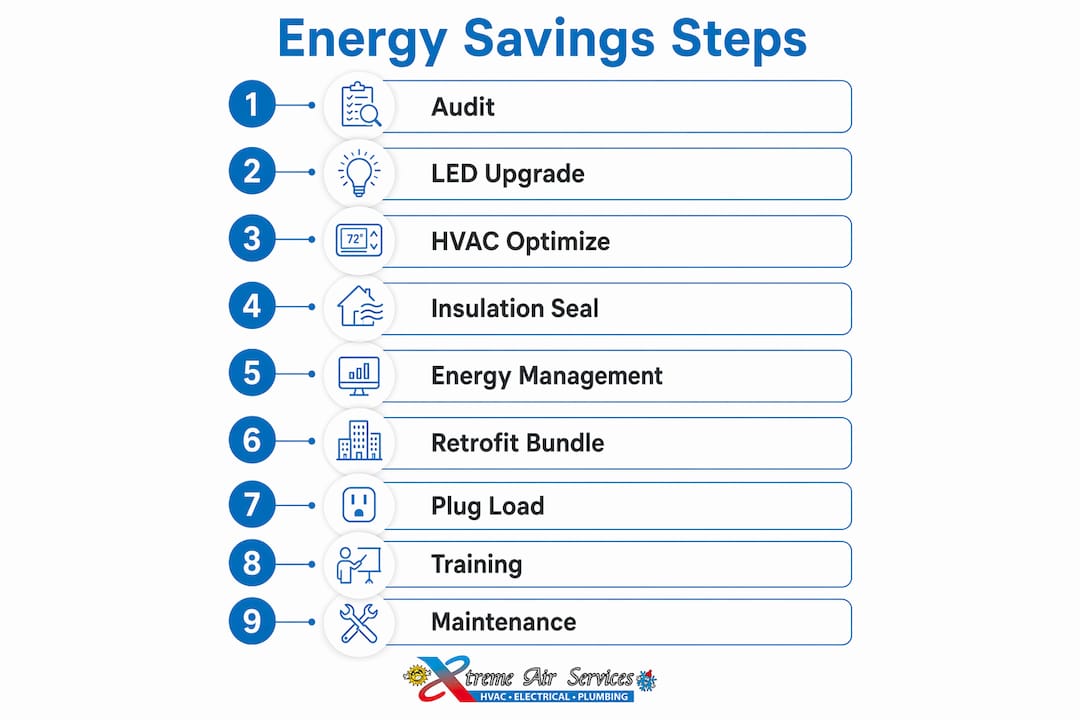
Real-time monitoring catches problems fast. A sensor offset in an air handler’s discharge air temperature can increase HVAC energy use noticeably. Without continuous monitoring, that kind of drift goes undetected for months.
Peak load management is another area where EMIS pays off. Demand charges can represent a large portion of a commercial utility bill, particularly for larger buildings. EMIS tools use load duration curves to identify when and why peak demand spikes occur, giving you the data to flatten them through scheduling or load shifting.
Demand response programs offered by utilities let you reduce load during grid stress events in exchange for bill credits. An EMIS makes participation practical by automating the response rather than relying on manual intervention.
5. Bundle energy retrofits for deeper savings
Single-measure upgrades rarely deliver the savings that bundled retrofits do. Replacing only the lighting, for example, misses the HVAC load reduction that comes with it. Replacing only the chiller misses the control improvements that let it run efficiently.
Bundle-based retrofits that combine chilled water plant optimization with lighting and sensor upgrades achieve over 20% energy savings, consistently outperforming single-measure projects. One California demonstration project combined high-efficiency chillers using low-global-warming-potential refrigerant, LED lighting with integrated advanced controls, and variable-volume laboratory ventilation. The result was 1,463,380 kWh of annual savings and a 283 kW reduction in peak electrical demand.
The financial case extends beyond utility bills. Buildings with ENERGY STAR certification often secure 30–35 basis points better mortgage interest rates and command rental premiums of 3–16% over comparable uncertified buildings. Efficiency is a balance sheet asset, not just an operating expense reduction.
Geothermal heat pumps fit naturally into a bundled retrofit strategy for buildings with the right site conditions. They use the stable temperature of the earth as a heat source and sink, dramatically reducing the energy required for both heating and cooling compared to conventional systems. Upfront costs are higher, but operating costs over a 20-year horizon are substantially lower.
6. Tackle plug and process loads
Once HVAC and lighting are addressed, plug and process loads (PPLs) become the next frontier. PPLs account for about 28% of primary energy use in U.S. commercial buildings, covering everything from computers and printers to elevators, kitchen equipment, and medical imaging systems.
Key figure: NREL research found that a single MRI scanner consumed up to 14 kWh per day in idle mode on weekends, costing more than $27 per day per machine at $0.15/kWh while not scanning any patients.
The challenge with PPLs is scale. The list of devices contributing to plug loads is effectively infinite, and designing controls that reduce load without disrupting operations requires a different approach than HVAC or lighting. NREL recommends four starting steps: designate a PPL champion, institutionalize PPL measures into procurement and operations policy, benchmark current equipment with a walkthrough, and build a business case for each intervention.
Smart power strips, advanced power management settings on office equipment, and occupancy-based outlet controls all reduce idle consumption without requiring occupant behavior changes. For process equipment, scheduling high-draw operations during off-peak hours reduces both energy use and demand charges simultaneously.
7. Train building occupants and staff on energy-saving practices
Technology alone does not hold the gains. Occupants who leave equipment running overnight, override thermostat setpoints, or prop open exterior doors undermine every efficiency upgrade you install.
Effective training is specific, not generic. Show staff exactly which behaviors cost money: a computer left on overnight, a conference room light running through the weekend, a door held open during peak cooling hours. Post reminders near light switches and equipment panels. Make energy use data visible on a shared dashboard so teams can see the impact of their habits in real time.
Building managers benefit from periodic recommissioning sessions where controls, schedules, and setpoints are reviewed against actual occupancy patterns. Occupancy changes over time, and a schedule set three years ago may no longer match how the building is actually used.
8. Schedule regular equipment maintenance to prevent energy waste
Deferred maintenance is one of the most common sources of avoidable energy waste in commercial buildings. A dirty condenser coil, a worn fan belt, or a leaking steam trap each adds a small but persistent load that compounds across every operating hour.
A structured HVAC preventive maintenance program covers filter changes, coil cleaning, refrigerant checks, belt inspections, and controls calibration on a fixed schedule rather than waiting for a breakdown. Reactive repairs cost more and often involve extended downtime that disrupts building operations.
Electrical systems need the same attention. Loose connections, aging panels, and undersized circuits all generate heat and waste energy. Xtremeairservices provides both HVAC maintenance plans and commercial electrical services to keep both systems running at peak efficiency year-round.
Key Takeaways
Bundling multiple energy upgrades, from HVAC optimization to LED lighting and envelope sealing, consistently delivers over 20% energy savings and outperforms any single-measure approach.
| Point | Details |
|---|---|
| Audit before upgrading | Benchmark with ENERGY STAR Portfolio Manager to identify where energy is actually lost. |
| LED lighting impact | Upgrading to LEDs cuts lighting energy use by up to 50%, with additional savings from occupancy controls. |
| HVAC scheduling payback | Aligning HVAC runtime with occupancy saves 8–15% of building energy with no equipment investment. |
| Envelope load reduction | Insulation and air sealing can reduce HVAC heating and cooling load by 20–30%. |
| PPL share of energy use | Plug and process loads account for about 28% of primary energy use in U.S. commercial buildings. |
FAQ
What is the fastest way to lower commercial building energy costs?
Aligning HVAC schedules with actual occupancy hours is the fastest no-cost fix, saving 8–15% of building energy immediately. Pairing that with LED lighting upgrades delivers the next largest return with a short payback period.
How much can an energy audit save a commercial building?
Buildings that benchmark regularly reduce energy use by roughly 2% per year on average, and a professional audit typically identifies opportunities well beyond that by revealing HVAC, lighting, and plug load inefficiencies simultaneously.
What are plug and process loads, and why do they matter?
Plug and process loads are all the energy used by equipment not tied to HVAC, lighting, or water heating, including computers, kitchen appliances, elevators, and medical devices. They account for about 28% of primary energy use in U.S. commercial buildings, making them a major target once core systems are optimized.
Does ENERGY STAR certification improve property value?
Yes. ENERGY STAR-certified buildings typically command rental premiums of 3–16% and often secure mortgage interest rates 30–35 basis points lower than comparable uncertified properties.
How does KoolDuct help reduce energy costs?
KoolDuct is a pre-insulated duct panel system that addresses both thermal loss and air leakage in ductwork simultaneously. It is particularly useful in retrofit projects where adding external insulation to existing ducts is impractical.